
It’s 6:07 a.m. Night float just signed out. You’re half‑logged into the EMR with one hand while chewing a protein bar with the other. You’ve already been paged twice. And in the back of your mind, there’s this constant low‑grade anxiety:
“What do my attendings really think of my notes? Do they even read them? Or are they quietly judging every line?”
Let me tell you how this actually works. What really happens after you click “sign.”
Because your notes are being evaluated. Just not in the way you think.
The ugly truth: most attendings don’t read your whole note
Let’s start with the part nobody tells you as an intern.
Most attendings do not read your entire daily progress note. They skim. Aggressively.
On a typical teaching service, an attending may be “responsible” for 15–20 patients per day per team, sometimes more. Multiple teams. Different services. Layers of consults. I’ve watched attendings open a note, scroll for three seconds, then say, “OK, let’s go see the patient.”
But. That doesn’t mean your note doesn’t matter. It does. Just in a very targeted way.
Here’s where attendings actually look:
- Today’s interval events / brief HPI update
- Assessment & Plan headers and first sentences
- Any numbers that look “off”: vitals, labs, I/O, weights
- Meds changes, new antibiotics, anticoag, pressors, drips
- Discharge planning/Barriers to discharge line
Everything else? They assume. They infer. Or they ignore.
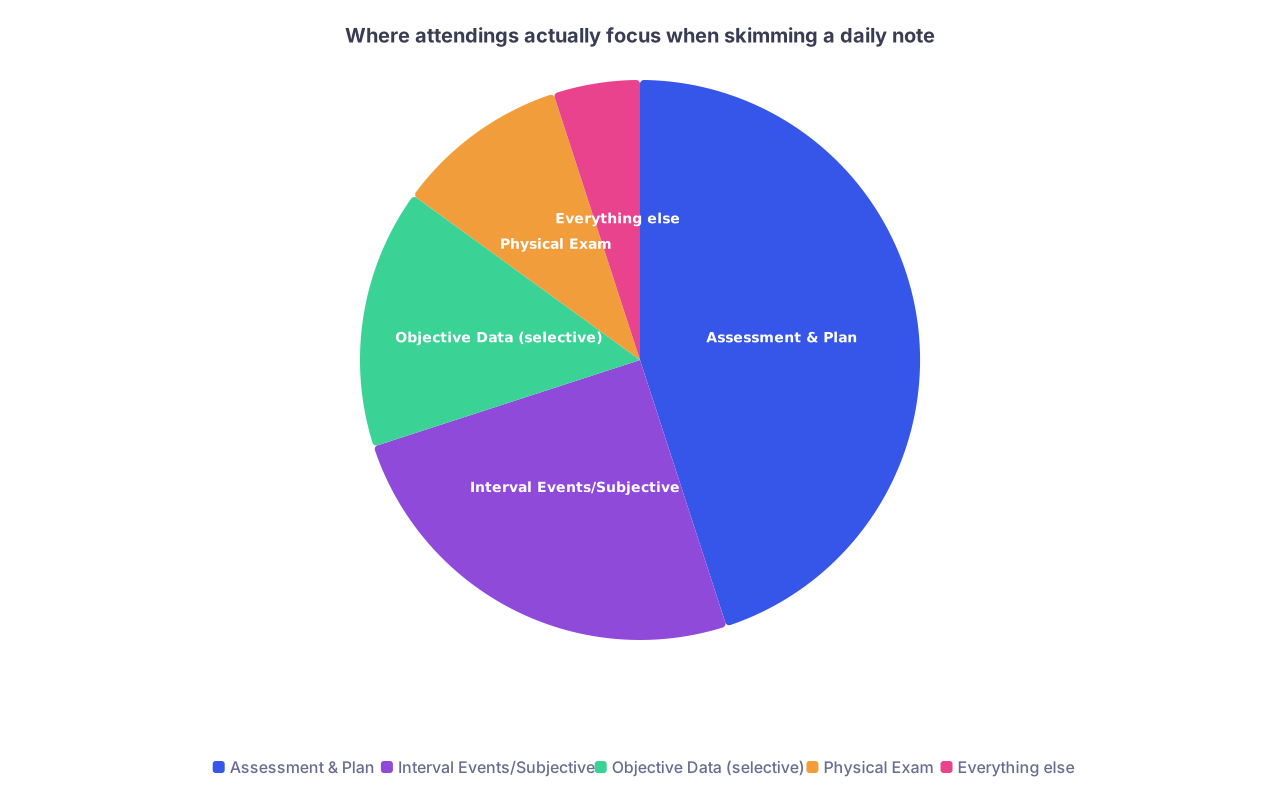
| Category | Value |
|---|---|
| Assessment & Plan | 45 |
| Interval Events/Subjective | 25 |
| Objective Data (selective) | 15 |
| Physical Exam | 10 |
| Everything else | 5 |
So if you’re pouring perfectionist energy into rewriting a full ROS for day #7 of the same pneumonia admission, you’re wasting time. And probably burning yourself out.
The scrutiny lives in the Assessment & Plan and in whether your story matches reality.
Behind closed doors—on feedback forms, in faculty meetings, and in those “How is the intern?” hallway conversations—your notes are shorthand for:
- Do you know what’s going on with your patient?
- Can we trust your clinical thinking?
- Are you safe?
- Are you efficient, or are you drowning?
That’s the real evaluation.
What program leadership quietly sees in your notes
Here’s the part that almost nobody explains to you: notes are a proxy metric for a bunch of ACGME milestones. Your PD isn’t sitting at home reading your daily notes like a novel, but attendings’ impressions of your documentation get fed back into evals.
And those impressions are not subtle.
1. “Does this resident get the ‘why’ of the admission?”
If your Assessment starts with:
“Acute hypoxic respiratory failure 2/2 pneumonia vs pulmonary edema”
and everything that follows fits that framework, you’re signaling: I understand the problem representation.
If instead you have 16 bullet points:
“Pneumonia, hypoxia, cough, shortness of breath, fever, sepsis, AKI, tachycardia, leukocytosis…”
with no hierarchy, no synthesis, and no primary problem, attendings translate that as:
“This resident lists, but doesn’t think.”
I’ve sat in evaluation meetings where someone literally said:
“Her notes read like a med student who copied UpToDate. No prioritization.”
That’s devastating because it shapes how attendings talk about you: “strong vs average vs struggling.” And that gets remembered at rank time for fellowship letters, chief selection, all of it.
2. “Is this resident safe?”
Documentation is one of the few hard artifacts of your thinking. If your note says “Will restart home Eliquis” on a patient who had a big GI bleed 2 days ago, and the attending catches it in your note (or worse, pharmacy pages them)… that sticks.
People remember safety landmines that show up in notes. Much more than they remember your nice differential for hyponatremia.
Repeated patterns that trip alarms behind closed doors:
- Plans that ignore major overnight events (“No change” after an RRT)
- Copying forward a normal exam on a patient now in the ICU
- Listing “sepsis” but no lactic trend, no cultures, no source, no antibiotics rationale
- Plans that do not match current vitals or labs (“stable” when MAPs are 58)
You will absolutely be discussed for this. Informally at first. If it persists, it turns into “needs improvement in clinical reasoning” on your eval.
3. “Can they prioritize?”
Faculty notice when every problem gets the same amount of ink.
Example of a note that quietly impresses people:
- #Acute hypoxic respiratory failure (primary problem) – 3–4 tight sentences: cause, current status, what changed, today’s plan
- #AKI – 1–2 lines
- #DM2 – 1 line
- #HTN – “Stable, continue home meds”
Versus the intern who writes a 10‑line essay on “Chronic hypertension” and 2 lines on “New O2 requirement to 6L.”
Attendings see that and think: This person does not feel the difference between what can kill my patient today and what cannot. And that becomes an evaluation about judgement, not writing.
The real “red flags” attendings talk about
Nobody puts this in official policy, so I’ll say it for them. There are specific note behaviors that faculty complain about in workrooms and behind closed doors.
I’ve heard variations of all of this:
1. The copy‑forward zombie
The resident who copies forward yesterday’s note for 10 days straight, changing only the creatinine and the date.
What attendings actually think:
- “I don't trust this person is reassessing the patient.”
- “If the note never changes, are they even seeing the patient?”
- “This is medicolegally dangerous.”
The fastest way to lose credibility is to have a physical exam or plan that’s clearly outdated. A wound that was “clean, dry, intact” 4 days after the operative note and then still “clean, dry, intact” on the day it was found to be purulent in the ED? That will get brought up.
2. The over‑documenter who’s always behind
You know the type. Beautifully formatted, textbook‑length notes. But always charting at 8 PM and leaving at 9:30.
Behind closed doors, faculty will say things like:
“Yeah, his notes are nice, but he can’t finish his work.”
“She’s still writing when everyone else is home. That’s not sustainable.”
No one gives you extra credit on your eval for 4‑page progress notes. They do dock you for inefficiency. Even if they don’t write it, they think it. And it shows up as “needs to improve time management” or “workload handling.”
3. The vague hand‑waver
The note that says:
- “Continue to monitor”
- “Supportive care”
- “Will follow”
- “Consider consulting X”
- “Trend labs”
with no specifics. What are we monitoring? What parameter will make us act? When are we rechecking labs? What’s the actual threshold?
Attendings read this as:
“This resident either doesn’t know what to do or is afraid to commit.”
A vague plan is worse than a wrong but concrete plan. Wrong can be corrected and turned into a teaching moment. Vague is useless.
4. The EMR‑macro addict
SmartPhrases and templates are fine. Essential, actually. But.
If your Assessment & Plan reads like:
“.COPDPLAN” → giant canned paragraph on COPD management, including vent settings, BiPAP titration, smoking cessation counseling, inhaler teaching…
…on a patient here for an ankle fracture who happens to have COPD?
That screams: “I have no idea what’s actually happening with this patient. I just fired a macro.”
I’ve watched attendings scroll, sigh, and say quietly, “They just threw a macro at the problem.”
Once that reputation sticks, they start double‑checking everything you document. Not a fun place to be.
What strong residents do differently in their notes
Let me be very clear: the goal is not to write pretty notes. The goal is to write useful notes that prove you understand what’s going on, without sinking your entire day into the EMR.
The residents who secretly impress attendings with their documentation tend to do a few things consistently.
They write for tomorrow, not today
Good notes help tomorrow’s you, tomorrow’s cross‑cover, and the attending who’s off‑service but gets called about the patient in 2 weeks.
Strong residents ask themselves while writing:
- If I were cross‑cover reading this at 2 a.m., would I know what to worry about?
- If this patient crashes, does this note tell the story of what we thought was happening?
They include one or two “anchors” in the plan:
- For diuresis: “Goal net -1 to -1.5L today, holding if SBP < 95 or Cr > 2.0”
- For sepsis: “If still febrile tomorrow with WBC > 15, broaden to pip‑tazo and add CT A/P”
You don’t need five lines. You need one sharp line that shows actual thresholds and intentions.
They treat the Assessment as their mini‑rounds
Behind closed doors, attendings love notes where the Assessment & Plan sounds like the oral presentation on rounds. Short, prioritized, and actually synthesized.
A strong intern’s Assessment often looks like this:
“#Acute decompensated HFrEF – likely triggered by med nonadherence (missed diuretics x 1 week per wife) vs AF with RVR at admission. Now improved from 4L to 1L O2, still +6L from baseline weight. BNP down but still elevated. Today will be more aggressive with diuresis with clear goals.”
That tells the attending you understand etiology, current status, trajectory, and today’s action.
Compare that to:
“#CHF – continue with Lasix. Monitor weight. Daily BMP.”
Same meds. Completely different level of trust.
They update the story, not just the numbers
Smart interns explicitly comment on trends:
“Na up from 124 → 130 over 36h; safe correction rate so far, will relax q6 checks to BID.”
They don’t just paste labs. They interpret them in a sentence. That single sentence buys you more credit than 20 pasted lab values.
How your notes get weaponized (or defended) in conflicts
Another quiet truth: notes are receipts.
If there’s a bad outcome, a conflict with a consultant, a disagreement with nursing, or a complaint from a family—your notes suddenly matter a lot more.
I’ve seen this play out in M&Ms and risk‑management reviews:
- The resident whose note clearly documented “Discussed with GI fellow, plan to hold anticoagulation until repeat Hgb in a.m.” got protected when there was confusion later.
- The resident whose note vaguely said “Will follow Hgb” with no mention of a consultant’s bad suggestion got thrown under the bus as “unclear plan, no documentation of discussions.”
Faculty remember when your documentation saves them. Or saves the team. That’s when they talk in PD meetings and say things like, “She’s junior but her documentation is rock solid. She’s safe.”
On the flip side, if your note is useless in those moments, that colors how safe you’re perceived to be. Fair or not, that’s how it works.
The PD lens: milestones hiding in your SOAP note
Your program director may not say this explicitly, but your notes feed into a bunch of milestones:
| What your note shows | Milestone faculty infer |
|---|---|
| Clear problem list, prioritization | Patient Care, Clinical Reasoning |
| Concise, structured A/P | Medical Knowledge, Communication |
| Updated exams, no copy‑forward disasters | Professionalism, Safety |
| Specific thresholds and follow‑up plans | Systems‑Based Practice, Patient Care |
| Finishing notes on time, not at midnight | Practice‑Based Learning, Efficiency |
When an attending fills out your end‑of‑rotation eval and checks boxes like “Meets expectations” vs “Below expectations in clinical reasoning,” they’re thinking about how you think. Notes are the main written evidence.
If you’re consistently behind on notes, they’ll phrase it as “documentation sometimes delayed,” but what they mean is “I’m worried this person is not handling workload well.” That matters when PDs decide who needs remediation, who is “solid,” and who’s ready for senior responsibilities.
How to actually write notes that attendings respect (without staying until 9 PM)
Let’s get concrete. You’re not here for theory. You want to survive.
Here’s a practical framework I’ve seen strong residents use that balances quality with speed.
1. Template the skeleton, not the brain
Use templates for:
- Basic structure: Subjective / Objective / Assessment & Plan
- Standard vitals, labs, I/O blocks
- Common exam phrases that you truly re‑verify (not copy mindlessly)
Do not template:
- Assessment & Plan thinking
- Copy‑pasted consultant recs (summarize instead)
- ROS for day #9 of an uncomplicated admission
You want the EMR to carry the boring parts so your limited mental energy goes to the 5–10 key sentences that matter.
2. Make the first line of each problem do 80% of the work
Train yourself to write:
“#Problem – [etiology or differential], [current status vs yesterday], [today’s goal].”
Examples:
- “#AKI – likely pre‑renal from poor PO, Cr 1.2 → 2.0; improved with IVF, now plateau at 1.6; today will trial stopping fluids and monitor UOP and Cr.”
- “#AF with RVR – likely triggered by infection and volume overload; rate controlled on metoprolol, HR now 80s; continue same dose, hold if SBP < 90.”
That first line tells the attending you’re awake, thinking, and situating the problem in time.
3. One sentence of interpretation for each major data cluster
Labs:
“WBC trended down 16 → 11; supports improving infection.”
Imaging:
“CXR today with improved RLL infiltrate, residual haziness but no new effusion.”
Vitals:
“Still requiring 4L O2, but sat ≥ 92% at rest, desats with ambulation.”
This is what attendings look for when they “just skim.” They’re not going to compare individual lab values across days. They want your synthesis.
4. Explicit “if‑then” statements for anything that can crash
Built‑in safety language earns trust:
- “If MAP < 60 despite 500 cc bolus, will call MICU for pressor consideration.”
- “If Hgb downtrends below 7, will transfuse 1 unit and reassess.”
- “If O2 need escalates beyond 6L, consider repeat CXR and ABG, notify attending.”
You’re not writing a legal document. You’re showing that you’ve thought one move ahead.
5. Tighten the physical exam to what matters today
Nobody wants a 20‑line normal exam on day 8. But everyone hates a clearly fake copy‑forward.
Smart trick I’ve seen: maintain a lean “core” exam relevant to the main problem, and explicitly state what wasn’t re‑checked.
“Focused exam today: lungs, heart, volume status, lower extremities. Full neuro unchanged per yesterday, no new focal deficits reported.”
You’re honest, still concise, and not pretending you listened to bowel sounds in all 4 quadrants at 6:15 a.m. on every patient.
How attendings quietly grade your notes in real time
You won’t see a rubric. But here’s the mental scoring system I’ve seen faculty use at the workstation—whether they admit it or not.
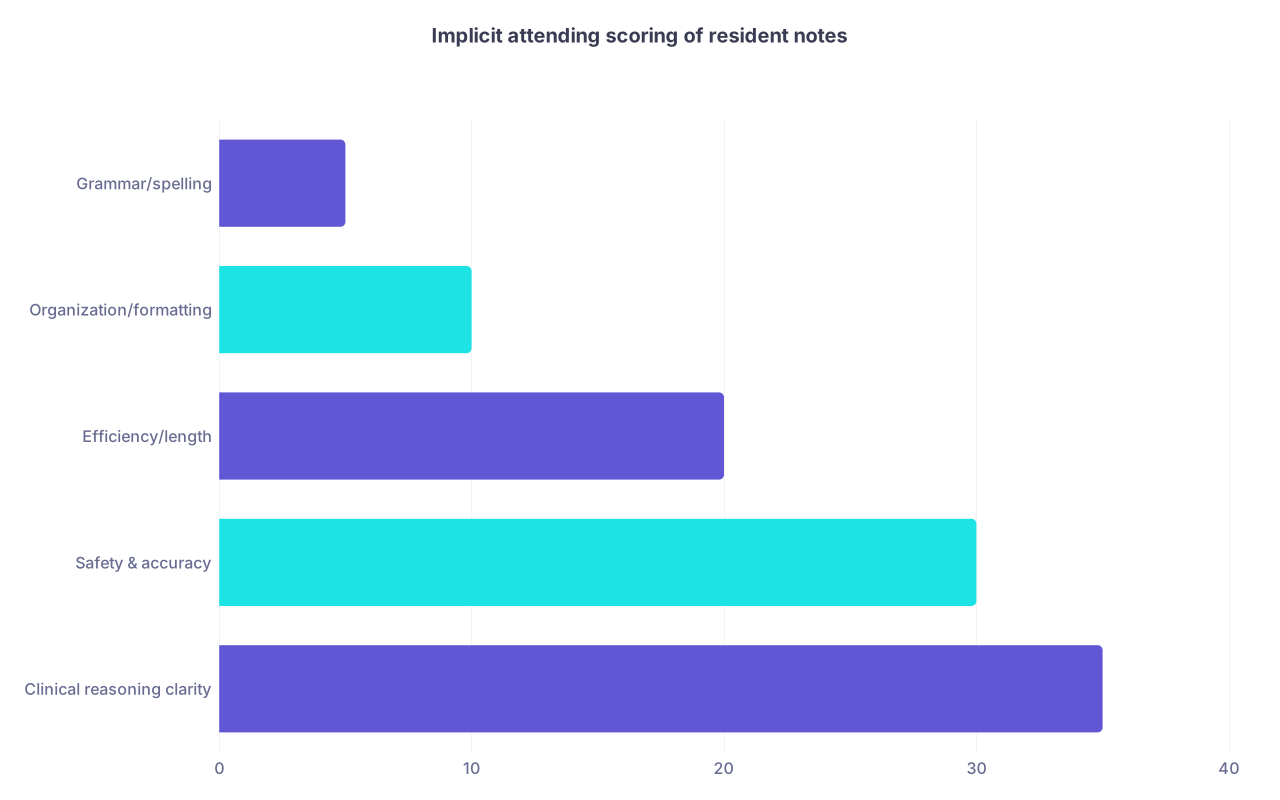
| Category | Value |
|---|---|
| Clinical reasoning clarity | 35 |
| Safety & accuracy | 30 |
| Efficiency/length | 20 |
| Organization/formatting | 10 |
| Grammar/spelling | 5 |
They care about:
- Does this help me understand what’s going on with this patient in 30 seconds?
- Do I feel safer or less safe after reading this?
- Am I spending my time hunting for the plan buried under fluff?
No one is docking you for a missing comma. They will dock you (mentally at least) for a three‑screen, rambling note with no clear sense of “what changed and what’s next.”
FAQs
1. Do attendings actually read my whole note or just the A/P?
Most skim only the key parts: interval events, Assessment & Plan, and specific data if something looks off. On a busy service, no one has time to read full SOAP novels. But if there’s any concern about safety or a bad outcome, they absolutely go back and read everything in detail. That’s when the quality—and honesty—of your notes really matters.
2. Is it bad to use copy‑forward if I update things?
Copy‑forward itself isn’t evil. Blind copy‑forward is. If your exam, assessment, and plan don’t change for days in a dynamic patient, attendings assume you’re not reassessing. Safest approach: copy the skeleton, then visibly rewrite the key pieces. At least one or two sentences should clearly anchor the note to today.
3. How long should a daily progress note be for a complex patient?
For a truly sick, multi‑problem ICU or complex ward patient, 1–2 screens of text is reasonable. Beyond that, you’re usually repeating yourself or padding. Focus on prioritization and clarity, not length. If an attending sees a long note that still doesn’t tell them “why they’re here” and “what’s different today,” they’ll be annoyed, not impressed.
4. Do my notes really affect my evaluations and promotion?
Yes. Not directly as “note grades,” but through faculty impressions of your reasoning, safety, and efficiency. Attending comments like “solid clinical reasoning,” “occasionally unsafe plans,” or “struggles with time management” are often based on what they see in your notes combined with your presentations. PDs read those comments when deciding about promotion, remediation, and letters.
5. How do I get faster at writing without sacrificing quality?
Front‑load your thinking on rounds. As you pre‑round, mentally craft the 1–2 key sentences for each major problem. Use templates for structure, not content. Immediately after rounds, bang out the Assessment & Plan while everything’s fresh, then fill in the Objective/Subjective around it. Strong residents often finish most notes by early afternoon because they don’t rewrite the entire world every day—they just update the story.
Key things to remember:
- Your note is not a transcript; it’s proof of your thinking.
- Attendings judge you more by your Assessment & Plan and safety language than by length or formatting.
- Efficient, honest, updated notes that clearly say “what changed and what’s next” will quietly boost your reputation far more than a perfect ROS ever will.