
The way most residents pre-round is broken. They wander room to room, click randomly through charts, and then wonder why attending rounds feel like a firing squad.
You need structure. Down to the hour. Sometimes down to the minute.
Here is a concrete, hour‑by‑hour template for efficient pre‑rounding on a heavy ward day (think 12–18 patients, a couple of fresh admits, one or two disasters simmering). I am assuming:
- Start: 5:00 a.m. alarm
- Rounds: 8:00 a.m. with attending
- Team: You + interns/med students (or you as the intern with an upper)
- Setting: Typical medicine/surgery ward service
Adjust times by ±30–60 minutes if your rounds start earlier or later, but keep the sequence.
4:30–5:00 – Pre‑Game Before You Leave Home
At this point you should not be touching the EMR for “just a quick look.” That black hole will eat your morning.
Your job in this half hour:
-
- Wake, caffeine, quick shower.
- Mental checklist (literally say it in your head):
“Sick list, new events, overnight admits, labs, vitals, notes.”
-
- Glance at your patient list (printed last night or on your phone).
Mark:- Who is ICU‑watch status on the floor.
- Who is likely to discharge.
- Who is a new admission from yesterday evening.
- Decide:
- Top 3 “must‑see first in person” patients.
- Who you can safely quick‑chart and see later on team rounds.
- Glance at your patient list (printed last night or on your phone).
5 minutes – Hard stop time
- Decide now: “I need pre‑rounding done by 7:30.”
- That means you budget backward. If you overrun, you cut low‑yield tasks, not sick‑patient evaluation.
5:00–5:20 – First Pass: The Sick List and Overnight Events (No Room Entries Yet)
At this point you should be sitting at a computer, not walking the halls.
Goal: Identify landmines before you step onto the ward.
5:00–5:10 – Triage the list (chart only)
Run down every patient briefly. For each, check:- Overnight vitals trends
- Hypotension, tachycardia, new fevers, desats, higher O2 needs.
- New nursing/RT notes and alerts
- Rapid response called? High MEWS/NEWS? Fall?
- New orders/events
- Transfer orders, new imaging, new consults placed overnight.
As you go, mark each patient on your list with a simple triage code:
- “S” – Sick / unstable / high concern
- “W” – Watch / moderate concern
- “Sx” – Stable / routine
- Overnight vitals trends
5:10–5:20 – Sick first: build a mini‑plan in your head
- For every “S” patient:
- Write 1–2 bullets in your notes or on index card:
- “Rising O2, CXR pending, likely diuresis or consider CT‑PE.”
- “Febrile, lactate ordered, broaden abx?”
- Star those names on your rounding list. These are your first in‑person visits.
- Write 1–2 bullets in your notes or on index card:
- For every “S” patient:
You are not writing full notes yet. You are collecting targets.
5:20–5:50 – Rapid Chart‑Review Block (All Patients, No Interruptions)
Phones away. No chatting at the workroom door. This is 30 minutes of pure EMR speed.
At this point you should be building the skeleton of your notes and plans. One pass through each chart:
For each patient (2–3 minutes max):
Review data in a fixed order (so your brain stops wasting time switching paths):
- MAR since last review
- New labs and micro
- Imaging reports
- I/O and weights
- Vitals + O2 needs
- Active lines/drains/catheters
Drop a note skeleton in the EMR (or your personal doc):
- Problem #1: One‑line status + next step
- Problem #2: Same
- Anticipated dispo: “Needs PT eval,” “Likely dc tomorrow,” etc.
Example for a CHF patient:
- “HFpEF – O2 2L → 3L overnight, +2 kg from baseline, CXR: increased congestion. Plan: extra 40 IV lasix, recheck BMP, I/O strict, daily weight.”
You do not write the full note now. You only anchor:
- Changes since yesterday
- Today’s main plan
- Expected tasks (labs/consults/imaging to order)
By 5:50, you should have:
- A partial skeleton for every patient
- A clear mental map of who is sick, who is borderline, and who is boring but time‑consuming
5:50–6:10 – First In‑Person Sweep: Sick and High‑Risk Patients
Now you walk.
At this point you should see your S‑coded patients in person. No excuses.
For each sick/high‑risk patient (5–7 minutes max):
-
- Monitor, O2 device, posture, obvious distress.
- Any “this looks worse than the numbers” instinct – trust it.
Mini‑focused exam
- ABCs first: work of breathing, mental status, perfusion.
- Targeted: lungs, edema, abdominal tenderness, neuro changes.
Immediate adjustments
- Ask the nurse: “Anything worrying you about them?”
- Place urgent orders you already know you will need:
- Stat labs (lactate, troponin, VBG/ABG, repeat CBC/BMP)
- CXR, head CT, ultrasound, etc.
- Page relevant consults early if obvious:
- “Rising creatinine, anuric, likely need nephro.”
- “Possible stroke symptoms, call neurology now.”
Update your plan skeleton
- Add: “Seen 6:00 – resp worse, lungs with crackles, will escalate O2, diuresis, discuss possible upgrade to higher level of care on rounds.”
If a patient feels acutely unsafe, you escalate now. You do not wait for “formal rounds.”
6:10–6:40 – Stable Patient Chart‑Review + Quick Bedside Checks
Now you make your second layer: the stable majority.
At this point you should aim to touch each chart and most patients, but at different depths.
6:10–6:25 – Finish chart passes for remaining patients
For any patient you did not fully review at 5:20–5:50:
- Repeat the same fast sequence:
- Labs → Imaging → Vitals → I/O → New orders
- Update your skeleton plan.
Aim: No patient chart remains “unopened” this morning.
6:25–6:40 – Quick bedside encounters for stable patients
You will not have a long conversation with every stable patient during pre‑rounds. You will:
- Check:
- “Any chest pain, shortness of breath, new pain, new confusion?”
- Is the physical exam grossly different? (Lungs, edema, surgical site, neuro status.)
- Clarify:
- Pain control ok? Eating? Voiding? Bowel movement?
- Any overnight issues from their perspective.
You can combine rooms that are close together (rooms 401, 403, 405) in a single pass to save steps.
If time is tight, prioritize:
- New admissions
- Those with major change in labs/imaging
- Likely discharges (to confirm they really can leave)
6:40–6:55 – Orders, Task List, and Communication Sprint
This 15‑minute block makes or breaks your morning. At this point you should stop wandering and sit down again.
6:40–6:50 – Enter time‑sensitive orders
For each patient, run your list top to bottom and:
- Place any orders that are not dependent on attending input:
- Routine AM labs that you already know you need
- Imaging your team obviously agreed on yesterday
- PT/OT/SW consults for dispo planning
- Med dose adjustments that are clearly indicated
The goal: when you walk into 8:00 rounds, most of the routine work is already in motion.
6:50–6:55 – Communicate with nursing / ancillary staff
- Quick messages or in‑person hits:
- “Mr. X may need transfer if his O2 worsens – page me if he hits X threshold.”
- “Ms. Y is likely discharge; can you check if meds to bed can be set up by noon?”
You are not doing long conversations now. You are aligning expectations.
6:55–7:15 – Note Drafting Block (Prioritize Sick and Discharge Notes)
At this point you should be hammering out at least partial notes, not still collecting data.
Order of priority for notes:
- Sick / complicated patients – attending will grill you.
- Likely discharges – case management and pharmacy will chase you.
- New admissions – your H&P probably done, but progress note for the day needed.
For each priority note:
- Plug in:
- Overnight events: 1–2 bullet lines, not a novel.
- Objective: auto‑fill vitals/labs, tidy as needed.
- Assessment & Plan: use the skeleton you created earlier and flesh out.
You do not need perfection here. You need:
- Reasonable completeness
- No obvious contradictions
- Clear plan bullets your attending can scan quickly
7:15–7:30 – Team Sync and Final Gap Check
At this point you should regroup with your intern(s)/students or your senior.
If you are the intern:
- Quickly run through:
- Who is sick and why
- Any patients who changed significantly overnight
- Any tests/consults already ordered this morning
- Hand off:
- “I have not seen Mrs. Z in person yet, but chart is reviewed and she is stable. Let us hit her early on rounds.”
If you are the senior:
- Clarify:
- “Here are the 3 sickest – we see them first on rounds.”
- “These two are solid for discharge, push paperwork early.”
- Confirm:
- That each intern has a complete patient list
- That no new admission has been missed in the chaos
This is also when you adjust the rounding order on paper to be logical:
- Start with sickest or geographically clustered sick patients
- Cluster by pods/units to avoid walking marathons
- Place discharges in the first half of rounds so orders can move early
7:30–8:00 – Buffer, Cleanup, and Pre‑Rounds Mini‑Rehearsal
If you pre‑rounded efficiently, you have 30 golden minutes. Most residents waste them. Do not.
At this point you should be doing three things:
7:30–7:40 – Final chart spot‑checks
- Recheck vitals on the sick list.
- See if any stat labs/imaging you ordered already resulted.
- Update your mental plan: “If creatinine is up again, I am pushing for nephro consult on rounds.”
7:40–7:50 – Tighten 3–4 key presentations
- For:
- Your sickest patient
- Your most complicated chronic patient
- Each new admission
- Run the script in your head (or with your co‑resident):
- “Mr. A is a 67‑year‑old with HFpEF here for ADHF who overnight…”
- Focus on: changes, reasons, and today’s plan.
- For:
7:50–8:00 – Print / organize and mentally reset
- Print updated lists if your team uses paper.
- Make sure you have:
- Pen, rounding list, notes, pager/phone, maybe a small sticky with “Do not forget” tasks.
- Take 90 seconds. Breathe. Rounds are about to be loud and chaotic. You have already done the thinking.
Hour‑by‑Hour Overview Template
Here is the same structure in one place so you can adapt it to your own schedule:
| Time Block | Primary Focus |
|---|---|
| 4:30–5:00 | Personal prep, macro triage plan |
| 5:00–5:20 | Sick list identification, overnight review |
| 5:20–5:50 | Full chart skeleton planning (all pts) |
| 5:50–6:10 | In-person assessment of sick patients |
| 6:10–6:40 | Stable chart review + brief bedside checks |
| 6:40–6:55 | Orders and quick communications |
| 6:55–7:15 | Draft notes for sick/discharge patients |
| 7:15–7:30 | Team sync and rounding order planning |
| 7:30–8:00 | Buffer, spot-checks, presentation polish |
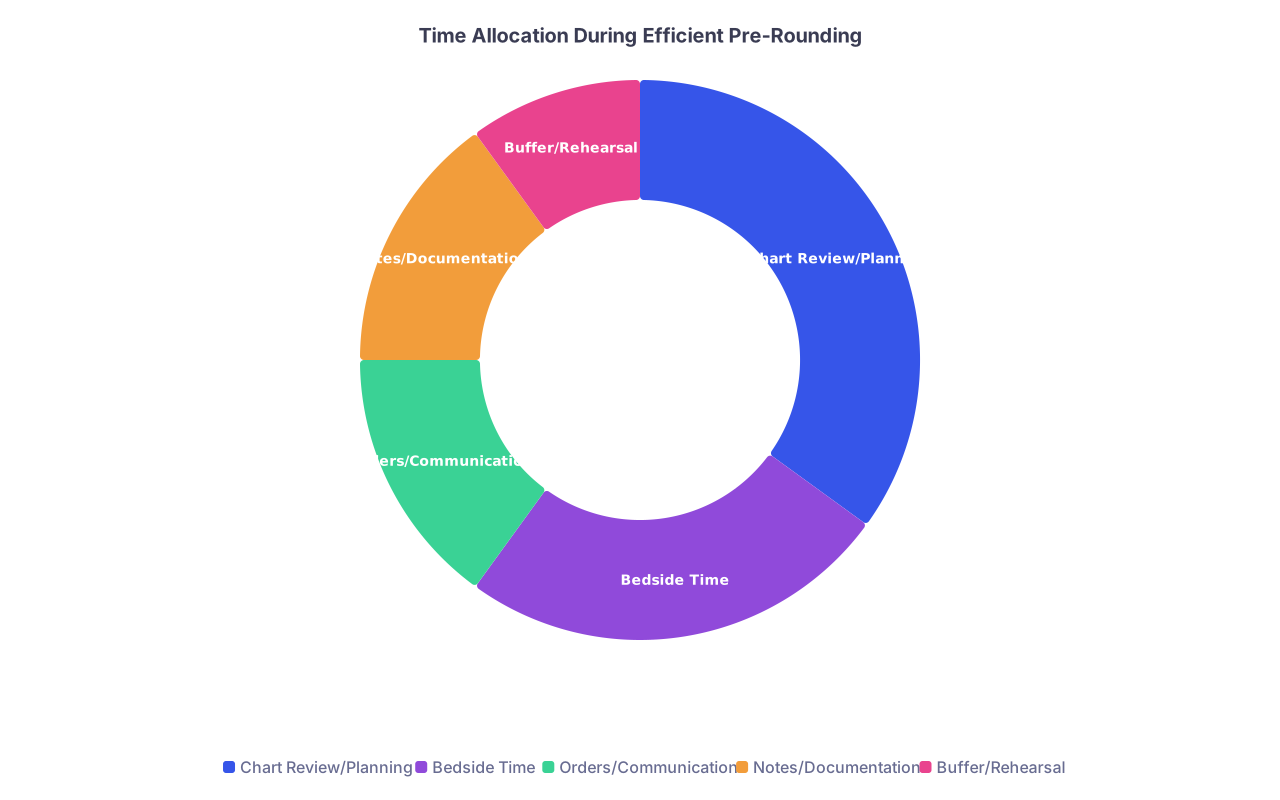
| Category | Value |
|---|---|
| Chart Review/Planning | 35 |
| Bedside Time | 25 |
| Orders/Communication | 15 |
| Notes/Documentation | 15 |
| Buffer/Rehearsal | 10 |
How to Adjust This Template for Different Realities
Because life on the wards never behaves.
If rounds start earlier (e.g., 7:30)
You compress blocks, not eliminate key steps:
- 4:15–4:45 – Personal + macro plan
- 4:45–5:10 – Sick list and overnight review
- 5:10–5:35 – Chart skeletons
- 5:35–6:00 – Sick in‑person checks
- 6:00–6:20 – Stable bedside + chart finishes
- 6:20–6:35 – Orders + comms
- 6:35–7:00 – Notes for sick/discharges
- 7:00–7:30 – Team sync + buffer
You always maintain:
- Early identification of sick patients
- At least one bedside sweep before rounds
- Time to place key orders before the attending appears
If you have a smaller census (8–10 patients)
Lean into more bedside time and better notes:
- Extend bedside blocks by 5–10 minutes.
- Actually sit with that complicated social‑dispo patient for more than 2 minutes.
- Flesh out full notes before rounds so post‑round work is lighter.
If you have a massive census (18–24 patients)
You will not pre‑round perfectly on everyone. That is reality. You ruthlessly triage:
- Non‑negotiable:
- Sick list fully seen in person
- Every chart reviewed, at least briefly
- Flexible:
- Some stable “frequent flyer” patients get chart‑review only before rounds and bedside during team rounds.
- Notes for rock‑stable patients may wait until after rounds.
EMR Efficiency Tricks That Plug Directly into This Timeline
If you want this timeline to work, you cannot click like a lost intern.
Build SmartLists / Dot Phrases
- One dot phrase for:
- “Overnight events and subjective”
- Common plan sections (CHF, COPD, CAP, post‑op day X)
- During the 5:20–5:50 block, you drop the template and customize 3–4 lines, not write from scratch.
Use one consistent “morning view”
During chart review blocks, always open:
- Vitals/flowsheet
- Labs (24–48 hr view)
- I/O
- Notes (last 24 hrs)
Dock those so you flip faster. Stop re‑building your workspace for every patient.
Batch tasks
Do not:
- Review one patient → order labs → walk away → come back.
Instead:
- Review several charts → then batch lab orders for 5 patients in one shot.
- Then batch imaging.
- Then batch consults.
This is exactly what those 6:40–6:50 minutes are for.
Visualizing the Morning Flow

| Step | Description |
|---|---|
| Step 1 | Arrive 5 -00 |
| Step 2 | Overnight review and sick list |
| Step 3 | Chart skeleton for all patients |
| Step 4 | In person sick patient checks |
| Step 5 | Stable chart review and quick bedside |
| Step 6 | Orders and brief communication |
| Step 7 | Draft notes for sick/discharge |
| Step 8 | Team sync and plan rounds order |
| Step 9 | Buffer - spot checks and rehearsal |
| Step 10 | Attending rounds |
The Real Goal: Walking Into Rounds Already Done
On a well‑run day, by the time your attending shows up you should:
- Already know who is sick, and why.
- Already have the main orders in place.
- Already have a working dispo plan for every patient.
- Already be prepared for at least 3 “pimping traps” on your complex cases.
You will feel the difference. Instead of frantically clicking for data while presenting, you will be confirming what you already decided.
Do this tomorrow:
Print your current patient list tonight. Tomorrow morning at 5:00 a.m., draw three columns on it: “Sick First,” “Watch,” “Stable.” Spend your first 20 minutes exactly as I outlined—no room entries, just triage and skeleton plans. Then ask yourself at 8:00 a.m.: “Did rounds feel less chaotic?”