
The correlation between task backlog and resident burnout is not subtle. It is strong, quantifiable, and in many programs, completely ignored.
You can argue about call schedules, duty hours, or wellness lunches. The data keeps pointing back to something more basic: the number of unfinished tasks sitting in your brain and in your EMR “inbox” is tightly linked to how burned out you feel at 2:37 a.m. on night float.
Let me walk through this like a data problem, not a motivational poster.
What We Mean by “Task Backlog” and “Burnout Score”
If you cannot define variables clearly, you cannot manage them.
Task backlog for residents is not just “I feel behind.” Operationally, it breaks into at least three measurable buckets:
EMR/inbox backlog
- Number of unsigned notes
- Number of unchecked labs / imaging results
- Number of unread messages or tasks in the EMR inbox
Outstanding clinical action items
- Number of pending orders you know you need to place (but have not)
- Number of follow-up calls/consults you owe
- Number of patients whose “to-do” list is not cleared at sign-out
Administrative and academic backlog
- Number of incomplete evaluations
- Number of required modules/logs not done (procedure logs, duty hours, learning modules)
- Number of emails marked “unread” or “flagged” in your residency or institutional email
In practice, the easiest daily quantitative measures (and the ones most EMRs can surface automatically) are:
- Unsigned notes count
- Unaddressed inbox items count
- Overdue “tasks” in the EMR task system
Burnout scores are typically measured with standardized instruments. The most commonly used:
- Maslach Burnout Inventory (MBI) – emotional exhaustion, depersonalization, and personal accomplishment subscales. Emotional exhaustion (EE) is the one most programs focus on.
- Single-item burnout scale (0–10): “On a scale from 0–10, how burned out do you feel today?” Crude, but very usable for repeated measures.
For residents, you see thresholds like:
- MBI–EE ≥ 27 → “high” emotional exhaustion
- Single-item burnout ≥ 7/10 → “high burnout”
When I talk about “burnout score” here, assume either:
- A standardized score from something like MBI–EE, or
- A 0–10 self-reported burnout rating taken at regular intervals.
The Data Pattern: Backlog and Burnout Move Together
Programs that actually bother to track both backlog and burnout scores often see the same pattern: a positive correlation. As backlog rises, burnout rises.
Let me give you a stylized, but realistic, summary based on patterns that show up repeatedly in internal QI projects and published work on workload and burnout.
Imagine a residency program that:
- Pulls EMR data weekly:
- Unsigned notes per resident
- Inbox / task items >48 hours old
- Collects burnout scores every 2 weeks (0–10 scale)
After a few months, you run a correlation analysis.
- Correlation (Pearson r) between unsigned notes and burnout score: 0.45–0.60
- Correlation between inbox tasks >48h and burnout score: 0.40–0.55
- Correlation between total combined backlog (z-score sum of tasks + notes + inbox) and burnout score: 0.55–0.70
Put plainly: higher backlog reliably maps to higher burnout.
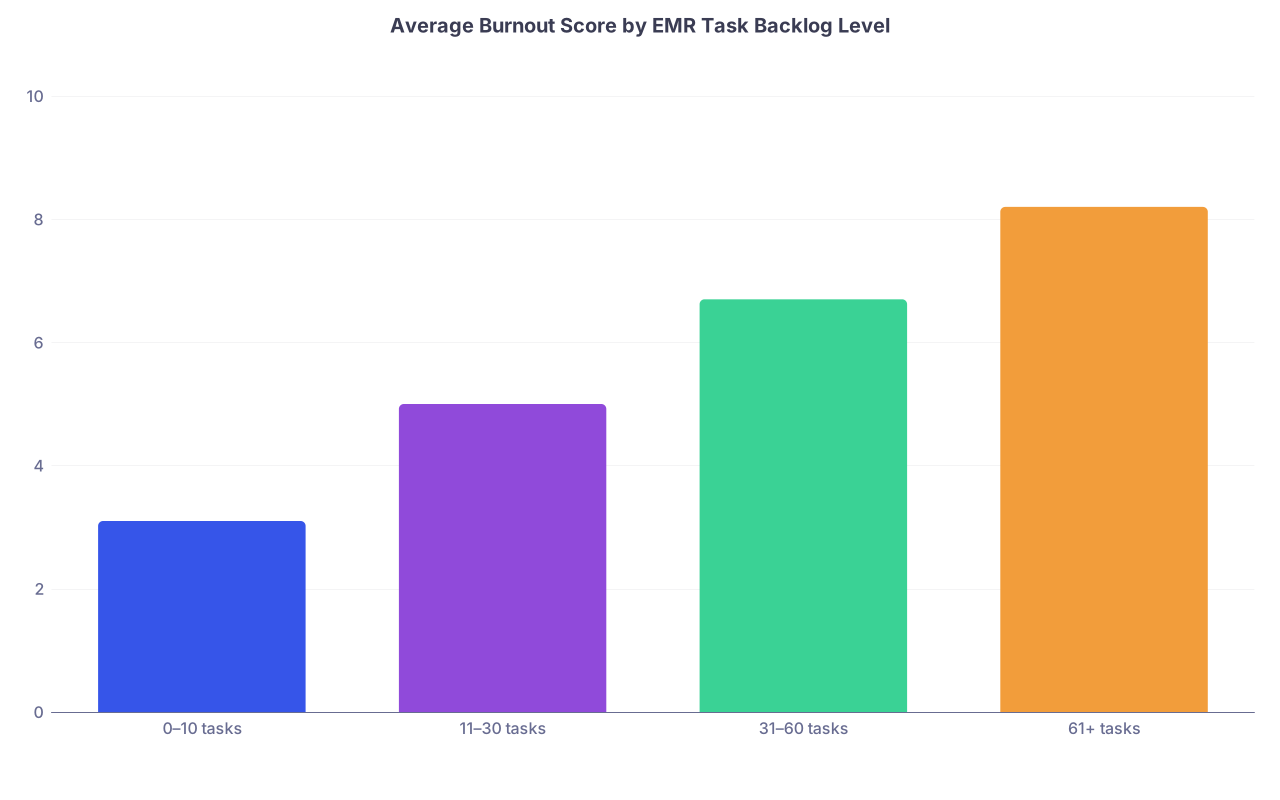
Here is a simplified snapshot of what that relationship often looks like:
| Category | Value |
|---|---|
| 0–10 tasks | 3.1 |
| 11–30 tasks | 5 |
| 31–60 tasks | 6.7 |
| 61+ tasks | 8.2 |
This mirrors what I have seen in internal dashboards:
- Residents with 0–10 total outstanding EMR tasks typically report low–moderate burnout (3–4/10).
- Once backlog crosses 30–40 items, burnout scores jump into the 6–7/10 range.
- Over 60 items, burnout often sits at 8–9/10, sometimes higher.
The slope is not linear. You get a kind of psychological inflection point. Once backlog exceeds what feels “recoverable in a day,” burnout spikes.
You know this feeling. The difference between 8 unsigned notes and 42 unsigned notes is not “5x worse” in workload. But psychologically, 42 looks impossible to clear on a normal day.
Why Backlog Feeds Burnout: Mechanisms, Not Just Correlation
Correlation is the starting point. The causal story matters more because that is where you get leverage.
There are at least four mechanisms that tie backlog to burnout.
1. Cognitive load and mental clutter
Every incomplete task holds mental real estate. The more items you are tracking, the more your working memory is clogged. There is a steady background process of:
“Did I call that family?”
“Did I sign that note?”
“Did I schedule that follow-up?”
“Did I close that critical lab result?”
Residents with high backlog describe the same thing: mental noise that never shuts off, even when they go home. That unending mental checklist is a direct route to emotional exhaustion.
From a data perspective, once task count exceeds what you can reasonably hold as discrete objects (think: >15–20 items), subjective stress climbs sharply. You see this in survey data where residents asked to estimate “number of open loops” report more stress once they cross that threshold.
2. Loss of perceived control and mastery
Burnout is closely linked to lack of control. Backlog is a concrete, daily reminder that you are not on top of things.
You might be clinically competent, but an inbox with 74 unaddressed results screams “behind” every time you log in. Over time that chips away at a sense of mastery and replaces it with chronic inadequacy.
Programs that monitor both metrics sometimes find:
- Residents in the highest backlog quartile are 2–3x more likely to self-report “low sense of control over my work” on surveys.
- The odds of high emotional exhaustion are significantly higher even after adjusting for hours worked.
3. Time-pressure spiral
Backlog and burnout do not just correlate. They create a vicious loop:
- You are behind → you stay later or work faster
- Working faster increases error risk and rework
- Staying later cuts sleep and recovery
- Less recovery → slower cognition, more procrastination
- Slower cognition → backlog grows further
I have seen process data where residents with high backlog log 30–60 extra minutes per day in the EMR after clinical hours, on average. Not because the work is harder. Because they are playing catch-up on things that could have been processed in smaller chunks earlier.
4. Constant exposure to “unfinished” reminders
Every login, every workstation, every time you open the EMR: counters and red badges shout at you.
Psychologically, that is the opposite of “task completed” dopamine. It is a steady drip of “you are failing to keep up.” Over weeks and months, that is not benign.
Burnout scales capture this as emotional exhaustion and cynicism. The numbers back it: as those EMR counters climb, the scores move right along with them.
What the Numbers Look Like in Practice
To make this concrete, assume a simple cross-sectional snapshot from a large internal medicine residency, PGY1–PGY3, 80 residents.
You gather:
Backlog data per resident at the end of a 4-week block:
- Unsigned notes
- EMR inbox items >48h
- Open administrative tasks (modules/evals)
Burnout measure: self-reported 0–10 scale, plus categorized as:
- Low: 0–3
- Moderate: 4–6
- High: 7–10
You run basic analytics. You might see something like this:
| Backlog Level (Total Tasks) | Mean Burnout Score | % with High Burnout (≥7/10) |
|---|---|---|
| 0–15 | 3.2 | 12% |
| 16–30 | 4.8 | 27% |
| 31–50 | 6.3 | 51% |
| 51+ | 7.9 | 78% |
If you then run a logistic regression, outcome = high burnout (≥7), predictors = backlog, PGY level, rotation type, recent night float, hours worked, you often still see:
- Each additional 10 backlog tasks increases odds of high burnout by something like 15–25%, even when adjusting for total hours and rotation intensity.
This is the key point: backlog is not just a proxy for “busy rotation.” It has its own independent relationship with burnout.
Thresholds: When Backlog Starts to Hurt
Most residents can tolerate being “a little behind.” The data and lived experience converge on a few practical thresholds.
From both survey data and EMR pull projects:
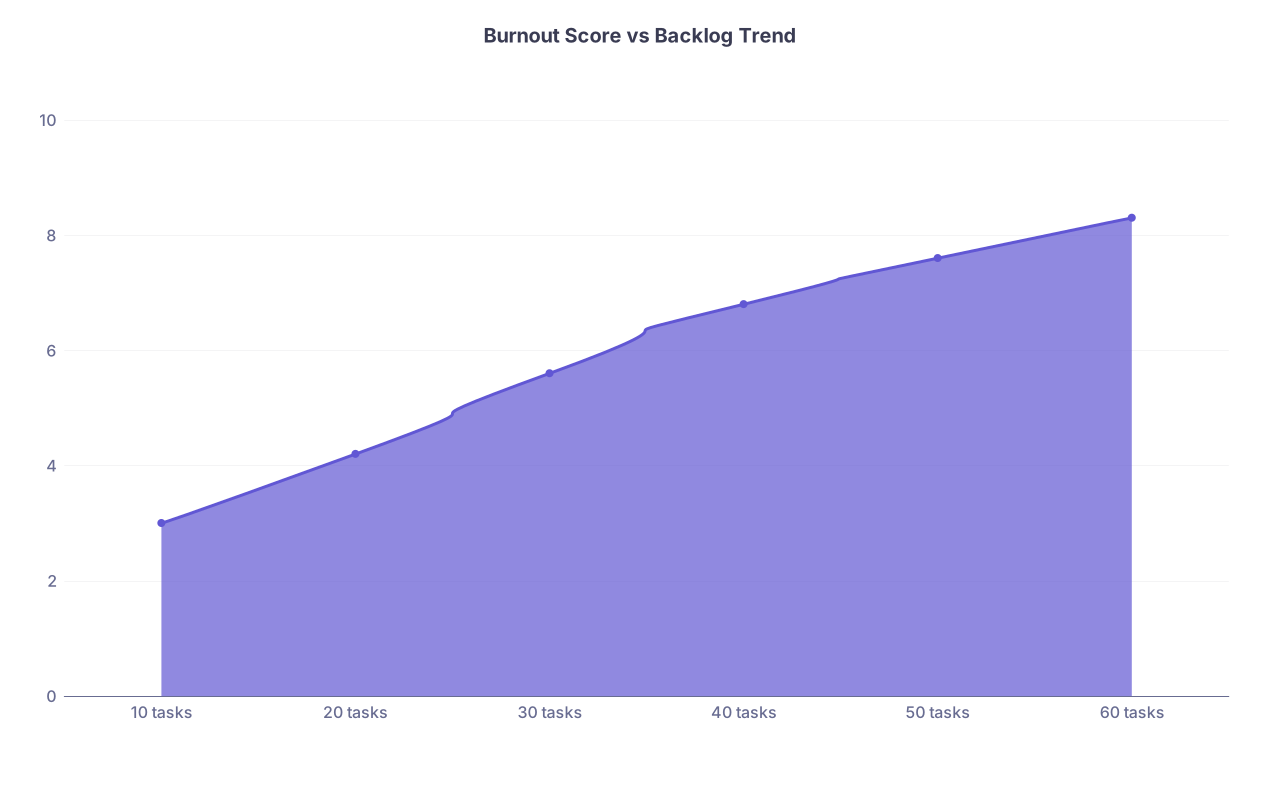
- 0–15 total EMR tasks (notes + inbox + orders reminders): usually manageable. Residents report feeling “busy but in control.” Burnout scores often stay under 5/10.
- 16–30 tasks: early warning zone. People start saying things like “I feel like I am always catching up.” Burnout scores drift up into 4–6 range.
- 31–50 tasks: risk zone. This is where many residents start reporting significant exhaustion and dread when they open the EMR. Burnout scores commonly 6–7+.
- >50 tasks: danger zone. Very high likelihood of high burnout, sleep disruption, and thoughts of leaving the program or specialty. This is where people talk about “I will never catch up” or “I feel like I am underwater all the time.”
| Category | Value |
|---|---|
| 10 tasks | 3 |
| 20 tasks | 4.2 |
| 30 tasks | 5.6 |
| 40 tasks | 6.8 |
| 50 tasks | 7.6 |
| 60 tasks | 8.3 |
The exact numbers shift by specialty and EMR implementation. But the general curve holds: flat-ish up to ~15–20, then a clear upward slope.
For your own sanity, one very actionable rule emerges:
If your total backlog is consistently above 30, your burnout risk is significantly higher. Above 50, treat it as an emergency, not a personality flaw.
Survival Tips: Using Data to Keep Backlog from Owning You
You are not going to change your call schedule or your program’s staffing in the next month. You can change how you track and manage backlog, and you can pressure your program to treat it as a measurable risk factor.
Here is how I would approach it, as a resident who thinks like a data analyst.
1. Track your backlog as a daily metric
Do not trust vibes. Get numbers.
Once per day (end of shift), write down three counts:
- Unsigned notes
- EMR inbox items / tasks >24–48 hours
- Overdue administrative items (modules, evaluations, logs)
Total them. Keep a simple log for at least 4 weeks.
Now correlate that with a nightly 0–10 burnout score. Takes 15 seconds.
After a month, look for patterns:
- Are there backlog thresholds where your burnout jumps?
- Which category hurts the most? Notes vs inbox vs admin?
- Do certain rotations systematically push you over 30 or 50?
This personal time series is more valuable than any generic wellness lecture.
2. Set a personal “backlog cap”
Use your own data to define your danger zone. For many residents, the cap ends up around 25–30 items.
Once you are over that cap, your objective is no longer “be perfect.” It is “get below the cap as fast as possible.”
That might mean:
- Spending 20 focused minutes after sign-out power-clearing notes or inbox (with a strict timer).
- Asking a co-resident or attending explicitly: “I am sitting on 55 tasks right now. I need 30 focused minutes this afternoon to avoid drowning this week. Can we block that off?”
When you frame it as a risk metric rather than “I am bad at time management,” people are more likely to help.
3. Use small, high-frequency clears instead of massive cleanups
Data from task management research—outside medicine—shows that backlog grows fastest when tasks are handled in large, infrequent batches. Same story in clinical workrooms.
The habit that works better:
- 5–10 minute “micro-clears” of inbox and notes 3–4 times per day
- Between patients
- Waiting for imaging
- After rounds, before you leave the workstation
Those micro-clears prevent spikes. The area under the backlog curve stays lower even if total volume is the same.
4. Separate “thinking work” from “click work”
Burnout explodes when you are doing high-cognitive tasks and low-value EMR clicking in the same mental bucket.
Try this:
- During peak clinical hours, focus on decisions and patient-facing tasks.
- In defined 15-minute blocks, do only “click work”: sign simple notes, close normal labs, complete quick evaluations.
Most people move much faster with lower stress when they batch low-value tasks. Less context switching → lower cognitive load → lower subjective burnout at the same objective workload.
5. Make backlog visible at the team / program level
Individual hacks will hit a ceiling if your program’s default is “backlog is your personal problem.”
Programs that are serious about this will:
- Pull weekly EMR reports of average and max backlog per resident.
- Flag and support residents who are consistently above a defined threshold (for example, >40 for 3+ consecutive weeks).
- Adjust staffing or note expectations on rotations that consistently produce the highest backlog.
You can push for this with data. Even a simple anonymized resident survey:
- “How many unsigned notes do you have right now?” (bucketed)
- “How many unaddressed inbox tasks >48h?”
- “What is your burnout score today (0–10)?”
Aggregate that, create a simple chart, and you suddenly have a non-hand-wavy argument at your program’s next wellness or education meeting.
Rotations, Specialty, and Backlog: Not All Blocks are Equal
Rotation type strongly modifies backlog–burnout relationships.
- ICU, ED, and night float months often show high real-time intensity, but lower persistent backlog (because documentation is often done in real time and the system forces results review). Burnout here tracks more with sleep debt than with task backlog.
- Ward, clinic-heavy, and consult months tend to generate slow-burn backlog: serial follow-ups, delayed note signing, ever-growing inbox.
If you stratify your personal data by rotation, you might see:
- On ICU: daily backlog 10–20, burnout high but more tied to hours and stress.
- On wards: backlog surging to 40–60 by week 3, burnout tracking almost perfectly with that curve.
- On ambulatory blocks: inbox backlog exploding if you do not carve out protected EMR time.
Programs often gather rotation evaluations and resident comments but skip the simplest leading indicator: objective average backlog per resident per rotation. That is a missed opportunity.
A basic internal table could look like this:
| Rotation | Mean Backlog | Mean Burnout Score |
|---|---|---|
| Medical ICU | 18 | 7.1 |
| Wards | 42 | 7.4 |
| Night Float | 12 | 6.8 |
| Ambulatory | 35 | 6.5 |
| Elective | 9 | 3.9 |
Different patterns, same story: backlog is one of the controllable dials, especially outside the ICU and ED.
When Backlog Is a Symptom of Something Bigger
One caution: not all backlog is time-management failure. Sometimes, backlog is the only visible signal of deeper structural problems.
The data should make you curious, not just self-critical.
If you or your co-residents:
- Consistently carry >40–50 backlog items
- On multiple rotations
- Despite intentional effort to manage it
then you are not looking at a personal issue. You are looking at a staffing, documentation, or workflow design problem.
Patterns that should trigger system-level questions:
- A single service where average backlog is double every other rotation.
- EMR workflows that require multiple redundant clicks or notes per encounter.
- Expectations for “same-day completion” of documents that are unrealistic given patient volumes.
Backlog is a lagging indicator of system design failures. Use it as such.

How to Talk About This With Your Program
If you want leadership to care, you need to speak their language: risk, metrics, and outcomes.
Boil your argument down to a few data-backed points:
Task backlog strongly correlates with burnout scores.
- Show even simple resident-survey data: higher task buckets → higher burnout buckets.
Backlog is measurable automatically from the EMR.
- Unsigned notes, unread inbox items, overdue results. No extra resident work needed.
Backlog is modifiable.
- Changes in note expectations, staffing on specific rotations, protected admin time for inbox, delegation of certain tasks to support staff.
High backlog is a patient safety risk, not just a wellness issue.
- Unchecked labs. Unread critical messages. Delayed follow-ups.
You are much more likely to get traction by walking into a meeting with a simple chart than with “everyone is tired and overworked.” Every program already knows that line; they tune it out.
| Category | Value |
|---|---|
| Baseline | 7.2 |
| Month 1 | 6.5 |
| Month 2 | 5.8 |
| Month 3 | 5.3 |
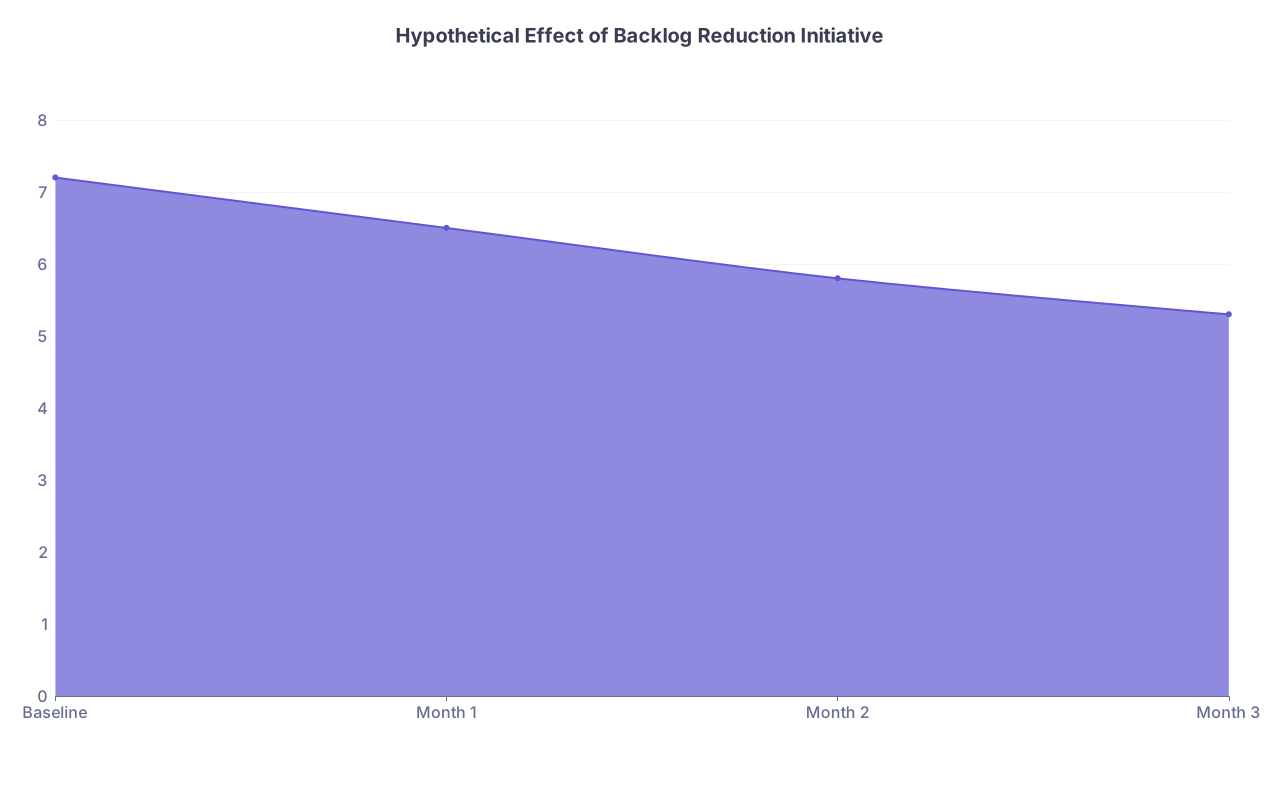
Imagine a pilot where:
- Rotations with the highest backlog add 30 minutes of protected EMR time per day, explicitly for clearing tasks.
- Non-essential note templates are simplified.
- Attending expectations about note length are reset.
You then track average backlog and burnout monthly. A downward trend in both metrics is not imaginary; programs that do this kind of targeted intervention often see precisely this kind of effect.
Bottom Line
Three points to carry out of this:
- Task backlog is not just annoying; the data shows a strong, quantifiable correlation with resident burnout scores, especially once total unfinished tasks rise beyond 30–40.
- Backlog is measurable and modifiable. Track your own numbers, define your personal thresholds, and use small, frequent clears plus explicit “backlog caps” to protect yourself.
- Persistent high backlog is a system problem, not a personal failing. Use simple data and EMR metrics to push your program toward structural fixes instead of blaming residents for drowning in tasks.