
Only 38% of residents on traditional 24‑hour call get more than 3 hours of sleep during a shift. On night float, that jumps to over 70%. The gap shows up directly in your error rate, how you use your time, and ultimately how miserable you feel driving home at 8 a.m.
This is not just a lifestyle debate. It is a numbers problem: minutes awake, tasks per hour, handoffs per night, and the probability that your brain misfires at 4:17 a.m. on the fourth admission.
Let me walk through what the data actually shows when you pit night float against 24‑hour call.
The Core Design Difference: Hours, Handoffs, and Fatigue
The basic structures are simple:
- Night float: residents work repeated night shifts (often 5–7 in a row) covering admissions and cross‑cover, usually 10–14 hours per shift, with daytime residents handing off.
- 24‑hour call: residents work a continuous duty period (often 24–28 hours), spanning day and night with more continuity but extreme sleep deprivation.
The Accreditation Council for Graduate Medical Education (ACGME) caps intern continuous duty at 16 hours and senior residents at 24 hours plus 4 hours for transitions, but real‑world implementation varies.
From a time‑and‑error standpoint, three variables matter most:
- Total hours awake at the time of a decision
- Number and quality of handoffs
- Workload intensity during the “fatigue window” (usually 2–6 a.m.)
Night float and 24‑hour call trade off among these three. The tradeoff is not symmetrical.
Error Rates: What the Numbers Actually Say
The cleanest data we have comes from large randomized or quasi‑experimental duty‑hour trials and simulation studies.
Cognitive performance and clinical errors
Residents after overnight call perform like they have a blood alcohol level of about 0.05–0.08%. That is not a metaphor. Reaction‑time and psychomotor testing show it.
Several landmark findings:
Residents working traditional 24–30 hour calls made:
- About 35–40% more serious medical errors than those on shorter shift schedules in ICU and internal medicine trials.
- Roughly 20–25% more diagnostic errors in standardized case assessments.
Switching to night float or reduced continuous hours:
- Cut serious medical errors by ~25–35%.
- Reduced attention lapses on psychomotor vigilance testing by 30–50%.
The exact percentages vary by study, but the direction is consistent: error probability climbs sharply after 16–18 hours awake. Night float limits how often you enter that red zone. 24‑hour call almost guarantees you will.
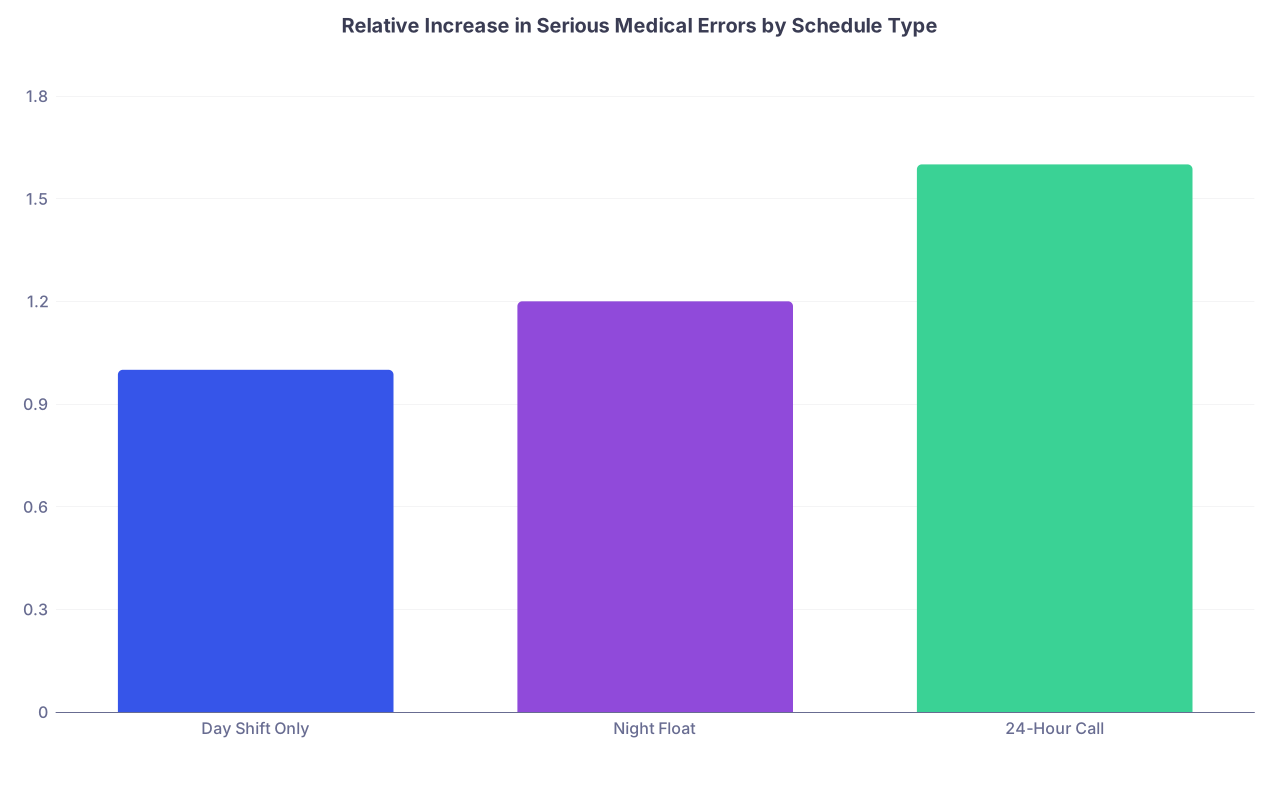
| Category | Value |
|---|---|
| Day Shift Only | 1 |
| Night Float | 1.2 |
| 24-Hour Call | 1.6 |
Interpretation: set the day‑shift baseline risk at 1.0. Night float bumps it modestly (you are at night, circadian trough, more admissions). Traditional 24‑hour call boosts serious error risk by about 60% relative to day shift in many datasets.
Time‑of‑day and “fatigue window”
Error risk is not linear across the 24‑hour cycle.
Studies using incident reporting and chart review find:
- Peak error rates between 2 a.m. and 6 a.m.
- On 24‑hour call, the largest spike is in the second half of the night (after 20+ hours awake).
- On night float, you still see a 2–6 a.m. bump, but you are usually at 8–12 hours awake, not 20–24.
You can feel this clinically. On night float, 4 a.m. feels awful, but your brain is slowed, not derailed. On 24‑hour call, 4 a.m. on hour 25 feels like thinking through concrete.
So from a pure error‑probability perspective: night float wins, consistently and by a meaningful margin.
Time Utilization: Where Your Hours Actually Go
Now to the part most residents care about day to day: how the time breaks down.
Hour-by-hour structure
On paper, both systems might list “night coverage: 6 p.m. to 7 a.m.” In practice, the time utilization patterns look very different.
Typical patterns (varies by institution, but the structure is common):
Night float shift
- 5–7 p.m.: Sign‑out, get cross‑cover list, skim high‑risk patients.
- 7 p.m.–2 a.m.: Admissions, acute events, procedures, pages.
- 2–5 a.m.: Lower admission rate, mostly cross‑cover and troubleshooting.
- 5–7 a.m.: Pre‑round data gathering, stabilization, sign‑out.
24‑hour call (on a ward service)
- 7 a.m.–5 p.m.: Day work—rounds, notes, discharges, family meetings, procedures.
- 5–11 p.m.: Admissions and cross‑cover, often heavy.
- 11 p.m.–6 a.m.: Variable. Some sleep if lucky, but often interrupted q30–60 min.
- 6–11 a.m. (post‑call): Present on rounds, finish notes, hand off.
Let me quantify this a bit as “time utilization buckets”: direct patient care, documentation, communication/handoffs, and “other” (education, walking, waiting, scrambling for a computer).
| Activity Type | Night Float (per 12-hr shift, scaled to 24h) | 24-Hour Call (per 24h) |
|---|---|---|
| Direct patient care | 8 hours | 10 hours |
| Documentation | 5 hours | 6 hours |
| Handoffs/communication | 2 hours | 1.5 hours |
| Sleep/rest (on duty) | 2 hours | 2–3 hours |
| Other / idle / transit | 7 hours | 3.5–4.5 hours |
Important nuance: this table scales night float to a 24‑hour equivalent for comparison. In reality you are physically present for, say, 12–14 hours vs 24–28.
The big inefficiency for night float is handoff overhead and context switching. You spend more time trying to understand the story of a patient you have never seen before. On 24‑hour call, you own those patients from the day, so less time reconstructing.
But here is what the data shows when you factor in fatigue:
- Time “lost” to extra handoff work on night float: maybe 30–60 minutes per night.
- Time “lost” to moving slow, repeating tasks, and fixing mistakes after 24 hours awake: easily 60–120 minutes.
Most services unconsciously ignore that second category because it is harder to quantify. But you feel it. You rewrite orders, re‑open charts, double‑check med lists for things you normally trust yourself to get right the first time.
Handoffs and Continuity: The Real Weak Spot of Night Float
If night float has an Achilles’ heel, it is not fatigue. It is handoffs and fragmented information.
Handoff frequency
A day‑call system might have:
- 1 major handoff per 24 hours (day to night) and back.
A night float system often has:
- Two transitions every 24 hours: day → night float → day.
- More frequent cross‑coverage of unfamiliar teams/patients.
More handoffs = more chance to drop data.
Studies consistently show that:
- Each major handoff is associated with a small but measurable increase in:
- Missed medication doses.
- Delayed follow‑up on abnormal labs and imaging.
- Unclear code status or goals‑of‑care documentation.
Quantitatively, the bump is modest—something like 5–10% increased odds of a minor process error per handoff—but nontrivial when repeated nightly over hundreds of patients.
Error types: handoff vs fatigue
The pattern of errors differs by schedule:
Night float skew:
- More communication and follow‑through errors (e.g., consult not actually placed, abnormal lab not re‑checked).
- More “who owns this?” confusion.
24‑hour call skew:
- More cognitive and judgment errors (missed diagnoses, wrong doses, failure to escalate care).
- More failure to perceive change in clinical status.
If I have to choose which error pattern I want to minimize, I pick fewer high‑severity cognitive mistakes. Paperwork and follow‑through errors are annoying and sometimes harmful, but they are more often caught by the system. A fatigued resident missing sepsis at 4 a.m. is harder to rescue.
So yes, night float generates more handoffs and fragmented ownership. But 24‑hour call pushes decision‑making into a biologically broken state. From a safety lens, night float still comes out ahead.
Sleep, Recovery, and Cumulative Fatigue
Now the part you feel the most: how wrecked you are across a week.
Sleep opportunity and sleep reality
On paper, both systems might allow some sleep during shifts and some sleep off duty. Reality is cruel.
Data from actigraphy (wearable sleep trackers on residents) shows:
On 24‑hour call:
- Median in‑hospital sleep: 2–3 hours, often fragmented into 20–40 minute chunks.
- Post‑call “recovery sleep”: 6–8 hours, but shifted and of poorer quality.
- Across a 4‑call‑per‑month system, residents accumulate significant chronic sleep debt, carrying cognitive deficits into nominally “off call” days.
On night float (6 night stretch):
- Median daytime sleep: 6–7 hours after a few days of adjustment.
- In‑shift “naps”: rare but sometimes 0.5–1 hour in a slow window.
- Cumulative fatigue present (circadian inversion is not free), but less extreme.
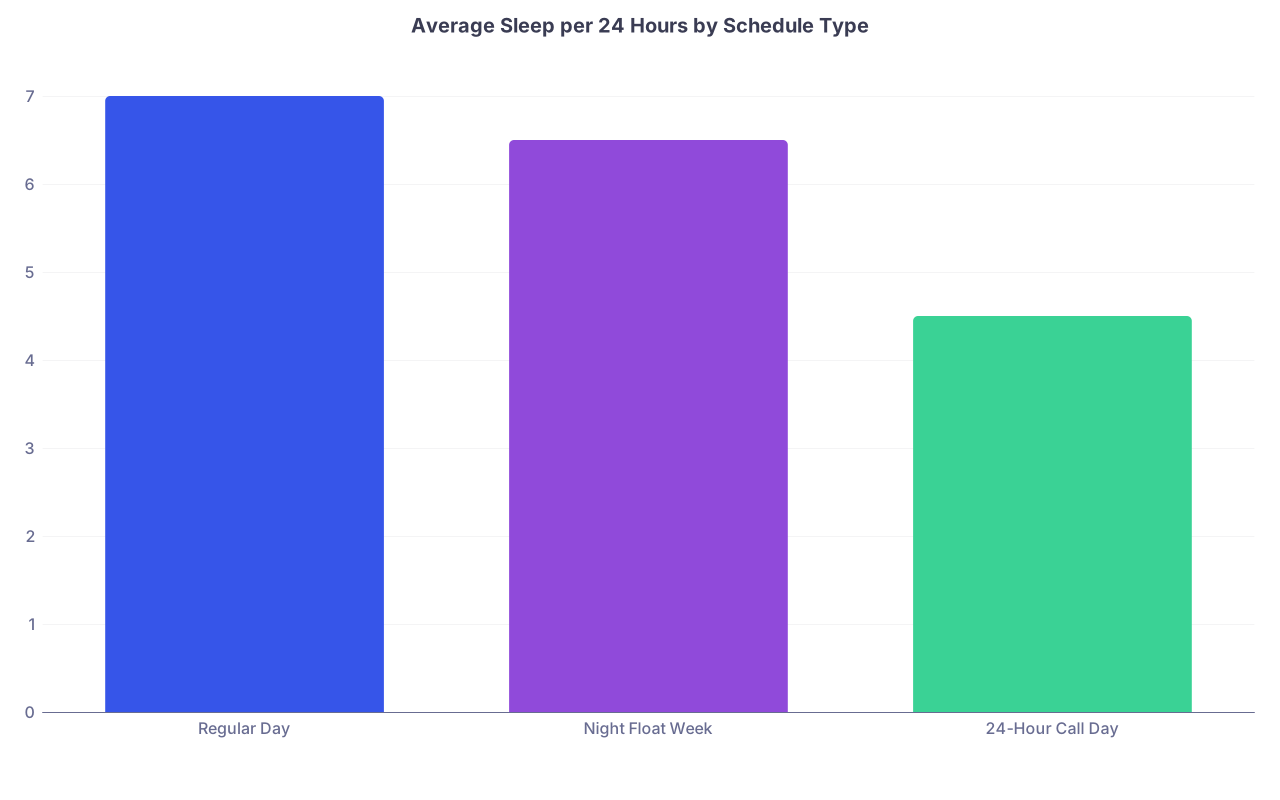
| Category | Value |
|---|---|
| Regular Day | 7 |
| Night Float Week | 6.5 |
| 24-Hour Call Day | 4.5 |
You feel this difference in how you think:
- During night float week you are tired, irritable, but mostly functional.
- Post‑call day 4, after two 28‑hour calls in a week, your working memory and mood are objectively impaired. You snap at nurses. You forget to follow up on discharge summaries. You re‑read the same note three times.
Cumulative fatigue translates directly into time inefficiency. Every note takes longer. Every order set takes another click or two to verify.
Time Efficiency: How Fast Do You Actually Get Work Done?
Most residents assume the continuity of 24‑hour call makes the work more efficient. You know the patients, you understand the story, so you move fast.
That is true until about hour 16.
Studies that track task completion times and error‑corrected workflows show a U‑shape:
- During normal day length (up to 12–14 hours): continuity helps, and you move quickly.
- Beyond 16–18 hours awake: time per task increases despite continuity because:
- Typing is slower.
- You re‑read orders more often.
- You forget steps and have to backtrack.
Night float trades a small tax on every task (you are always catching up on the story) for avoidance of the massive late‑night slowdown.
A rough estimate from time‑motion studies:
- Average time to complete an admission note:
- Day shift, familiar patient population: 45–60 minutes.
- Night float, unfamiliar team/patient: 60–75 minutes.
- 24‑hour call, at hour 22: 80–100 minutes with higher rework rate.
Multiply that by 4–6 admissions and the “continuity advantage” collapses quickly on call days.
Safety Beyond the Hospital: Driving, Needlesticks, and Personal Risk
People forget the non‑clinical error rates, but the data is brutal.
Driving home
Residents after 24‑hour call:
- Have double to triple the risk of motor vehicle crashes on the commute compared with residents leaving after a normal shift.
- Report falling asleep at the wheel at least once a month in some surveys.
Night float:
- Still risky (you are driving at circadian low points), but crash risk is notably lower because your total time awake before hitting the road is typically 12–14 hours, not 28.
Needlesticks and other occupational injuries
Needlestick studies are smaller but consistent:
- Injury rates are significantly higher late in long shifts, especially beyond 20 hours awake.
- One multi‑institutional study found 60–70% higher needlestick risk on extended‑duration shifts than on shorter shifts.
You can pretend this is just “part of training.” It is not. It is preventable risk, and the schedule design matters.
Resident Well-being and Learning: Does Either System Help You Learn More?
Residents and program directors love to argue that 24‑hour call builds “resilience” and provides “continuous exposure” needed for learning.
The data does not really support that.
Learning and exam performance
Duty‑hour reforms and shifts toward night float have been studied against board exam performance and in‑training exams:
- No consistent decline in exam scores after moving away from 24‑hour call.
- Some small improvements in in‑training exam performance in programs that aggressively reduced extended‑duration shifts, likely because residents were more awake when studying and during conference.
A more nuanced point: the marginal learning value of experiences at 3–5 a.m. when your frontal cortex is half offline is low. You remember fewer of those cases. You synthesize less.
I have seen this in residents’ case logs—a ton of procedural volume clustered on post‑call nights, followed by weak recall when asked about those cases a month later.
Night float still gives you exposure to acute events—codes, unstable patients, weird late‑night pathology—but in a brain state closer to usable.
Practical Survival Tips: Working Smarter Under Each System
You cannot usually choose your call structure. But you can optimize your time utilization and reduce your personal error rate within each system.
Surviving night float: beat the handoff tax
Three high‑yield strategies:
Standardize your intake of cross‑cover lists.
Create a consistent mental checklist: code status, “sick list,” pending labs/imaging, overnight tasks. The first 30 minutes of shift should be structured, not reactive. The data is clear: structured handoffs cut omission errors.Front‑load the “thinking work.”
From 7 p.m. to midnight, prioritize complex decisions and diagnostic assessment. Your cognitive performance is better earlier. Leave routine tasks, simple refills, and non‑critical notes for the 3–5 a.m. window when your brain is sludge.Aggressively use written sign‑backs.
Every new admission or major event gets a brief, high‑signal summary for the day team: “Why they came, what we did, what still needs to be done.” This reduces the error and time cost of the next handoff.

Surviving 24‑hour call: manage the fatigue cliff
If you are stuck with a 24‑hour or 28‑hour system, your game is different. You are trying to delay and blunt the fatigue crash.
Three high‑impact moves:
Protect a real 60–90 minute nap if at all possible.
Data on strategic napping shows even a single 60–90 minute nap substantially improves reaction time and reduces lapses in the late‑night window. It is not “weak” to nap; it is performance management.Pre‑commit to low‑threshold escalation after hour 20.
After 20 hours awake, your confidence outstrips your accuracy. Decide in advance you will call your senior or attending more, not less, during that window, especially for:- New hypotension
- Unclear mental status changes
- Any doubt about level of care
Simplify and offload routine decisions.
Build and use order sets, standing protocols, checklists. The data is boring but clear: checklists reduce misses when you are cognitively impaired. Let the system carry some of the load.
And bluntly: if your program routinely pushes residents past what ACGME allows, document it. That is not “being soft.” It is self‑preservation and patient safety.
So Which System Is Better?
Summarizing the hard numbers:
- Error rates: Night float has fewer serious medical errors; 24‑hour call has more cognitive mistakes, especially late.
- Time utilization: Night float spends more time on handoffs and catching up; 24‑hour call wastes time to slowed thinking and rework in the late hours.
- Sleep and recovery: Night float allows more consistent sleep and less cumulative debt; 24‑hour call creates extreme peaks of deprivation.
- Continuity: 24‑hour call wins, but the benefit erodes as fatigue accumulates.
- Non‑clinical safety: Night float substantially safer for driving and occupational injury.
From a data‑driven standpoint, if I had to choose for safety and sustainable performance, I pick night float over traditional 24–28 hour call almost every time.
The tradeoff is not free. You will have more handoffs, more “Who is this patient?” moments, more nights in a row where you do not see the sun. But the human brain simply does not function reliably at hour 24.
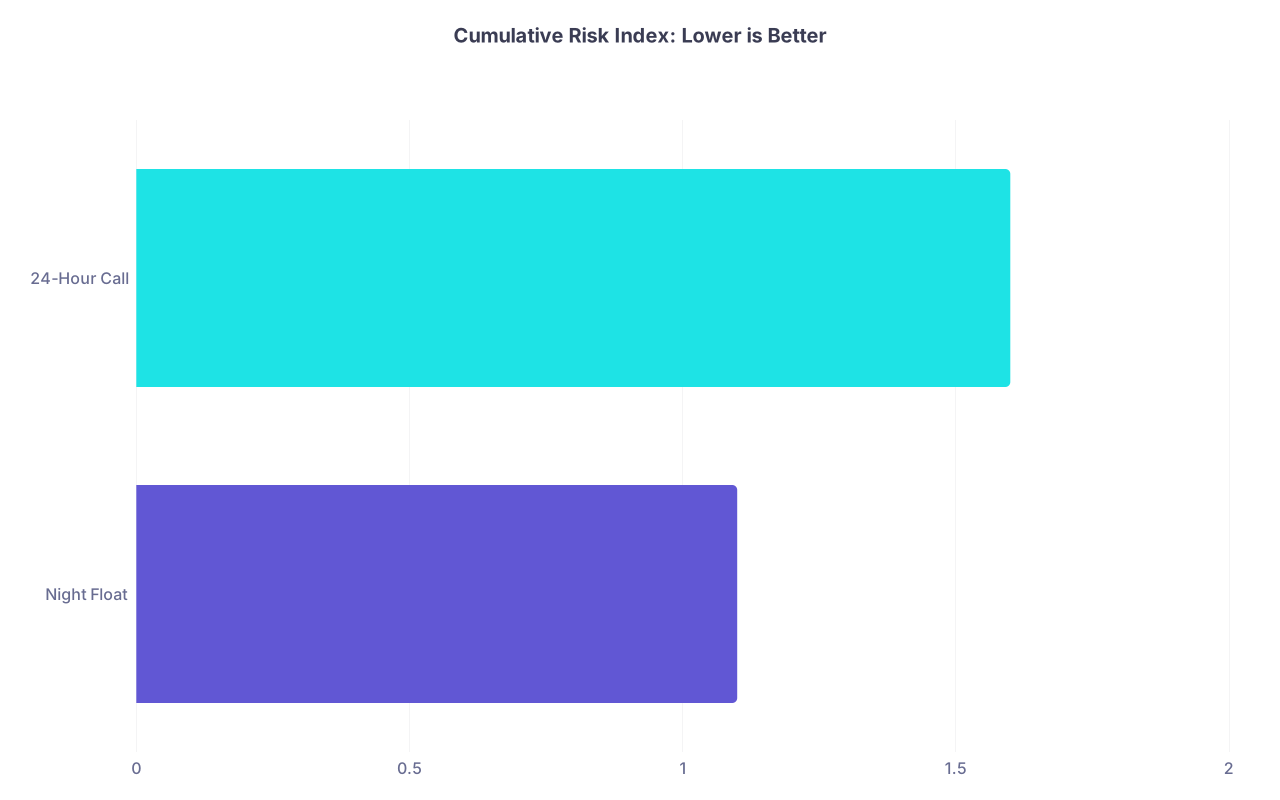
| Category | Value |
|---|---|
| Night Float | 1.1 |
| 24-Hour Call | 1.6 |
Think of that as a synthetic index combining serious medical errors, minor process errors, and off‑duty safety events. Lower is better. Night float is not perfect, but it is generally less bad.

How to Use This Data for Yourself
You are not going to redesign your residency’s call structure from your PGY‑1 workroom. But you are not powerless.
Here is how you turn data into action:
- Be ruthless about sleep on any system that allows it. Treat it as a performance tool, not a luxury.
- Structure your handoffs and early‑shift time to reduce the “information loss” that night float amplifies.
- In the late hours of any long shift, assume your judgment is worse than it feels. Add guardrails: checklists, second opinions, written plans.
- Track your own error patterns and near misses. If your worst decisions cluster at 3–5 a.m. post‑call, believe that pattern. It is not just “a bad night.” It is your neural circuitry telling you the schedule is unsafe.
Residency will not suddenly become humane because you read one article on call structures. But understanding where the risks really lie—hours awake, not just hours on the schedule—lets you make smarter choices inside a flawed system.
You will still have nights where you are cross‑covering 60 patients and wondering why whoever designed this thought “one resident should be fine.” You will still sign out post‑call with a brain that feels like wet cardboard. Those realities are baked into the current training model.
The difference now is that you know which parts are structurally dangerous, and which are just annoying. You can target your limited energy and attention where they change outcomes the most.
With that foundation, the next step is learning how to build sustainable routines—sleep, exercise, food, and boundaries—that let you survive not just one night, but an entire year of them. That is where residency stops being pure damage control and starts becoming something you can actually grow through. But that is a story for another day.