
The debate about checklists in residency is mostly emotional. The data is not. And the data is far less romantic than the “Atul Gawande saved the world with checklists” narrative you keep hearing on rounds.
Some checklists clearly help residents. Many waste time. A few actively make care slower and more error-prone.
Let’s walk through what the numbers actually say about efficiency, cognitive load, and outcomes when residents use checklists.
What Problem Are Checklists Supposed To Solve?
Strip away the buzzwords and you get three concrete claims about checklists for residents:
- They reduce errors and omissions.
- They speed up routine workflows.
- They free up working memory for harder clinical decisions.
All three are testable. And people have tested them—in the OR, ICU, wards, ED, even in EMR workflows.
Before we get to results, keep the baseline in mind: residents already operate near cognitive capacity. On a busy ward month:
- 60–80 patients per day across the team
- 12–20 active orders per patient in many services
- Dozens of handoffs, calls, and interruptions per shift
You do not need more “things to click.” You need fewer dumb decisions and fewer reworks.
That is the actual bar: does a checklist decrease rework (calling back nurses, reordering, clarifying, fixing mistakes) more than it increases front-end time?
What The Big Surgical and ICU Studies Really Show
Most people’s mental model of “checklists work” comes from a few famous trials. Let’s quantify what they actually did.
Surgical safety checklists: big win, but not your daily note template
The WHO Surgical Safety Checklist and its descendants are massively studied. The headline: reduced complications and mortality.
In one frequently cited multicenter study (Haynes et al.) implementing the checklist across 8 hospitals:
- Major complications dropped from about 11% to about 7%
- In-hospital mortality dropped from roughly 1.5% to 0.8%
That is not subtle. A relative reduction in major complications of ~36–40%.
But here is the catch for residents: those were short, tightly scoped checklists:
- 19 items
- Focused on high-leverage, binary steps (antibiotics given, site marked, airway plan clarified, etc.)
- Used at discrete, predictable moments (before induction, before incision, before leaving OR)
Residents on medicine wards often try to convert that success into sprawling “comprehensive” admission or rounding checklists with 40–60 items. That is not the same thing.
The data show: short, high-signal checklists for well-bounded processes are effective. Long, catch-all lists? Much shakier.
ICU bundles: checklist plus enforcement
Look at central line infection prevention. Pronovost’s group and others showed:
- CLABSI rates dropping 60–70% when a 5-item insertion checklist was implemented
- Items like hand hygiene, full sterile barrier, chlorhexidine prep, avoiding femoral lines, dressing review
Again, short list. 5 items. Huge effect size.
But there is an important confounder: they did not just “add a checklist.” They also:
- Empowered nurses to stop the procedure if items were missed
- Standardized kits and workflows
- Created visible data feedback loops
So the data for ICU and procedural checklists says: checklists work when they are embedded into a system that enforces them and when the task is well defined.
On the wards at 3 a.m. with 20 admits and two cross-cover pages per minute? Different universe.
Do Checklists Make Residents More Efficient?
Let’s move from safety to throughput. Residents care about how long rounds take, how late they stay, and how often they miss things they have to fix later.
The efficiency question has two pieces:
- Time per task with vs without checklist
- Downstream rework and errors with vs without checklist
Where both have been measured, the pattern is consistent.
Rounding checklists: mixed, but there are some numbers
Several internal medicine services have tried daily rounding checklists. Things like:
- “Code status documented”
- “DVT prophylaxis ordered”
- “Indwelling catheters reassessed”
- “Dispo barriers listed”
One common result set:
- Time per patient on rounds increased by 5–15% in the first 1–2 weeks
- Omission rates for key items decreased by 30–60% (e.g., more consistent VTE prophylaxis, fewer missing code statuses)
- Over 1–2 months, total length of stay for some diagnoses decreased modestly (on the order of 0.1–0.3 days)
Translation: in the short term, you slow down. In the slightly longer term, you trade some front-loaded time for less chasing down issues later.
Where the data are clearer is on structured discharge checklists.
Discharge checklists: where efficiency gains actually show up
Discharge is surprisingly measurable: readmissions, time of discharge order, time patient actually leaves, number of callbacks, etc.
Studies looking at resident-led discharge checklists report things like:
- Time from “discharge order placed” to patient leaving dropping by 30–90 minutes on average
- Medication reconciliation completeness up by 20–30 percentage points
- Follow-up appointments arranged more consistently (often jumping from ~60% to >85%)
- Slight reductions in 30-day readmissions (varies by population, but numbers like 1–3 percentage points)
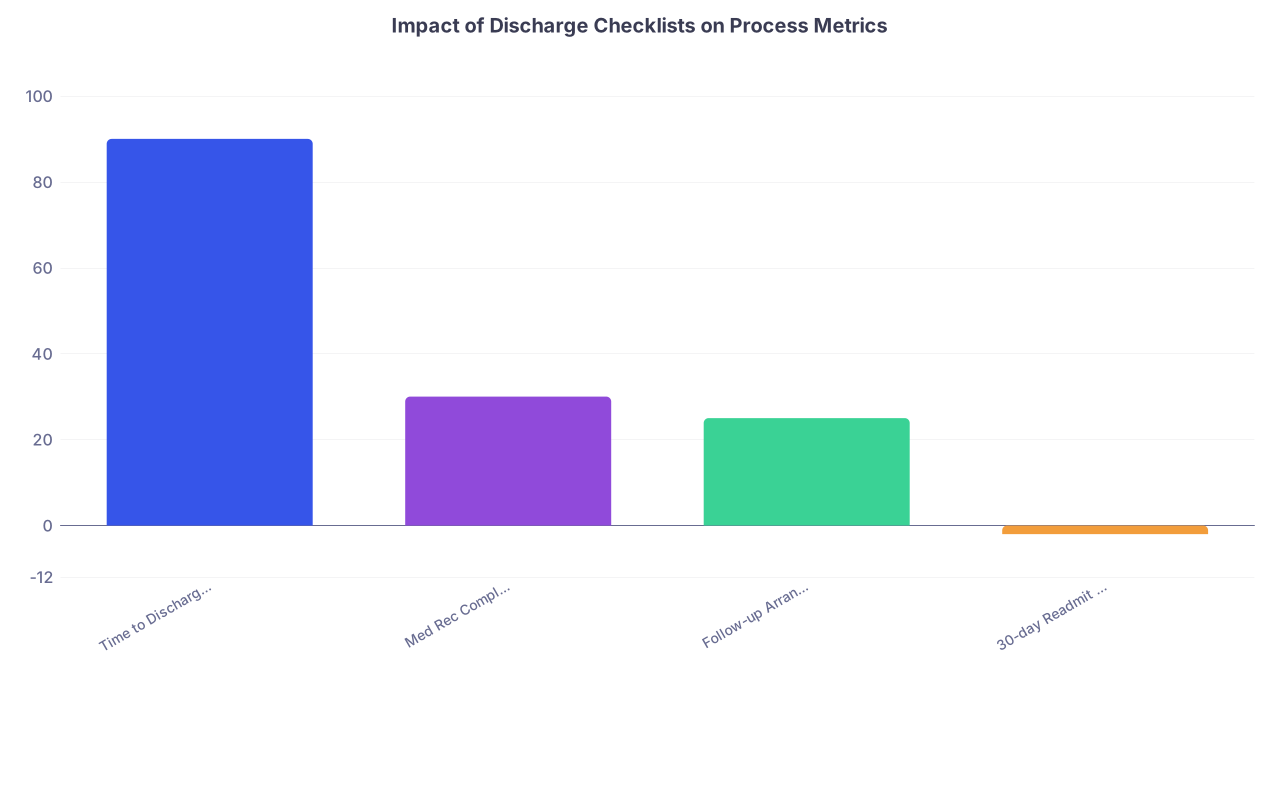
| Category | Value |
|---|---|
| Time to Discharge (min) | 90 |
| Med Rec Complete (%) | 30 |
| Follow-up Arranged (%) | 25 |
| 30-day Readmit (%) | -2 |
Interpret the chart like this: −2 on 30-day readmits means a 2 percentage point reduction; 90 minutes faster discharge; 30 and 25 point jumps on med rec and follow-up.
From a resident’s perspective:
- You invest maybe 3–5 extra minutes per patient at the time of discharge to walk the checklist.
- You avoid multiple pages later for missing paperwork, wrong scripts, no follow-up, and angry families.
When I have seen programs track this honestly, the net effect is fewer evening clean-up tasks and fewer 7 p.m. calls about “the discharge that is not actually ready.”
When Checklists Backfire: Alert Fatigue and Click Exhaustion
Not every checklist is physical. A lot of your “checklists” are actually EMR alerts, BPA pop-ups, or mandatory order-set boxes.
The data here is more brutal.
Several hospitals that studied alert acceptance rates found:
90% of interruptive EMR alerts are overridden
- Clinically important alerts get drowned in noise from low-yield reminders
In one system that added multiple mandatory fields and “soft” pop-up reminders into order entry:
- Order entry time increased by ~20–30%
- Resident self-reported frustration and burnout measures climbed
- There was no meaningful change in adverse event rates after 1 year
In other words: shove a checklist into the EMR without discrimination, and you mostly redistribute time from thinking to clicking. That is not efficiency. That is cosmetic compliance.
This is where residents are right to be cynical. If the “checklist” feels like:
- 10 extra clicks per admission for something you already always do
- Repeated alerts for contraindications that almost never apply
- Documentation demands that have no visible impact on care
…the odds are high that it is a net loss.
The lesson from the data: checklist value is highly sensitive to item quality. Signal-to-noise ratio matters.
Cognitive Load: Does A Checklist Free Your Brain Or Clutter It?
You are not a robot. Working memory is finite, especially post-call.
Checklists are supposed to offload memory so you can allocate cognition to diagnostic reasoning and prioritization. But that only works if the list is designed to match how your brain operates under stress.
Cognitive load studies (both in medicine and in other complex fields like aviation) generally show:
- Short, chunked lists reduce error rates, especially for rare but critical steps.
- Long, linear lists increase time-on-task and may increase error rates when people are interrupted and lose their place.
- Under acute stress, people will often skip steps in long checklists unless the culture enforces them.
Think of an ACLS algorithm card. It works because:
- It is short
- It is structured around decision points
- A team member can “own” it in real time
By contrast, a 40-item “admission checklist” pasted into your note template? The data on actual adherence is abysmal. Residents routinely:
- Auto-populate or skip fields
- Ignore embedded prompts
- Rely on habit, not the list, to drive actions
So from a cognitive load angle, the numbers boil down to:
- Checklists with <10–15 items that map to discrete phases of work tend to help.
- Mega-lists used as documentation templates typically fail to reduce omissions and might increase overall cognitive friction.
Which Checklists Actually Help Residents Day-To-Day?
Let’s categorize the types you are likely to see and be blunt about which ones pull their weight.
| Checklist Type | Typical Length | Efficiency Impact | Net Value |
|---|---|---|---|
| Surgical/Procedural | 10–20 items | Slightly slower upfront; fewer complications and rework | High |
| ICU Device/Bundle | 5–15 items | Neutral to positive; fewer line/vent issues | High |
| Brief Rounding Checklist | 5–10 items | Slight slow down, fewer omissions | Moderate–High |
| Discharge Checklist | 10–20 items | Faster discharge overall; fewer callbacks | High |
| EMR “Pop-up” Reminders | 1–5 items each | Slower, mostly overridden | Low |
| Exhaustive Admission List | 30–60+ items | Slower, often ignored or gamed | Low–Moderate |
If you have limited patience (and you do), focus your energy on:
- Discharge checklists
- Brief rounding “anchor” lists for must-not-miss items
- Procedural checklists if you are in surgery, anesthesia, or ICU-heavy fields
For everything else, skepticism is warranted until someone shows you the before-and-after data.
Process Matters: How Checklists Are Introduced Changes Everything
The same checklist can be helpful or hated depending on rollout.
I have watched two services implement almost identical discharge checklists with very different results.
Service A (successful):
- Co-designed by 3 residents, 1 attending, 1 nurse, 1 case manager
- Piloted on a single team for 4 weeks
- Measured: time to discharge, number of pharmacy/nurse callbacks, patient satisfaction on discharge communication
- Items revised or cut every week based on complaints and timing data
Result: Residents complained the first week, then quietly admitted that afternoons felt calmer. Leadership backed off other low-yield documentation to “make room” for the checklist.
Service B (failure):
- Checklist dumped into EMR as mandatory fields overnight, no warning
- No removal of other documentation requirements
- No tracking of efficiency metrics, only admonitions to “improve quality”
Result: Residents developed templated shortcuts, auto-filled text, and resentment. Any potential quality benefit was undercut by gaming and workarounds.
The underlying rule is simple: if nobody is collecting baseline and follow-up data, assume the checklist exists to make an administrator feel better, not to make your life easier.
Designing Checklists That Actually Save You Time
Let me be practical. If you have any influence over how your team uses checklists (and residents usually have more leverage than they think), these design constraints are non-negotiable.
1. Cap the list length
For daily-use resident checklists:
- 5–10 items for quick rounding anchors
- 10–20 items for discharge, maximum, and grouped by category (meds, follow-up, documentation, patient understanding)
Beyond that, adherence and usefulness drop fast.
2. Tie items to measurable pain points
If an item is going on a checklist, you should be able to answer:
- How often is this omitted now?
- What happens when it is missed? (Rework? Readmission? Safety event?)
- What is the evidence that this step prevents that problem?
If the answer to “what happens when it is missed” is basically “someone gets mildly annoyed,” it probably does not belong.
3. Kill deadweight regularly
Checklists are not sacred. They accumulate junk. If your service never prunes them, you end up with a bureaucratic sediment layer.
A simple rule that some high-functioning teams use:
- Quarterly review of the checklist
- Any item that has near-100% compliance and extremely low error impact gets removed or auto-defaulted
- New items can only be added if something is removed (one-in, one-out rule)
Without this, lists only grow. They never shrink. The data show that growth without pruning erodes adherence over time.
How To Use Checklists Without Becoming A Robot
You are training to be a physician, not a box-checker. The point of a checklist is to protect your bandwidth, not to replace it.
A few specific strategies residents have used effectively:
Use the checklist as a final sweep, not a script.
Think through the patient first. Then sweep the list to catch mechanical misses. That preserves your clinical reasoning and uses the list for what it is good at: remembering the boring things.Delegate ownership when possible.
For example, on some teams, the senior resident owns the discharge checklist sweep on complex patients, juniors draft, and nurses verify specific elements like home services. Shared responsibility, not one person drowning in details.Track one or two metrics yourself for proof.
I have seen senior residents keep a simple 2-column tally: “discharge callbacks per week before/after checklist,” or “number of missing DVT prophylaxis orders on afternoon safety huddles.” When they took that back to leadership, they had the leverage to either justify the checklist or argue to kill it.
Where The Data Are Still Thin
You will notice a pattern: lots of good numbers for:
- Surgery
- ICU bundles
- Discharge processes
Much weaker data for:
- General ward “global” checklists
- EMR-integrated resident-specific prompts
- Education outcomes like resident learning or reasoning quality
We do not have strong randomized data on whether internal medicine ward checklists improve diagnostic accuracy or decision-making. Most studies focus on process measures and safety events, not reasoning quality.
There is also limited work on how checklists affect burnout, beyond indirect measures like time in EMR or order-entry duration.
So if you feel that some checklists are mentally draining without clear benefit, you are not imagining things. We simply do not have rigorous trial data to fully quantify that cost in most environments.
Practical Takeaways You Can Actually Use This Month
Strip this down to what the evidence supports for you as a resident:
Checklists are most powerful for:
- High-risk, repeatable procedures (lines, intubations, OR cases).
- Discharges, where failures create rework and readmissions.
Small, well-targeted lists (5–20 items) show clear efficiency and safety benefits over time. Oversized lists usually do not.
EMR-based “checklist by pop-up” strategies perform badly. High override rates, higher click time, minimal proven benefit.
The net effect on your efficiency depends heavily on design and buy-in. Resident-involved design plus pruning equals much better odds of success.
If nobody is measuring before/after metrics, treat new checklists as unproven experiments, not gospel.
You are not wrong to be skeptical. A lot of “quality” initiatives weaponize the word “checklist” without any underlying data. But well-designed checklists, in the right places, do make residents faster in the only way that matters: fewer mistakes to fix later, fewer preventable crises, fewer 7 p.m. callbacks about a discharge you thought was done.
You are in the thick of residency life and challenges now. Surviving it is partly about tactics like these—finding the small process changes that quietly save you thirty minutes a day and a few pages a night. Once those are locked in, you can start thinking more aggressively about bigger system redesigns, about leadership roles, about shaping how your hospital works instead of just enduring it. But that is a data story for another phase of your training.
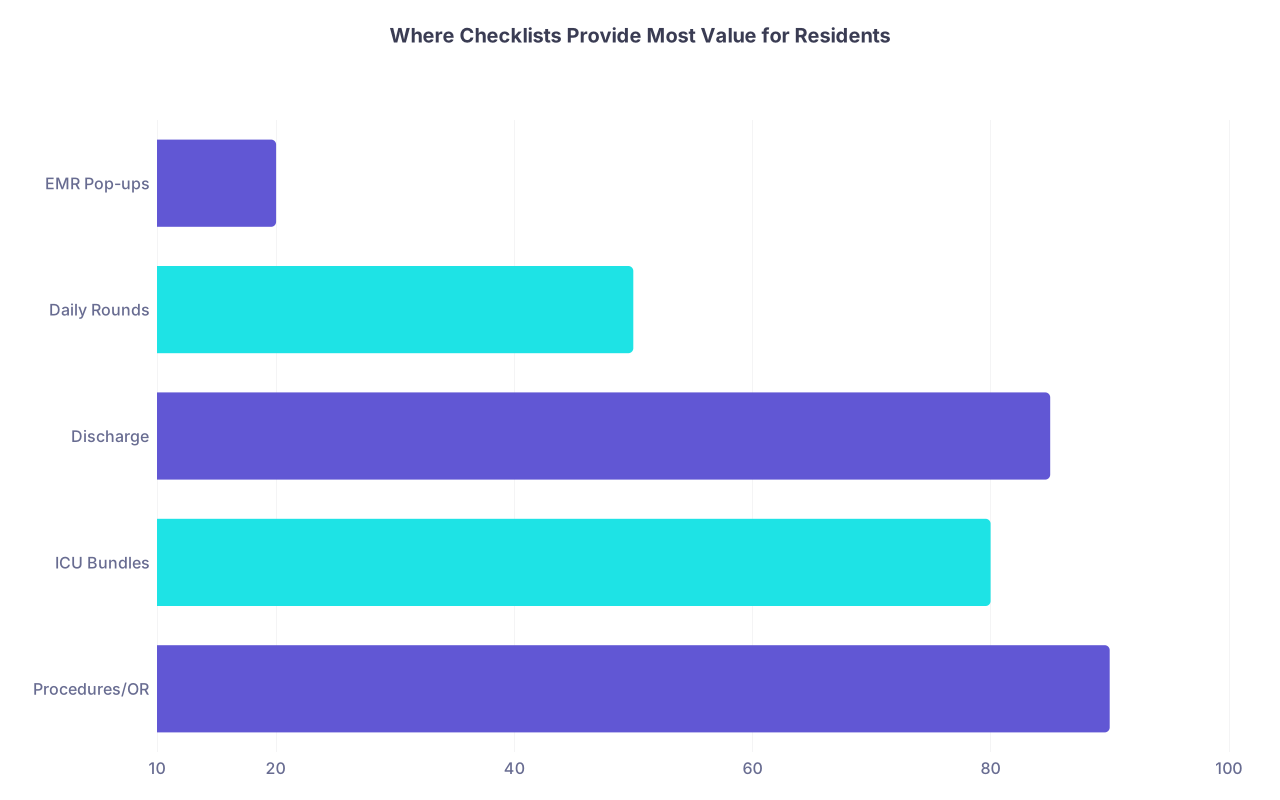
| Category | Value |
|---|---|
| Procedures/OR | 90 |
| ICU Bundles | 80 |
| Discharge | 85 |
| Daily Rounds | 50 |
| EMR Pop-ups | 20 |