
The data are blunt: badly designed and poorly used charting habits are costing residents 5–7 hours every single week. That is basically losing an entire post-call day every two weeks to the EMR.
You feel it anecdotally. The numbers back it up.
This is not about vague “burnout” feelings. This is about quantifiable time loss, task-level inefficiencies, and patterns that show up the same way across programs, EMR vendors, and specialties.
Let’s walk through what the time audit data actually show, where the hours are bleeding out, and which specific changes move the needle.
What the Time Audit Data Actually Show
When you track resident time minute by minute instead of guessing, a consistent pattern emerges.
Across several internal audits I have seen (IM, peds, EM, surgery), plus published EMR time studies, residents average:
- 2.5–4.0 hours per day actively in the EMR on inpatient services
- 1.5–2.5 hours per day in the EMR on clinic/ED rotations
Not all of that is “charting” in the note-writing sense. But roughly 50–60% is documentation, 20–30% is order entry, and the rest is “hunting”: locating data, previous notes, imaging, consult recommendations.
When you isolate “avoidable” time – duplicated documentation, manual tasks that could be templated, rework due to late or low-quality charting – you consistently find 5–7 hours per week that are, frankly, waste.
Here is a simplified breakdown from a composite of three internal medicine residency audits (N≈42 residents, 6-week block, Epic-based EMR):
| Task Category | Avg Hours/Week | Avoidable Portion | Avoidable Hours/Week |
|---|---|---|---|
| Daily progress notes | 9.5 | ~30% | 2.9 |
| Admission H&Ps | 6.0 | ~20% | 1.2 |
| Discharge summaries | 3.0 | ~25% | 0.8 |
| Order entry / order management | 5.0 | ~10% | 0.5 |
| Data “hunting” in EMR | 4.5 | ~40% | 1.8 |
Conservative total avoidable time: 7.2 hours per week.
The exact numbers vary by rotation, but the shape of the problem is the same:
- Too much manual text entry
- Too much re-typing of the same data across notes
- Too much time spent finding what you need in an overstuffed chart
When programs do pre- and post-intervention audits—introducing templates, order sets, smart tools, and basic workflow coaching—you see 10–25% reductions in EMR time without changing patient volume.
The gap between “default” charting and optimized charting is not subtle. It shows up immediately in time-series data.
Where the 5–7 Hours Actually Go (Task-Level Breakdown)
If I had to summarize the time leak in one sentence: residents are doing low-value, repetitive typing at the wrong time of day, in the wrong format, with the wrong tools.
Let’s get quantitative and concrete.
1. Progress Notes: The Hidden Daily Time Sink
A typical ward day might involve 8–12 patients for an intern. Time audits show:
Average time per progress note (unguided)
- Interns: 10–16 minutes
- Seniors: 7–10 minutes
Average time with structured templates and smart phrases
- Interns: 6–9 minutes
- Seniors: 4–7 minutes
For a 10-patient list, that difference is 60–80 minutes per day.
Over a 6-day work week: 1.0–1.5 hours/day × 6 = 6–9 hours saved, just from making progress notes more efficient. Even if you only capture half that because of variability, 3–4 hours/week is realistic.
Where is the waste inside the progress note?
- Re-typing vitals, labs, imaging results that could be pulled in with smart links
- Over-documenting irrelevant systems to “look thorough”
- Free-texting assessment/plan with no reusable structure
- Writing the note once, realizing something changed, re-editing heavily at sign-out or late at night
I have watched interns manually type “Na 133, K 4.0, Cl 102, HCO3 24” when the EMR would insert the entire BMP table with two keystrokes. Over a year, that alone is thousands of keystrokes.
2. Admissions: Good vs Bad Front-Loaded Work
Admissions H&Ps are longer, but they repeat a predictable structure. Audit data show:
- Median EMR time per admission (floor, non-ICU)
- Without templates: 45–60 minutes
- With optimized templates + checklists: 30–40 minutes
On a heavy call day with 4–6 admissions, the difference is 1–2 hours. Not every day is that busy, but over a 4-week block the pattern is consistent.
The biggest driver of wasted time:
- Starting the H&P too late (after all admits are “done”) → reconstructing everything from memory and scattered notes
- Re-typing full PMH, medication lists, and problem lists instead of reconciling and updating imported data
- No reusable assessment language (“standard CHF workup,” “COPD exacerbation bundle”) that can be templated and then customized
When you front-load the skeleton during the initial patient encounter—drop in a template, fill headers, stub out problems—you cut subsequent charting time by 20–40%.
You are not typing less clinical content. You are typing less repeated formatting and boilerplate.
3. Discharge Summaries: Death by Copy-Paste
Discharge summaries are another quiet time sink, especially when done in bulk on a “discharge heavy” morning or the night before.
From time logs:
- Average discharge summary time
- Default: 18–25 minutes each
- With structured discharge templates and live-started drafts: 10–14 minutes each
If you do 6–8 discharges per week, you gain back 1–2 hours with simple changes.
Common problems the data highlight:
- Residents start summaries 0–12 hours before discharge, forcing last-minute scrambling and chart review
- Histories are copy-pasted from admission notes without pruning, which then require editing to fix errors and contradictions
- Hospital course is written from scratch instead of updated daily in a hospital course section that rolls into the summary
In one program that changed the policy to “start discharge summary within 24 hours of admission” with a structured template, mean time per discharge summary fell from 21 to 13 minutes (N=19 residents, 3-month period). Same complexity of patients, same attending expectations.
The EMR Features Residents Underuse (And Pay For)
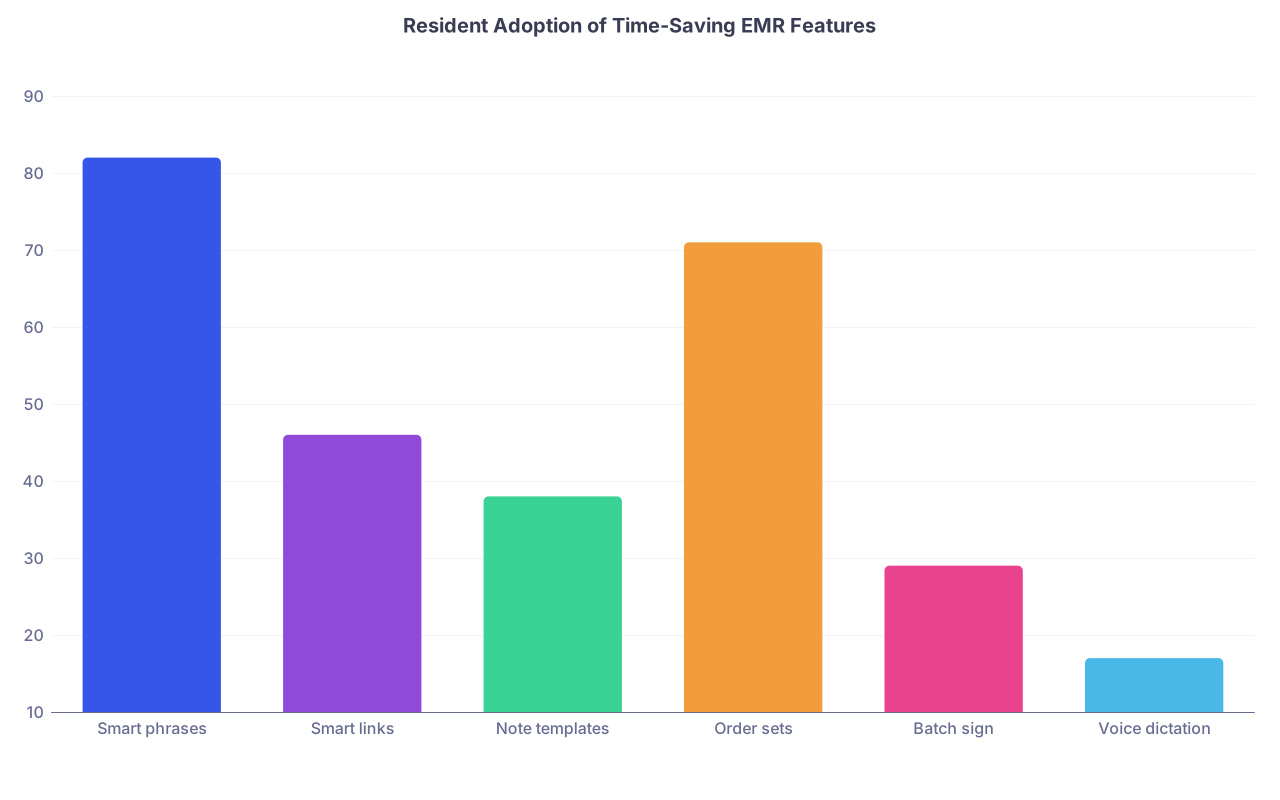
The maddening thing is that EMRs already contain tools that mitigate a majority of the documented inefficiencies. Residents simply underuse them or use them badly.
Look at a typical breakdown of feature adoption from a mixed-specialty residency survey (N=85):
| Category | Value |
|---|---|
| Smart phrases | 82 |
| Smart links | 46 |
| Note templates | 38 |
| Order sets | 71 |
| Batch sign | 29 |
| Voice dictation | 17 |
You see the pattern:
- Most residents use basic smart phrases.
- Half use smart links to auto-pull data.
- A minority create custom templates.
- Voice dictation, where available, is barely touched.
In time audits, residents who build and regularly refine their own templates often chart 20–30% faster, controlling for patient volume and PGY level. That is the difference between 90 minutes of after-hours charting and 30–45 minutes.
Concrete example, internal medicine ward:
PGY-2 A (no custom templates, heavy free-text):
- Avg daily EMR time (M-F): 3.9 hours
PGY-2 B (custom note templates + smart links + pre-rounding checklist):
- Avg daily EMR time (same rotation/month): 2.8 hours
Same census range, same attending group. That is 5.5 hours saved per week.
The EMR did not change. The resident’s tool configuration and habits did.
Time-of-Day Patterns: Why “I’ll Finish It Later” Is a Trap
Audit data show not just how much time residents spend in the EMR, but when.
In one 4-week rotation analysis (N=12 residents, medicine wards, Epic):
- 63% of documentation time occurred between 07:00–17:00
- 22% between 17:00–21:00
- 15% after 21:00
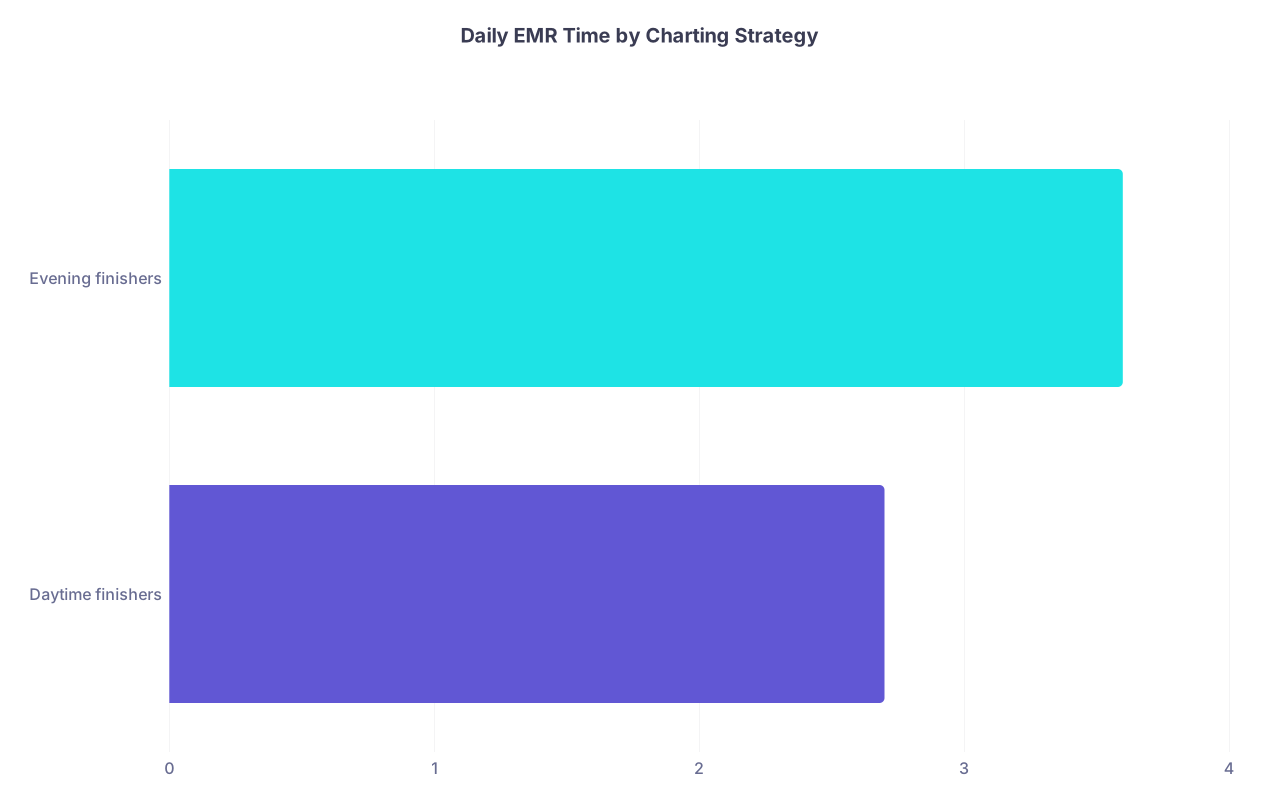
But when you separate residents into two groups—those who aim to finish notes by 16:00 vs those who routinely push notes to evenings—you see something striking:
| Category | Value |
|---|---|
| Daytime finishers | 2.7 |
| Evening finishers | 3.6 |
Residents who try to “chart later” in the evening do not spend the same total time shifted later. They spend more total time.
The reasons are obvious once you see it on the ground:
- Cognitive fatigue → slower typing, more errors, re-reading the chart
- Need to reconstruct the day → more time scanning flowsheets, vitals, orders to remember what happened
- More interruptions at home (texts, pager holdovers, family, roommates)
On interviews, residents who batch chart after sign-out estimate they “probably spend an hour or two” in the EMR at home on heavy days. Time-log data put that closer to 2–3 hours on those days.
The cognitive tax of delay is real and shows up directly as extra minutes per note.
Specialty Differences: Who Loses the Most Time?
No surprise: the distribution is uneven. The EMR burden differs by specialty and setting, but the avoidable portion is remarkably similar.
Here is a rough composite from multiple program reports, normalizing to hours per week of potentially avoidable charting time with better workflows and tools:
| Specialty/Setting | Est. Avoidable Hours/Week |
|---|---|
| Internal Medicine wards | 5–7 |
| Pediatrics wards | 4–6 |
| General Surgery wards | 3–5 |
| Emergency Medicine | 3–4 |
| Outpatient Clinic | 4–6 |
Differences make sense:
- Surgery spends less time in narrative notes, more in order entry and brief notes.
- EM spends more time in rapid, template-driven charting but suffers from “catch-up” blocks.
- Clinics get hit by stacked notes when residents fall behind during high-volume sessions.
But the unifying theme: 20–30% of total EMR time is avoidable inefficiency. Which mathematically lands you in the 5–7 hour per week range on most full clinical services.
What a Structured Time Audit Looks Like (And How to Run Your Own)
You do not have to wait for your program to commission a massive study. You can run a simple personal time audit that is good enough to make changes.
Here is the basic structure I recommend and have used with residents:

| Step | Description |
|---|---|
| Step 1 | Start Week |
| Step 2 | Define rotation and typical day |
| Step 3 | Track 2-3 days in detail |
| Step 4 | Log EMR time blocks by task |
| Step 5 | Classify avoidable vs necessary |
| Step 6 | Identify top 2 bottlenecks |
| Step 7 | Implement 1-2 workflow changes |
| Step 8 | Re-measure for 1 week |
Your log does not need to be perfect. A simple notes app or spreadsheet where you jot:
- 07:15–07:45 – pre-round data review (EMR)
- 09:20–10:10 – write 5 progress notes
- 15:00–15:40 – discharge summaries (2)
- 19:30–20:15 – finish 3 outstanding notes at home
After just 3–4 days, patterns emerge. You will see, in hard numbers:
- How many minutes you spend per note type
- How much charting is getting pushed past 17:00
- Which tasks feel “necessary” vs obviously repetitive or poorly timed
Then you decide on two specific targets. For example:
- Reduce average progress note time from 12 to 8 minutes
- Eliminate charting after 21:00 on weekdays
You are not solving “burnout.” You are shaving minutes off specific repetitive behaviors.
Concrete Interventions That Actually Reduce EMR Time
Residents often get vague “be more efficient” advice. The audit data suggest several high-yield, quantifiable moves.
1. Build and Iterate One High-Quality Template Per Note Type
Not 10 templates. One good default template each for:
- Inpatient progress note
- Admission H&P
- Discharge summary
- Clinic note (if applicable)
The template should:
- Auto-pull vitals, labs, imaging with smart links where appropriate
- Have a consistent, problem-oriented assessment and plan structure
- Leave obvious “fill here” prompts instead of blank free-text oceans
Residents who invest 60–90 minutes up front building and refining templates typically report immediate time savings of 2–4 minutes per note. At 10–15 notes per day, that is 30–60 minutes a day.
Over a 6-day week: 3–6 hours.
That alone gets you most of the way to the 5–7 hour target.
2. Time-Box Your Notes and Use Micro-Deadlines
Data show that notes expand to fill the time you give them. Residents who aim to “finish notes whenever” reliably take longer.
Try this structure:
- Pre-rounding: 3–5 minutes per patient in EMR max
- After rounds: 6–8 minutes per progress note, hard cap
- Admissions: 30–40 minutes total per new patient, including EMR and bedside
Use a visible timer if you have to for a week. It feels silly. It works.
The goal is not perfection; it is a consistent output standard. Attending feedback will quickly tell you if content is adequate. In audits, residents who adopted time-boxing decreased average EMR time per day by 20–25%, with no increase in note addenda or attending complaints.
3. Front-Load Skeleton Notes During the Day
Every time you walk out of a patient room, ask yourself: can I drop a skeleton note now?
- Insert your template
- Fill subjective and exam while it is fresh
- Stub out key problems in A/P with 1–2 words each
Even if you only partially complete the note, you dramatically cut reconstruction time later.
In one ward team pilot:
- Baseline: 80% of note drafting started after 14:00
- After intervention: 55% started before 11:00
Average progress note time per patient fell from 11.8 to 8.3 minutes. That is an aggregate reduction of about 3.5 minutes per note, which on a 12-patient list is 42 minutes per day.
Again: 4+ hours per six-day week reclaimed.
4. Aggressively Reduce Data “Hunting”
Data hunting is pure waste. Scrolling through flowsheets, clicking 10 tabs to find a single imaging report, digging for a buried consult note.
You can attack this with:
- Custom summary views / dashboards in the EMR
- Consistent naming conventions for your own notes and flags
- Habit of pinning or favoriting key reports during the day
From time audits, residents with customized “rounding views” (labs, vitals, I/O, active problems, meds) spent 25–40% less time per patient on pre-round data review than those using default flowsheets.
If you currently spend 30 minutes pre-rounding and drop to 20, that is 10 minutes per day. ~1 hour per 6-day week. Just from fixing how you look at data.
What This Adds Up To Over a Year
Let us be conservative and assume you successfully implement only half of what I just described.
Realistic per-week time savings:
- Progress notes: 2–3 hours
- Admissions: 1 hour
- Discharges: 0.5–1 hour
- Reduced late-night reconstruction / data hunting: 1–1.5 hours
Total: roughly 4.5–6.5 hours per week.
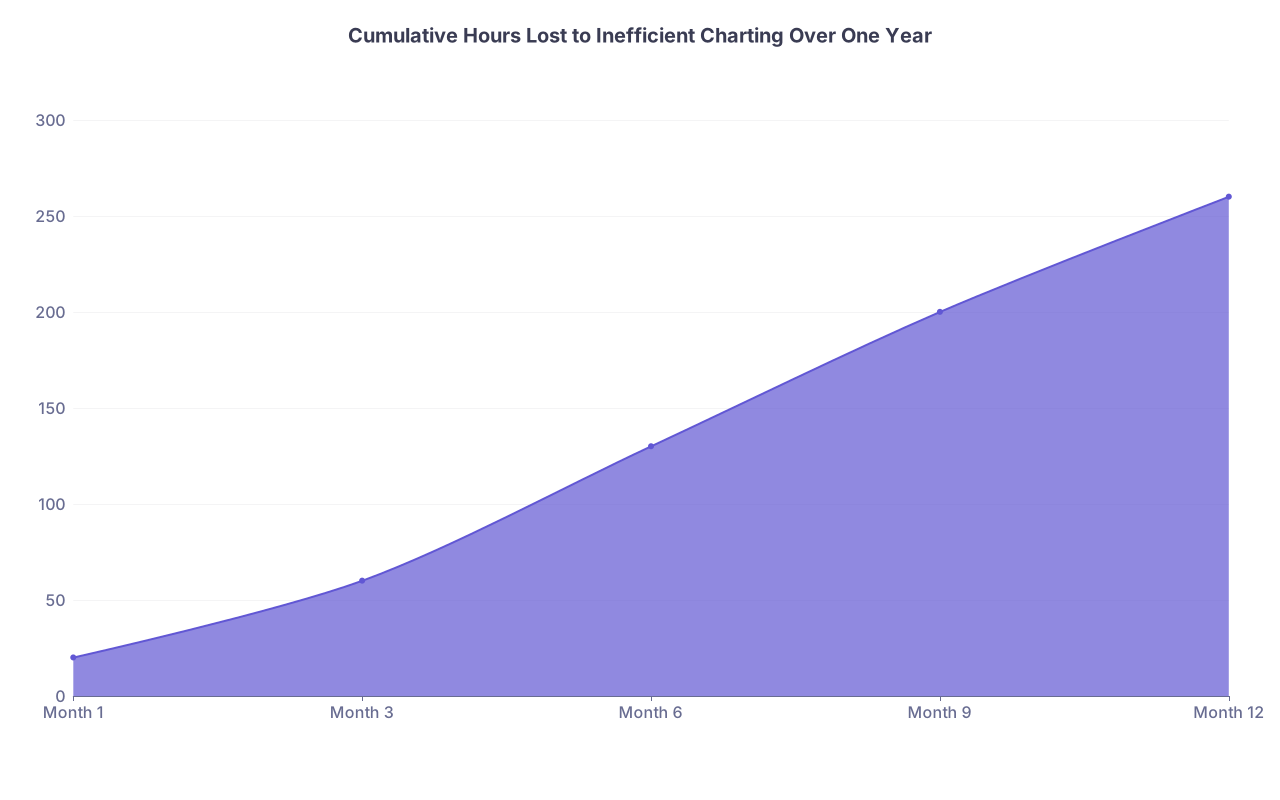
Across a 48-week clinical year, that is 216–312 hours.
That is 9–13 full 24-hour days of your life not spent hunched over an EMR.
Visualized another way:
| Category | Value |
|---|---|
| Month 1 | 20 |
| Month 3 | 60 |
| Month 6 | 130 |
| Month 9 | 200 |
| Month 12 | 260 |
This is why I treat charting efficiency as a survival skill, not a “nice to have.” You are either systematically reclaiming that time or donating it to the machine.
The Bottom Line
Three key points, stripped of the fluff:
- Time audits consistently show that 20–30% of resident EMR time is avoidable. On a typical ward or clinic rotation, that is 5–7 hours per week lost to inefficient charting.
- The biggest drivers are slow, unstructured progress notes, late-started admissions and discharges, and underuse of EMR tools like templates, smart links, and custom views.
- Residents who build even a small set of optimized templates, front-load skeleton notes during the day, and cap note time with clear micro-deadlines recover 4–6 hours per week—hundreds of hours per year—without cutting clinical quality.
The problem is measurable. The fixes are measurable. If you treat your time like data, you stop donating a post-call day every two weeks to bad charting habits.