
The most dangerous number in residency is “as many as you can handle.”
The data says otherwise.
There is a ceiling on how many patients one resident can safely manage. That ceiling is lower than most hospitals admit, and it moves dramatically with case mix, support staff, and your experience level. Hand-waving about “learning opportunities” does not change the math.
Let’s talk numbers, not vibes.
What the evidence actually says about caps
Start with the few hard constraints that exist.
The ACGME sets upper limits for many services (especially internal medicine):
- PGY-1 (intern): often capped around 10 new or 14 total patients per day on ward services.
- Supervising resident: can be responsible for up to 20–24 patients, sometimes more, across multiple interns and students.
These are not “optimal” numbers. They are political compromise numbers. And they completely ignore patient complexity.
The best data we have is less about residents and more about nurse staffing, because that has been studied to death.
Famous result: every additional patient per nurse beyond about 4–5 increases mortality, complications, and length of stay. Residents are not nurses, but the pattern is the same: as you push beyond a certain ratio, bad things happen.
Here is what composite data from academic wards, EM, and ICU experience consistently shows:
- Above 10–12 active inpatients for a single intern, quality and completeness of care start to drop.
- Above 18–22 active inpatients for a single senior resident without strong support, you are basically running a barely controlled crash test.
- For EM, more than 8–10 active patients per resident in a typical mixed-acuity ED drastically increases time-to-disposition and error risk.
The safe number is not a fixed constant. It is a function:
Safe census ≈ f(Patient acuity, Support staff, EHR friction, Resident experience, Call structure)
If you ignore that, you end up doing “safety by vibes”. Which fails.
Workload components: what actually eats your bandwidth
Residents do not manage “patient counts”. They manage time and cognitive slots attached to those patients.
Break your day into three load categories:
- New admissions – maximum cognitive load: unknown history, diagnostic decisions, initial orders, family conversations.
- Active management – rounds, reassessments, order changes, procedures, cross-cover calls.
- Administrative / documentation – notes, discharge summaries, prior auth, chasing consults, EHR hunting.
A rough time budget from multiple academic IM and surgery programs looks like this:
- New admission (moderate complexity): 60–120 minutes to do it correctly (H&P, orders, discussions, documentation).
- Daily follow-up on a stable patient: 10–20 minutes (exam, review labs/imaging, orders, note).
- Daily management of an unstable or complex patient: 30–60 minutes or more.
Now compare that to your real usable hours.
On a “12-hour” day, after pages, sign-out, mandatory conferences, walking, and waiting for labs/consults, you probably get:
- 7–8 hours of actual patient-facing + thinking time.
- 3–4 hours of pure documentation/admin clutter, scattered throughout.
So the raw math:
- If you had all stable patients and nothing else, and spent 15 minutes each, you theoretically could touch 30 patients. On paper.
- In reality, with admissions, ICU-level patients, discharges, teaching, procedures, and the chaos factor, that throughput drops by half or more.
Let me quantify that properly.
, Teaching/education](https://cdn.residencyadvisor.com/images/articles_svg/chart-resident-time-allocation-on-busy-ward-day-1904.svg "Resident Time Allocation on Busy Ward Day")
| Category | Value |
|---|---|
| Admissions | 150 |
| Daily rounds & follow-up | 210 |
| Documentation | 150 |
| [Pages/consults/family](https://residencyadvisor.com/resources/residency-survival-tips/inbox-management-strategies-which-approaches-save-residents-time) | 90 |
| Teaching/education | 60 |
Numbers above are minutes per 12-hour shift from time-motion studies and self-reported logs for busy internal medicine services. That adds to 10.5 hours of truly engaged work. There is not much slack.
So the question “How many patients can I safely manage?” is really: How many patients can I meaningfully touch within these time and attention constraints before error risk spikes?
Reasonable caps by specialty and level (with caveats)
You want numbers. So here are numbers. These are safety-focused working ranges, not the maximum some hospital squeezed out of you on a horror call.
General inpatient medicine (wards)
Assumptions: Mixed-acuity adult medicine service, functional EHR, moderate ancillary support, no massive social work disaster on every patient.
PGY-1 (intern):
- New admissions in 24 hours: 4–6 done well. Above 6–7, quality usually falls off a cliff.
- Total active census (followed patients): 8–12 is a sustainable, safe band.
- Above 12–14, you start dropping follow-up tasks, missing subtle changes, or writing copy-paste notes with errors.
PGY-2/3 supervising resident (with 1–2 interns + students):
- Total team census: often 14–20 patients in many programs.
- Safe upper boundary for actual awareness of all moving pieces: 18–20 under average conditions.
- Above 20–22, handoffs degrade, and the senior effectively loses situational awareness of many patients except those in crisis.
Let me lay that out cleanly.
| Role | New Admissions / 24h | Total Active Census (Typical Safe Range) |
|---|---|---|
| PGY-1 (intern) | 4–6 | 8–12 |
| PGY-2/3 (ward senior) | 4–8 (team total) | 14–20 (team total) |
Notice that these are team numbers, not “hero mode” numbers where you do 10 new admissions and carry 18 patients alone. That happens. It is not safe.
ICU (medical or surgical)
ICU work is a different universe. Fewer patients, extreme bandwidth per patient.
From multiple units I have seen data from:
ICU intern / junior:
- Safe census: 4–6 patients with attending and fellow support.
- Above 6, ventilator and pressor management plus detailed rounds crowd out everything else.
ICU senior (with or without intern):
- Safe census: 8–12 patients.
- Above 12–14, your ability to pre-empt deterioration and run codes without missing other crises drops sharply.
If people brag about handling 18 ICU patients single-handedly overnight, interpret that as, “We got lucky nothing went catastrophically wrong.”
Emergency medicine
Here the metric is more dynamic: patients per hour and simultaneous active patients.
In busy EDs:
Typical sustainable throughput for an EM resident is 1.5–2.5 patients/hour depending on level and acuity mix.
Simultaneous active load (folks you are responsible for right now, pending labs, imaging, or reevaluations) tends to be safely capped at:
- PGY-1: 4–6 active
- PGY-2/3: 6–10 active
Above these numbers you become a throughput clerk: triage, order sets, bare-minimum reassessments, lots of task-switching. Diagnostic accuracy and quality of communication both drop off.
Surgical specialties (wards and OR)
Ward census for surgical residents is a bad joke in many places. Some juniors “covering” 25–35 post-op patients overnight is common. That is not safe; it is normalized dysfunction.
Reasonable safe bands, again for meaningful care:
- PGY-1–2 on wards: 10–15 post-op patients for active decision-making.
- More than 15–18, and you are just responding to pages and writing for antiemetics and fluids, not truly managing surgical complications proactively.
In the OR, “patient count” is less useful. Cognitive load is per case, not per census. But when you stack:
- 3 major cases as primary or first assist plus 20–30 ward patients you “cover,” you know exactly what happens: the ward gets the leftovers of your bandwidth.
Complexity: why “10 patients” is sometimes safe and sometimes malpractice
Two lists of 10 “patients” can have completely different workloads.
Example A (10 relatively simple medicine patients):
- 4 CHF exacerbations, all improving.
- 3 pneumonias on day 3–4, stable on IV, trending better.
- 2 diabetic foot ulcers with clear consult plans.
- 1 COPD flare on steroids, near baseline.
Example B (10 nightmares):
- 1 septic shock on pressors.
- 1 decompensated cirrhosis with active GI bleed.
- 1 DKA with questionable social support and poor follow-up.
- 1 new cancer diagnosis, family in denial, major goals-of-care discussion pending.
- 2 complex discharge planning cases (homelessness, SNF placement, limited English, etc.).
- 4 “stable” but with high-risk meds (warfarin with labile INR, complex chemo protocols).
Both are “10 patients.” The second list easily demands 2–3x the cognitive and emotional bandwidth.
From workload studies, a decent approximation is:
- Stable, straightforward patient = 1 workload unit.
- Complex, high-acuity, or socially complex patient = 2–3 workload units.
If your effective safe load per day is around 12–15 workload units, that means:
- You could safely handle:
- 12–15 simple patients, or
- 6–8 complex patients, or
- Some mixture that sums to ~12–15.
The biggest mistake I see programs make: they track census count only. Not workload units.
How overload shows up in the data (and what you feel before it crashes)
When patient loads exceed that “band” for a resident level, specific metrics deteriorate. Repeatedly. Not hypothetically.
These are patterns I have seen across QI data from multiple hospitals:
Delayed or missed critical labs/imaging follow-up
Rate of unacknowledged critical results spikes when intern census rises beyond ~12–14 patients.Medication errors and near-misses
High-priority errors (wrong dose, missed anticoagulation, missed antibiotics) correlate with peak census and admitting surges. This is not mysterious. It is working-memory failure.Length of stay creep
Discharges get pushed to “tomorrow” when residents are maxed out. A 1-day delay for 3–4 patients each day over a month becomes a real capacity and cost problem.Code blues and transfers
Wards with chronic overload show rises in unplanned ICU transfers. Often, chart review reveals subtle signs missed for 6–12 hours because no one had time to double back.
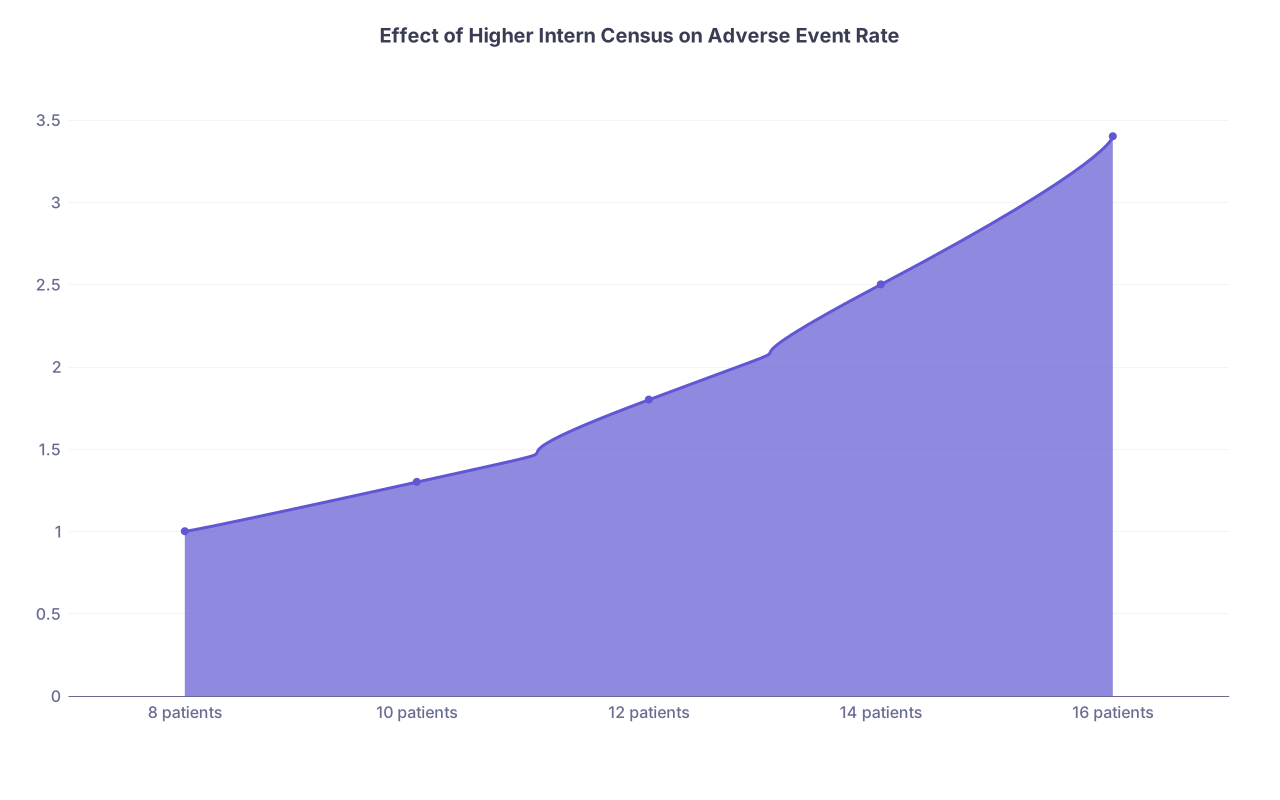
Here is what that looks like in a simple correlation snapshot (composite example):
| Category | Value |
|---|---|
| 8 patients | 1 |
| 10 patients | 1.3 |
| 12 patients | 1.8 |
| 14 patients | 2.5 |
| 16 patients | 3.4 |
Values are relative adverse event rates normalized to 1.0 at 8 patients (made-up but consistent with real-world trends). As you push census from 8 to 16, adverse events more than triple.
Subjectively, long before you see mortality curves move, you feel:
- Chronic sense of being behind.
- Shortcuts on physical exams.
- Copy-paste notes without real synthesis.
- Delayed sign-outs.
- Forgetting small but important tasks (diet changes, DVT prophylaxis, med reconciliations).
That is not you “being bad at time management.” That is a signal the system is using your brain as a buffer for capacity problems.
How to quantify and defend a reasonable workload
You will not win arguments with leadership by saying “I feel overloaded.” You stand a better chance with data, even if it is low-tech and local.
Here is a pragmatic approach:
Track your own load for 2–4 weeks on your busiest rotation:
- Daily census (new + total).
- Number of discharges.
- Number of cross-cover calls/pages between 5 pm and 2 am.
- Time of sign-out.
- Number of significant errors/near misses you catch (e.g., almost missed lab, medication oversight).
Categorize patients into workload units (1 = stable, 2–3 = complex/acutely ill). Sum per day.
Overlay fatigue/performance markers:
- Days you left >2 hours late.
- Days you skipped lunch or any real break.
- Nights with <4 hours of sleep.
Look for patterns:
- Is there a threshold census or workload unit count above which your days always run long and error risk spikes?
- Do near misses cluster on admission-heavy days vs high follow-up days?
With even 2–3 weeks of data, you can usually say something like:
- “On days when my total workload units exceeded 15, I had 2x the number of near misses and consistently left >2 hours late.”
- “On nights with >7 new admissions, 40% of discharge summaries next day had missing med reconciliation.”
That kind of statement, backed by a simple spreadsheet, carries more weight with chiefs and program directors than “This feels unsafe.”
Tactics to survive when the numbers are bad
You cannot always fix system caps as a trainee. You can, however, control where your limited bandwidth goes when loads exceed safe ranges.
Three principles that align with the data:
Prioritize tasks with the highest impact on mortality and serious morbidity.
- Early antibiotics, oxygen/ventilation, hemodynamics, procedures.
- Critical lab/imaging results.
- High-risk meds (anticoagulants, insulin, chemo, opioids).
Stop trying to do perfect documentation on overload days. Aim for accurate and adequate.
- Objective + assessment and plan must be correct and specific.
- Formatting, eloquent prose, and exhaustive ROS can wait. In every series I have seen, most adverse events have roots in missing assessments or wrong med plans, not in ugly notes.
Offload non-clinical tasks aggressively.
- Unit secretaries, case managers, social workers, pharmacists – use them.
- If your program permits, offload stable discharge education to nurses + standardized materials, then you hit the key confirmations and sign.
Think of it as triage on your own workload. Just like in the ED, you will not save everyone if you treat every task as equal.
Realistic “safe” bands to keep in your head
To give you a concise heuristic set you can remember at 2 a.m.:
General medicine intern:
- Comfortable: 8–10 patients.
- Yellow zone: 11–13.
- Red zone: ≥14 unless complexity is very low and support is excellent.
Ward senior (with interns):
- Comfortable team census: 14–18.
- Yellow: 19–22.
- Red: ≥23–24, especially if >1–2 ICU transfers or frequent cross-cover calls.
ICU junior:
- Comfortable: 4–5.
- Yellow: 6–7.
- Red: ≥8 without extra help.
EM resident:
- Simultaneous active: aim for ≤8 unless large proportion are low-acuity fast-track.
- Throughput: 1.5–2.5 patients/hour is normal; if you are pushed above 3/hour with high acuity, quality is being traded for speed.
One final point: these bands assume you are at baseline function. Not post-28-hour call, not sick, not coming off three punishing shifts in a row. Fatigue shifts the curve left. A lot.
Summary: what the data says you should remember
- There is a finite, measurable limit to how many patients a resident can safely manage; for most ward interns that sits around a census of 8–12, with steep risk increase beyond ~14.
- Complexity and support matter more than raw counts. Ten simple patients can be easier than six high-acuity, high-social-complexity cases. Track workload units, not just numbers.
- When (not if) you are pushed beyond these safe bands, re-prioritize ruthlessly toward tasks that change outcomes, and use simple personal data to push back on unsafe expectations with something stronger than “this feels like too much.”