The line “I work best under pressure” is a lie residents tell themselves so they can survive an impossible system.
The Myth: Pressure Makes You Perform
You hear it in intern orientation, on interview days, at 2 a.m. in the call room:
“I actually work better when it’s busy.”
“I need the adrenaline to focus.”
“If I’m not under the gun, I procrastinate.”
Let me be blunt. Residency already supplies more “pressure” than your brain was designed to handle. Layering a personal productivity myth on top of that does not turn you into some peak-performance machine. It just camouflages burnout, poor planning, and a nervous system stuck in fight-or-flight.
And the data backs this up.
The relationship between stress and performance is not linear. It’s an inverted U-curve (Yerkes–Dodson law). Too little arousal: you’re bored, distracted, unfocused. Moderate, predictable challenge: you perform well. Too much, sustained, uncontrollable stress: performance and learning fall off a cliff.
Residency, for most people, lives on the right side of that curve. You are not “working best” there. You’re surviving.
Let’s dissect what is actually going on when you “work best under pressure.”
What Pressure Actually Does To Your Brain
You already know the physical symptoms: racing heart, clenched jaw, shallow breathing, that wired-but-exhausted feeling at 4 a.m. That’s your sympathetic nervous system and HPA axis in overdrive.
Cognitively, here’s what high, chronic pressure does:
- Shrinks your working memory bandwidth
- Increases reliance on habits and shortcuts
- Impairs complex decision-making and flexible thinking
- Narrows your attention (good for “don’t die in this moment,” bad for nuanced diagnostic reasoning)
Under severe time pressure, your brain switches from “slow, analytic mode” to “fast, heuristic mode.” In trauma bay resuscitation or a code, that’s adaptive. You’re drawing on rehearsed algorithms: ACLS, ATLS, stroke codes. Those are made for speed and pattern recognition.
But the rest of residency is not one prolonged code. It’s:
- nuanced medication adjustments
- subtle diagnostic differentials
- weighing risk vs benefit of discharge vs admission
- anticipatory planning for overnight events
Those tasks require working memory, synthesis, and reflection. Exactly what chronic pressure erodes.
So when you feel like you “come alive” only when something is due in 30 minutes or when you’re triple-boarded and drowning in pages, what’s actually happening is simpler: distraction falls away because you have no choice. Not because your brain objectively performs better that way.
The Three Real Phenomena Behind “I Work Best Under Pressure”
People who swear they work best under pressure usually fall into some combination of these three buckets.
1. The Procrastination-Driven Adrenaline Addict
This is the resident who waits until the last day to do their ITE review, QI project write-up, or fellowship personal statement, then cranks out an impressive product. They walk away thinking, “See? I needed the pressure.”
What really happened:
- The looming deadline finally overwhelmed their avoidance.
- Adrenaline temporarily boosted focus and suppressed distraction.
- They judged the process by the outcome (finished product) rather than the cost (sleep, anxiety, other dropped responsibilities).
There’s research on this. Chronic procrastinators don’t perform better under pressure. They just compress the same amount of work into a smaller, more painful window, with higher stress and often worse quality. But medicine rewards outcomes, not processes, so the illusion survives.
2. The High-Tolerance, Low-Insight Workhorse
These are the “iron interns” everyone quietly admires. They can carry huge lists, stay late, absorb extra cross-cover, and still be functional the next day. They’ll swear they “thrive when it’s crazy.”
Here’s the problem: the early phase of burnout often masquerades as hyper-productivity. You detach from emotions, suppress normal human limits, and lean into the identity of the reliable workhorse. It feels like “performing under pressure.” It’s actually numbing.
You see this when:
- They start missing small but important details (non-critical labs, subtle imaging findings).
- Their documentation quality erodes.
- They need increasingly intense stimulation (more coffee, more chaos) to feel “on.”
It’s not peak performance. It’s a high-functioning stress response.
3. The Under-Challenged in Non-Acute Settings
There’s a minority for whom this myth has a kernel of truth—but in a very narrow situation.
For certain personalities, low-acuity, slow-paced settings feel numbing. They become inattentive, bored, and sloppy. Then you put them in a brisk ED shift or busy ICU, and they look sharper. Of course they say, “I work best under pressure.”
What’s actually true:
- They work poorly in boredom and moderately well in moderate-to-high, time-limited pressure.
- They still crash under unrelenting, uncontrolled stress. Same human physiology.
So yes, some people do better when under-stimulated vs appropriately challenged. That’s not “I work best under pressure.” That’s “I do poorly when I’m bored.”
What The Data From Medicine Actually Shows
You want evidence. Fair.
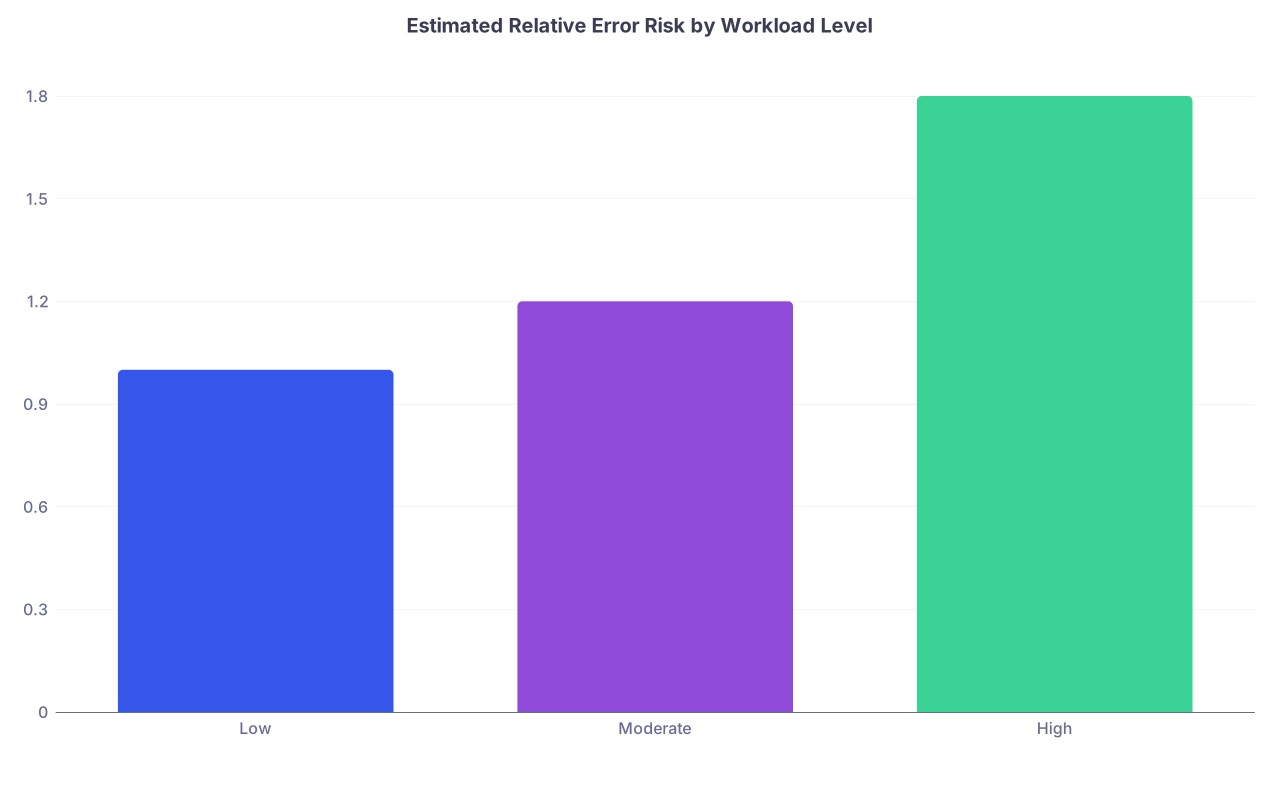
Error Rates vs Workload
When attendings and residents are under high workload and time pressure, error rates and near misses go up. This isn’t controversial; it shows up across ICU, ED, internal medicine, anesthesia.
| Category | Value |
|---|---|
| Low | 1 |
| Moderate | 1.2 |
| High | 1.8 |
Roughly: compared to low workload, moderate increases error risk a bit, high bumps it a lot. You might feel “in the zone” when everything’s on fire, but the system data (falls, med errors, delayed diagnoses) is not impressed.
Cognitive Performance Under Fatigue and Stress
Sleep restriction alone (which you have, guaranteed) impairs:
- psychomotor vigilance
- working memory
- executive function
- mood regulation
Layer time pressure on top and your performance declines further. People feel like they’re adapting. Objectively, they are slower, less accurate, and more rigid in thinking.
Burnout, Not Bravery
Programs with higher perceived time pressure and “work until it’s done” cultures have:
- higher burnout scores
- more depression and suicidal ideation
- more self-reported unprofessional behavior (cutting corners, ignoring safety checks)
That macho “I’m best when I’m slammed” mindset isn’t just wrong—it’s correlated with worse outcomes for both you and your patients.
How This Myth Quietly Hurts Residents
The “I work best under pressure” story isn’t just inaccurate. It’s harmful in specific ways.
It normalizes dangerous workloads.
If everyone “works best under pressure,” then overload looks like a feature, not a bug. Leadership can label understaffing as “good clinical exposure.”It hides planning and systems failures.
Last-minute chaos from poor discharge coordination, bad communication, or sloppy sign-out gets reframed as “great learning under pressure.”It shames residents who do not function in chaos.
The quieter, methodical residents—who actually make fewer errors when given reasonable time—start feeling “weak” or “slow,” even though they’re practicing safer medicine.It blocks you from fixing your own workflow.
If you believe pressure is your superpower, you have no reason to learn better planning, batching, and cognitive offloading. You just keep chugging caffeine and waiting for the adrenaline to kick in.
What Actually Helps You Perform In Residency
Let’s talk survival tactics that are evidence-aligned, not Instagram-inspirational.
1. Aim For Stable, Moderate Cognitive Load
You’re not going to get “low pressure” in residency. But you can keep yourself closer to the optimal middle.
This looks like:
- Front-loading decisions on call nights before you get buried with pages.
- Proactively clarifying unclear plans on rounds instead of “figuring it out later” at 1 a.m.
- Doing short, frequent micro-reviews of complex patients so nothing festers until crisis time.
The best residents I’ve watched weren’t heroes in codes. They were the ones whose patients needed fewer codes because problems were anticipated.
2. Use Pressure as a Signal, Not a Fuel Source
Feeling that “pressure high”? Use it as a warning sign:
- “I’m starting to skip steps.” → Time to slow down and use a checklist.
- “I’m feeling wired, not focused.” → Quick reset: 3 deep breaths, stand, walk to printer and back, regain perspective.
- “Everything feels urgent.” → Force-rank tasks, ask senior for triage help.

Treat pressure like pain. Useful as information, harmful as constant fuel.
3. Schedule Boredom For Deep Work
If you only ever do important tasks at the last possible moment, you’ll keep believing you “need” pressure.
You can break that.
Pick one thing per week that you usually procrastinate on—maybe board review or a research project. Schedule a 30–45 minute block during a non-insane day. No adrenaline, no looming crisis. Just deliberate focus.
First few times, it will feel awful. Your brain will scream that you’re “wasting time.” Do it anyway. You’re teaching your nervous system that it doesn’t need a cortisol bomb to do cognitively demanding work.
Over a few weeks, you’ll notice something: the quality of your thinking in those low-pressure sessions is better. More creative, more nuanced. That’s real “best.”
4. Offload Your Brain—Aggressively
Under pressure, working memory is the first thing to go. So stop relying on it.
Concrete tactics I’ve seen work for residents:
- A single notepad page per shift for running task lists, constantly re-prioritized.
- Standard phrases/macros for common documentation chunks, so you’re not reinventing the wheel at 2 a.m.
- Micro-checklists for high-risk tasks: paracentesis, LP, high-risk discharges. Not full textbooks—just the 5–7 steps you can’t afford to skip when stressed.
| Task Type | Micro-Checklist Item Count |
|---|---|
| Paracentesis | 6 |
| High-risk Discharge | 7 |
| New ICU Admission | 8 |
| Overnight Cross-cover Sign-out | 5 |
Those little scaffolds protect you when pressure makes you stupid. Which it does. Which it will.
5. Redefine “Good Under Pressure”
Being good under pressure in residency shouldn’t mean:
- You take more work than is safe.
- You never say no.
- You brag about staying late or skipping breaks.
It should mean:
- You maintain basic systems (checklists, communication) even when slammed.
- You recognize when your performance is slipping and ask for backup.
- You protect future-you by not turning every problem into a last-minute crisis.
The best senior I ever watched on nights did something that looked almost lazy. At 7 p.m. sign-out, instead of sprinting to see the sickest patient first, he quietly:
- Sorted the to-do list by true urgency.
- Called the nurse on the second sickest patient and clarified thresholds for escalation.
- Pre-ordered a 2 a.m. lab on a borderline patient so we could avoid a 4 a.m. disaster.
Residents thought he was too “chill.” His patients had fewer emergencies. That’s what “good under pressure” really is: doing the unsexy, preventive work that keeps pressure at manageable levels.
A More Honest Script
You do not have to walk around saying, “I work best under pressure.” You can be more accurate—and more powerful.
Try:
- “I can function under pressure, but I do my best thinking when I’m not constantly in crisis mode.”
- “I handle acute situations well, but I do my safest work with a bit of time and space.”
- “I’m learning how to prevent avoidable last-minute chaos instead of feeding off it.”
Those mindsets leave room for growth. And for institutional accountability. Because no amount of time management jiu jitsu compensates for chronically unsafe staffing or toxic expectations.