
What do you actually think when you see that senior who “remembers every lab, every med, every consult” and walks around with empty hands like some kind of diagnostic demigod? Be honest: a mix of awe, jealousy, and quiet panic that you’re not built for this.
Let me blow that up for you.
That “superhuman resident who never writes anything down” is mostly myth, partly performance, and occasionally a setup for serious error. And no, you do not become a better doctor by trying to copy it.
Where This Myth Comes From (And Why It’s Toxic)
Every hospital has a version of this legend.
The PGY‑3 on nights who “knows every patient on three floors from memory.”
The ICU fellow who “can round on 18 patients without a list.”
The surgical chief who “never looks at the chart and still knows every lab trend.”
Sounds impressive. Until you actually watch what’s happening.
Here’s what’s really going on most of the time:
They are writing things down — just not where you see it.
Tiny folded lists in the pocket. Scut sheets. Stickers on the badge. Post-it notes on the computer. Or they quickly scribble during prerounds, then transfer to the note and rely on that.They’re working off pattern recognition, not perfect recall.
“DKA in 4B, GI bleeder in 5C, COPD'er in 6A.” They remember problems and patterns, not actual numbers. That’s fine, until subtle but important changes get missed because they “basically know the story.”They’ve compressed the information. Hard.
They’re not tracking all meds, all labs, all events. They remember “pressors up,” “Cr slowly climbing,” “on 6L and stable.” That’s not memory superpowers. That’s chunking and brutal simplification.Some of them are faking it.
I’ve watched seniors ask, “Remind me, what was his creatinine yesterday?” in a tone that sounds like teaching but is actually “I have no clue and did not write it down.” You will too, once you see the trick.
And here’s the ugly core: the culture quietly celebrates the appearance of effortless mental mastery. Not safety. Not redundancy. Not systems that make it hard to screw up. Just looking like you can keep it all in your head.
Which is stupid, because the data on human memory under fatigue and stress is not subtle.
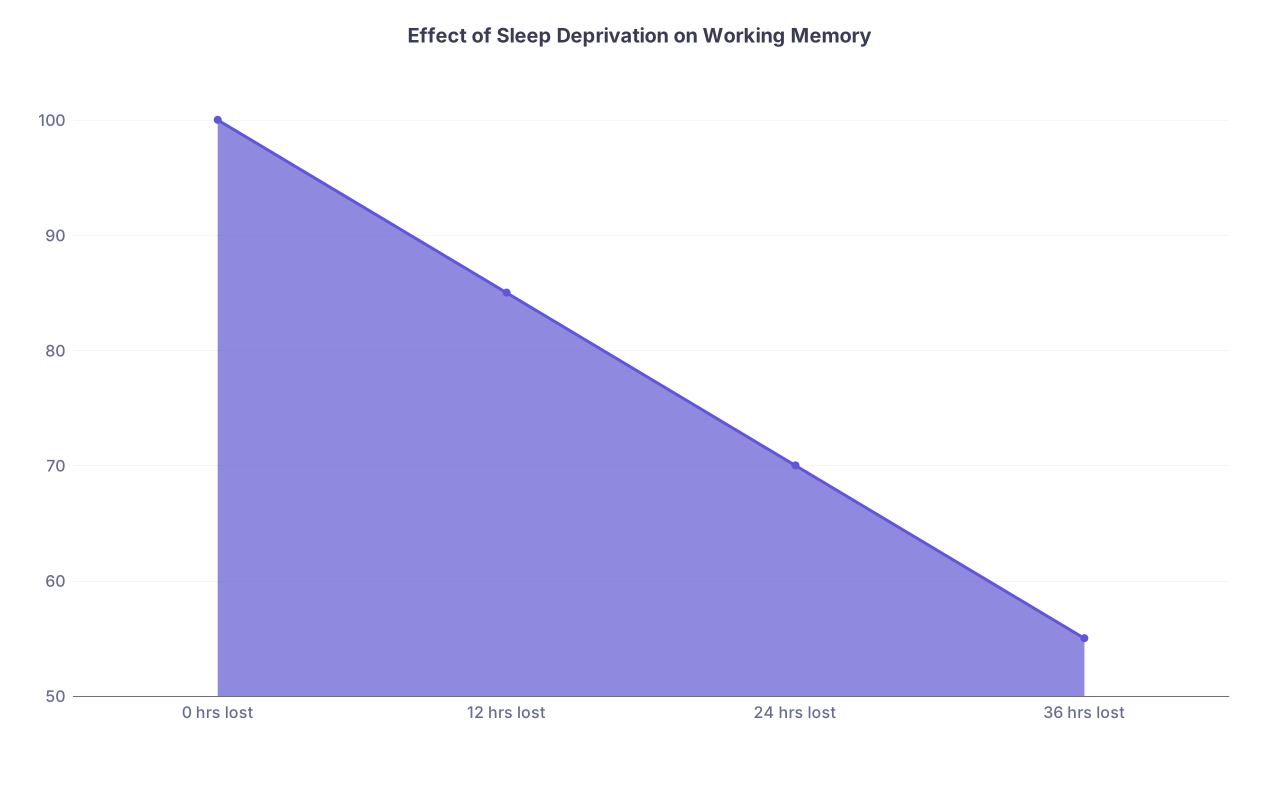
| Category | Value |
|---|---|
| 0 hrs lost | 100 |
| 12 hrs lost | 85 |
| 24 hrs lost | 70 |
| 36 hrs lost | 55 |
Those numbers are representative of what multiple cognitive studies show: working memory and executive function tank as sleep debt and continuous wakefulness climb. Residency is built on both.
And yet we act like refusing to write things down is a flex instead of a liability.
What the Science Actually Says About Your Brain on Call
Let’s cut through the macho nonsense and look at how your brain actually works in residency conditions.
Three key pieces:
Working memory is tiny.
Classic number is 7±2 items, but more recent research suggests it’s more like 4 meaningful chunks under real-world conditions. Each “item” is not a lab value. It’s one chunk of information.“Septic shock patient on norepi + rising lactate” = one chunk.
“AKI on CKD, Cr 2.1 from 1.3” = one chunk.You’re not juggling an entire sign-out in your head. You’re juggling a handful of chunks before things fall off the back of the mental conveyor belt.
Attention is fragile under stress and fatigue.
Sleep deprivation, night shifts, and high cognitive load all crush accuracy. Error rates in simulated medical tasks climb dramatically after 16–24 hours awake. This is not a moral failing. It’s biology.Externalizing information reduces error. Dramatically.
Aviation, nuclear power, and high-reliability organizations figured this out decades ago: checklists, written prompts, and structured notes are not for amateurs. They’re for experts who understand that memory fails.
Healthcare is just late to the party and still clings to the idea that “a good resident just knows.”
Spoiler: good residents build systems that do not depend on them being at 100% every hour of every call. Because you won’t be.
The Real Residents Who Actually Mess Up By “Remembering”
Let’s move from theory to the floor.
Here are real, composite scenarios I’ve seen variations of more times than I like:
Case 1: The Missed Creatinine
Senior is “off-list” — no paper, no folded note, just vibes. Long call, 18 patients.
Nephro consult comes in the next morning:
“Why did no one notice this guy’s creatinine doubled from 1.1 to 2.3 over the last 36 hours while on vancomycin and an ACE inhibitor?”
Because in that senior’s head, the patient was filed as: “pneumonia, stable, on vanc/zosyn.” That was the chunk. No external reminder that “this is the guy whose Cr you said you’d trend because he’s a little dry and on nephrotoxins.”
If it’s not on your list, it depends on your memory. At 3 a.m., your memory is garbage.
Case 2: The Double-Dosed Anticoagulant
Cross-cover night. Multiple admits. Pages every three minutes.
Nurse calls: “Cardiology wants the patient on heparin. Can you put in the order?”
Resident thinks, “Right, the NSTEMI guy,” and slaps in a heparin infusion.
No list. No cross-check. No visual cue that “this guy was switched from DOAC to heparin” was already done by days and the EMR’s MAR view is confusing by default. Twelve hours later: supratherapeutic PTT, drop in hemoglobin, CT for possible bleed.
Not because the resident was dumb. Because they trusted their brain over a simple written system.
Case 3: The ICU That “Knows Every Patient”
I once watched a fellow who prided himself on “never needing paper” run rounds on 14 vented patients. Gorgeous speeches. Knew every vent setting, every pressor dose, every last ABG.
Then someone asked: “Wait, patient in Bed 7 — are we still checking CKs daily on the high-dose statin with rhabdo last week, or did we stop?”
Blank look. Quick chart dive. No CK for 3 days. New AKI that everyone had been blaming on sepsis.
Because the big sexy data — pressors, FiO2, lactates — lived in his head. The quiet follow-ups that were planned 3 days ago and not affecting today’s drama? Completely untracked.
This is exactly what the cognitive psychology literature predicts: salience bias and recency dominate recall. You remember the loud, the recent, the dramatic. You forget the planned-but-not-yet-urgent.
Writing things down isn’t weakness. It’s a correction for predictable human bias.
What Actually Works: External Brains for Residents
Here’s the part no one will glamorize on rounds: the residents who make the fewest dumb mistakes almost always have some kind of external brain.
Not fancy. Not beautiful. But consistent.

I’m talking about:
- The folded sign-out sheet with a tiny “To Do / Follow Up” column.
- The back of the progress note where you scribble a 3-bullet micro-plan before you ever open the orders tab.
- A quick digital note or checklist you keep open all shift if your EMR isn’t total trash.
The exact format matters less than two features:
It’s fast.
Anything that takes more than a couple seconds per patient during prerounds won’t survive a real call night.It’s findable.
If your “system” is 50 sticky notes in four pockets and three random text drafts on your phone, that’s not an external brain. That’s confetti.
The Minimum Viable System
If you want something concrete, here’s as close to universal as it gets: a list with one column that forces you to externalize what your brain will otherwise “try to remember.”
Call it “F/U” or “Next” — does not matter.
For each patient, you jot 1–3 words that answer: “What is the next thing future-me must not forget about this patient?”
“Trend Cr”
“Stop vanc if MRSA neg”
“D/C Foley if voiding trial ok”
“Check K after diuresis”
That’s it. Not full plans. Just landmines you’re planting for yourself so you don’t step on them at 2 a.m.
And yes, you still use the EMR for labs, meds, imaging. But the EMR is a library, not a memory. Your list is the index that tells you what to look for.
Why Writing Things Down Doesn’t Make You Slower
The other myth under this myth: “I don’t have time to write things down. It slows me down.”
This sounds true. It is usually wrong.
Short version: writing the right things down is a time multiplier, not a time sink.
Here’s a simple comparison. Think of one patient on call over 12 hours.
| Approach | Extra seconds early | Time lost later to fixing or rechecking | Error risk |
|---|---|---|---|
| Pure memory | 0–5 sec | 5–20 min (re-reads, re-asking, mistakes) | High |
| Short written cue | 10–20 sec | 1–5 min (fast re-orientation) | Lower |
You burn 10 seconds writing “recheck K” once.
Or you burn 10 minutes three hours later scrolling through labs, trying to remember if you actually ordered the repeat.
Scale that to 12 patients. Or 18. The math gets ugly fast for the “I keep it in my head” crowd.

| Step | Description |
|---|---|
| Step 1 | Start of Shift |
| Step 2 | Lower cognitive load |
| Step 3 | High cognitive load |
| Step 4 | More capacity for decisions |
| Step 5 | More rechecking and confusion |
| Step 6 | Higher error risk |
| Step 7 | Lower error risk |
| Step 8 | Use external notes? |
One more thing: EMRs are designed for billing, not cognition. They’re cluttered. Information is scattered across 10 tabs. Pretending you “remember everything” is often just you being too tired or proud to admit the system is working against your brain and you need a simple overlay on top of it.
How To Use Writing Without Becoming a Scribe
Let me be clear: I’m not telling you to walk around with a 6-page binder like a paranoid intern, rewriting the chart on loose paper.
There’s a point where “writing things down” turns into compulsive documentation that just creates new failure points.
So here’s the line I’d draw, based on watching residents who are consistently solid rather than spectacularly performing:
Write down:
Pending tasks with time sensitivity.
“Reassess pain at 22:00,” “Redraw CBC at 16:00,” “Recheck POC glucose.”Short-term follow-ups on new decisions.
“Started diuresis -> check BMP in am,” “New med -> recheck BP in 2h.”Important deltas from baseline.
Yesterday: sat 95% on 2L. Today: 90% on 4L. That belongs on your radar, not the ether.
Do not waste time writing down:
- Static data you can pull in 3 seconds from EMR (DOB, room number, med list).
- Story details that matter for learning but not for today’s safety (“played football in college, likes jazz”).
- Full narrative plans that duplicate your note.
Your external brain is not a legal document. It is a working scratchpad for the shift. It exists to protect you from predictable failure modes: fatigue, interruptions, cognitive overload, and plain old human forgetfulness.

Dealing With the Culture: When Seniors Flex Their Memory
You’ll encounter seniors who brag about “never using a list” or tease interns whose pockets rattle with folded sign-outs.
Some of them are just unaware of their own error rate. Others care more about looking slick than being safe. A few are actually good and have quiet, simple systems they don’t advertise.
Your job is not to impress them. Your job is to get through residency with as few preventable disasters as possible, and with some cognitive bandwidth left for actually learning medicine instead of just firefighting.
If someone gives you grief for writing things down, the honest answer is something like:
“I know my brain at 4 a.m. I’d rather have it on paper than hope I remember.”
Then shrug and keep doing what works. The loudest critics are rarely the people getting called into M&M to explain why something got missed.
And yes, there is a skill to needing less written over time. As you get more experienced, your chunks get bigger. You encode “upper GI bleed, cirrhotic, on pressors” as one unified pattern. You can carry more in your head because you’re not juggling raw numbers; you’re juggling clinical stories.
But that doesn’t mean you ever stop externalizing the parts that bite you when you forget them: labs to follow, fragile plans, timer-based tasks, diagnostic “if X then Y” forks.
The Quiet Flex: Being the Resident Who Rarely Forgets the Important Stuff
Here’s the irony.
No attending will ever give you an evaluation that says: “Wow, this resident looked so cool without a list.”
They will say:
- “Never lost track of follow-ups.”
- “Reliable even on heavy call nights.”
- “Always knew what we were waiting for before changing management.”
Those comments don’t come from raw memory. They come from systems — usually boring little ones — that compensate for being human in an inhuman schedule.
And patients do not care if you look like a genius. They care if you forgot to call them with the CT result, or re-dose their antibiotics, or take out the Foley when you said you would.
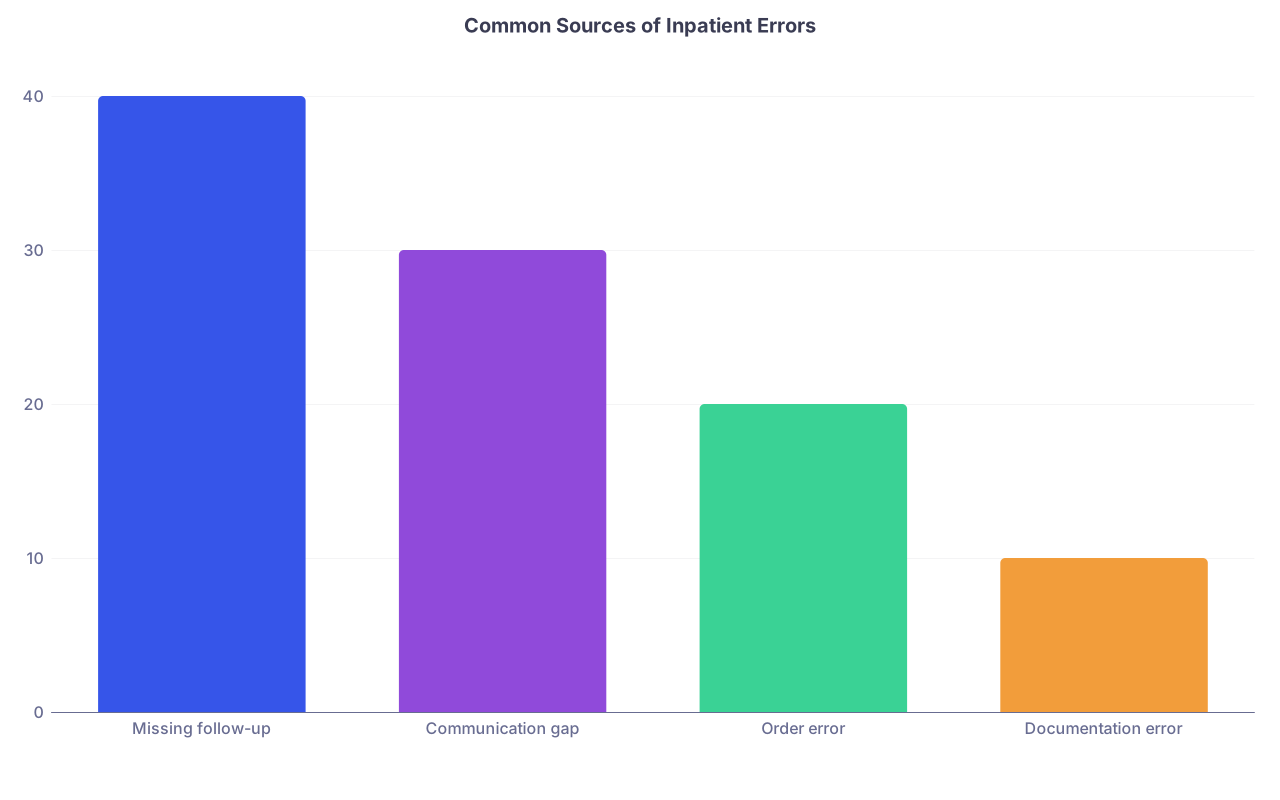
| Category | Value |
|---|---|
| Missing follow-up | 40 |
| Communication gap | 30 |
| Order error | 20 |
| Documentation error | 10 |
Notice what dominates: missing follow-up and communication gaps. Both dramatically improved by simply writing down what future-you and future-team need to do.
So no, the best residents are not the ones who never write anything. They’re the ones who learned not to trust their brain in conditions where every shred of evidence says you shouldn’t.
Years from now, you won’t remember the one senior who flexed about never carrying a list. You will remember the one night you almost missed something important — or did miss it — and quietly promised yourself you’d never again rely on memory alone when a pen and a scrap of paper could have saved you.