The dogma that “everything should be digital now” in residency is wrong. So is the romantic idea that you can survive modern training with just a pocket notebook and a good pen. The truth is uglier, more nuanced, and a lot more practical.
You’re not choosing a philosophy. You’re choosing tools under sleep deprivation, time pressure, and medico‑legal risk. That changes the calculus.
Let’s walk through what the data actually shows about paper vs digital in residency, and where each one really belongs in your day.
The core myth: “Digital is always better now”
Hospitals have spent billions forcing everything into the EMR. So residents start to believe: if it’s not in the computer, it’s inefficient, unsafe, or unprofessional.
That’s not what the literature says.
There are three separate questions hiding inside this fake “paper vs digital” war:
- What’s better for patient safety and coordination?
- What’s better for your memory and learning?
- What’s better for speed and sanity on a 28‑hour call?
Those do not all have the same answer.
1. Patient safety and coordination
For the official record, digital wins. Easily.
Computerized provider order entry (CPOE) and electronic records have repeatedly shown reductions in certain types of prescribing errors, dose errors, and allergy misses. The classic 2003 Bates et al. data and a pile of follow‑up studies say the same thing in different ways: typed, standardized, checked orders are safer than scribbled chicken scratch.
Electronic sign-out tools integrated with the EMR reduce missing allergy lists, wrong rooms, and outdated medication lists compared with random Word documents or hand‑written lists. I’ve seen old-school paper sign-outs that still listed a patient as “on pressors” three days after they left the ICU.
So if you’re talking:
- Orders
- Vital sign trends
- Labs, imaging, med lists
- The handoff document that everyone else will use
Digital should be the single source of truth. Paper is a dangerous “shadow chart” if it pretends to be official.
But that’s not where most residents actually struggle on a day-to-day basis.
2. Memory, learning, and thinking clearly
Here’s where digital fanboys lose the argument.
Cognitive psychology and education research have been hammering the same point for years: writing by hand enhances encoding and retention compared with typing, especially when the goal is understanding, not transcription.
You’ll see this in multiple studies on note-taking and learning. A widely‑cited one: Mueller & Oppenheimer (2014) showed that students who took longhand notes performed better on conceptual questions than laptop users, even though laptop users took more notes. The explanation is obvious once you feel it on wards: typing encourages verbatim capture; handwriting forces summarization and processing.
Residency is conceptual learning under fire. Pattern recognition. “What does this lab trend mean, and what am I going to do about it at 3 am?”
For that, paper is usually superior. Not because paper is magical, but because of how you use it:
- You jot down only what matters.
- You draw arrows between labs and symptoms.
- You physically box problems and write “PLAN” under them.
- You sketch a quick nephron or coronary artery when teaching a med student.
Could you do that on an iPad with a stylus? Sure. But now you’re not using digital text, you’re basically recreating paper on glass. Same cognitive mechanism.
If your “digital system” is just typing into Evernote, OneNote, or random EMR sticky notes, you’re probably sabotaging your own learning compared to a scruffy pocket notebook.
The real question: What survives 14 hours into your call?
Residents do not live in controlled trial conditions. You live on overheard pages, bad Wi‑Fi, and the one free computer that’s never where you are.
Lean too hard into any one extreme—pure paper or pure digital—and you’ll get burned.
Let’s break it down by actual use cases.
Sign-out and task management: Hybrid or you lose
Sign-out is where people try to be clever and usually make a mess.
Some programs still cling to entirely paper sign-out. A printed list, pencil scribbles for tasks, updates during the day. The downside is obvious: one copy, locally edited, out of date the second it’s printed. I’ve literally seen three different versions of “the list” floating around a night shift, none correct.
Fully digital sign-out in the EMR has the opposite problem: it’s “clean” but slow to interact with under pressure. You’re not going to log into Epic during a rapid response just to update “replete K” to “K given at 21:34”.
Here’s what actually works in the wild, and it lines up with what human factors data says about high‑reliability teams:
- One official digital sign‑out tied to the EMR. This contains identifiers, hospital course, problem list, code status, clear anticipatory guidance.
- Local, disposable paper or quick-note layer for the shift’s tasks and “working memory.”
The aviation world figured this out decades ago. There’s the official flight plan and logs. And then there’s the sticky notes on the panel during turbulence.
Your EMR sign-out is the official log. Your scribbled “to do” columns, checkboxes, and arrows during rounds? That’s your cockpit sticky note.
This hybrid approach solves three problems at once:
- Up-to-date, legally defensible information lives in one place.
- You can act fast during the shift without fighting a clunky interface.
- Your scribbles auto-expire; you throw the paper out at the end of the call.
Is there direct RCT-level evidence of “hybrid sign-out” vs pure digital vs pure paper? No. But there is good evidence that:
- Handoffs with structured templates reduce errors.
- Redundant, inconsistent sources of truth increase them.
- External memory aids (checklists, written task lists) improve performance under load.
Hybrid gives you structure + flexibility. Full digital gives you structure + friction.
Rounding and daily workflow: Why paper keeps refusing to die
If you walk through a medicine or surgery floor at 9 a.m. in a modern US hospital, guess what you’ll still see in 2025?
Not sleek tablet-only teams.
You’ll see interns holding printed lists, scribbling vitals and plans, despite having badge taps and workstation-on-wheels everywhere.
This isn’t nostalgia. It’s function.
On rounds you need:
- A fast, portable way to see the whole service.
- Space to write evolving plans as attendings talk.
- The ability to mark tasks clearly: labs to follow, meds to change, calls to make.
Tapping inside the EMR to find “today’s hemoglobin” on patient #14 while your attending stares at you is slower than scanning your margin where you already wrote “Hgb 7.2 (6.9 yest).” A lot slower.
Human factors research in ICU and ED environments has shown again and again: tools that match the pace and context of work get used. Tools that break flow get bypassed, no matter how “advanced” they are. Paper is brutally efficient at being low‑friction and high‑visibility.
The right compromise during rounds looks like this:
- Use EMR before rounds to update your mental model: trends, imaging, orders.
- Print or quickly compile a lean list with key data (no 7-page “labs” printout nonsense).
- Write your real-time adjustments, discussions, and to-dos on that list.
- Then, after rounds, sit down at a computer and translate the final plan into clean orders, notes, and (if needed) updated sign-out.
Paper is the scratchpad. The EMR is the final draft.
The residents who try to be “fully digital” and take all their real-time notes in the chart directly often either:
- Fall behind in rounds.
- Stop thinking deeply because they’re just data entry robots.
- Or end up with messy, bloated notes full of half-baked plan fragments and contradictions.
Learning and exam prep: Your brain doesn’t care about “tech-forward”
Now let’s talk about you, not just your patients.
You’re also supposed to somehow learn medicine, synthesize it, and not bomb your in‑service or boards.
The research on learning is pretty consistent:
- Active recall beats passive review.
- Spaced repetition beats cramming.
- Handwriting and generative note-taking beat mindless highlighting or copy-paste.
Digital tools shine at spaced repetition and retrieval practice. Anki is practically a religion in some programs, for good reason. Adaptive question banks, searchable PDF guidelines, quick PubMed lookups—trying to do those on paper would be masochistic.
But the capture step—what you do during conference, bedside teaching, or a great case—often works best on paper. It forces you to connect dots:
- “Why was this PE so hard to diagnose?”
- “What exactly made us choose ceftriaxone over pip-tazo here?”
- “What did the attending say about when NOT to order a CTA?”
Write that part by hand. Then, later, you translate it into cards or a digital knowledge base. The friction of rewriting is not a bug. It’s memory consolidation.
Residents who try to do everything directly in digital form often end up with:
- 2000 untagged OneNote pages.
- 50 open browser tabs “to read later” (you won’t).
- Or 400 disorganized Anki cards they never review.
The blended workflow—paper first, then intentional digital curation—is what sticks.
| Task Category | Paper Best Used For | Digital Best Used For |
|---|---|---|
| Sign-out & Handoffs | Real-time task tracking, quick notes | Official sign-out, history, meds, labs |
| Rounds & Workflow | Service list, live plan edits | Orders, final plans, documentation |
| Learning & Exams | Conceptual notes, diagrams | Spaced repetition, search, guidelines |
| On-Call Management | Running task list, phone messages | Orders, formal notes, team communication |
“But the hospital is going ‘paperless’ – doesn’t that settle it?”
No. “Paperless” is an administrative fantasy.
What they really mean is no unofficial clinical record outside the EMR. And that part is reasonable.
You should not:
- Keep your own parallel “chart” in a notebook.
- Store identifiable patient data on your personal phone or notes app.
- Walk around with last month’s lists with MRNs and diagnoses.
That’s not just policy; it’s risk management and HIPAA.
But a de-identified, first-name-only rounding list? A notebook with “ARDS weaning steps” and “approach to SIADH”? A folded index card with your favorite STEMI activation criteria? Those are not threats to the “paperless” vision. Those are what keep you functional.
The key is:
- No protected health information in permanent personal storage.
- No pretending your scratchpad is the official record.
- Secure disposal: shred or hospital bin at end of shift.
If your institution tells you “no paper at all, ever,” what they really mean is “no unregulated parallel charts.” I have yet to see a resident actually disciplined for carrying a scrub pocket notebook with de-identified plans and teaching points.
The silent factor: burnout and cognitive load
One thing people barely talk about: how the tool itself affects how fried you feel.
The EMR is cognitively expensive. Constant clicks, alerts, scrolling, tiny font. There’s decent correlational data linking time in the EMR with burnout and after‑hours “pajama time” documentation.
Paper doesn’t page you. It doesn’t throw up red alert boxes. It doesn’t auto-log you out in the middle of writing. It sits there and lets you think.
On a bad call night, the difference between feeling like a drowning data clerk and feeling like a doctor often comes down to whether you have:
- A clear, handwritten list of the 10 things you absolutely must do next.
- Or a vague mental mess you’re trying to hold while clicking between five EMR tabs.
Digital tools crush information storage. Paper crushes moment-to-moment cognition. You need both, but if you throw away paper entirely, you’re voluntarily increasing your cognitive load when you can least afford it.
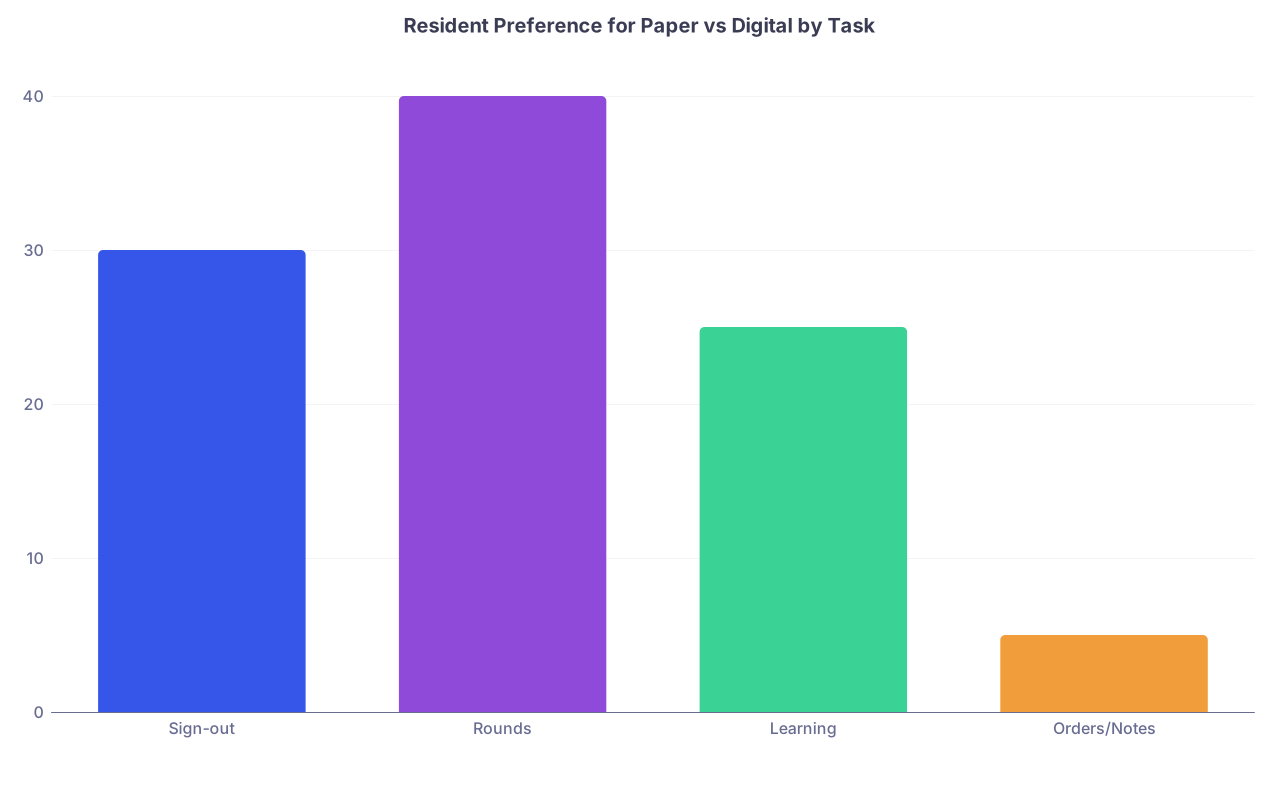
| Category | Value |
|---|---|
| Sign-out | 30 |
| Rounds | 40 |
| Learning | 25 |
| Orders/Notes | 5 |
(Example breakdown: percentage of tasks where residents I’ve worked with prefer some paper component. Not a published trial—just the reality of how people actually work when nobody’s watching.)
When digital really is non-negotiable
Let me be clear: there are areas where clinging to paper is not just inefficient; it’s unsafe or flat-out impossible:
- Medication reconciliation
- Order entry (obviously)
- Critical value acknowledgement
- Cross-cover documentation
- Reading and responding to cross-cover messages or in-basket items
Trying to “keep track” of these on paper is how you miss a positive blood culture or never follow up a critical potassium of 2.5. Any workflow that depends on lab notifications, timestamps, or audited trail belongs in the EMR.
Think of it this way:
If a lawyer or QA committee might one day ask, “What did you know, and when did you know it?”, that thing belongs entirely in the digital system.

| Step | Description |
|---|---|
| Step 1 | New Task or Info |
| Step 2 | Use EMR only |
| Step 3 | Paper or stylus notes |
| Step 4 | Use whichever is fastest |
| Step 5 | Close loop in EMR |
| Step 6 | Transfer key points later |
| Step 7 | Shred paper if used |
| Step 8 | Needs official record? |
| Step 9 | For thinking or memory? |
The bottom line: Stop asking “paper or digital?” – ask “for what?”
If you’ve read this far, you’ve probably already figured out the punchline.
There is no global winner. Anyone pushing “all digital” or “back to paper” as a religion is missing how residency actually feels at 2 am.
Here’s the distilled reality:
Digital is the source of truth. Orders, meds, vitals, handoff summaries, and anything that might be audited later live in the EMR, clean and up-to-date. That’s non-negotiable.
Paper (or pen-on-glass) is your thinking tool. Fast, flexible, cognitively light. Use it for rounds, task lists, conceptual learning, and on-the-fly reasoning—then throw it out or distill it into structured digital form later.
The safest residents quietly run a hybrid system. Official, legal, permanent information: digital. Personal, temporary, cognitive scaffolding: paper. People who try to live at either extreme usually end up slower, more stressed, or more error‑prone.
Stop trying to prove you’re “modern” by abandoning paper. Prove you’re competent by choosing the right tool for the job—and by the end of intern year, you’ll know exactly what belongs in your pocket and what belongs in the chart.