
Multitasking is not your superpower. It is your leak.
If you’re a resident, you’ve probably been praised for it. “She’s amazing, she’s multitasking all the time.” You’re on the phone with radiology, typing notes, answering a nurse’s question, while mentally trying to remember if the patient in 4B ever got their evening insulin. It feels like you’re doing three jobs at once.
You are not. You’re just switching between them badly and burning cognitive fuel you don’t have.
Let’s strip the myth down and look at what the data actually says—and what actually makes you faster, safer, and less miserable.
The Multitasking Myth: You’re Not Doing What You Think You’re Doing
Reality first: human brains do not multitask complex things. They task-switch.
You can walk and chew gum. You cannot accurately reconcile meds, answer a nurse about pressor titration, and respond to a family’s end-of-life question as “parallel tasks.” That’s not “multitasking.” That’s you rapidly bouncing your attention back and forth and paying a toll every time.
Cognitive psychology has been hammering this home for decades:
- Every context switch (Task A → Task B) has a measurable cost in time and accuracy.
- The more complex and non-automatic the task, the bigger the cost.
- People who think they’re great multitaskers are usually the worst at it.
There’s a classic Stanford study on “heavy media multitaskers.” They found those people were more distractible, worse at filtering irrelevant information, and less efficient at switching tasks. In plain English: the folks proudest of their multitasking were objectively worse at focusing.
Residency just weaponizes that delusion with pagers and acuity.
You feel productive because your brain gets tiny dopamine hits from “responding” constantly. But your actual work quality and time to completion? Often worse than if you did one thing cleanly.
What Multitasking Actually Costs You on the Wards
Let’s get concrete. Here’s what this looks like in a real hospital, not a lab.
You’re on night float:
- You’re writing an H&P on a new admission.
- Your phone rings—nurse on 6E: “Can you come look at Mr. C, his blood pressure is dropping?”
- While talking, your pager goes off: cross-cover patient wants pain meds.
- You keep typing your H&P while on the phone, half-listening to the nurse.
Sounds like “peak efficiency,” right?
What actually happens:
Your H&P is slower.
Every time you break focus from the story and your mental problem representation, you have to rebuild the context: “Wait, why was he admitted? What did the CT show?” That reassembly costs time.Your documentation is worse.
Copy-paste errors, missing allergies, wrong med doses—these spike when residents are interrupted. Nursing and quality data back that up.Your clinical decisions degrade.
When you answer clinical questions with half your brain, you lean on heuristics and habit. “Yeah, give some fluids” might be right—until you remember the patient is in heart failure.Your stress rises while your accuracy falls.
The perception of chaos and “constant interruptions” correlates with burnout. Residents often feel they’re barely hanging on—this isn’t about weakness. It’s about a system that punishes focus.
Most of this is invisible cost. You just feel like the shift was “crazy” and you “got a lot done.” You rarely see the chart review error that almost happened, or the near-miss a nurse caught at the last second.
The One Place Multitasking Does Help (Sort Of)
To be fair, not all “doing two things” is bad.
There are two categories of tasks:
Automatic / low cognitive load
Stuff like: walking, grabbing supplies, logging into the EMR, scrolling to the next tab, copying a phone number.Deliberate / high cognitive load
Stuff like: dose calculations, diagnostic reasoning, goals-of-care conversations, medication reconciliation, writing orders.
Pairing a high-load task with another high-load task? Terrible.
Pairing a high-load task with an automatic, almost muscle-memory task? Fine, sometimes efficient.
Example that works:
You're walking from ICU to radiology. While walking, you call the radiologist to clarify the CT report. Walking is automatic. The clinical conversation gets the full cognitive pie.
Example that fails:
You’re placing a central line and trying to answer the nurse’s question about insulin dosing. Both require deliberate attention. You will either miss a detail or increase risk.
So no, you’re not going to “fix” the system by becoming a “better multitasker.” You’re going to survive by deciding ruthlessly when you will not multitask.
What Actually Improves Efficiency (Backed by Data, Not Vibes)
Let’s talk about what moves the needle. These are not productivity hacks imported from tech bros. These are tactics that fit residency chaos and have evidence behind them.
1. Single-Tasking Critical Work
The most contrarian thing you can do on a busy service? Deliberate single-tasking.
There are certain activities where you should mentally flip a do-not-disturb sign:
- Writing orders for heparin, insulin, chemo, or high-risk meds
- Reconciling meds on admission or discharge
- Placing central lines, arterial lines, LPs, chest tubes
- Calling a family with bad news or goals-of-care discussions
- Interpreting subtle imaging or EKGs where the outcome meaningfully changes management
I’ve watched residents literally put a sticky note on their computer that said “HEPARIN ORDERS – PLEASE WAIT 2 MIN” as a physical barrier when people came up to them. Does it feel awkward? At first. Does it reduce errors? Yes.
The research on “interruption-free zones” for med administration and critical orders in nursing is solid: fewer interruptions → fewer errors. The same logic applies to you.
2. Batching: The Opposite of Frantic Multitasking
Most residents live in reactive mode. If a thought pops into your head, you start it. If a message pops up, you answer it. Constant mental pinball.
Batching fights that.
You group similar tasks and do them in one block. That reduces task-switching cost and keeps your brain in one mode longer.
Some examples that actually work on busy rotations:
Calls and pages block
For non-urgent pages: “I’ll return a batch of calls every 15–20 minutes unless it’s clearly emergent.” You keep a scratch list. Then you call down the list rapidly. Same conversational mode, same mental context.Orders block
After pre-rounding, you spend 15–20 minutes entering all non-urgent morning orders together. You’re “in ordering brain” instead of scattering them through 3 hours with constant context switches.Discharge block
You and your co-resident set a 30–45 minute “discharge sprint” where both of you crank through discharge summaries and scripts together, minimizing interruptions. Nurses quickly learn that’s when dispo actually happens, and it reduces the “chaos all day” vibe.
This is not idealized theory. I’ve seen residents on punishing medicine services reclaim hours a week using exactly this.
3. Externalizing Your Brain: Lists, Not Memory
There’s a nasty lie in medicine: the “best” residents remember everything.
No. The best ones do not trust their memory for operational details.
When you’re relying on brain RAM to track:
- 6 pending call-backs
- 3 labs to recheck
- 2 consults to re-page
- 1 patient to re-examine after fluids
…you will either forget or constantly mentally loop through that list. Both are expensive.
The efficient residents externalize aggressively:
- Mini whiteboard in your pocket
- One-page folded rounding list with designated sections: “Calls,” “Labs to recheck,” “To do after rounds”
- EMR “sticky notes” or task lists used deliberately, not randomly
Every item written down = one less cognitive tab open. That frees actual brain power for diagnostic thinking and prioritization.
4. Using “Micro-Focus” Instead of Fake Multitasking
Residents rarely get long, uninterrupted blocks. You get 3–7 minute windows between pages, not 45 minutes of silence.
So the game isn’t “deep work Days.” It’s micro-focus.
You treat those 3–7 minute pockets as real, protected units:
- Pick one thing.
- Work only on that one thing.
- Get it to a clean stopping point.
For example:
- 4 minutes while waiting for transport → finish one discharge instruction section, not “skim three notes and half-write two orders.”
- 6 minutes before sign-out → reconcile meds for one complex patient fully, not “half-check three.”
The mental rule: no half-starts. Either you start and finish a mini-task or you consciously decide, “This is not a good candidate for a 4-minute window.” That single choice kills a lot of scattered half-done work.
5. Structured Communication: Kill the Back-and-Forth
A huge chunk of “multitasking” is just you ping-ponging between unclear communications.
Every “Can you come see?” or “What do you want to do?” page that lacks context forces you to chase more info, which means more task switching and more time.
Residents who communicate efficiently use structured patterns:
- With nurses: “If it’s about vitals, please include latest BP, HR, O2, and current meds in the page.”
- When calling consults: concise one-liner, then a pre-thought-out question: “We’re asking if you recommend scope this admission, or if outpatient is safe.”
That up-front clarity pays off twice:
- Fewer back-and-forth interruptions
- Faster decisions per interaction
| Style | Example Page Content |
|---|---|
| Vague | "Pt in 7B tachy, please call" |
| Semi-structured | "7B: HR 130, BP 88/50, RR 24, on 2L, looks pale" |
| Structured | "7B: HR 130, BP 88/50, RR 24 on 2L NC, lactate pending, 1L NS already given, please call" |
Guess which one lets you prioritize accurately without three follow-up calls.
6. Protecting Your Cognitive Battery (Yes, Even on Q4)
Everyone in residency underestimates fatigue. Then they proudly multitask more when they’re tired—as if that compensates.
The data is merciless: sleep deprivation wrecks working memory, attention, and executive function. That makes multitasking damage even worse, because your brain has less bandwidth to absorb switching costs.
You will not always control your call schedule. You do control a few things that actually improve performance:
- Micro-rest: 5–10 minutes with eyes closed, no phone, in a dark call room beats 5 minutes of scrolling every time.
- Monotask when exhausted: The more tired you are, the more you should force yourself to do one thing at a time for critical tasks. Your error rate will skyrocket otherwise.
- Routines to reduce decisions: Same food, same pre-call routine, same sign-out structure. Every automatic routine is one less deliberate decision.
You are not a machine. But you can make your human brain use its fuel less stupidly.
How to De-Multitask in a Culture That Worships It
Here’s the pushback I hear: “This sounds nice, but my hospital is chaos. I have to multitask, or everything falls apart.”
No, you don’t. You have to look busy and responsive. Different thing.
You can implement this without being that resident who “doesn’t help the team.”
A realistic way to start:
Pick two “never multitask” activities.
For example: heparin/insulin orders and breaking bad news calls. For those, you consciously stop everything else. People will respect it if you’re clear: “Give me 2 minutes, I’m entering insulin orders and I don’t want to mess this up.”Start batching one category of work.
Pages are the easiest. Instead of answering every non-urgent page the millisecond it dings, you reply in short batches (every 10–15 minutes) unless it’s clearly critical. You’ll be faster overall and less scattered.Use a tiny physical capture tool.
Index card, mini whiteboard, or back of your sign-out. Everything you would “keep in your head” for the next 30–60 minutes goes there instead.Do one micro-focus block per half-day.
10–15 minutes where you tell your co-resident, “I’m going to finish these two discharges, can you grab pages unless emergent?” Then trade.
You’ll be surprised how quickly nurses, co-residents, and even attendings adapt when you consistently follow through and actually get things done faster and more safely.
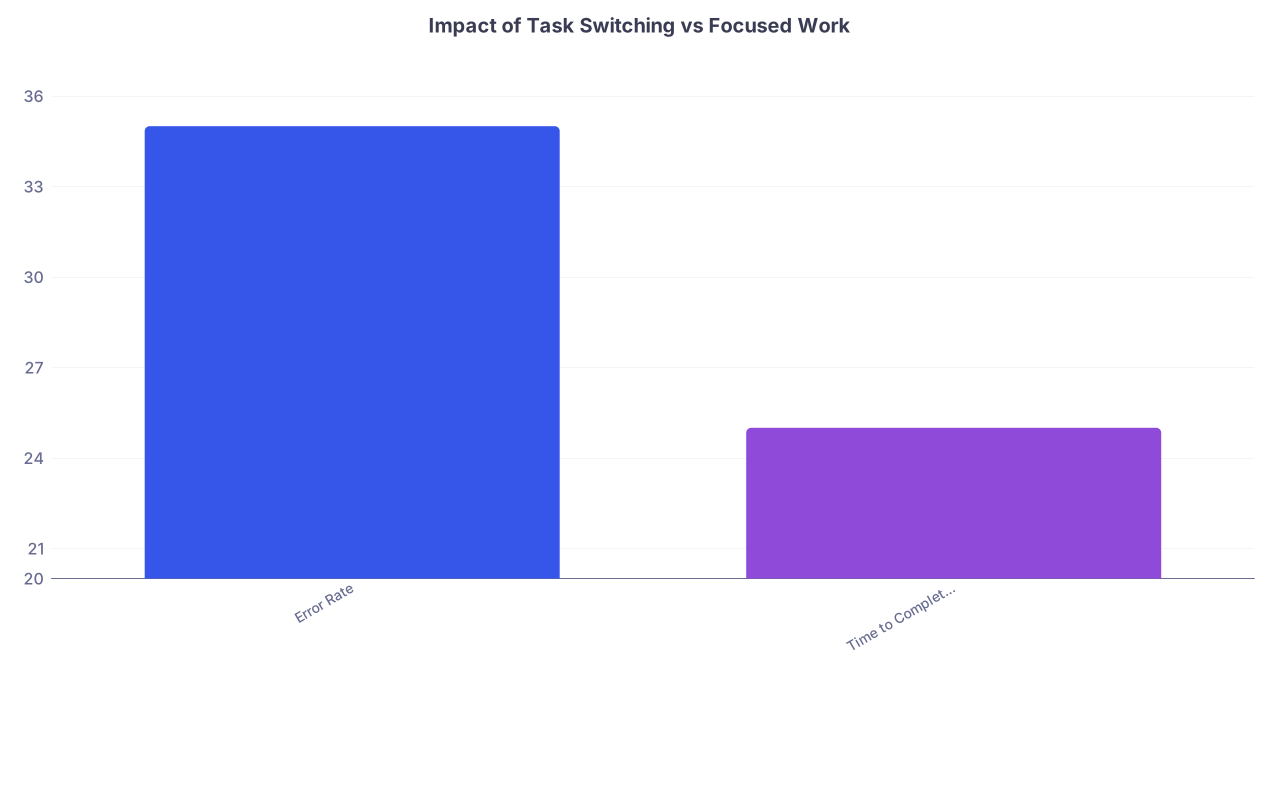
| Category | Value |
|---|---|
| Error Rate | 35 |
| Time to Complete Task | 25 |
(Example concept: residents with frequent task switching showing ~35% higher error rate and ~25% longer completion time on complex tasks compared with periods of focused work, based on cognitive and workflow studies.)

| Step | Description |
|---|---|
| Step 1 | Start Shift |
| Step 2 | Frequent task switching |
| Step 3 | Batch and single task |
| Step 4 | Higher error risk |
| Step 5 | Longer total time |
| Step 6 | Lower error risk |
| Step 7 | Shorter total time |
| Step 8 | Approach |

The Uncomfortable Truth: Multitasking Feels Heroic, Not Effective
A lot of this comes down to ego and culture.
Hospitals glorify the resident who:
- Answers every page instantly
- Is always reachable, always typing, always running
- Brags about writing notes while “simultaneously” running a code and calling a consult
But when you actually watch the quiet, efficient senior who:
- Asks for 2–3 minutes to finish a critical task before answering
- Moves methodically through lists
- Seems oddly calm even on crazy days
…they usually leave on time more often. Their patients have fewer loose ends. Nurses trust their orders more. And they’re less burned out.
That’s not because they’re smarter. It’s because they’re not lighting their limited cognitive resources on fire in the name of “multitasking.”
You’re not weak if you can’t keep five complex things straight in your head while your pager screams. You’re normal. The real skill is refusing to pretend otherwise—and building a way of working that respects how brains actually function.
Years from now, you won’t remember how many pages you answered per hour. You’ll remember whether you learned to protect your attention in the middle of chaos—and that, more than any fake multitasking badge, is what lets you survive residency with your judgment and sanity intact.