
Staying late every day is not a badge of honor. It’s usually a sign that the system is broken and you’re paying the price with your life and brain cells.
Medicine loves the martyr myth. The resident who always stays late, “goes the extra mile,” never complains, “finishes the work no matter what.” You know how attendings talk about them: “She’s so dedicated.” “He’s a workhorse.” It sounds like praise. It’s often code for something else: this person is absorbing dysfunction the system refuses to fix.
Let’s pull this apart with data, not romanticism.
The Myth of the Noble Late-Stayer
There’s a persistent, toxic story in residency: if you stay late, you care. If you leave on time, you’re less committed, maybe even lazy. You’ve heard it in a hundred versions:
“Yeah, he’s technically allowed to leave, but the work still has to get done.”
“She always finishes her notes before going home. That’s the kind of dedication we’re looking for.”
This is how you normalize systemic failure as individual virtue.
The numbers don’t support the romance. They support something closer to abuse.
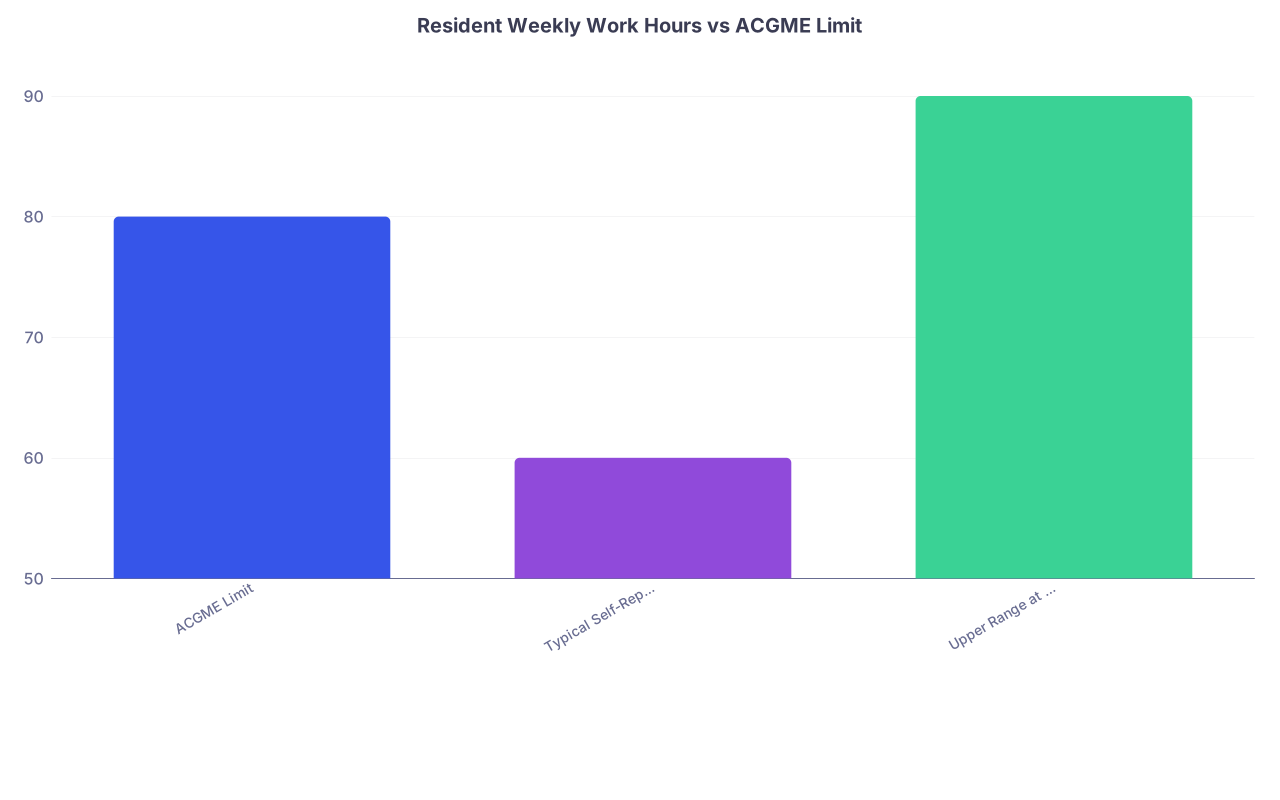
| Category | Value |
|---|---|
| ACGME Limit | 80 |
| Typical Self-Reported | 60 |
| Upper Range at Busy Programs | 90 |
Studies of resident work hours consistently show that “80 hours” is more of a public relations ceiling than a lived reality at many programs. Self-reported averages often hide the spikes: 60–70 hours many weeks, but 85–90 during heavy rotations or when staffing is short. The “just finish up” culture doesn’t show up neatly in duty hour logs.
Now layer in the cognitive effects. Sleep deprivation research is not subtle:
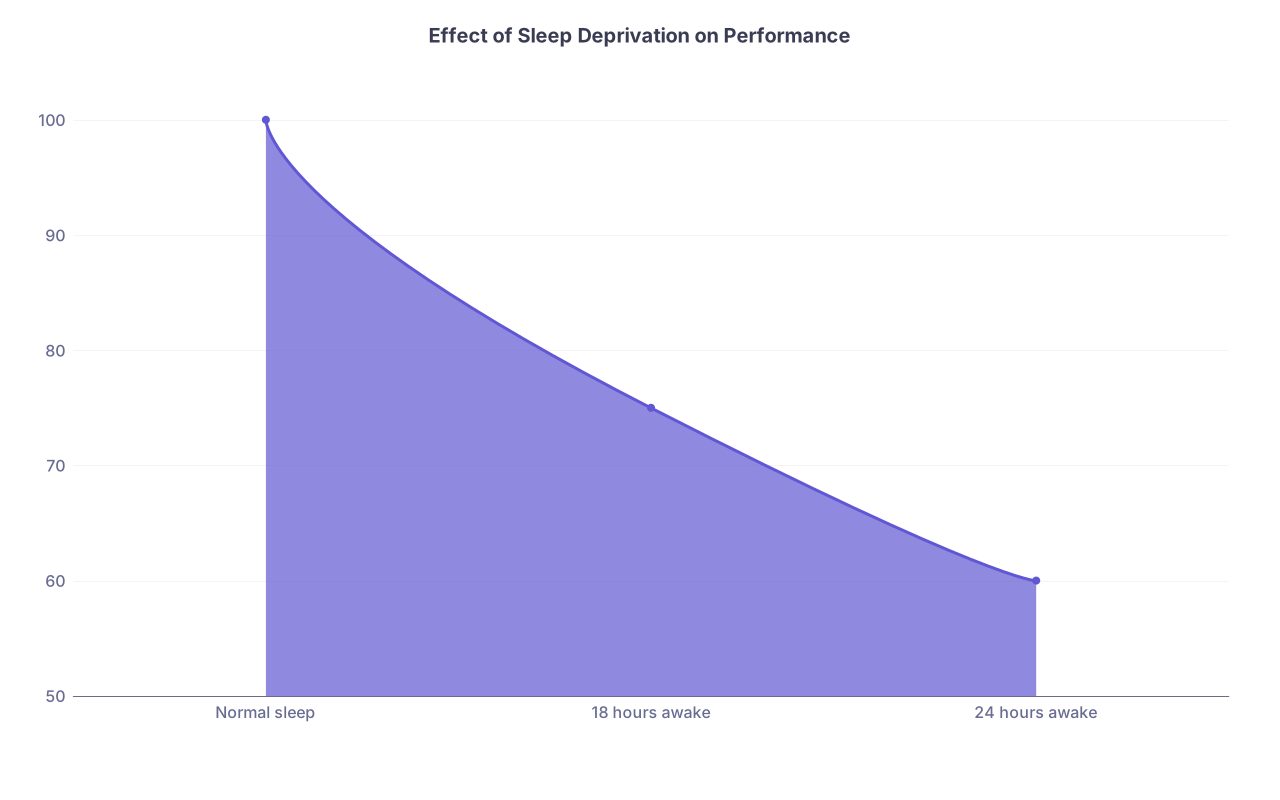
| Category | Value |
|---|---|
| Normal sleep | 100 |
| 18 hours awake | 75 |
| 24 hours awake | 60 |
The performance of someone awake for 18–24 hours is comparable to having a blood alcohol level around 0.05–0.10. That’s not “dedicated.” That’s impaired.
Yet medicine routinely frames residents who repeatedly push themselves into that cognitive territory as “team players.”
No other high-risk industry would applaud this. If a pilot boasted about hanging around the airport off the clock to finish paperwork after a 16-hour day, we wouldn’t call that dedication. We’d call that a safety concern.
What Staying Late Actually Signals (And It’s Not Just “Work Ethic”)
Let me be blunt: staying late sometimes is normal. Medicine is messy, admissions cluster at 6 p.m., codes don’t care about your sign-out time. The issue is the pattern, not the outlier day.
Chronic late-staying tends to reflect at least one of four things:
- Bad system design or staffing
- Broken workflows and tech
- Cultural pressure and fear
- True individual inefficiency (much rarer than people claim)
You’ll hear attendings and chiefs jump to #4 because it keeps everyone comfortable. “She just needs to be more efficient.” Sometimes that’s true. More often, that’s lazy analysis.
1. System and staffing failure
If everyone on a service routinely stays an hour or two late, that’s not eight independent people each failing time management. That’s a service that is improperly staffed or overloaded.
Examples you’ve probably seen:
- A “2 resident” service silently becomes a “1 resident + 1 resident covering two things” because of vacations or vacancies, with no workload adjustment.
- Clinics that consistently double-book to “help access” but don’t add MA or nursing support, so you’re finishing notes at 8 p.m.
- Services that add new clinical responsibilities (more admits, new unit coverage, extra consult expectations) without adjusting caps or staffing.
When workload expands and staffing doesn’t, extra hours don’t represent heroism. They represent the unpaid subsidy residents provide to keep the system from admitting the problem.

2. Workflow and EMR failure
You can watch two residents on the same service diverge by an hour or more at the end of the day just based on workflow.
But there’s a ceiling to personal optimization when the tools are garbage. An EMR that takes 20 clicks to place standard orders. No standardized templates for common notes. Labs and imaging that result at weird staggered times because no one looked at batching and turnaround.
None of this is “you’re not committed enough.” It’s design failure.
Take note timing. If morning labs consistently result at 10–11 a.m., but rounds are at 9, here’s what that guarantees:
- You will “re-round” in the afternoon.
- You will call families back late because your actual plan shifted.
- You will inevitably be finishing documentation later.
What gets interpreted as “she just needs to pre-chart better” is often more honestly described as “this hospital set up information flow in a way that makes timely decisions impossible.”
Culture: How Guilt and Fear Masquerade as Professionalism
You’re not just fighting systems. You’re fighting culture. And culture is sneakier.

| Step | Description |
|---|---|
| Step 1 | Understaffed service |
| Step 2 | Resident stays late |
| Step 3 | Seen as dedicated |
| Step 4 | System not pressured to change |
| Step 5 | Others feel guilty leaving |
This is the loop. The late-stayer is praised, the system breathes a sigh of relief, and everyone else absorbs the guilt. Three specific cultural myths drive this:
“If I leave, I’m abandoning my patients.”
No. If you sign out appropriately to an on-call team that exists for exactly this reason, you’re participating in a safety system. A well-done sign-out is safer than an exhausted PGY-2 trying to “just tuck in a couple more patients.”“The nurses will be stuck if I don’t finish everything.”
Also twisted. The nurses are there 24/7. There are cross-cover residents and night teams. What actually hurts nurses is the chronic understaffing that leads to 5–6 patients each on a heavy floor, not whether your last non-urgent med rec gets done at 6 p.m. or 7:30 p.m.“If I leave on time, people will think I don’t care.”
This one is real in many programs, because some attendings still harbor the 1980s “real doctors work until they drop” mindset. But that doesn’t make it valid. It just means they haven’t updated their mental model since pagers were new technology.
The research is not on their side. Burned-out physicians make more errors, have worse empathy, worse patient communication, and are more likely to leave medicine. Residency programs that ignore that are not “old school.” They are negligent.
| Belief | Reality |
|---|---|
| Late = dedicated | Often late = overwhelmed system |
| Leaving on time = lazy | Leaving on time = boundaries and safety |
| More hours = better training | More hours beyond a threshold = diminishing returns and more errors |
| It will get better after training | Burnout patterns often follow you into attending life if normalized early |
The Data: Burnout Is Not a Personal Weakness
Let’s stop pretending this is about personal toughness.
Multiple large studies of residents show burnout rates in the 40–70% range, depending on specialty and year. The drivers are depressingly consistent:
- Excessive workload
- Lack of control over schedule
- Inefficient processes
- Poor work-life integration
Notice what’s not first on the list: “not resilient enough.” That’s the favorite hospital wellness seminar distraction.
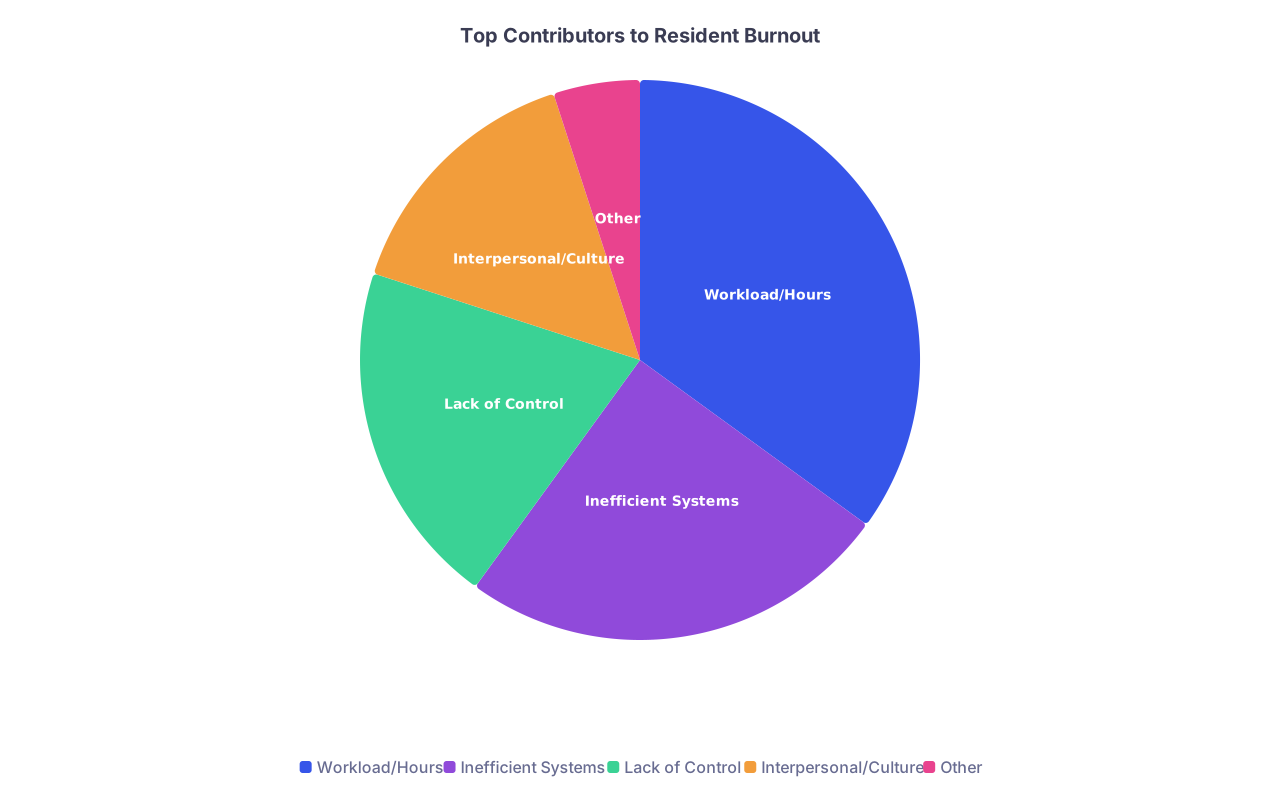
| Category | Value |
|---|---|
| Workload/Hours | 35 |
| Inefficient Systems | 25 |
| Lack of Control | 20 |
| Interpersonal/Culture | 15 |
| Other | 5 |
The “resilience” framing is seductive because it shifts blame to you. If you’re burned out, maybe you need yoga. Or mindfulness. Or a gratitude journal. Anything but staffing more residents, hiring another APP, fixing the EMR, or cancelling that useless, chronically late-starting noon conference that eats time but adds no value.
You staying late every night props up this charade.
When It Is You (And How to Tell)
Now for the part residents sometimes don’t like to hear: occasionally, it is you. Not your worth as a doctor, but your skills at managing time, notes, or prioritization.
I’ve watched this in real life on wards:
- Two interns with identical patient loads.
- Same attending, same senior, same number of admits.
- One leaves at 5:30 most days, one at 7:30–8:00 like clockwork.
When you follow them around, here’s what you find:
- The late one rewrites entire notes from scratch at 4 p.m. instead of templating and editing pre-charted versions.
- They answer every non-urgent page immediately instead of batching calls and messaging.
- They don’t close charts as they go, leaving all documentation for the end of the day.
- They don’t delegate things like scheduling follow-ups or printing discharge instructions to nursing or unit clerks when appropriate.
These are skills. They can be taught. Someone who chronically stays late because they never learned them doesn’t need moral judgment; they need coaching and structure.
The key is pattern recognition. Ask:
Are most people on this service staying late?
If yes, that’s system-level.Are you significantly later than your peers with the same load?
If yes, that’s a signal to dissect your workflow.
This isn’t about shame. It’s about honesty. Blaming “the system” for everything is just as lazy as blaming “resident inefficiency” for everything.

Practical Survival: How to Stop Being the System’s Shock Absorber
You can’t fix your hospital. You probably can’t even fix your department. But you can stop volunteering to be the human sponge that soaks up every drop of dysfunction.
A few concrete principles that work in the real world:
1. Redefine “good doctor” for yourself.
If your internal definition of a good doctor is “never leaves until everything is perfect,” you’re set up for endless self-harm. A better definition: “Delivers safe, thoughtful care, uses backup systems appropriately, and is still functional enough to do it again tomorrow.”
2. Use the call system the way it was designed.
Night float exists. Cross-cover exists. If you routinely stay past sign-out doing work that those systems are supposed to absorb, you’re not being noble; you’re undermining the safety net. Give thorough sign-out. Hand off non-urgent issues. Leave.
3. Triage your perfectionism.
There are notes that need to be beautiful (complex onc patient getting transferred; contentious family; high-risk discharge with shaky follow-up). There are also non-eventful daily progress notes on truly stable patients that no one will read except maybe billing. Learn the difference.
4. Close loops during the day.
Don’t hoard work for the end. Place orders as soon as decisions are made. Dictate or complete discharge summaries early. Pre-chart efficiently. Call families before 4 p.m. instead of letting all those calls stack to 5:30.
5. Make your late-stays visible as system failures, not personal heroics.
Log duty hours accurately. If something chronically pushes you over, document it. When your chief asks, “Why were you here late?” your answer shouldn’t be “Just wanted to get everything perfect.” It should be “We had X patients, Y new admits, and Z tasks that realistically exceed our current staffing.”
That’s how you gently force the conversation out of the “dedication” fantasy and into workload reality.
The Long Game: Habits You Build Now Will Follow You
The dangerous lie in residency is, “It’s just for a few years. I’ll fix my life later.”
No, you won’t. Not automatically.
Patterns you normalize in residency harden into your default settings. If you spend three years teaching your brain that a “good doctor” always sacrifices themselves, that charting at home till 11 p.m. is “just what it takes,” that saying no is selfish—you will carry that into attending life. Then you get more responsibility, more email, and no work-hour limits.
I’ve watched attendings in their 40s still staying late for “just a couple of notes” every night, resenting their lives, marriages fraying, kids growing up without them. Many of them started exactly where you are now, being praised for staying late as residents.
Contrast that with the attendings who are respected and sane:
- They run tight lists.
- They use the team effectively.
- They are ruthless about what must be done today vs what can safely wait.
- And they go home.
Those habits do not magically appear with a promotion. You’re rehearsing something every day in residency. Make sure what you’re rehearsing is sustainable.

The Bottom Line
Staying late is not inherently virtuous. It’s often a symptom, not a strength. Here’s the distilled truth:
- Chronic late-staying usually reflects system failures—workload, staffing, and workflow—not superior dedication.
- You are not obligated to be the shock absorber for a dysfunctional system; using handoffs and boundaries is part of safe, modern care, not abandonment.
- The habits you normalize now—martyrdom or boundaries—will follow you well beyond residency, so choose the ones you actually want to live with.