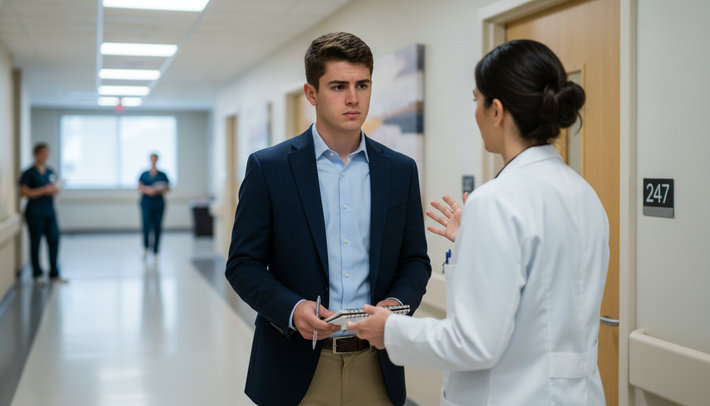
Most pre-meds approach shadowing like a collector grabbing rare Pokémon. You scribble hours into a logbook, aim for the flashiest specialty, and call it a day. Wrong. Shadowing isn't about accumulating experiences, it's about precision-striking your future career. And if you don't choose your shadowing targets based on the type of attending you want to become, you're just wasting time.
Here's the hard truth: by the end of first year of medical school, your CV needs to start whispering a coherent story. That story splits early into two dominant tracks, the Clinician-Educator and the Research-Active physician. They live in different worlds, talk different languages, and judge success entirely differently. I'm going to walk you, month by month, through exactly how to shadow for each, what to steal from their routines, and when to pivot. At this point you should be thinking not just about who to shadow, but why.
This article is for educational purposes only. It is not financial advice, not legal advice, and not tax advice. Figures vary by individual circumstances, so consult a qualified professional before acting.
Month 1-2: Audit Your Instincts
Before you stalk anyone's clinic, you need a brutally honest self-audit. Schedule two half-days. Shadow a known teaching attending (ask the residency program office, they'll tell you who the medical students fight to get). Then shadow a physician-scientist who runs an active lab. Don't just show up. Arm yourself with a 5-question framework:
- Does this attending talk to patients or over them to the team?
- How do they explain diagnostic reasoning, at the whiteboard or with a journal article pulled mid-rounds?
- Does a call from the IRB or a grant deadline make them duck out of patient conversations?
- When a student says something stupid, do they correct with a story or with a data point?
- Do you feel an electric pull toward teaching a first-year resident or toward solving a data puzzle?
I've seen pre-meds cry after a day with a pure researcher because the silence around the patient bed felt empty. I've seen others nearly doze off during a masterful bedside teaching session because they craved the lab's hum. Neither reaction is a failure, it's diagnostic data. Log it.
The Clinician-Educator Path: Shadowing for Impact
This path isn't just about loving to teach. It's about obsessing over pedagogy while a patient's life hangs in the balance. The attendings you want to shadow don't just "round", they orchestrate a moving classroom.
Identifying the Right Mentor
Skip the Ivy League name on the door. Find the attending who stays 20 minutes after rounds to diagram a metabolic pathway for a confused intern. Look for the one whose residents mimic their sentence structures because the clarity is that contagious. I always tell students: "Find the attending who treats every hallway consult like a mini-lecture." One of my best mentors would literally sketch out a neuron's action potential on a napkin for a patient's family and then turn to the med student and say, "Now teach it back to me." That's gold.
What to Observe: The Anatomy of a Teaching Moment
Before finalizing your strategy, ensure you are avoiding common pitfalls by performing an End-of-Year Review: Auditing Your Shadowing Portfolio Before Applying.
While shadowing an educator, don't just watch the patient interaction. Watch the feedback loop. Exactly when does the attending pause and ask the resident, "What would you do next?" Is it open-ended or leading? Does the attending then synthesize the resident's answer into a broader principle, or do they just give the answer and move on?
Here's your checklist for the educator-focused shadowing day:
- Count how many times the attending directly teaches a trainee vs. instructs a nurse or patient.
- Map the whiteboard: Did the attending draw a mechanism, a timeline, or a differential algorithm?
- Note a moment of "constructive discomfort", how did the attending push a learner without breaking confidence?
- Ask the attending afterward, "What made that specific teaching moment effective?" Their answer reveals their philosophy.
By the end of a week of this shadowing, you'll know if you get a dopamine hit from watching someone else's lightbulb moment. If you do, start building a teaching portfolio now, not later. Volunteer as a tutor for pre-clinical courses, develop a patient-education handout, anything that shows you're wired to translate complexity.
The Research-Active Path: Shadowing the Academic Physician
This is not about the clinician who happens to have a dusty co-authored paper. I'm talking about the attending who is a Principal Investigator (PI) first in their own mental schedule. Patient care is vital, but their brain's background processor is always crunching a dataset.
For those unsure if their current routine is effective, consult Myth vs Reality: Does More Shadowing Always Help Your MD Application? to align your efforts with data-backed trends.
Prioritizing the Lab-Capable Attending
Find an attending with an active clinical trial, a wet lab, or a steady stream of grant submissions. How? PubMed their name in front of you during the shadowing day. If they've published three case reports in five years, they're an educator with a hobby. If they're co-author on mechanistic studies or multi-center trials with significant funding, you've found a real researcher. I've seen students waste months shadowing a "researcher" who turned out to be just a prolific lecturer. Don't make that mistake.

Understanding the PI Role
As you shadow, you'll notice the PI's day has a relentless rhythm. Morning: review overnight lab results on a tablet while walking to clinic. Midday: a 20-minute scream at a monitor over a rejected R01 segment, then seamlessly into a compassionate oncology consult. Afternoon: research coordinator meeting over a standing desk, eating a protein bar. Late evening: up-to-date on manuscript submissions.
Your mission here is to see if that rhythm excites you or drains you. Watch how they handle the "handoff" between bench and bedside. Do they draw direct lines from their research to the patient in front of them? ("Your tumor's mutation is exactly what my lab is trying to target.") That's the spine-tingling stuff. If you hear that and feel nothing, research-active may be a grind.
From Shadow to Research Assistant
At this point you're not just observing, you're recruiting yourself. After shadowing, offer to do a chart review for their retrospective study, enter data, or help with a literature search. I tell students: "Your best chance at authorship doesn't come from an email. It comes from being in the room when the PI mutters, 'I need someone to pull these 200 charts.'" Be that someone.
Time Allocation & Portfolio Growth: A Sharp Contrast
By month three, you must decide what your CV will champion. Look at how these two physicians actually spend their week. I've broken this down brutally because pre-meds romanticize both.
The educator pours nearly a third of their working life into formal and informal teaching, things that don't show up on a CV line but shape a residency program. The researcher blocks 30-40% of their week for protected research time. Notice that patient care takes a slight hit; you can't have it all.
Success metrics? The educator counts lectures delivered, teaching awards, and residency match outcomes. The researcher counts grants funded, papers in Nature or specialty journals, and H-index. Which kind of validation fuels you? If you answer "both," you'll be average at both for a decade before you pick a lane. Medicine punishes indefinite hybrids. Pick.
When to Pivot (And It's Not a Failure)
Between Year 1 and Year 3 of medical school, your interests can shift. You might realize you love patient care but need the rush of discovery. Or you might discover that 80-hour bench weeks make you physically ill. Here's your timeline checkpoint: End of Year 1, decide if you're leaning educator or researcher. Year 2, build depth, lead a curriculum innovation project (educator) or secure a summer research grant (researcher). If by start of Year 3 clerkships you feel a turn, you pivot. How? Stack your elective rotations with the other type. Pivot publicly. Tell your mentors, "I thought I was researcher, but I thrive at the bedside teaching." They'll help you rebadge.
Month 3-6: Formalize Relationships and Build Your Narrative
At this point, your shadowing isn't just observation, it's interviewing future mentors. By month 4, you should have identified one primary mentor in your chosen track. Ask for a 20-minute "career architecture" meeting. Bring a draft of your 5-year goal. I'm serious. Walk in and say, "I see myself as a clinician-educator in academic neurology. Based on your path, what should I be doing right now that I' not?" That question alone has landed students research projects, away rotations, and letters of recommendation.
Action Plan for the Clinician-Educator Trainee
- Month 3: Record yourself teaching a mock OSCE station and ask your mentor to critique it.
- Month 4: Propose a new module for your medical school's pre-clinical curriculum, even a 30-minute workshop.
- Month 5: Attend a national education conference (virtual or in-person). Network with program directors who run teaching tracks.
- Month 6: Draft your personal statement's teaching philosophy paragraph. Yes, you can start this early.
Action Plan for the Research-Active Trainee
- Month 3: Identify a dataset you can clean and analyze under your PI's supervision.
- Month4: Submit an abstract to a regional conference. Even a poster counts.
- Month5: Learn basic statistics or coding (R, Python) enough to not be dependent on a biostatistician for every question.
- Month6: Map out a potential gap year (if needed) to do full-time research before residency applications.

Your Strategic Action Plan: Stop Drifting
I've watched brilliant students turn into residency application casualties because they never committed to a narrative. The Clinician-Educator candidate who has only "shadowed in the ICU" with no evidence of teaching initiative looks exactly like the Research-Active candidate who never touched a dataset. Both get the same hollow rejection: "Lacks focus."
So here's your precise timeline. Follow it, and your application will scream intention instead of whispering confusion.
- Month1-2: Shadow one educator, one researcher. Complete the self-audit questions. Write a 200-word reflection for each day, be honest.
- Month3: Declare your primary interest (even if you're 60% sure). Reach out to 2-3 attendings in that track for further shadowing and a mentorship chat.
- Month4-6: Execute the action plan above. Product matters. A draft teaching module, an abstract submitted, a dataset started.
- Beyond: When you write your residency personal statement, you will not say "I love teaching" or "I want to do research." You will say, "I developed a bedside teaching card system for medical students that improved post-rounds retention by 40%" or "I analyzed immune repertoire data from a melanoma trial, identifying a biomarker now under prospective study." That is a career trajectory admissions committees can bet on.
Pick your fork in the hallway. Use these months deliberately. Your future self, whether holding a chalk marker or a pipette, will thank you.