Every application season, I sit behind closed doors with medical school admissions committees, watching faculty dissect hundreds of shadowing entries. Most applicants treat shadowing like a binary box to check: you either spent 50 hours in an clinic, or you didn't.
That is dead wrong.
What applicants rarely realize is that how you secure and execute your shadowing hours sends a massive, unvarnished signal to the committee about your professional maturity, your emotional intelligence, and your respect for institutional boundaries.
The distinction between "walk-in" shadowing, showing up unannounced, emailing on a whim, or cornering a doctor at a clinic station, and "scheduled" shadowing is not a mere administrative detail. It is an inadvertent personality test. AdComs read between the lines of your application. We know how academic medical centers work, we know how community clinics operate, and we can spot the operational friction you created from a mile away.
Let me tell you what really happens on the clinical side when you show up, what admissions officers infer when they read your activity descriptions, and how you can transform even an informal experience into bulletproof evidence of your readiness for medicine.
This article is for educational purposes only. It is not financial advice, not legal advice, and not tax advice. Figures vary by individual circumstances, consult a qualified professional before acting.
Define the Two Worlds: What "Walk‑In" Really Means to Staff
Let's strip away the romance of the "go-getter premed." To an applicant, walking into an outpatient clinic or an emergency department to ask a doctor if you can follow them around feels like bold initiative. To the charge nurse, the clinic manager, and the compliance officer, it looks like an unexploded risk management bomb.

In the real world, "walk-in shadowing" takes a few predictable forms:
- Showing up cold at a clinic front desk asking to speak with the attending physician.
- Cornering a doctor in a hospital hallway or cafeteria because you saw their name badge.
- Sending a "hey, can I come in tomorrow?" email at 11:00 PM to a surgeon you've never met.
- Hovering near the nurses' station after a relative's appointment, hoping to pitch yourself.
Here is what happens behind the scenes the moment you do this: the doctor might say "sure, hang out," because physicians are notoriously bad at saying no face-to-face. But the frontline staff instantly inherit a migraine. They have to verify if you have signed a HIPAA non-disclosure agreement, whether your immunization records are on file, if occupational health cleared you, and whether the department manager will write them up for having an unbadged civilian in a clinical care area.
When you walk in unannounced, you force a busy team to scramble through permissions they don't have time to process. Even if the doctor likes your spunk, the operational friction you generate leaves a quiet trail of annoyance.
Define Scheduled Shadowing: What the Schedule Signals (Even Before You Speak)
Scheduled shadowing is an entirely different operational animal. It means someone, you, a coordinator, or a faculty sponsor, invested real time before you ever set foot on the unit. It means badging, background checks, vaccination verification, and scheduling clearance were locked down weeks in advance.

When you show up for a scheduled shadowing block, the first five minutes communicate volumes before you even open your mouth:
- System Respect: You acknowledge that healthcare systems run on rigorous workflows and strict patient privacy regulations, not personal convenience.
- Predictability: The attending doctor has already built your presence into their cognitive bandwidth for the day. They know you are coming, they know you are cleared, and they aren't worrying about an audit from risk management.
- Institutional Artifacts: Scheduled visitors leave an official, verifiable paper trail. You are logged into the visitor management system, your name appears on department rosters, and your presence is structurally documented.
Faculty remember scheduled visitors because they represent zero operational stress. And when an attending associates you with zero stress, they are infinitely more likely to give you meaningful clinical access, explain complex pathology, and write a stellar evaluation.
What AdComs Infer From Each Format (The Real Signals)
When AdCom members review your AMCAS, AACOMAS, or TMDSAS application, we don't just count your shadowing hours. We evaluate risk. Medical schools are terrified of matriculating students who lack boundaries, fail to respect hierarchy, or break compliance rules.
Here is the secret scorecard faculty and AdComs use when evaluating the signals sent by how you shadowed:
Let's break down these inferences:
The Walk-In Signal Profile
- The Positive: It demonstrates raw persistence and drive. You aren't afraid of rejection.
- The Hidden Negative: It signals a potential boundary blindspot. AdComs wonder: Does this applicant understand clinical liability? Will they overstep their scope as a medical student on rotations? Did they force a physician to bypass hospital safety protocols just to get their hours?
- The Reference Trap: Walk-in shadowing rarely produces deep, personalized letters of recommendation. The attending remembers you as "that eager premed who hung out for an afternoon," not as a polished future colleague.
The Scheduled Signal Profile
- The Positive: High organizational aptitude, respect for institutional hierarchy, emotional maturity, and low compliance risk.
- The Hidden Benefit: High reference quality. When an attending agrees to a scheduled block, they have mentally opted into a mentoring role. They are prepared to observe you.
- The Depth Factor: Repeated, scheduled blocks allow the physician to watch you interact with patients over time, verifying your empathy, poise, and professional instincts.
A single detailed, glowing sentence from a clinical attending who observed you across four scheduled weeks will completely obliterate 100 hours of vague, unverified walk-in shadowing across five different urgent care centers.
The Reference Letters & Evaluation Loop: Why "Did Someone File Paperwork?" Matters
Let me tell you what really happens when a faculty physician sits down to write a letter of recommendation for a premed.
Doctors are busy. If you shadowed them informally via a walk-in or a quick hallway favor, six months later they will not remember the specifics of your interactions. They won't recall which patient encounter made your eyes light up, nor will they remember how professionally you stood quietly out of the way during a delicate physical exam.
When writing your letter, if there is no official paper trail, no coordinator approval, no logged dates, no formal onboarding, the physician will fall back on generic fluff: "John shadowed me in clinic. He was punctual, polite, and clearly interested in medicine."
To an admissions committee, that is the kiss of death. It's a "phantom letter."
When your shadowing is scheduled and officially cleared, the attending feels safe. They can formally evaluate you because you were legally permitted to be there. They can comment on your ability to respect patient privacy under HIPAA, your understanding of interprofessional team dynamics, and your endurance during long clinical shifts.
If you did start with a walk-in approach, you must bridge the gap immediately. You have to convert that informal initial contact into a structured, documented pipeline.
Walk‑In Without Getting Crushed: How to Make It Look, And Be, Professional
Walk-in shadowing isn't inherently evil, unplanned, chaotic entry is. If you live in an area without a major academic pipeline and you must reach out directly to local private practices or community clinics, you must eliminate all operational friction.
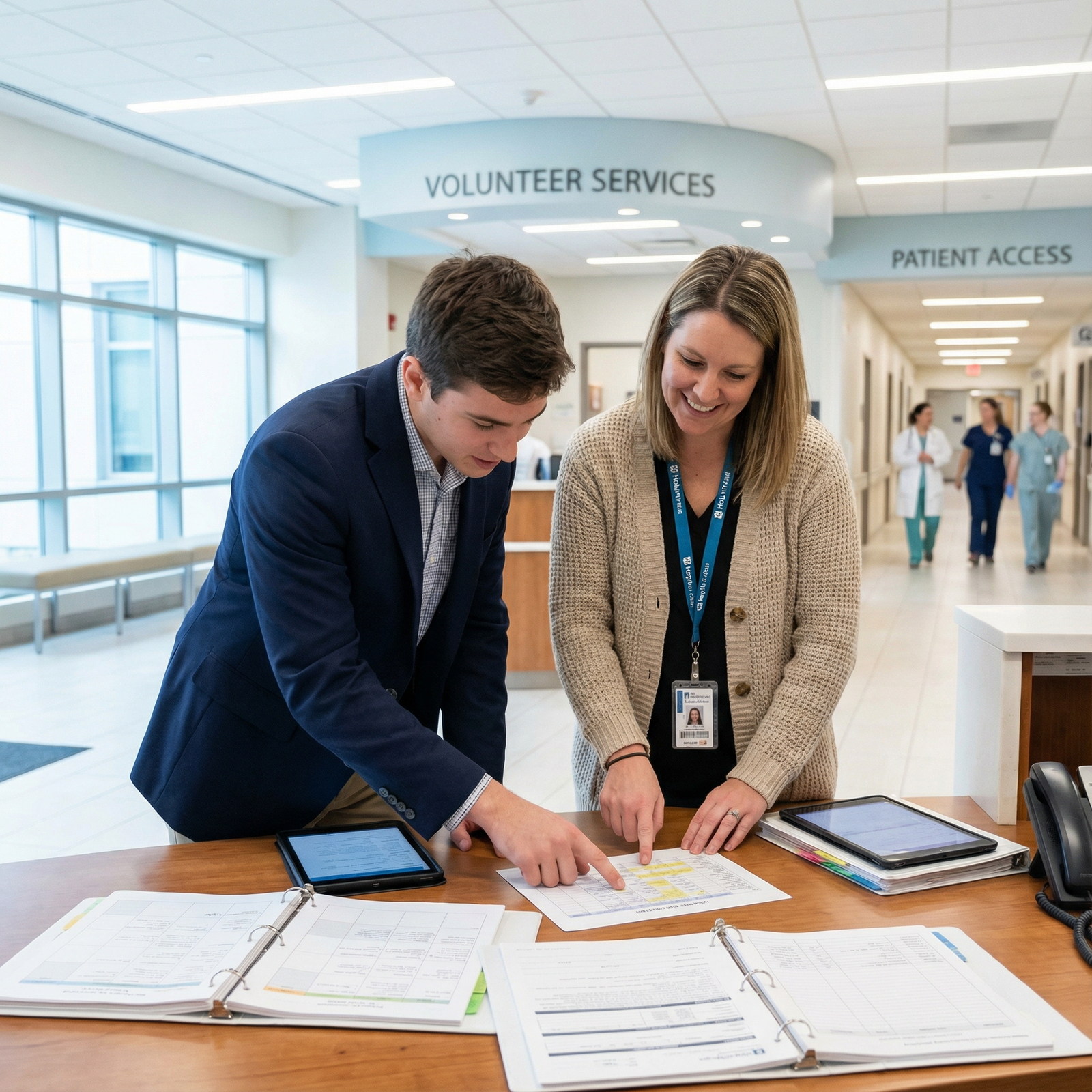
Here is the exact protocol to execute a walk-in or cold outreach without looking like an amateur:
1. The Pre-Cleared Portfolio
Never walk into a clinic with empty hands and a hope. Carry a neat, professional folder containing:
- A concise 1-page resume.
- Proof of up-to-date immunizations (TB test, Flu, Hepatitis B, COVID-19).
- A letter of intent from your university premed advisor verifying your good standing.
- A signed general liability waiver template.
2. The Script for Frontline Staff
When approaching a front desk or clinic manager, never ask: "Is the doctor available so I can ask to shadow?" That immediately puts the staff on the defensive.
Instead, use this exact phrasing:
"Hello! My name is Alex, I'm a pre-medical student at State University. I'm looking to complete official clinical shadowing hours, and I want to make sure I follow your practice's exact compliance process. Could you direct me to the clinic manager or coordinator who handles educational observers?"
This script immediately signals three things: you respect their hierarchy, you care about compliance, and you aren't going to ambush their doctors.
3. Accepting "No" as a Test
If the staff tells you, "We don't allow shadowing due to health system policies," your response is your final test of professional maturity.
Do not argue. Do not ask for exceptions. Smile, hand them a business card or contact slip, and say:
"I completely understand and respect your security policies. Thank you so much for your time and for keeping patient data safe."
You would be amazed at how many clinic managers call a student back three weeks later simply because that student was the only premed all month who didn't act entitled when rejected.
Scheduled Shadowing That Doesn't Fade: How to Get Evidence, Not Just Access
Congratulations, you got a scheduled block. Now, how do you prevent it from turning into a passive, boring blur where you stand in a corner for six hours and learn nothing?
You build an Observation Log.
AdComs love specifics. When an applicant writes, "I saw how hard oncology is," we yawn. When an applicant writes, "I observed how Dr. Vance balanced empathetic transparency with clinical objectivity when breaking bad news about a stage IV recurrence," we pay attention.
The 5-Point Clinical Observation Log
After every single shadowing session, spend 10 minutes in your car writing down these five fields:
- Date & Hours: Exact metrics for your application log.
- Clinical Theme of the Day: (e.g., Navigating patient non-compliance in diabetic management).
- One Specific Question Asked: (e.g., I asked the attending how they manage cognitive fatigue during 12-hour surgical calls).
- One Professional Behavior Observed: (e.g., Observed how the surgeon deferred to the scrub tech's count error without ego).
- Follow-Up Reading: (e.g., Read NEJM paper on current GLP-1 receptor agonist guidelines after seeing 4 clinic patients on the regimen).
The End-of-Day Debrief Strategy
Two minutes before you leave, approach your host clinician with a micro-debrief.
"Dr. Smith, thank you so much for today. Watching how you explained that procedure to the nervous patient in Room 4 was incredible. Is there anything specific I should read or prepare before I come back next Tuesday?"
This single habit turns you from a silent shadow into an active, high-yield learner. It guarantees that when letter-writing season comes, that doctor will remember you clearly.
Common Mistakes AdComs Quietly Penalize (Even If a Doctor Said 'Sure')
Let's address the landmines. I have seen countless applicants tank what should have been great experiences because they broke unspoken clinical etiquette rules. Even if the attending doctor tells you "it's fine," trust me, the committee will judge you if these make it into your record or narrative:
- The Mobile Phone Twitch: Pulling out your phone in an exam room, an OR control room, or a nurses' station. In healthcare, a phone out in a clinical space is treated as an active HIPAA breach risk. Put it in airplane mode and leave it in your bag.
- Dressing Like a Student, Not a Clinician: Showing up in wrinkled scrubs, sneakers, or casual business attire with open-toed shoes. If you aren't sure of the dress code, wear a professional ironed outfit with comfortable, closed-toe leather shoes.
- Interrupting Patient Interactions: Asking questions while the doctor is actively talking to a patient or taking a history. Save every single question for the hallway or the office.
- Overstepping Authorization Scope: Claiming on your application that you "assisted with a suture" or "helped hold retraction" when you were strictly cleared only as a passive observer. AdCom physicians read this instantly as a massive compliance violation. You are an observer, not a medical trainee. Keep your narrative strictly within scope.
Decision Framework: When Walk‑In Helps vs When Scheduled Is Non‑Negotiable
Should you ever walk in? Yes, but only in specific scenarios where institutional policy permits it. Use this decision matrix to determine your approach:
The General Rule:
- Large Academic Centers & Hospitals: Walk-ins are a total non-starter. You will be stopped by security, you will annoy coordinators, and you risk getting blacklisted from the system's formal volunteer pathways. Scheduled is non-negotiable.
- Rural Clinics & Solo Private Practices: Direct, walk-in outreach to introduce yourself to a clinic manager is often acceptable, and sometimes expected, because these practices lack complex institutional clearance bureaucracy.
Framing It in Your Application
When you write your personal statement and activity descriptions, how you frame your shadowing dictates how the committee views your maturity.
Never write:
"I walked into a local clinic, talked my way into the back, and convinced the doctor to let me watch procedures all day." (Translates to: I am reckless and don't care about rules.)
Instead, write:
"Following formal health system clearance and HIPAA compliance onboarding, I completed 40 scheduled hours observing Dr. Jones in outpatient family medicine..." (Translates to: I understand clinical governance and act like a professional.)
If your initial contact was informal, focus the narrative entirely on what happened after you were formally integrated into their workflow. Frame your persistence as structured, compliant effort.
Key Takeaways
- AdComs evaluate operational maturity, not just hours. How you secure shadowing tells us how you will handle institutional rules as a medical student.
- Walk-in shadowing carries hidden friction. It puts frontline staff in a tough spot regarding HIPAA, liability, and safety policies.
- Scheduled shadowing yields superior letters. Structured, cleared blocks allow attendings to evaluate you safely and systematically over time.
- Document specifics immediately. Use an observation log after every shift to build a repository of rich, reflective evidence for your essay narratives.