
Educational disclaimer: This article is for general medical education and immigration-awareness purposes only. It is not legal, tax, financial, or immigration advice. Rules and outcomes can vary by case, institution, timing, and country of processing. IMG residents should review questions with qualified immigration counsel, their GME office, and other appropriate professionals before making decisions.
Here's the mistake. A dangerous one.
You get H-1B status for residency, hear the words dual intent, and your brain relaxes. You assume you're in the "safe" visa category now. Green card plans? Fine. Travel? Fine. Employer changes? Probably fine. That false sense of safety is exactly how IMG residents get blindsided.
I've seen this happen in real life. A resident had valid H-1B status, strong performance, no disciplinary issues, and still got tripped up because they treated the label like protection instead of treating the paperwork like a live system that needed constant checking. Another traveled home for a family event assuming "I'm H-1B, so reentry is straightforward." It wasn't. Missing document review. Old visa stamp. Panic at the consulate. Training start date suddenly too close for comfort.
That's the core problem: people confuse H-1B being generally compatible with dual intent with H-1B making everything immigration-safe. Those are not the same thing. Not even close.
For IMG residents, the danger points are painfully predictable:
- visa stamping
- reentry after travel
- extension timing
- employer or training-site changes
- leave, payroll, and status interruptions
- sloppy records between GME, HR, and counsel
If you remember one thing, remember this: dual intent does not mean zero scrutiny. It does not mean zero risk. And it absolutely does not mean you can stop paying attention.
This article is for educational purposes only. It is not financial advice, not legal advice, and not tax advice. Figures vary by individual circumstances, consult a qualified professional before acting.
Hook: The H-1B Myth That Gets IMGs Into Trouble
The myth survives because it sounds neat and comforting. H-1B is known as a visa category that can coexist with future immigrant intent. So people flatten that into a lazy summary: "H-1B is safe if I want a green card later." Then they flatten it even further into something worse: "H-1B means I don't need to worry much."
Wrong.
H-1B is not a magic shield. It is a work-authorized immigration status tied to specific facts. Specific employer. Specific role. Specific dates. Specific petition. If those facts drift, if your travel plans don't match your documents, if your program changes details and nobody updates the immigration side properly, you can run into trouble fast.
The residency environment makes this worse. Residents are overloaded, sleep-deprived, and conditioned to trust systems. You assume GME has it. HR has it. Outside counsel has it. Sometimes they do. Sometimes they absolutely do not. And when there is a mismatch, you are the one standing at the consulate window or port of entry trying to explain why your training site changed three months ago and your paperwork did not.
That is why I push back hard on the "safe dual intent" myth. It makes smart people careless.
For related background, it also helps to understand the broader differences between J-1 vs H-1B for IMG residency training, the common timing traps in the ERAS and Match visa planning timeline, how residency-to-fellowship visa transitions can create new filing issues, why travel and visa stamping rules for IMG physicians deserve their own checklist, what to review in an IMG residency contract before signing, and how fellowship sponsorship policies vary by institution can affect longer-term planning.
Myth vs Reality: What Dual Intent Actually Means for H-1B
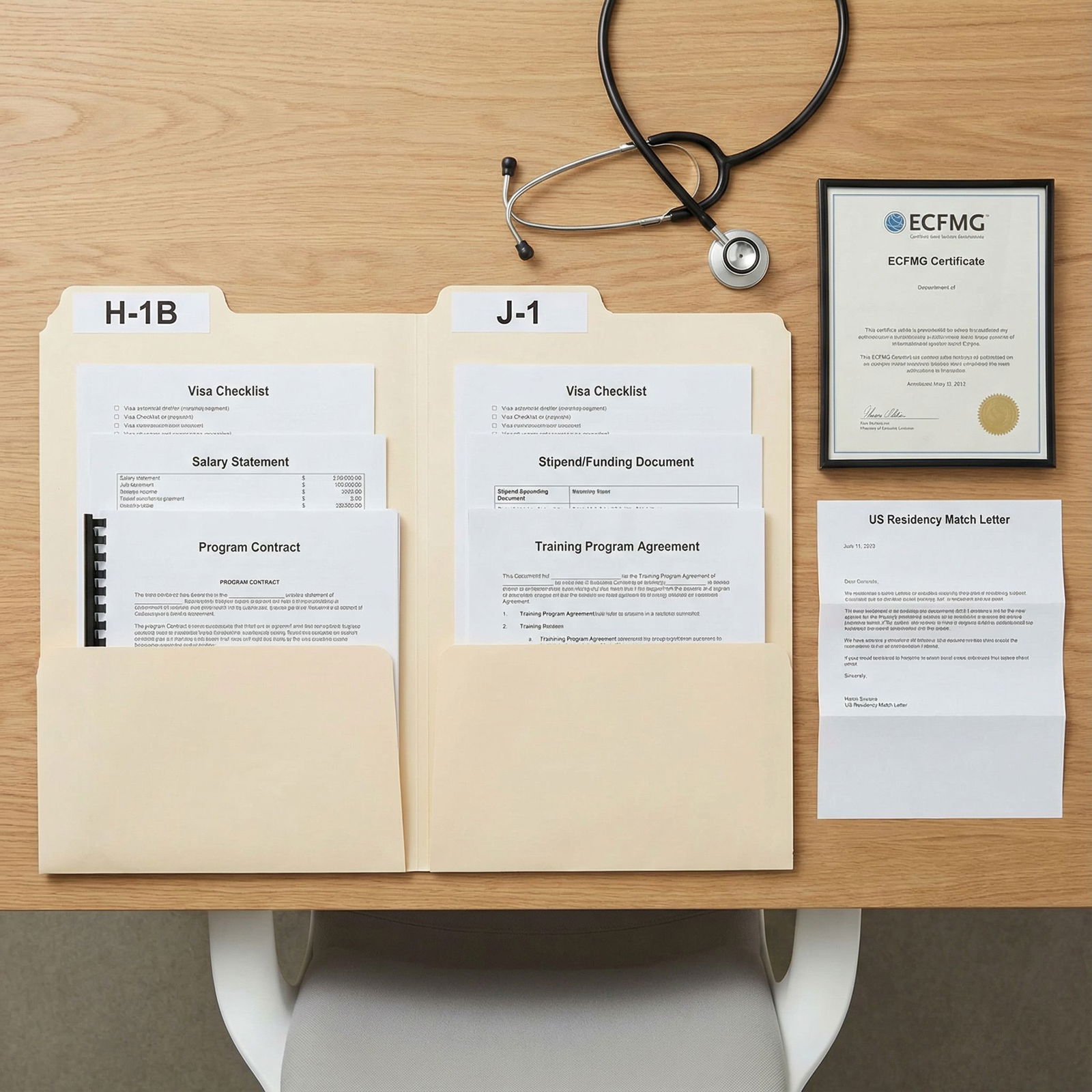
Let's clean this up in plain language.
Dual intent means H-1B is generally compatible with two things being true at once:
- You are coming temporarily to work.
- You may also want permanent residence in the future.
That is helpful. It matters. But don't make the classic mistake of stretching that concept beyond what it actually does.
Myth:
"If I'm on H-1B, I can openly show immigrant intent and I'm basically insulated from visa trouble."
Reality:
H-1B does not erase scrutiny. It does not excuse inconsistencies. It does not fix bad travel planning, stale records, or employer changes that were handled sloppily.
Consular officers still review facts. Border officers still review facts. USCIS still reviews facts. If your story, documents, timing, or employment details do not line up, the phrase dual intent will not rescue you.
A better way to think about H-1B is this:
- It is more forgiving than categories that require clear nonimmigrant intent.
- It is not immunity from review.
- It is not permission to be vague.
- It is not a substitute for document discipline.
IMG residents get into trouble when they treat a legal concept like a lifestyle guarantee. I've heard versions of this over and over: "But my friend said H-1B is the good one." That kind of secondhand advice is how people get stranded abroad or discover too late that status in the U.S. is not the same thing as having what you need for smooth reentry.
The hard truth? H-1B is often a solid option. But sloppy confidence ruins solid options every day.
Where IMG Residents Get Burned: Common H-1B Pitfalls
This is where good residents make bad assumptions.
1) Travel without a real reentry check
Big one. Maybe the biggest.
You can be in valid H-1B status inside the U.S. and still have reentry problems if:
- your visa stamp is expired
- your petition documents are incomplete
- your passport validity is an issue
- your employer situation has changed
- your travel timing overlaps with an extension, amendment, or transfer question
Status and visa are not the same thing. Don't mix them up. That confusion burns people every year.
2) Assuming your hospital "handles everything"
No. Your program may sponsor you. That does not mean every coordinator, HR staffer, lawyer, and administrator knows your real timeline or catches every discrepancy.
I've seen:
- payroll dates not matching expectations
- site changes not clearly communicated
- moonlighting questions answered casually when they should have triggered legal review
- leave of absence handled as an HR issue only, with nobody checking immigration consequences
That is not evil. It's just bureaucracy. And bureaucracy is terrible at protecting the person who assumes too much.
3) Employer, training-site, or role changes
A residency or fellowship setup can change in ways that feel minor operationally but matter legally. Main site changes. Added locations. Transition from one institution to another. Fellowship after residency. Chief year. Research block. These details can affect whether an amendment, new filing, or timing review is needed.
Don't decide on your own that a change is "probably administrative." That phrase causes damage.
4) Gaps, leave, and payroll problems
If the petition says one thing and the real-world history says another, that's a red flag.
Examples:
- unpaid leave without proper review
- delayed onboarding
- gap between programs
- inconsistent payroll records
- not keeping pay stubs or approval notices
- unexplained time not working
A clean immigration file is built from boring documents. Pay statements. I-94 records. Approval notices. Passport validity. Appointment letters. Rotation details when relevant. Ignore the boring stuff and you create exciting problems.
5) Moonlighting and side work assumptions
Residents hear things in hallways. "Everyone does it." "It's internal." "It's under the same hospital system." Bad logic. H-1B work authorization is employer- and role-specific. If there's any question about work outside the approved setup, stop and verify before you do anything.
Not after. Before.
How to Tell If You Are Actually Safe: A Practical Checklist
If you want a practical way to think about safety, stop asking, "Do I have H-1B?" Start asking, "Do the facts still match the file, and am I prepared for the next checkpoint?"
Use this checklist.
Your H-1B safety checklist
A. Confirm your core status documents
- Current H-1B approval notice
- Most recent I-94
- Valid passport
- Current visa stamp status, if travel is possible or planned
- Copies of prior immigration approvals if relevant
If you can't find these quickly, that's already a problem.
B. Confirm that your actual job matches the petition
Ask:
- Is the sponsoring employer the same?
- Are you working in the expected role?
- Have your main training locations changed?
- Did anything about your schedule, duties, or structure change in a way that might matter?
If the facts changed, don't guess whether it's okay.
C. Check dates like your career depends on them
Because it does.
Review:
- petition start and end dates
- passport expiration
- visa stamp expiration
- training transition dates
- fellowship start dates
- any cap-gap assumptions, if applicable in your broader planning
One of the dumbest mistakes is noticing a date problem only after booking travel or signing a new contract.
D. Separate "status" from "visa"
This distinction matters constantly.
- Status = your lawful authorization to stay/work in the U.S.
- Visa stamp = what you may need to seek entry after travel abroad
You can be fine in the U.S. and still not be ready to reenter after an international trip. Don't let that surprise you.
E. Keep continuity records
Maintain:
- pay stubs
- W-2s or payroll summaries
- offer and appointment letters
- leave documentation
- rotation or site documentation if changes occurred
- email confirmations from GME/HR/counsel on major immigration-related questions
This is your defensive file. Build it before you need it.
The stop-and-verify rule
If any of these happen, stop and verify before acting:
- international travel
- visa stamping appointment
- leave of absence
- moonlighting
- change in program or institution
- new training site
- delayed start date
- early resignation or contract change
- transition from residency to fellowship
That pause can save months of chaos.
What to Do Instead: Safer Planning Before You Assume Dual Intent Will Protect You
Prompt: Vintage sketch style with modern realism, an IMG resident seated at a desk under warm lamp light reviewing passport, I-94 printout, H-1B approval notice, and travel checklist while speaking to immigration counsel on a laptop video call, papers neatly arranged, subtle hospital badge and boarding pass nearby, cautious organized mood, detailed pen-and-ink textures with soft color wash, no text overlays, no watermark
Here's the smarter approach. Less swagger. More systems.
1. Build one immigration folder
Digital and physical if possible. Keep:
- passport copies
- visa stamps
- I-94 records
- H-1B approval notices
- contracts and appointment letters
- pay records
- counsel emails on important decisions
Do not rely on your institution to be your only archive.
2. Review before every trip
Not after the ticket is booked. Before.
Check:
- Do I need a valid visa stamp for reentry?
- Is my passport valid long enough?
- Has anything changed in my employment or training setup?
- Am I traveling during an extension or amendment issue?
- Do I have the right support letter or documents?
Travel is where false confidence gets punished.
3. Ask about changes early
Before:
- switching programs
- adding sites
- accepting moonlighting
- taking leave
- moving from residency to fellowship
- assuming H-1B portability applies cleanly in your case
Early questions are cheap. Late fixes are ugly.
4. Coordinate, don't assume
Loop in:
- GME
- HR
- immigration counsel
- your future program, if changing roles
And then verify that everyone is talking about the same facts. Same dates. Same employer name. Same sites. Same plan. You'd be amazed how often one office has old information while another is acting on something newer.
5. Do a status review now
Don't wait for the next emergency.
This week, sit down and review:
- what status you are in
- when it expires
- whether your travel documents match your plans
- whether any training or work details have changed
- where your weak points are
That's the action step. Real, boring, protective action. H-1B can be a strong pathway for IMG residents. I believe that. But treating it like automatic safety is lazy thinking, and lazy thinking is what gets people in trouble. Review your file now. Find the gaps now. Fix them before the next renewal, trip, or job change forces the issue.
Key Takeaways
- H-1B can support dual intent, but do not make the mistake of treating it as automatic protection from immigration problems.
- The biggest risks for IMG residents are travel, status gaps, employer changes, and poor documentation, not the H-1B label itself.