
Understanding the Landscape: Why Visa Planning Is Critical in Alaska & Hawaii
International medical graduates (IMGs) applying to Alaska residency and Hawaii residency programs face the same core U.S. visa framework as those targeting the mainland—but with some unique regional realities:
- Fewer total residency positions
- Geographic isolation and limited local workforce
- Heavy reliance on physicians in underserved and rural areas
- A strong need for long‑term retention after training
Because of these factors, programs in Alaska and Hawaii may think more strategically about which visa types they sponsor and how likely a resident is to stay post‑training. Understanding J‑1 vs H‑1B, common IMG visa options, and state‑specific trends is essential before you apply.
This guide focuses on practical, actionable strategies to help you:
- Choose between J‑1 and H‑1B pathways
- Identify which programs in Alaska and Hawaii sponsor which visas
- Anticipate waiver and long‑term immigration options after residency
- Plan your residency visa timeline around Match, USMLE, and ECFMG milestones
Core Visa Options for IMGs in Alaska & Hawaii
Most IMGs in U.S. residency use one of two primary visa types: J‑1 (Exchange Visitor) or H‑1B (Temporary Worker: Specialty Occupation). A small subset may use other statuses (e.g., permanent residents, EAD holders), but the J‑1 vs H‑1B decision is central for many applicants.
1. J‑1 Visa for Residency
The J‑1 physician visa is managed via ECFMG sponsorship and is the most common visa pathway for IMGs entering U.S. graduate medical education.
Key features:
- Sponsored by ECFMG, not by each individual program’s own petition
- Limited to graduate medical education (residency/fellowship)
- Usually issued in one-year increments, renewable up to the length of approved training
- Comes with a 2-year home residence requirement (INA 212(e)) for most J‑1 physicians
Pros of J‑1 for Alaska & Hawaii residency
- Widely accepted: Many programs that don’t sponsor H‑1B will still accept J‑1 residents.
- Administratively familiar: Program coordinators and GME offices are usually very comfortable with J‑1 workflows.
- Shorter lead time: Often easier to secure in time for July 1 start, especially for IMGs finalizing exams or ECFMG certification close to Match.
Cons of J‑1
- Two‑year home country physical presence requirement after completion of training, unless you qualify for and obtain a valid J‑1 waiver.
- Time on J‑1 does not generally lead to permanent residence (green card) by itself; a separate path is required after training (e.g., waiver, H‑1B, or other options).
- You are generally limited in moonlighting and work location to the training program unless ECFMG authorization is granted.
For Alaska and Hawaii, the J‑1 can still be an excellent option, but your post‑residency strategy must include either:
- Returning to your home country for two years, or
- Obtaining a J‑1 waiver job in the U.S. (often in underserved areas, which are common in both states)
2. H‑1B Visa for Residency
The H‑1B is a dual‑intent employment visa that allows you to have long‑term immigration plans (including permanent residency) while in training.
Key features:
- Employer-sponsored (the residency program petitions for you)
- Specialty occupation classification; you must typically have:
- USMLE Step 3 passed before petition filing (in most states/programs)
- Full ECFMG certification
- Not subject to the regular H‑1B “cap” when sponsored by qualifying non‑profit or academic hospitals (most residency programs fall under “cap-exempt” category)
Pros of H‑1B for Alaska & Hawaii
- No two‑year home residency requirement like J‑1.
- Dual intent: You can apply for a green card while in H‑1B status.
- Some flexibility after training—can potentially transfer H‑1B to an employer in Alaska, Hawaii, or another state.
Cons of H‑1B
- Not all programs sponsor H‑1B; in smaller, geographically isolated states, some institutions avoid the extra legal/administrative cost.
- Requires Step 3 and ECFMG certification sufficiently early to file before residency start (this timing is a common barrier for IMGs).
- Time-limited: Maximum of 6 years in H‑1B status (with some exceptions if green card processes have begun).
3. Other/Additional Statuses
While less common in the context of residency visa planning, a small number of applicants may enter training in:
- Permanent resident (green card) status
- Other work-authorized statuses (e.g., EAD via asylum, TPS, DACA, or marriage to a U.S. citizen/permanent resident)
- Canadian citizens under special professional categories (though these usually matter more for non-GME roles)
If you hold another status, you may not need a “residency visa” per se, but programs will still verify your work authorization carefully.
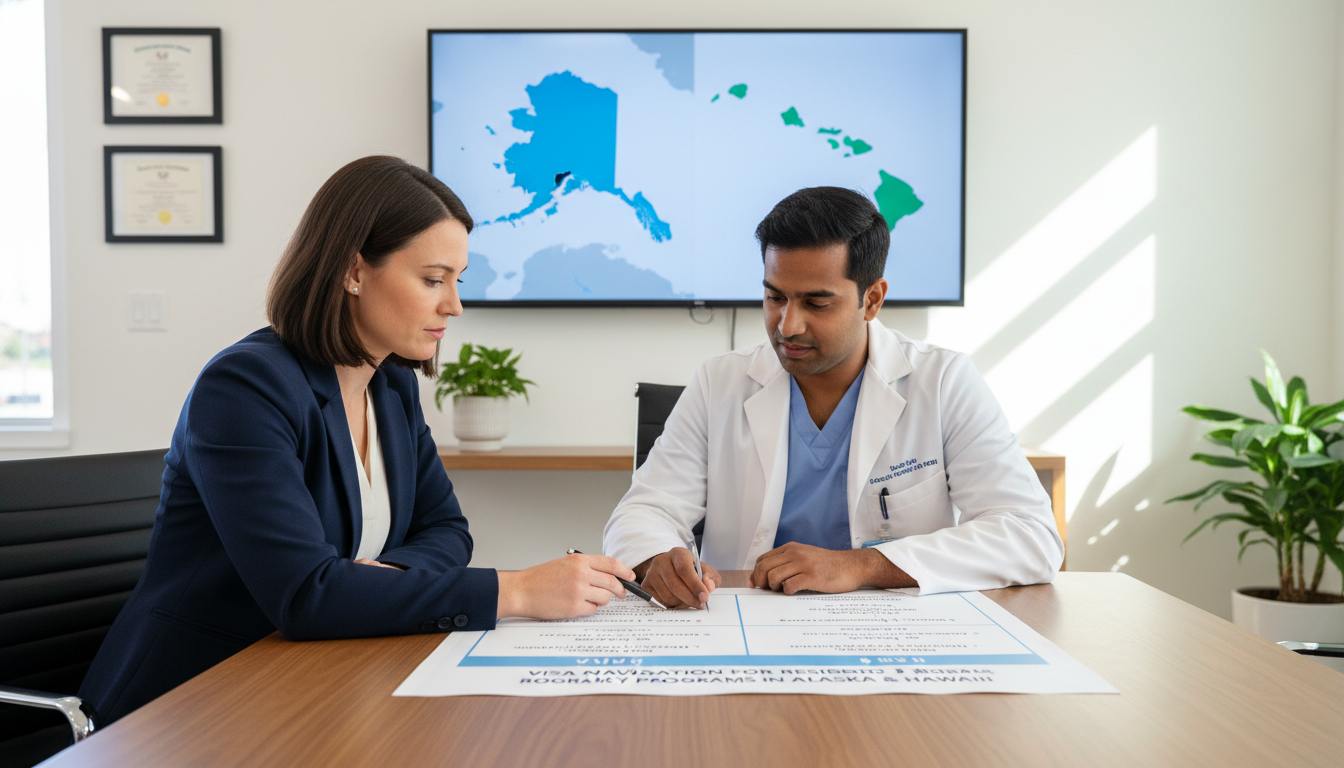
J‑1 vs H‑1B: Strategic Choices for Alaska & Hawaii Residency
Deciding between J‑1 vs H‑1B is not just about program eligibility; it also shapes your options after training. For Alaska and Hawaii, with their strong need for physicians in underserved areas, your choice may align closely with long‑term workforce needs.
When a J‑1 Path Makes Sense
Consider favoring J‑1 if:
Your Step 3 timing is tight.
- You may not be able to sit Step 3 before Match or before the program’s H‑1B filing deadline.
- Some Alaska and Hawaii hospitals have early cutoffs for H‑1B paperwork due to payroll/HR cycles.
You are open to a J‑1 waiver job in the U.S. after residency, which often:
- Is in a Health Professional Shortage Area (HPSA) or Medically Underserved Area (MUA).
- Could be in community hospitals or clinics in rural or remote regions of Alaska or Hawaii.
Your main goal is residency training and board certification, and you are prepared to:
- Return home for two years (if you prefer to work in your home country for a period), or
- Strategically compete for a J‑1 waiver spot post‑training.
Example scenario
- You match into an Alaska family medicine residency that accepts J‑1 but not H‑1B.
- You complete three years of training on J‑1.
- After residency, you secure a Conrad 30 J‑1 waiver position in a rural Alaskan community health center for three years.
- You later transition to H‑1B and eventually to a green card based on employer sponsorship.
When an H‑1B Path Makes Sense
H‑1B may be preferable if:
You want to avoid the two‑year home residency requirement entirely.
You aim for long‑term practice in Alaska or Hawaii and hope to:
- Remain at the same institution that trained you, or
- Transition smoothly to another employer in the same state or mainland.
You are ready to:
- Pass USMLE Step 3 early (ideally before Match or soon after).
- Meet stricter program criteria for H‑1B sponsorship (e.g., sometimes higher board scores, earlier ECFMG certification).
Example scenario
- You target a Hawaii internal medicine residency program known to sponsor H‑1B.
- You pass Step 3 before Match, are ECFMG certified, and the program files an H‑1B petition shortly after Match Day.
- After residency and maybe a fellowship, you accept a hospitalist job in the same health system on H‑1B and start a green card process there.
Mixed Strategy: Applying Broadly with a Preference
For many IMGs, a realistic plan is:
- Indicate willingness to accept J‑1 or H‑1B on ERAS, unless you have strong reasons otherwise.
- But strategically target programs known to sponsor your preferred visa type.
- Once you have interviews or offers, discuss visa options in more detail with program leadership or GME.
State‑Specific Considerations: Alaska Residency
Alaska has a small number of residency programs and a profound need for physicians in underserved communities. These factors can influence visa strategy, especially for IMGs.
Types of Residency Programs in Alaska
Alaska’s primary GME presence includes:
- Family medicine (e.g., community‑based or university‑affiliated programs)
- Psychiatry (in development or expansion in some years)
- Certain specialty tracks partnering with mainland institutions (e.g., WWAMI‑affiliated rotations)
Programs may be linked to larger academic centers in the Pacific Northwest, which can shape their visa policies (particularly J‑1 sponsorship history).
J‑1 in Alaska Residency Programs
Alaska’s reliance on IMGs, especially in primary care, often makes J‑1 sponsorship acceptable and relatively common.
Important points:
- J‑1 physicians can train effectively in regional and rural settings.
- After residency, J‑1 waiver jobs are often available in Alaska because:
- Many regions qualify as HPSA/MUA.
- The state has an interest in retaining physicians who have trained there.
J‑1 waiver options relevant to Alaska:
Conrad 30 Program (State‑based)
- Alaska has a Conrad 30 program offering up to 30 J‑1 waivers per year.
- Priorities often go to primary care and high‑need areas.
- Many positions are in rural or remote communities.
Federal Programs
- VA (Department of Veterans Affairs)
- Appalachian Regional Commission (not applicable to Alaska)
- Delta Regional Authority (not applicable to Alaska)
- Other federal agencies sometimes sponsor waivers for specific institutions.
H‑1B in Alaska Residency Programs
Smaller programs may be more cautious about H‑1B sponsorship due to administrative burden. However, some institutions, especially those affiliated with university systems or larger hospital networks, may sponsor H‑1B if:
- You have Step 3 completed early.
- The program has previously succeeded with H‑1B residents.
After training, H‑1B‑based practice in Alaska is often concentrated in:
- Major hospitals in Anchorage or regional hubs
- Community health centers with the resources to sponsor H‑1B or green cards
- Telemedicine‑integrated practices that still require physician presence for certain care
Practical Advice for Alaska‑Focused Applicants
- Research early: Contact Alaska residency programs directly or check their websites/NRMP/FRIEDA listings regarding visa policies.
- Highlight retention interest: Emphasize during interviews your interest in long‑term practice in Alaska—programs often prefer applicants likely to stay.
- Align specialty and waiver potential: Family medicine, internal medicine, and psychiatry are especially aligned with Alaska’s long‑term needs and J‑1 waiver availability.

State‑Specific Considerations: Hawaii Residency Programs
Hawaii residency programs are primarily clustered around major health systems in Honolulu and select community hospitals. Competition can be significant given the desirable location, but the island geography also creates healthcare access challenges in outer islands and rural communities.
J‑1 in Hawaii Residency Programs
Many Hawaii residency programs accept J‑1 visa residents, especially in:
- Internal medicine
- Family medicine
- Psychiatry
- Pediatrics and certain other specialties depending on the year
J‑1 physicians often rotate through:
- Large tertiary care centers on Oahu
- Community hospitals and clinics that serve diverse and underserved populations
- Rural/neighbor island rotations
Post‑residency J‑1 waiver options in Hawaii:
- Conrad 30: Hawaii also operates a state Conrad 30 program.
- Primary care and psychiatry are often priority fields.
- Many opportunities lie in neighbor islands or under‑resourced communities on Oahu.
For an IMG who trains on J‑1 in Hawaii, a common pathway is:
- Complete residency (and sometimes fellowship).
- Obtain a J‑1 waiver position in a shortage area, possibly on a neighbor island.
- After three years of service, transition to H‑1B/green card.
H‑1B in Hawaii Residency Programs
Hawaii programs that sponsor H‑1B usually do so for:
- Highly qualified candidates who meet all criteria well in advance.
- Specialties where the institutions know they can justify long‑term staffing needs.
Potential advantages in Hawaii:
- H‑1B residents can more easily remain with the same institution post‑GME.
- Dual intent allows for earlier initiation of permanent residence processes.
Constraints:
- Some Hawaii programs explicitly do not sponsor H‑1B due to administrative cost or policy.
- Others might limit H‑1B to a fixed number of positions per year.
Practical Advice for Hawaii‑Focused Applicants
- Target programs aligned with your visa status: If you want H‑1B, carefully confirm each program’s historical willingness to sponsor it.
- Be explicit about Step 3 plans: If aiming for H‑1B, mention your Step 3 status in your application and interviews.
- Show long‑term interest in Hawaii: Programs may perceive J‑1 applicants more favorably if they express commitment to future practice in Hawaii, including potential J‑1 waiver service in underserved areas.
Application Strategy, Timeline, and Actionable Steps
To navigate residency visa options effectively in Alaska and Hawaii, you need a coordinated plan that ties together exams, ECFMG certification, and immigration steps.
Step 1: Before Applying – Clarify Your Visa Goals
Ask yourself:
- Am I willing to do a J‑1 waiver or return home for two years?
- Can I realistically pass Step 3 early enough for H‑1B?
- Where do I want to practice long‑term—Alaska, Hawaii, mainland U.S., or my home country?
Based on your answers, define:
- Primary preference: J‑1 or H‑1B
- Backup option: The other visa type or another legal status (if applicable)
Step 2: Research Alaska & Hawaii Programs’ Visa Policies
Use:
- Program websites (often under “International Medical Graduates” or “Visa Sponsorship” sections)
- FREIDA, program brochures, or informational webinars
- Direct emails to program coordinators with precise questions, e.g.:
- “Do you sponsor J‑1 visas through ECFMG?”
- “Do you sponsor H‑1B visas for residents, and if so, what requirements must be met (e.g., Step 3 timing)?”
Make a simple spreadsheet:
- Columns: Program name, specialty, state (AK/HI), J‑1 (Y/N), H‑1B (Y/N), Step 3 required for H‑1B (Y/N), comments.
- Use this to prioritize where to apply, especially if you have limited application budget.
Step 3: Align Exams and ECFMG Certification with Visa Targets
If targeting H‑1B:
- Schedule USMLE Step 3 early—ideally before or around Match season.
- Some states have their own rules about Step 3 timing for residency licensure and H‑1B petitions; confirm with programs.
If comfortable with J‑1:
- Focus on completing USMLE Steps 1 and 2 CK and securing ECFMG certification in time for Match and visa processing.
- Ensure your home country residence status and citizenship documentation are updated for the DS‑2019 (J‑1) process.
Step 4: During Interviews – Talk About Visa and Long‑Term Plans
Programs in Alaska and Hawaii often care deeply about retention. During interviews:
- Honestly state your visa needs:
“I will require a J‑1 visa sponsored through ECFMG” or
“I am eligible for either J‑1 or H‑1B and am working to complete Step 3 for H‑1B.” - Emphasize your interest in:
- Rural medicine
- Underserved populations
- Long‑term commitment to the region (especially powerful for Alaska and Hawaii)
This helps programs see you not just as a temporary trainee, but as a potential future colleague.
Step 5: After Match – Understand Next Steps for Your Visa Type
For J‑1:
- Program issues necessary GME documents for ECFMG.
- You submit DS‑2019 application and supporting documents to ECFMG.
- Once DS‑2019 is issued, you schedule a J‑1 visa interview at the U.S. consulate.
- Enter the U.S. in time for orientation and July 1 start.
For H‑1B:
- Program HR or legal team initiates the Labor Condition Application (LCA).
- They file an I‑129 H‑1B petition (cap‑exempt) on your behalf.
- After approval, you attend visa stamping (if outside U.S.) or change status (if already inside the U.S. in another lawful status).
- Begin residency on H‑1B status as specified in the approval notice.
Looking Beyond Residency: Long‑Term Paths in Alaska & Hawaii
J‑1 Residents
If you trained on J‑1 in Alaska or Hawaii, consider these post‑residency paths:
Conrad 30 Waiver Position in the Same State
- Work three years in a shortage area.
- Eventually change to H‑1B and potentially apply for a green card.
Federal Waiver Programs
- If you find eligible employment at a VA facility or another federal program site in Alaska or Hawaii.
Return Home for Two Years
- Some physicians choose to practice in their home country, then later return to the U.S. in another status.
H‑1B Residents
If you trained and worked on H‑1B:
Remain at the same institution post‑residency
- Many hospitals in Alaska and Hawaii need hospitalists, primary care, and psychiatrists.
- You may transition from “resident H‑1B” to “attending H‑1B” with the same employer.
Move to another employer in Alaska or Hawaii
- Transfer H‑1B to a new cap‑exempt employer (e.g., nonprofit hospital) or cap‑subject if appropriate.
Start a green card process
- Many institutions sponsoring H‑1B will also sponsor permanent residence (e.g., via PERM and I‑140).
FAQs: Visa Navigation for Residency in Alaska & Hawaii
1. Do all residency programs in Alaska and Hawaii sponsor visas for IMGs?
No. Some programs do not sponsor any visas and only accept U.S. citizens, permanent residents, or applicants with independent work authorization (e.g., EAD). Among those that do sponsor, J‑1 is more common than H‑1B. Always confirm each program’s current policy before applying.
2. Is it easier to get H‑1B for residency in Alaska or Hawaii compared to mainland U.S.?
Not necessarily. The process and requirements are essentially the same. Because Alaska and Hawaii have fewer programs and often limited legal resources, some may be more cautious about H‑1B sponsorship. Others, especially large academic centers, can be quite supportive. There is no automatic advantage based solely on location.
3. If I train on J‑1 in Hawaii, can I do my J‑1 waiver job in Alaska (or vice versa)?
Yes. Your J‑1 waiver job does not have to be in the same state where you completed residency. You could finish residency in Hawaii, then accept a J‑1 waiver position in Alaska, or the other way around, as long as you meet the waiver program’s criteria and obtain the waiver through that state or federal program.
4. Should I delay applying to Alaska or Hawaii residency programs if I don’t have Step 3 yet but want H‑1B?
Generally, no. You can still apply and interview. Many programs accept IMGs on J‑1 even if H‑1B is not possible due to Step 3 timing. If H‑1B is very important to you, make that clear during the process, but remain open to J‑1 if the program cannot wait for Step 3 or does not sponsor H‑1B at all. A flexible strategy often yields more opportunities.
Navigating visa options for IMGs in Alaska residency and Hawaii residency programs requires early planning, clear goals, and proactive communication with programs. By understanding J‑1 vs H‑1B, appreciating regional workforce needs, and aligning your long‑term plans with the realities of these unique states, you can build a viable and rewarding pathway to training—and potentially a career—in America’s northernmost and Pacific island frontiers.