Understanding the Visa Landscape as a Caribbean IMG
For a Caribbean medical school graduate, matching into a U.S. residency is only half of the challenge. The other half is securing the right visa to actually start training. Visa navigation for residency is a strategic process that needs to begin long before you submit ERAS.
As a Caribbean IMG, you likely fall into one of three broad categories:
U.S. Citizens or Permanent Residents (Green Card holders)
- No visa needed to train or work.
- You are considered “IMG” from an accreditation standpoint, but not for immigration.
Canadian Citizens or Other Foreign Nationals Studying in the Caribbean
- Typically require a J‑1 or H‑1B visa to pursue residency.
- Must plan around immigration rules, timing, and long‑term career goals.
Caribbean Nationals (from regional islands or Latin America) Studying in the Caribbean
- Similar immigration path as other foreign nationals, but sometimes with unique country-specific rules (e.g., exchange visitor agreements).
This article focuses on non‑U.S. citizen Caribbean IMGs and how to strategically navigate visas for residency—particularly the J‑1 vs H‑1B decision, the impact on your match strategy, and what you should be doing now to prepare.
You will see repeated references to “Caribbean medical school residency” and “SGU residency match” because large numbers of Caribbean IMGs graduate from institutions like St. George’s University (SGU), Ross, AUC, Saba, etc. The principles, however, apply across schools.
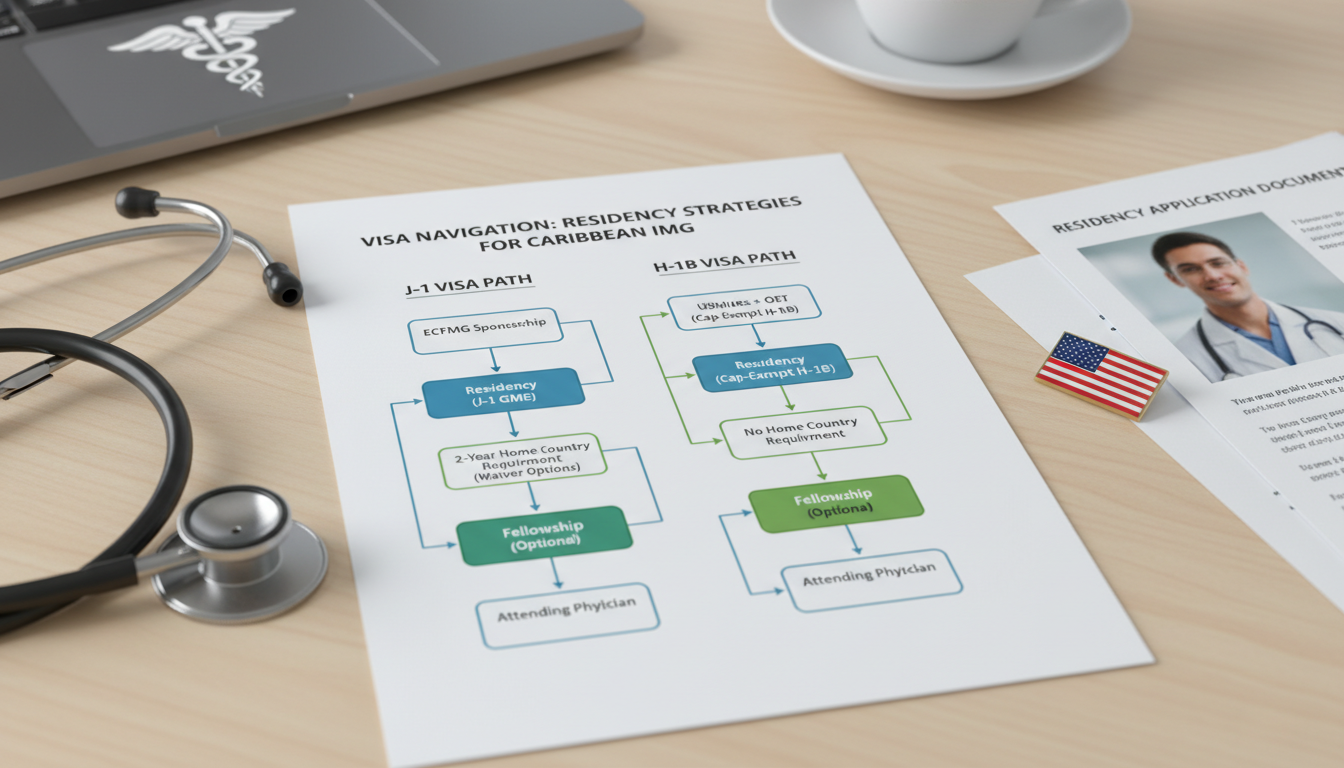
Core Visa Types for Residency: J‑1 vs H‑1B
The two main U.S. visa categories for residency are:
- J‑1 Alien Physician Visa (Exchange Visitor)
- H‑1B Temporary Worker Visa (Specialty Occupation)
Each has specific advantages, disadvantages, and long‑term consequences.
J‑1 Visa for Residency: The Default Path for Most IMGs
The J‑1 physician visa is the most commonly used route for international medical graduates entering U.S. residency.
Key Features:
- Purpose: Educational and training (not permanent immigration).
- Sponsor: The ECFMG (Educational Commission for Foreign Medical Graduates) is the visa sponsor, not the residency program.
- Duration: Granted yearly, typically renewable for up to 7 years of graduate medical education.
- SEVIS-Tracked: You are part of the exchange visitor program.
Pros of the J‑1 Visa:
Widely Accepted:
- A large majority of IMG‑friendly residency programs only sponsor or prefer J‑1.
- In many specialties, if you limit to H‑1B sponsorship only, your program list shrinks dramatically.
Lower Administrative Burden on Programs:
- ECFMG handles much of the immigration paperwork.
- Makes programs more willing to interview and rank J‑1 applicants.
Predictable for Training:
- Once approved, renewals during residency and fellowship are usually straightforward if you remain in good standing.
Cons of the J‑1 Visa:
Two‑Year Home Residence Requirement (HRR):
- Most J‑1 physicians are subject to a two-year home country physical presence requirement after completing training.
- You must return to your country of last permanent residence at the time of J‑1 issuance (often your citizenship country) for an accumulated two years before you can:
- Apply for an H‑1B or L‑1 visa, or
- Apply for a U.S. green card (permanent residency).
- Exception: You can often bypass this by securing a J‑1 waiver (discussed later).
Less Flexibility for Moonlighting or Non‑Training Work:
- Primary purpose must remain training; extra clinical work may be restricted by program and sponsor rules.
No Direct Dual Intent:
- J‑1 is not officially a “dual intent” visa. Publicly pursuing permanent immigration while on J‑1 can be complex and must be handled with legal guidance.
J‑1 Eligibility Highlights for Caribbean IMGs:
- ECFMG Certification (USMLE Step 1, Step 2 CK, and all certification requirements).
- A valid graduate medical education contract from an ACGME‑accredited U.S. residency.
- Proof of sufficient funds (usually met by your residency stipend).
- Compliance with ECFMG and U.S. Department of State requirements, including health insurance coverage.
H‑1B Visa for Residency: More Competitive but More Flexible Long‑Term
The H‑1B visa is a non‑immigrant work visa for specialty occupations and is often preferred by IMGs who want more flexibility toward permanent U.S. immigration.
Key Features:
- Sponsoring Entity: Your residency program petitions for the visa (not ECFMG).
- Duration: Up to six years total, often granted in 3‑year increments (residency + possibly fellowship).
- Dual Intent: You can be on H‑1B and simultaneously pursue a green card.
Pros of the H‑1B Visa:
No Two‑Year Home Requirement:
- You do not incur the J‑1 two‑year HRR.
- You can generally move directly into employment or permanent residency pathways after training.
Dual Intent:
- You can apply for a green card while on H‑1B without violating visa intent.
- Attractive for those seeking a long‑term U.S. career.
Stronger Position for Post‑Residency Jobs:
- Many employers are familiar with transitioning H‑1B clinicians into permanent staff roles.
Cons of the H‑1B Visa:
Limited Program Availability:
- Not all programs sponsor H‑1B because it is costlier and administratively complex.
- In some specialties or geographic areas, this can greatly reduce your options.
USMLE Step 3 Requirement (Usually):
- Most programs require USMLE Step 3 passed before H‑1B petition filing.
- This is a major timing challenge for Caribbean medical school residency applicants who are still in their final year or just graduating.
Higher Costs to Programs:
- Legal fees and filing costs are substantial, making some programs reluctant to sponsor H‑1B for interns.
Cap Issues (Sometimes):
- Many teaching hospitals are cap‑exempt, but not all.
- For cap‑subject employers after residency, timing of H‑1B lottery can complicate start dates.
J‑1 vs H‑1B: How to Decide as a Caribbean IMG
The decision is less about which visa is “better” and more about:
- Your career goals
- Your specialty competitiveness
- Your academic metrics
- Your timeline (especially for Step 3 and graduation)
You might lean toward J‑1 if:
- You want to maximize your chances of matching, especially in moderately competitive specialties.
- You are applying without Step 3 at the time of application.
- You are open to working in underserved or rural areas later (helpful for J‑1 waiver jobs).
- You prioritize getting into U.S. training over immediate immigration flexibility.
You might aim for H‑1B if:
- You have strong scores, strong CV, and more program interest.
- You are able to complete Step 3 early, ideally by September–December of the application cycle.
- You want to reduce dependency on J‑1 waivers and avoid the two‑year home requirement.
- You are targeting programs that explicitly offer H‑1B sponsorship (often large academic hospitals or IMG‑heavy community programs).
For many Caribbean IMGs, especially from SGU, Ross, AUC, and other well-known schools, the SGU residency match and similar outcomes show a strong reliance on J‑1 visas, simply because more programs are accessible that way. Even those aiming for H‑1B often include J‑1‑sponsoring programs to keep options open.
Pre‑Application Strategy: Building Visa‑Smart Residency Plans
For a Caribbean IMG, residency visa strategy must be integrated into your timeline, exam planning, and program list construction.
1. Plan USMLE Timing with Your Visa Goal in Mind
If your goal is to keep H‑1B on the table:
- Aim to pass Step 3 as early as realistically possible, often:
- During the last year of medical school, or
- During a transitional year or research position in the U.S.
- This requires:
- Strong Step 1 and Step 2 CK foundations.
- Good clinical knowledge and time for dedicated Step 3 prep.
If you are content with J‑1:
- You are not required to have Step 3 before residency.
- You can focus on excelling in:
- Step 1 and Step 2 CK
- Clinical rotations (especially U.S. clinical experience)
- Letters of recommendation and personal statement.
2. Research IMG Visa Options by Program Early
Program visa policies are not always obvious from websites alone.
Where to look:
- FREIDA: Some programs list whether they sponsor J‑1, H‑1B, or both.
- Program Websites:
- Look under “International Medical Graduates,” “Eligibility,” or “Application Requirements” sections.
- Email Programs (Smartly):
- Short, professional email to the program coordinator:
- Confirm whether the program sponsors J‑1 and/or H‑1B for PGY‑1.
- Ask if Step 3 is required for H‑1B.
- Short, professional email to the program coordinator:
Example email template:
Dear [Program Coordinator Name],
I am an international medical graduate from [Caribbean school name] planning to apply to your [Specialty] residency program this cycle. Could you please confirm which visa types your program sponsors for incoming PGY‑1 residents (J‑1 and/or H‑1B), and whether Step 3 is required for H‑1B sponsorship?
Thank you for your time and assistance.
Sincerely,
[Your Name], MD Candidate [Year]
Practical tip: Create a spreadsheet with columns:
- Program Name
- Specialty
- State
- J‑1 (Yes/No)
- H‑1B (Yes/No)
- Step 3 Required? (Y/N)
- Notes/Email Confirmation Date
This will guide your ERAS program selection and ranking strategy.
3. Balance Your Program List for Visa Flexibility
As a Caribbean IMG, you usually want to keep both doors open unless you have a very strong profile and clear path to H‑1B.
If you do not have Step 3:
- Prioritize J‑1‑sponsoring programs.
- Include a few H‑1B‑sponsoring programs that will consider applicants without Step 3 for interviews (and allow Step 3 to be completed later), but recognize your odds of H‑1B are lower.
If you have Step 3:
- Apply broadly to both H‑1B and J‑1‑friendly programs.
- When interviewing, you can discuss visa options with programs that support both.
- Be cautious about telling programs you’ll accept only H‑1B if they routinely sponsor J‑1; you don’t want to be seen as inflexible.
Application & Interview Phase: Communicating Visa Needs Strategically
How and when you talk about your visa can influence your match success.
1. ERAS Application: How to Present Your Visa Status
In your ERAS MyERAS application:
- Answer truthfully about:
- Citizenship
- Current visa status (if any)
- Whether you require visa sponsorship
- If you are a Canadian citizen or Caribbean national, indicate that you require sponsorship.
- You don’t need to write about “J‑1 vs H‑1B” preferences in your personal statement.
2. During Interviews: When Visa Discussion is Appropriate
Interviewers and coordinators may ask:
- “Do you require visa sponsorship?”
- “Do you have any preference between J‑1 and H‑1B?”
- “Have you taken Step 3?”
Guiding principles:
- Be transparent but not demanding.
- Align with program policy where possible.
Example responses:
If the program only supports J‑1:
Yes, I do require visa sponsorship. I understand your program sponsors J‑1 visas, and I would be very happy to train under a J‑1 visa with ECFMG sponsorship.
If the program sponsors both J‑1 and H‑1B, and you have Step 3:
I do require visa sponsorship and am eligible for both J‑1 and H‑1B. In the long term, H‑1B may align slightly better with my immigration goals, but my top priority is excellent training, and I would gladly accept either option depending on what your program typically offers.
If you do not yet have Step 3:
I do require a visa and at this time would be eligible for J‑1. I am planning to take Step 3 [approximate time frame] if schedule permits, but I understand most programs prefer to finalize their visa type before the start date, and I’m comfortable pursuing the J‑1 route.
Avoid ultimatums (“I will only accept H‑1B”) unless you are ready to significantly limit your options.

Post‑Match: Visa Processing, J‑1 Waivers, and Long‑Term Planning
Matching is an enormous milestone, but for non‑U.S. citizen Caribbean IMGs, the work is not over. Your residency visa must be processed correctly and on time.
1. After the Match: J‑1 Visa Processing Timeline
If your program sponsors J‑1:
Program Sends Contract & Eligibility Documents
- You sign your contract.
- They submit verification to ECFMG.
You Apply for J‑1 Sponsorship through ECFMG
- Submit required forms, fees, and supporting documents (passport, contract, etc.).
- ECFMG issues a Form DS‑2019 once approved.
Schedule a U.S. Visa Interview at a U.S. Embassy/Consulate
- Complete the DS‑160 (nonimmigrant visa application).
- Pay visa fees and SEVIS fee (if applicable).
- Bring:
- DS‑2019
- Program contract/offer letter
- Passport
- Financial and supporting documents
- Canadian citizens do not need a J‑1 visa stamp but must have DS‑2019 and cross the border in J‑1 status.
Enter the U.S. in J‑1 Status
- Typically up to 30 days before program start date.
Advice for Caribbean IMGs:
- Book your embassy appointment early; some Caribbean consulates have appointment backlogs.
- Double‑check that your passport validity extends beyond your anticipated training period.
- Maintain consistent documentation (names, dates, degrees) to avoid delays.
2. H‑1B Processing After Match
If your matched program sponsors H‑1B:
Program’s Legal Team Prepares the Petition
- Labor Condition Application (LCA) with the Department of Labor.
- H‑1B petition to USCIS, including:
- Proof of your medical degree and ECFMG certification.
- Proof of Step 3 passage.
- Program contract and job description.
USCIS Processing
- Standard or premium processing (often used due to tight timing).
- Upon approval, USCIS issues an approval notice (Form I‑797).
Consular Processing (If Applicable)
- If you are outside the U.S. or need a stamp, schedule a U.S. embassy visit.
- Canadian citizens do not need a physical H‑1B visa stamp but must be properly admitted in H‑1B status at the border.
Start Residency in H‑1B Status
- Ensure you have all approval notices and documents available when you begin.
Timing hazards:
- Delays in Step 3.
- USCIS backlogs.
- Embassy appointment availability.
In some cases, if H‑1B processing is delayed, programs may shift you to a J‑1 for timely start—this is something to clarify early if there is any risk.
3. J‑1 Waiver Pathways After Residency
If you complete residency (and possibly fellowship) on J‑1, you are usually subject to the two‑year home residence requirement unless you secure a waiver.
Main waiver options for Caribbean IMGs:
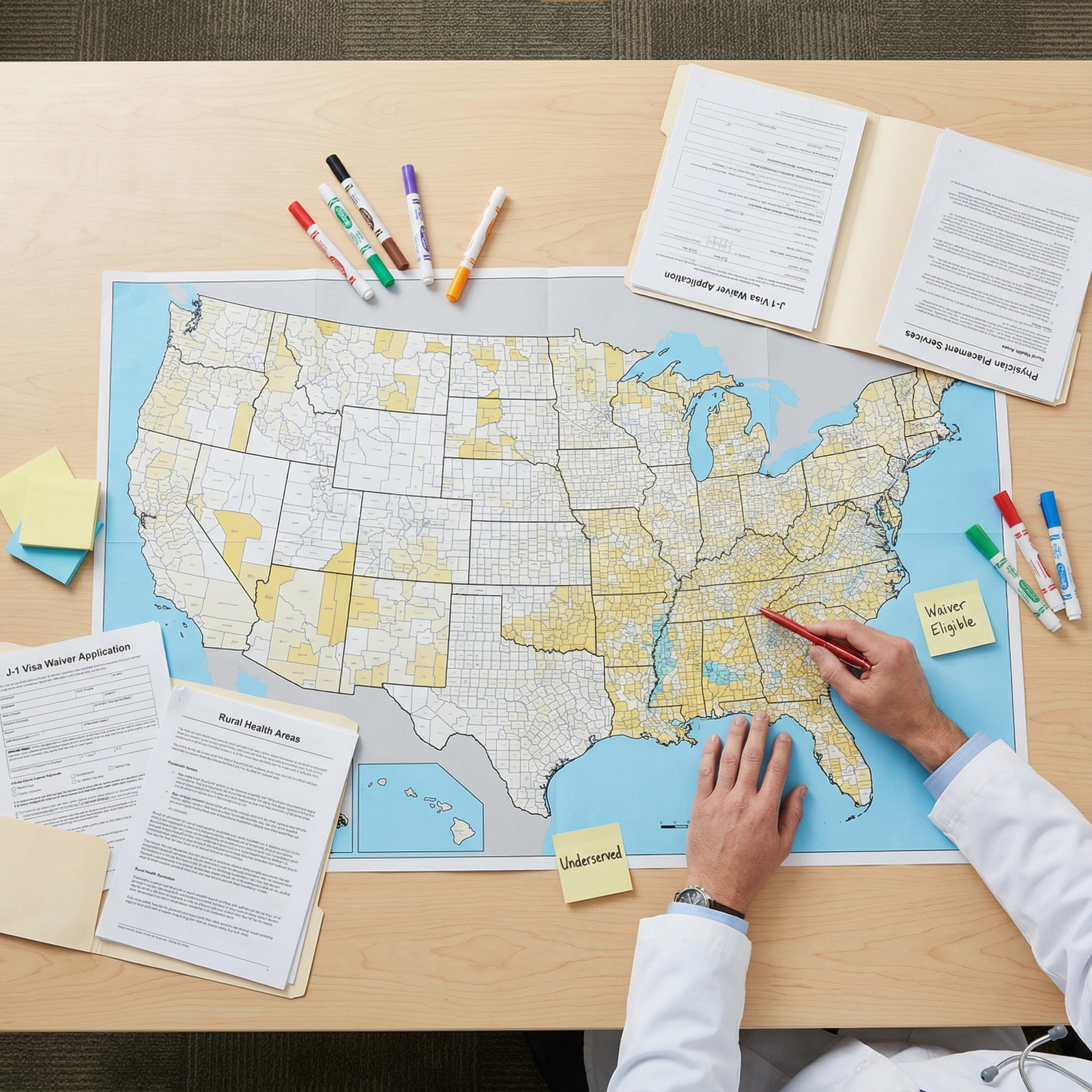
Conrad 30 Waiver Program (State‑Sponsored)
- Each U.S. state can sponsor up to 30 J‑1 physicians per year.
- Requirements:
- Full‑time clinical employment in a Health Professional Shortage Area (HPSA) or Medically Underserved Area (MUA), or serving an underserved population.
- Usually a 3‑year full‑time contract.
- Popular among primary care, psychiatry, and some hospital‑based specialties.
Federal Agency Waivers
- E.g., Department of Health and Human Services (HHS), Veterans Affairs (VA), etc.
- Often for research or underserved clinical work.
Hardship or Persecution Waivers
- Based on proving that returning home would:
- Cause exceptional hardship to a U.S. citizen or permanent resident spouse/child, or
- Subject you to persecution.
- Complex, typically requires experienced immigration counsel.
- Based on proving that returning home would:
Strategic implications:
- If you are J‑1, you should be aware early that your first job after training will likely be a J‑1 waiver position, often in a rural or underserved urban area.
- Many Caribbean IMGs successfully complete this path and later:
- Transition to different employers.
- Obtain permanent residency.
- Build long‑term careers in the U.S.
4. Long‑Term Career Planning: J‑1 vs H‑1B in Perspective
If you trained on J‑1 and obtained a waiver:
- You can generally change status to H‑1B for your waiver job.
- After 3 years, you may:
- Stay with the same employer, or
- Move to another employer ready to sponsor your H‑1B or green card.
If you trained on H‑1B from the start:
- You may already be in a position to transition directly to a staff job with continued H‑1B or a green card process.
- However, depending on your country of birth (e.g., India or China), green card backlogs could still be long.
Practical Tips and Common Pitfalls for Caribbean IMGs
1. Start Visa Planning Early—Ideally in 3rd or 4th Year
- Clarify your long‑term goal: U.S. career vs. flexibility to practice elsewhere.
- Decide whether you realistically want to pursue Step 3 before residency.
- Identify Caribbean medical school residency offices or advisors with IMG visa experience—SGU and similar schools often have dedicated support.
2. Avoid Inconsistencies in Your Story
Embassies and immigration officers look for consistency:
- Ensure your CV, DS‑160, and visa interview answers align:
- Graduation dates
- Rotations
- Future plans (training vs. permanent relocation)
- If you previously had a U.S. visa denial, know your record and be prepared to address it honestly.
3. Understand That Visa Policy Can Change
Immigration rules evolve. For this reason:
- Rely on current official sources:
- ECFMG
- U.S. Department of State
- USCIS
- When in doubt, consult a qualified immigration attorney—especially for complex situations (multiple prior visas, status changes, or family immigration plans).
4. Consider Family Implications (Spouse and Children)
Both J‑1 and H‑1B allow dependents:
- J‑2 dependents (spouse/children) can often apply for work authorization (EAD).
- H‑4 dependents usually cannot work unless under specific conditions (like if the H‑1B holder has started the green card process).
If you have or plan to have a family during residency, factor this into your visa preference.
FAQs: Visa Navigation for Caribbean IMGs Entering Residency
1. I’m a Caribbean IMG with no U.S. citizenship or green card. Which visa should I target for residency?
It depends on your profile and timing:
- If you do not have Step 3 and want maximum chances to match, you should be very open to J‑1.
- If you have Step 3, a strong application, and access to H‑1B‑sponsoring programs, you can actively pursue H‑1B while still applying broadly to J‑1‑friendly programs.
- Your primary goal as a Caribbean IMG is usually to secure solid training; immigration optimization can often be managed afterward, especially with J‑1 waiver routes.
2. Can I switch from J‑1 to H‑1B during or after residency?
- During residency:
- Rare and often complicated. If you are subject to the two‑year home residence requirement, you generally cannot change directly from J‑1 to H‑1B without first obtaining a J‑1 waiver.
- After residency:
- Once you secure a J‑1 waiver job, you often transition to H‑1B status with that employer for the waiver period.
- This is an area where personalized guidance from an immigration attorney is valuable.
3. Does being at a well-known Caribbean school (e.g., SGU) improve my visa chances?
Being at a well‑established school (like SGU, Ross, AUC, etc.) doesn’t change immigration law, but it can indirectly help:
- Programs already familiar with SGU residency match outcomes and Caribbean medical school residency patterns may feel more comfortable sponsoring visas for graduates from those schools.
- Established schools often:
- Provide documentation efficiently.
- Offer advising on IMG visa options.
- However, your visa category options (J‑1 vs H‑1B) are determined by:
- Program policy.
- Your exam status (especially Step 3).
- Your citizenship and prior immigration history.
4. If I already have a visitor (B‑1/B‑2) or student (F‑1) visa, does that help with residency visa sponsorship?
Not directly:
- Residency training uses J‑1 or H‑1B, not B‑1/B‑2 or standard F‑1.
- Having a prior U.S. visa can:
- Show a history of travel and compliance (if no overstays), which is positive.
- Also raise questions at the consulate if there were prior overstays or violations.
- Your residency visa type and approval depend primarily on:
- Your residency contract.
- ECFMG or program petition.
- Compliance with immigration rules and your documented intent.
Visa navigation for residency as a Caribbean IMG is complex, but it is manageable if you start early, understand J‑1 vs H‑1B clearly, and align your exam and application strategy with your visa goals. Focus first on becoming the strongest applicant you can—solid scores, strong clinical performance, and good letters—then use that position to negotiate the most favorable visa path within the realities of U.S. immigration and program policies.