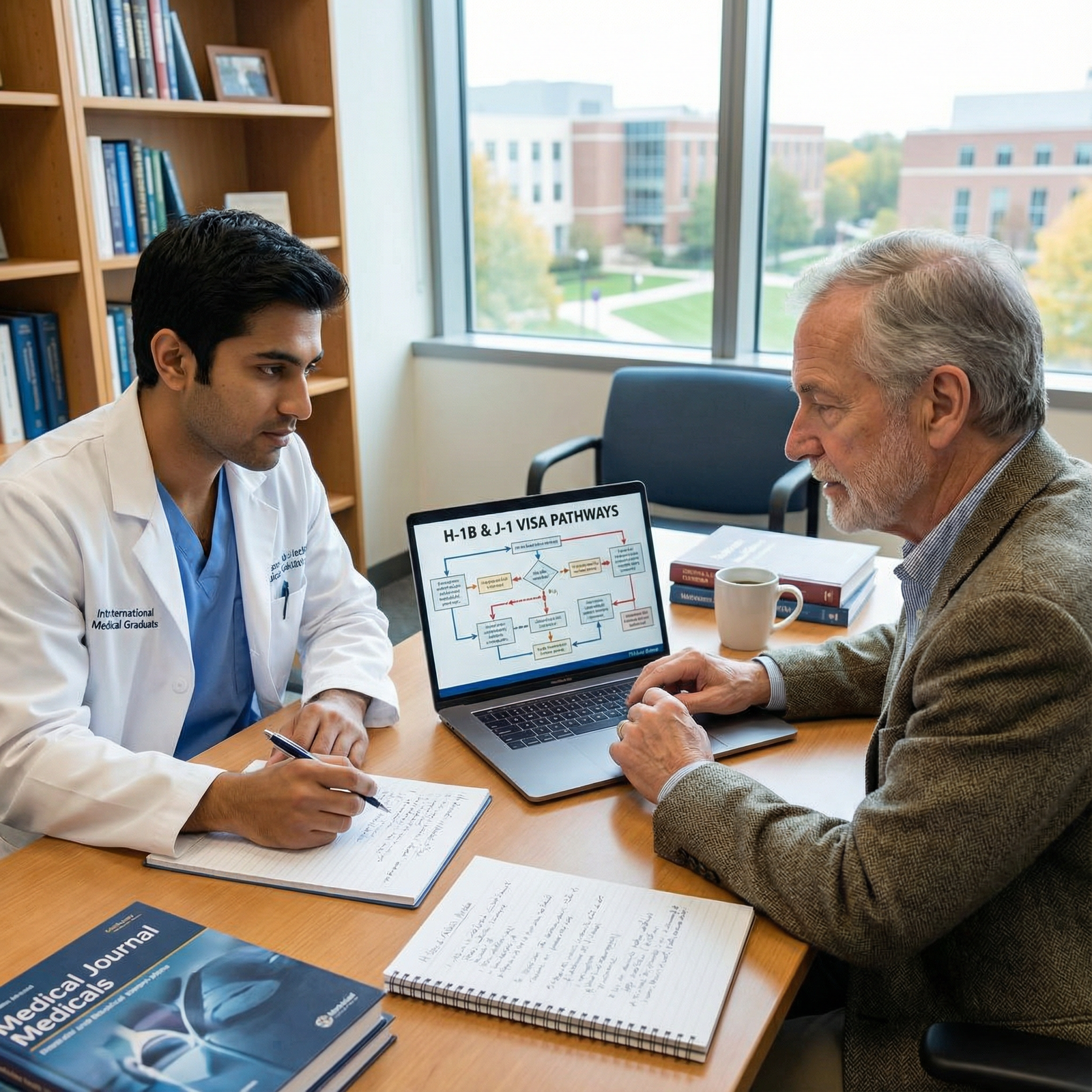
Understanding the Visa Landscape for Caribbean IMGs in Nuclear Medicine
For a Caribbean medical school graduate aiming for a nuclear medicine residency in the United States, visa strategy is not a side issue—it is central to your career planning. As a Caribbean IMG, you must think about immigration and training timelines at the same level of detail as your board exams and applications.
This is especially true for nuclear medicine residency and nuclear radiology pathways, where positions are fewer, program structures vary (independent residencies, fellowships, diagnostic radiology pathways), and some programs are more or less visa‑friendly than others.
This article will walk you through:
- The main visa options (J‑1 vs H‑1B and others)
- How visa type interacts with nuclear medicine training pathways
- Special considerations for Caribbean graduates (including SGU residency match and other schools)
- Practical strategies for choosing target programs and planning long‑term
- Common pitfalls and FAQs for Caribbean IMGs
Throughout, the focus is on practical, step‑by‑step advice for Caribbean IMGs targeting a nuclear medicine residency match in the US.
Core Visa Options for Caribbean IMGs: What Really Matters
For U.S. graduate medical education (GME), 90% of visa questions boil down to this: J‑1 vs H‑1B. Other statuses (F‑1, B‑1/B‑2, etc.) may exist earlier in your journey, but your residency visa will almost always be one of these two.
1. J‑1 Visa for Residency (ECFMG‑Sponsored)
What it is:
A nonimmigrant visa specifically for international physicians in U.S. training programs. ECFMG sponsors and manages this category for residency and fellowship.
Key features for Caribbean IMGs:
Common and widely accepted
- Most U.S. teaching hospitals that support IMGs are set up for J‑1 sponsorship
- Many nuclear medicine and nuclear radiology programs accept J‑1 but not H‑1B
Two-year home residency requirement
- After finishing J‑1 training, most physicians must return to their home country (country of last permanent residence) for at least two years OR obtain a waiver before they can:
- Get H‑1B status
- Change to L, K, or immigrant (green card) status
- This does not mean you must leave the U.S. immediately after finishing training, but it does significantly limit options without a waiver
- After finishing J‑1 training, most physicians must return to their home country (country of last permanent residence) for at least two years OR obtain a waiver before they can:
Duration and renewals
- Usually issued in one-year increments
- Can be renewed up to a total of 7 years of training (exceptions possible for specific reasons, but 7 is the general rule)
- Important for nuclear medicine because your path might be:
- 1–2 years internal medicine or transitional year +
- 3–4 years diagnostic radiology +
- 1–2 years nuclear medicine/nuclear radiology
Your cumulative years matter.
Sponsorship process
- Programs confirm they accept/sponsor J‑1 residents
- ECFMG coordinates your DS‑2019
- You attend a consular interview unless already in J‑1 status
Pros of J‑1 for Caribbean IMGs in Nuclear Medicine
More programs available
Many academic nuclear medicine and radiology programs are J‑1 only. If you insist on H‑1B, you will sharply limit your options.Simpler for hospitals
Institutions are already familiar with ECFMG procedures; processing is relatively streamlined.Easier to get for fresh graduates
There is no USMLE Step 3 requirement for J‑1 sponsorship (though some programs still prefer Step 3 passed).
Cons of J‑1
Home residency requirement
This is the single biggest issue. For Caribbean IMGs, the “home country” is usually:- Your country of legal permanent residence (not necessarily where your school was located)
- If you’re from a small Caribbean nation, arranging employment there in nuclear medicine after training can be difficult.
Waiver dependency
To stay and work in the U.S. after training, you often need a J‑1 waiver job, usually in a medically underserved area (often primary care; far fewer nuclear medicine postings).
2. H‑1B Visa for Residency
What it is:
A temporary worker visa for specialty occupations, including physicians. Instead of ECFMG sponsorship, the hospital petitions for your H‑1B status.
Key features for nuclear medicine residency
USMLE Step 3 required
- Almost all programs that sponsor H‑1B will require Step 3 passed before they can file your petition.
- This means you usually must pass Step 3 before residency start date, often even before rank lists are submitted.
Cap-exempt vs cap-subject
- Most residency programs are at cap-exempt institutions (universities, teaching hospitals), so they can file H‑1Bs year-round without lottery.
- Later, if you move to a private practice nuclear medicine group that is not cap-exempt, you must navigate the regular H‑1B lottery.
No two-year home residency requirement
- Major advantage. You can transition to another status (green card, different nonimmigrant category) from within the U.S. more flexibly.
Pros of H‑1B for Caribbean IMGs
More flexible long-term immigration path
- Easier transition to employment-based green card sponsorship without dealing with J‑1 waivers.
No J‑1 home country rule
- Especially valuable if your home country lacks nuclear medicine roles and you plan to remain in the U.S.
Cons of H‑1B
Not all programs sponsor it
- Many nuclear medicine and radiology programs do not support H‑1B for residents or fellows.
- Caribbean IMGs target a smaller set of programs if they limit themselves to H‑1B–friendly institutions.
Step 3 timing pressure
- Taking and passing Step 3 during clinical rotations or before graduation can be challenging for Caribbean students.
Costs and paperwork
- Higher processing burden for institutions. Some programs simply refuse due to HR or legal limitations.
How Visa Type Interacts with Nuclear Medicine Training Pathways
Nuclear medicine rarely exists in a vacuum. For many Caribbean IMGs, nuclear medicine is part of a broader imaging career that might include internal medicine, transitional years, radiology, or multiple fellowships. Your caribbean medical school residency planning should therefore look at the entire path, not just one training segment.
1. Common Nuclear Medicine Training Routes for IMGs
Depending on the institution and your background, possible paths include:
Direct Nuclear Medicine Residency (3 years)
- Less common but still present in some centers
- May accept IMGs with just a preliminary internship
Diagnostic Radiology Residency + Nuclear Radiology/Nuclear Medicine Fellowship
- 4 years diagnostic radiology residency
- 1 year nuclear radiology or nuclear medicine fellowship
- More common in large academic centers
Internal Medicine or Other Specialty → Nuclear Medicine
- Some physicians train in internal medicine or another specialty first and then do nuclear medicine
- May appeal to Caribbean grads who first match into broader fields
For each route, you must ask: Will my total years of training fit within my visa limits, and will each program support my visa category?
2. J‑1 in Multi‑Step Nuclear Medicine Paths
If you use a J‑1 for residency:
You can usually complete:
- 1 year preliminary/internal medicine +
- 3–4 years radiology +
- 1–2 years nuclear medicine/nuclear radiology
within the 7-year J‑1 maximum.
But you need to:
- Track total J‑1 duration (ECFMG monitors this)
- Avoid unnecessary additional fellowships if they risk exceeding the limit
- Make strategic choices about where you use your years (e.g., avoid redundant preliminary years)
Example scenario
A Caribbean IMG graduates from SGU, matches in a diagnostic radiology residency (J‑1) at a university hospital that also offers a nuclear radiology fellowship. Path:
- PGY‑1: Transitional year
- PGY‑2–5: Diagnostic radiology residency
- PGY‑6: Nuclear radiology fellowship
Total: 6 years of J‑1, safely within the 7-year limit. Afterwards, they must decide:
- Return to home country to fulfill the 2‑year requirement, or
- Seek a J‑1 waiver job (often in underserved regions; might involve more general radiology and less pure nuclear medicine), or
- Find another route (e.g., hardship or persecution waiver, marriage to a U.S. citizen plus specific legal pathways—this requires immigration counsel).
3. H‑1B Pathways for Nuclear Medicine
For H‑1B, your focus shifts:
- Ensure your initial residency (radiology, internal medicine, etc.) sponsors H‑1B.
- Confirm that your future nuclear medicine/nuclear radiology fellowship also sponsors H‑1B or can continue your status.
- Plan Step 3 early to qualify.
Example scenario
A Caribbean IMG from a top Caribbean school passes Steps 1, 2 CK, and Step 3 before graduation, matches into a cap-exempt academic diagnostic radiology program that sponsors H‑1B. After 4 years of radiology training under H‑1B, they transition directly into a nuclear medicine fellowship at the same institution, which files an H‑1B extension.
Outcome: After total 5–6 years on H‑1B, they may pursue an employment-based green card via an academic or private practice imaging group, with no J‑1 waiver requirement.
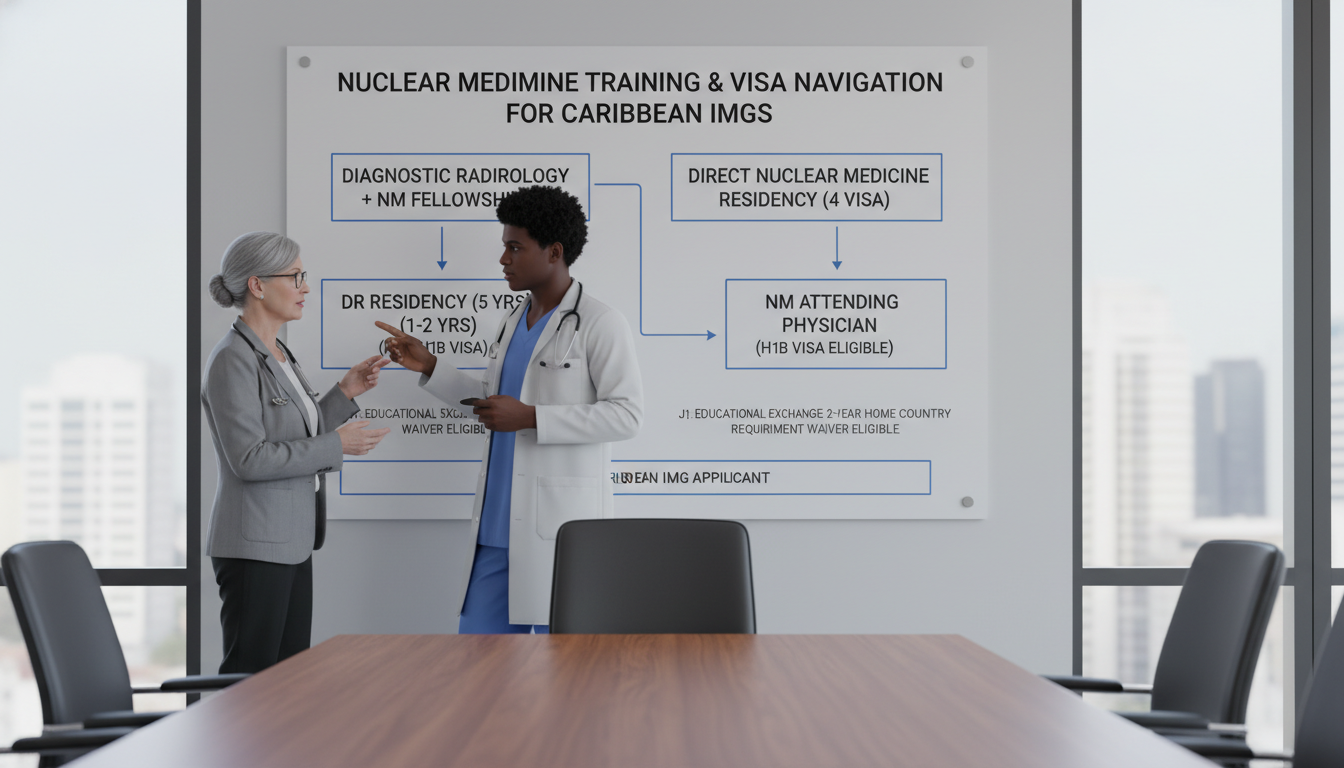
Caribbean IMG–Specific Considerations (Including SGU and Other Schools)
As a Caribbean medical grad, your visa navigation is affected not only by your citizenship but also by how U.S. programs perceive Caribbean schools and IMGs in general.
1. Caribbean Medical School Residency Realities
Many U.S. programs are familiar with:
- St. George’s University (SGU)
- Ross University
- American University of the Caribbean (AUC)
- Saba and other well‑known Caribbean schools
These schools have established pipelines into various specialties. For SGU residency match outcomes, internal medicine, family medicine, pediatrics, and psychiatry tend to dominate, but there are also placements into radiology and nuclear medicine–adjacent fields. For more competitive imaging specialties:
- Program directors often look carefully at:
- USMLE scores
- Clinical evaluations during U.S. rotations
- Research and scholarly activity (especially imaging-related)
- Professionalism and communication
Nuclear medicine is somewhat niche, which can be an advantage: fewer applicants, but fewer positions. A strong candidate can stand out.
2. Visa Perception by Programs
Programs typically categorize applicants as:
- U.S. citizens/green card holders
- Non-U.S. citizens requiring J‑1
- Non-U.S. citizens requiring H‑1B
For Caribbean IMGs:
- If you are a U.S. citizen or permanent resident who studied in the Caribbean, you do not need a residency visa. Your focus is purely on training.
- If you are a non-U.S. citizen, you are an IMG who will require a residency visa no matter how “U.S.-style” your medical school is.
Some nuclear medicine and radiology programs explicitly state on their websites:
- “We sponsor J‑1 visas only.”
- “We sponsor both J‑1 and H‑1B visas.”
- “We do not sponsor visas.”
You must read this information carefully and verify by email if it’s unclear.
3. Matching Strategy as a Caribbean IMG in Nuclear Medicine
To optimize your nuclear medicine match chances while managing visa issues:
Identify visa-friendly institutions early
- Create a spreadsheet of nuclear medicine, nuclear radiology, and radiology programs.
- For each, note:
- J‑1 vs H‑1B support
- History of matching IMGs
- Affiliation with large academic centers (often more visa expertise)
Be realistic about H‑1B
- If you aim only for H‑1B, your list may shrink to a fraction of programs.
- For many Caribbean IMGs, applying broadly with J‑1 openness increases chances of any match.
Leverage nuclear medicine’s niche status
- Show genuine interest through:
- Electives in nuclear medicine during clinical years
- Research in imaging or PET, SPECT, or theranostics
- Conferences (SNMMI, RSNA) and abstract submissions
- Programs are more likely to invest visa support in candidates with demonstrated commitment.
- Show genuine interest through:
Practical Step‑by‑Step Visa Planning for Caribbean IMGs
Step 1: Clarify Your Immigration Baseline
Ask yourself:
- What is my citizenship and country of permanent residence?
- Do I already have U.S. status (e.g., green card, DACA, other)? If yes, your situation is different.
- Am I open to eventually working in/moving back to my home country if J‑1 requires it?
This will guide whether you prioritize J‑1, H‑1B, or a combination.
Step 2: Decide on a Provisional Visa Strategy (J‑1 vs H‑1B)
For many Caribbean IMGs in nuclear medicine:
- Plan A (Most common): Apply broadly, accept J‑1 if that is the offer, and later pursue a J‑1 waiver or alternate immigration route.
- Plan B: Strong Step scores + early Step 3 → target H‑1B–friendly radiology programs that can lead into nuclear medicine at the same institution.
- Plan C: Match into a more IMG‑friendly specialty (e.g., internal medicine), then pursue nuclear medicine as a later step while revisiting visa options.
There is no single “best” answer. Your academic profile and long‑term life goals matter.
Step 3: Time Your Exams with Visa Needs
- USMLE Step 1 and 2 CK: Essential for all; aim for strong scores to be competitive for imaging.
- USMLE Step 3:
- Not required for J‑1 but often helpful.
- Required for most H‑1B residency sponsorships.
- Strategy:
- If leaning toward H‑1B, schedule Step 3 during your clinical rotations or shortly after graduation.
- Ensure score reports arrive before rank list deadlines for H‑1B–sponsoring programs.
Step 4: Screen Programs for Visa Policies
For each potential program (radiology, nuclear medicine, or direct nuclear medicine residency), look at:
- Program website: “International medical graduates” or “Visa information” section
- FREIDA or program data in ERAS
- Email the program coordinator or GME office if unclear
Ask specific questions:
- “Do you sponsor J‑1 visas?”
- “Do you sponsor H‑1B visas for residency/fellowship?”
- “Is there any limitation for Caribbean graduates?”
Record this information carefully. This is key to your residency visa planning.

Step 5: Plan for Long‑Term Immigration Use Cases
Think beyond residency:
- Do you aim to practice nuclear medicine in the U.S. permanently?
- Are you open to academics vs private practice?
- Are you willing to work in an underserved region (potentially in broader radiology) for a J‑1 waiver?
J‑1 Long‑Term Paths
- Apply for a J‑1 waiver after training via:
- Conrad 30 (state-based, more common in primary care but occasionally imaging roles exist)
- Federal agencies (e.g., VA system, HHS, etc.)
- Transition into H‑1B for your waiver job
- Eventually seek permanent residency
H‑1B Long‑Term Paths
- Remain in cap-exempt institutions (academic centers) extending H‑1B as needed
- Or transition to cap-subject private practice (nuclear medicine or radiology) via lottery
- Employer may sponsor PERM-based green card; your nuclear medicine subspecialty training can be a strong asset.
Common Pitfalls and How to Avoid Them
Pitfall 1: Ignoring Visa Policies Until After Interviews
Some Caribbean IMGs focus only on “Will they interview me?” and ignore “Will they sponsor my visa?” This can lead to:
- Ranking programs that do not sponsor your required visa type
- Last‑minute surprises when GME cannot process your visa
Solution:
Track visa policies before interview season. Only rank programs that are compatible with your status and goals.
Pitfall 2: Over‑Restricting to H‑1B Programs Without Realistic Step 3 Timeline
Insisting on H‑1B without:
- Early Step 3
- Strong Step 1/2 CK
- Solid application profile
…can reduce your options dramatically, especially in competitive imaging.
Solution:
Have a primary and backup visa plan. If Step 3 timing doesn’t work, be ready to accept J‑1 and build a robust plan for waiver and long‑term career growth.
Pitfall 3: Not Counting Total Training Years (J‑1)
For multi‑step training (prelim year + radiology + nuclear medicine fellowship), some IMGs underestimate total years of J‑1 usage.
Solution:
Map out your entire training timeline:
- Internship/PGY‑1
- Core residency years
- Fellowship(s)
Confirm with ECFMG or your future GME office that your plan stays within J‑1 duration limits.
Pitfall 4: Assuming Caribbean Location = Home Country for J‑1 Requirement
Your 2‑year J‑1 home residency requirement is tied to your permanent residence/citizenship, not your medical school location. A Jamaican citizen at SGU (Grenada) is usually tied to Jamaica, not Grenada.
Solution:
Clarify your country of permanent residence and discuss implications with an immigration expert if needed.
Frequently Asked Questions (FAQ)
1. As a Caribbean IMG interested in nuclear medicine, should I prioritize J‑1 or H‑1B?
It depends on your exam profile and long‑term goals:
- If you want maximum program options, especially in academic nuclear medicine or radiology, being open to J‑1 is essential.
- If you already have Step 3 and strong scores, and you strongly prefer staying in the U.S. without a home residency requirement, targeting H‑1B‑friendly programs is reasonable.
- Many Caribbean IMGs ultimately match on J‑1 and later navigate J‑1 waiver or alternate pathways, particularly if their primary focus is training quality and match probability rather than immediate immigration flexibility.
2. Can I do diagnostic radiology on J‑1 and then switch to H‑1B for a nuclear medicine fellowship?
Possibly, but the J‑1 two‑year home residency requirement complicates this. Once you have been on ECFMG‑sponsored J‑1, you generally:
- Must complete 2 years in your home country or
- Obtain a J‑1 waiver before switching to H‑1B or immigrant status.
In practice, many physicians complete all residency and fellowship years on J‑1, then seek a J‑1 waiver job on H‑1B. Directly switching to H‑1B for fellowship is not straightforward without dealing with the J‑1 obligation.
3. Are nuclear medicine residency and fellowship programs generally IMG‑friendly?
Many nuclear medicine and nuclear radiology programs in academic centers do accept IMGs, particularly those with strong imaging interest and research backgrounds. However:
- The number of positions is limited compared with internal medicine or family medicine.
- Some programs are J‑1 only; some may not sponsor visas at all.
- Caribbean IMGs must build a strong profile (Step scores, clinical evaluations, research) and apply strategically to nuclear medicine, radiology, and potential feeder specialties.
4. How early should I start planning my residency visa strategy as a Caribbean student?
Ideally by the start of your clinical years (third year equivalent):
- During core rotations, begin understanding IMG visa options and how they align with your specialty interests.
- By the time you are applying for electives or sub‑internships in radiology or nuclear medicine, you should already have a sense of:
- Whether you wish to aim for H‑1B (and thus need early Step 3)
- Which types of programs (J‑1 vs H‑1B) are realistic in your situation
- Early planning prevents last‑minute panic and allows you to align exams, research, and rotations with your long‑term nuclear medicine match and visa goals.
By approaching visa navigation as an integral part of your Caribbean medical school residency planning—especially in a specialized field like nuclear medicine—you put yourself in a much stronger position. Clarify your goals, understand J‑1 vs H‑1B, map your likely training route, and keep a running list of visa‑friendly programs. With this strategic mindset, you can pursue both your imaging career and your immigration objectives in a coordinated, realistic way.