
You can’t treat moonlighting as “just extra shifts” when you’re on a visa. On J-1 especially, it’s basically off the table most of the time. On H-1B, it’s sometimes possible but only if it’s set up correctly from a visa and contract perspective. Most residents and fellows get this wrong.
Let’s walk through what’s actually allowed, what’s risky, and how people do this without blowing up their status.
The One-Sentence Answer
J-1 clinical visa (ECFMG-sponsored):
Moonlighting is almost always prohibited. Internal moonlighting is only sometimes allowed and only if it fits inside your approved training and duty hour limits. External moonlighting is essentially not allowed.H-1B visa (resident/fellow):
Moonlighting is sometimes possible, but only if:- Your primary H-1B employer allows it in writing,
- Your total hours still look like legitimate training (not cheap labor), and
- Any outside site either has its own H-1B for you (concurrent H-1B) or is clearly included in your current H-1B and contract.
If you remember nothing else: on a visa, you can’t do “side work” unless immigration paperwork explicitly allows that specific work at that specific site.
Core Rules: Why Visa Status Changes Everything
J-1 Clinical Visa (ECFMG)
This category exists only to let you do accredited training. Not freelancing. Not side jobs.
For J-1:
- Your DS-2019 and ECFMG sponsorship describe:
- Program
- Specialty
- Institution
- Location(s)
- You’re supposed to work only within that defined training program.
Anything that looks like:
- Independent practice
- Billing outside your GME role
- Work not clearly part of the training curriculum
…is a problem.
ECFMG itself uses phrases like:
- “Clinical J-1 physicians are limited to training activities under the supervision of the program.”
- “Employment outside the approved training program is not permitted.”
That’s why classic “moonlighting for extra pay” usually conflicts with J-1 rules.
H-1B Visa (Resident/Fellow)
H-1B is for temporary professional employment. You’re an employee, not just a trainee. But it’s still employer-specific and job-specific.
Your H-1B approval (I-797) is tied to:
- Employer (e.g., “XYZ University Hospital”)
- Job title (Resident, Fellow)
- Location(s) (usually specified in the LCA)
- Full-time or part-time status, typical hours, wage
If you:
- Work at a different hospital
- Take shifts not covered by your H-1B/LCA
- Add significant hours that change the nature of your job
…you may be violating H-1B terms unless you file a concurrent H-1B or amendment.
So for moonlighting to be legal on H-1B:
- The immigration paperwork must explicitly cover it, and
- Your GME office must be on board.
Moonlighting on J‑1 During Residency/Fellowship
Here’s the blunt answer: assume “no” unless your program director and GME office show you, in writing, that a very narrow “yes” is allowed—and can tie it back to training.
External Moonlighting on J‑1
Typical scenario:
You’re a J-1 resident in internal medicine. You get offered:
- $120/hour to cover nights at a nearby community ED
- Or hospitalist shifts at another hospital in town
This is not allowed on a J-1 clinical visa.
Why?
- Different institution
- Not part of your ACGME/ACGME-International accredited training
- Independent practice, often unsupervised as a “resident”
That’s straight-up unauthorized employment. That can:
- Jeopardize your J-1 status
- Cause problems for future H-1B, O-1, or green card applications
- Come back to bite you if USCIS ever digs into past work
Anyone who says “nobody checks” is playing with your career, not theirs.
Internal Moonlighting on J‑1
This is where people try to find gray zones.
Examples:
- As a PGY‑3 internal medicine resident, you do extra night shifts at your own hospital, billing as an in-house moonlighter.
- As a cardiology fellow, you cover additional weekend CCU shifts at the same teaching hospital.
The key questions:
- Is this part of your training program or clearly approved as an educational activity?
- Does your program director consider this part of your training load and monitor it?
- Does it stay within ACGME duty hour limits?
- Is it only at the institution(s) listed on your DS‑2019 and in your program?
Even then, ECFMG is conservative. Many institutions simply write:
- “J‑1 visa holders may not moonlight under any circumstances.”
Some programs allow “internal moonlighting” but:
- Don’t use the word “moonlighting” in official forms,
- Treat it as extra call or additional duties under supervision,
- Pay it through the same GME payroll, and
- Ensure all documentation shows it’s part of training.
If your GME office has to do mental gymnastics to justify it, that should tell you something.
Bottom line for J‑1:
- External moonlighting: No.
- Internal moonlighting: Only if:
- The program and GME explicitly allow it,
- They confirm in writing it complies with ECFMG rules, and
- It stays clearly within your training role and duty hours.
If you’re on J‑1, plan your finances assuming no real moonlighting income.
Moonlighting on H‑1B During Residency/Fellowship
This is where it gets more nuanced. You’ll hear stories like:
- “I’m on H‑1B and I moonlight in the ICU every weekend.”
- “I pick up urgent care shifts across town.”
Sometimes that’s legal. Sometimes it’s just unregulated risk.
Let’s break it down.
Internal Moonlighting on H‑1B (Same Employer)
Example:
You’re an H‑1B PGY‑4 neurology resident employed by “ABC University Hospital.” You’re offered:
- Night float shifts in the hospitalist service for extra pay, same hospital.
- Additional ED coverage in the same system, billed internally.
Key points:
- If all work is for the same H‑1B employer
- At the same listed location(s)
- And your job duties reasonably fall under “Resident/Fellow Physician”
…then often no new H‑1B is needed, as long as:
- Total hours are consistent with full-time employment
- You’re paid at least the prevailing wage for your role
- It doesn’t contradict what’s in the existing LCA and contract
But you still need:
- GME approval (because of duty hours, fatigue, and medico-legal risk)
- Written confirmation from your institution’s immigration attorney that it’s compliant with your H‑1B terms
Programs differ:
- Some allow internal moonlighting only for seniors (PGY-2+ or 3+)
- Some cap hours per month
- Some say no H‑1B moonlighting at all because they don’t want to manage the risk
External Moonlighting on H‑1B (Different Employer)
Example:
You’re an H‑1B internal medicine resident at University Hospital. A nearby community hospital wants to pay you $150/hour for nocturnist shifts.
Your options if you want to do this legally:
The outside hospital files a concurrent H‑1B for you:
- You keep your main H‑1B with your residency program
- You get a second, separate H‑1B approval for the moonlighting site
- That petition:
- Lists their hospital as employer
- States hours/week (often 5–10/week)
- Pays appropriate prevailing wage
Your main H‑1B gets amended to include that work and site, if your university’s legal team and GME are willing (rare).
Real talk:
Most community sites don’t want the hassle of filing a concurrent H‑1B for a few shifts per month. And many GME offices won’t allow outside clinical work at all, regardless of visa.
Without a concurrent H‑1B?
- You’d be doing unauthorized employment.
- That’s absolutely discoverable via:
- Credentialing records,
- Hospital HR files,
- Billing records,
- Future immigration filings that ask about past employment.
This isn’t “just cash under the table.” If there’s a malpractice case or board complaint, your visa issue will be on full display.
Practical Steps If You’re Considering Moonlighting
Here’s the sane sequence if you’re an IMG resident or fellow on a visa.

| Step | Description |
|---|---|
| Step 1 | Want to moonlight? |
| Step 2 | Assume NO Ask GME in writing |
| Step 3 | Check contract & program rules |
| Step 4 | Ask GME + immigration lawyer about internal shifts |
| Step 5 | Concurrent H-1B needed + GME approval |
| Step 6 | If any doubt, DO NOT DO IT |
| Step 7 | Only work if you have written ok |
| Step 8 | If employer wont sponsor concurrent H-1B, walk away |
| Step 9 | Visa Type |
| Step 10 | Same employer/site? |
1. Confirm your visa type and sponsor
Don’t guess. Check:
- I-94
- DS-2019 (J-1)
- I-797 (H-1B)
- Your ECFMG/USCIS approval notices
2. Read your contract and handbook
Look for:
- “Moonlighting” section
- “Outside employment” rules
- “Professional activities” or “additional duties”
Many contracts explicitly say:
- J‑1s: “No moonlighting permitted”
- H‑1B: “Outside employment requires prior written approval”
3. Talk to the right people (in this order)
- Program Director – do they allow any moonlighting for anyone?
- GME Office – what’s the institutional rule?
- GME/Institutional Immigration Attorney – is it H‑1B/J‑1 compliant?
Don’t rely on:
- Co-residents’ stories
- A random attending
- The outside hospital’s recruiter (“We’ve had residents do this before” means nothing legally)
4. Get everything in writing
Bare minimum:
- Email from GME/PD: approval of the concept and shift structure
- Immigration office/attorney confirmation that:
- J‑1: it doesn’t violate ECFMG rules (rare)
- H‑1B: either covered by your current petition or a concurrent H‑1B is in place
If a concurrent H‑1B is used:
- Don’t start work until the receipt notice (and ideally approval) is in hand.
5. Watch your total hours and sanity
Even if visa and policy boxes are checked:
- ACGME still caps your duty hours
- Fatigue still affects your performance and patient safety
- Malpractice insurers may have opinions about your schedule
Many PDs will shut down moonlighting if it starts affecting:
- Clinic note completion
- Rotation performance
- Board prep and learning
Common Mistakes That Get IMGs Into Trouble
Here’s what I’ve actually seen cause problems:
Cash or 1099 work
- Doing urgent care, telemedicine, or clinic shifts as an “independent contractor” on J‑1 or H‑1B
- Visa status typically requires employer-employee relationship and specific authorization, not random 1099 gigs
Assuming “same hospital = automatic ok”
- On H‑1B, some hospitals have separate legal entities or campuses that aren’t covered by your LCA
- On J‑1, being in the same building doesn’t matter if it’s not in your training description
No concurrent H‑1B for outside work
- External moonlighting on H‑1B with zero immigration paperwork
- Shows up later when you list prior employers or they pull credentialing files
Adding shifts before paperwork is done
- “The hospital lawyer said they’ll file something next month, but they told me to go ahead and start now”
- That’s still unauthorized work until the petition is filed (and in many cases, safest when approved)
Ignoring future immigration plans
- J‑1 waivers, H‑1B transfers, O‑1, EB-2 NIW, PERM—all ask about your work history
- Unauthorized employment can complicate everything downstream
Short Version by Visa Type
| Visa Type | Internal Moonlighting | External Moonlighting |
|---|---|---|
| J-1 (ECFMG) | Rare, tightly controlled, must look like training | Essentially no |
| H-1B (Resident/Fellow) | Sometimes allowed if same employer/site | Only with concurrent H-1B + GME approval |
| Green Card / Citizen | Based on contract + state law, not visa | Based on contract + licensing/privileges |
How This Plays Out in Real Life
Let me give you three very typical patterns.
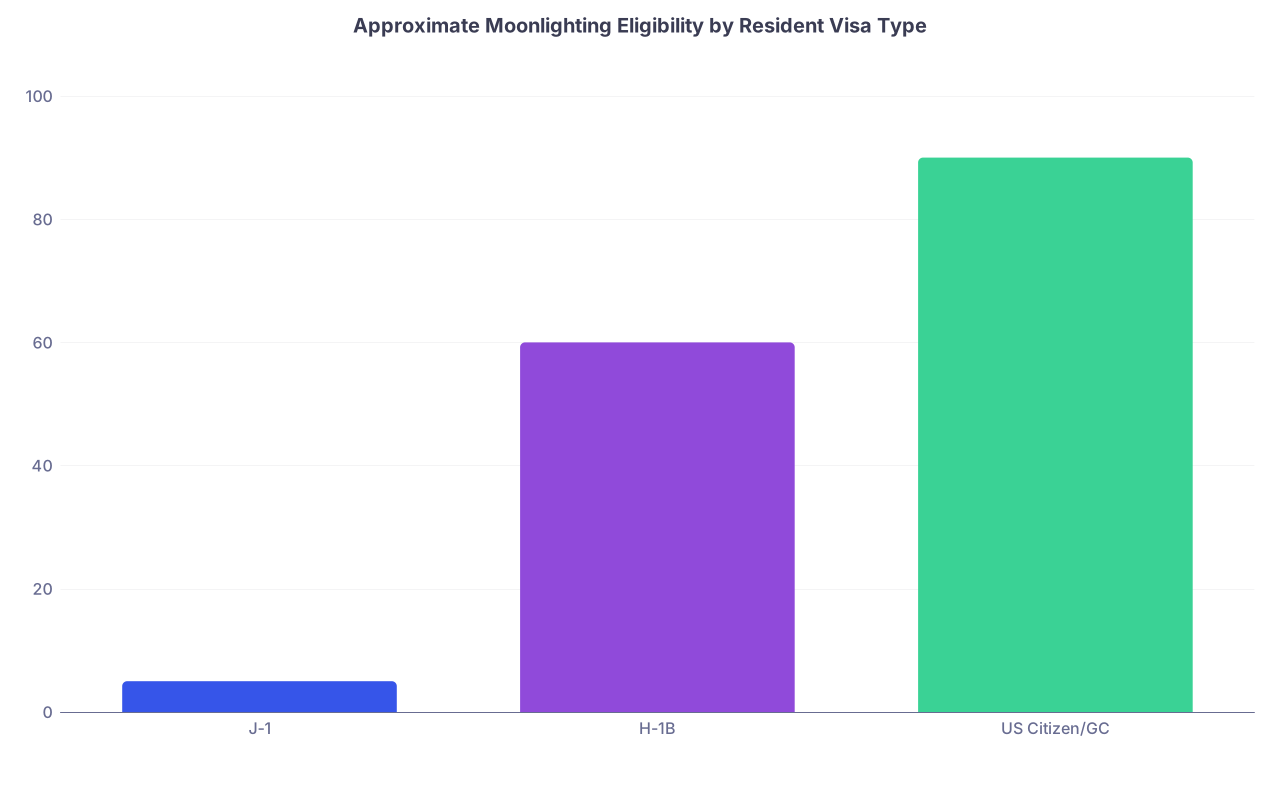
| Category | Value |
|---|---|
| J-1 | 5 |
| H-1B | 60 |
| US Citizen/GC | 90 |
Numbers above are a rough “percent of people who can realistically moonlight” based on what I see across programs—not official stats, but it captures the trend.
J‑1 IM resident, PGY‑2:
- Program handbook: “No moonlighting for J‑1 visa holders.”
- Result: No legal way to moonlight. Plan finances accordingly.
H‑1B neurology fellow at big academic center:
- Internal hospitalist shifts allowed, same employer.
- Immigration counsel says no new petition needed because duties and site are covered.
- GME caps at 2 shifts/month. Legal and pretty common.
H‑1B IM resident at university, offered community hospital shifts:
- Outside hospital doesn’t want to file concurrent H‑1B.
- University GME prohibits outside clinical work anyway.
- Result: If the resident does it anyway, they are out of status. If they say no, they’re safe but disappointed.
Visual: Big-Picture Timeline for Visa + Moonlighting Thinking
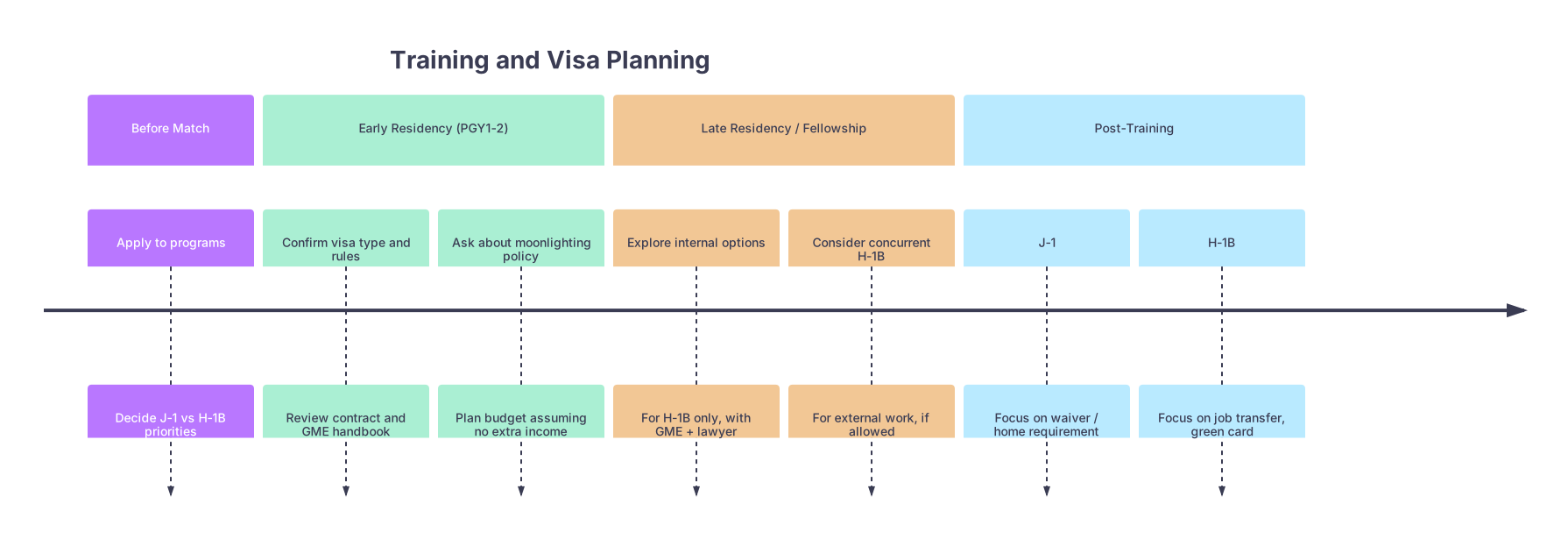
| Period | Event |
|---|---|
| Before Match - Apply to programs | Decide J-1 vs H-1B priorities |
| Early Residency (PGY1-2) - Confirm visa type and rules | Review contract and GME handbook |
| Early Residency (PGY1-2) - Ask about moonlighting policy | Plan budget assuming no extra income |
| Late Residency / Fellowship - Explore internal options | For H-1B only, with GME + lawyer |
| Late Residency / Fellowship - Consider concurrent H-1B | For external work, if allowed |
| Post-Training - J-1 | Focus on waiver / home requirement |
| Post-Training - H-1B | Focus on job transfer, green card |

FAQs: Moonlighting on J‑1 or H‑1B
1. Can I moonlight as a J‑1 resident if the shifts are in my own hospital?
Usually no, unless:
- Your GME office has a written policy allowing very specific internal work,
- It’s clearly part of your supervised training duties, and
- It doesn’t violate ECFMG rules or duty hours.
If your handbook or PD says “J‑1s can’t moonlight,” don’t try to find loopholes. That’s your answer.
2. I’m on H‑1B and my friend says nobody checks. Is unauthorized moonlighting really a big deal?
Yes. Unauthorized employment can:
- Make you technically out of status
- Create problems for future H‑1B transfers, O‑1s, and green cards
- Show up in credentialing, malpractice cases, or audits
Immigration consequences often hit years later, when you least want surprises.
3. What about telemedicine or online consults from home?
If you’re on J‑1 or H‑1B, any paid clinical work (including telemedicine, chart review, or online consults) must be:
- Authorized under your current visa employer and petition,
- Or covered by a concurrent H‑1B if it’s a different employer.
Being remote or at home doesn’t magically make it legal.
4. Can I do research-related side work on J‑1 or H‑1B?
If it’s:
- Purely non-clinical (no patient care, no prescribing, no chart access as a treating physician), and
- For your current employer, within your job description,
…then it may be allowed without extra steps. But:
- Different employer = likely needs its own authorization
- Get your institution’s immigration lawyer to sign off first
5. If my program switches me from J‑1 to H‑1B, can I start moonlighting right away?
No automatic yes. You still need:
- A contract and GME policy that allow moonlighting
- Immigration confirmation that your H‑1B covers those shifts (or a concurrent H‑1B if external)
- Compliance with duty hours and any program-specific rules (PGY level, evaluation history, etc.)
The visa type is just one piece.
6. Does being chief resident or a senior fellow change anything?
Titles don’t override visa law. Chief residents on J‑1 are still stuck with J‑1 rules. Chiefs or senior fellows on H‑1B might have more trust from PDs, but they still need:
- Written approval
- Proper immigration coverage
- Reasonable total hours
Being “more experienced” doesn’t give you separate work authorization.
7. What’s the safest way to approach this with my program?
Do it directly and in writing:
- “I’m on a [J‑1/H‑1B] visa and want to understand what, if any, moonlighting or additional paid clinical work is allowed for me. Can you please confirm the policy and whether the institution’s immigration counsel needs to review any proposed arrangement before I accept it?”
If the answer is vague, push (politely) for a clear yes/no in email. If you can’t get a clean, written “yes” from both GME and immigration, treat it as a “no.”
Key takeaways:
- On J‑1, plan on no real moonlighting; anything outside formal training is basically off-limits.
- On H‑1B, moonlighting is sometimes possible but only when contract, GME policy, and immigration paperwork all line up.
- If there’s no clear written approval from your program and their lawyer, the shift isn’t “extra cash”—it’s a liability.