

It’s late November. You’re staring at your ERAS portal, debating whether to tick “will require visa sponsorship.” You’ve read every forum post about J‑1 vs H‑1B, asked every senior resident who’ll talk to you, and all you’ve gotten is noise.
Then you hear the line that makes your stomach drop:
“We prefer J‑1s.”
Or the opposite: “We just do H‑1B. Less hassle.”
Let me tell you what’s actually going on behind those comments. Because what program directors say in public and what they say in closed-door meetings are not the same thing.
The Uncomfortable Truth: PDs Don’t Start With Visas. They Start With Risk.
Here’s the mental algorithm most program directors and GME offices actually run, even if they dress it up in polite language:
- Will this candidate make my life harder with immigration, payroll, or accreditation?
- Will this candidate match, start on time, and finish without a visa disaster?
- Can I still use them to fill my service needs without getting dragged into legal or HR hell?
Visa type is just a proxy for those three questions.
You think they’re comparing H‑1B vs J‑1 like two drugs in UpToDate. They’re not. They’re comparing:
- Who handles the work (ECFMG vs hospital lawyers)
- Who carries the immigration liability
- How replaceable you are if something explodes
That’s why you’ll see a categorical IM program at a mid-sized community hospital swear “we only do J‑1,” while a big-name academic center will confidently say “we’re happy to sponsor H‑1Bs.”
Different risk tolerance. Different infrastructure. Same basic calculus.
Let’s strip the marketing and walk through how they’re actually thinking.
What J‑1 Really Means to a Program Director
Nobody in leadership loves visas. They just hate some of them less. J‑1, for most PDs, is the “outsourced headache” option.
Here’s what they actually like about J‑1:
ECFMG handles most of the grunt work
Quietly, this is the single biggest selling point.
The institution doesn’t have to draft specialty occupation letters, run prevailing wage determinations, deal with H‑1B LCA postings, or argue with USCIS. ECFMG and their online system (OASIS/EVNet) carry most of that.When a coordinator says, “We’re familiar with J‑1,” what they often mean is:
“GME has a checklist. ECFMG tells us what to do. We don’t get sued.”Predictable timeline (by GME standards)
The PD knows:- Offer goes out in March
- You get forms to fill
- ECFMG processes sponsorship
- You show up in June/July
No lottery. No cap gap. No ‘pending H‑1B’ terror in late June.
They can replace you more easily if something goes wrong
This one never gets said out loud, but I’ve heard it in committee:
“If a J‑1 can’t get in, ECFMG can usually help us switch or adjust. With H‑1B, we’re stuck with USCIS timing.”
Translation: their flexibility is higher with J‑1s.The program is shielded from long-term immigration drama
With J‑1, the ‘problem’ of your long-term status gets punted down the road.- Two-year home requirement? Not their issue.
- Your waiver hunt later? Not their issue.
- Your green card? Definitely not their issue.
They’re focused on: Does this person show up this July and the next two to six Julys? J‑1 is clean from that narrow perspective.
Culture and habit
A lot of programs are “J‑1 by default” simply because that’s what they’ve been doing for 15+ years.
The GME office knows the ECFMG point person. The coordinator has the email templates. Legal has zero incentive to change what’s working.
So when you hear, “We only sponsor J‑1,” what’s often underneath is not deep policy analysis. It’s inertia, low risk tolerance, and institutional laziness. Plus a GME office that does not want to babysit USCIS.
But there’s a darker side you need to understand.
The J‑1 Downside They Won’t Say in the Interview Room
From your perspective, J‑1 has obvious problems:
- 2‑year home residency requirement
- Need for a waiver job later
- Less direct control over your long-term stay
From their perspective, the big hidden concern is this:
J‑1 residents are less likely to stay on as faculty long-term.
I have sat in meetings where an IM PD said,
“We’d prefer someone on H‑1B. Easier to keep them as a hospitalist if they’re strong.”
If the program is actively trying to build a pipeline of hospitalists, junior faculty, or subspecialty fellows, there is a quiet bias toward candidates whose visa situation makes it easier to keep them in-house. That often means H‑1B.
But if the program doesn’t care about keeping you post‑residency and just needs warm bodies to cover nights and clinics? J‑1 is perfectly fine. Sometimes preferred. Disposable labor with fewer institutional strings.
The subtext: J‑1 is the “short-term labor” model unless they’re very invested in you.
What H‑1B Really Signals To a Program
H‑1B sponsorship means one thing about a program that matters a lot:
Their institution is willing to spend money and legal capital on you.
From the program’s side, here’s how H‑1B looks.
It’s an institutional decision, not just a PD preference
This is the part applicants constantly miss.
The PD might personally like H‑1B residents. But if the hospital’s lawyers or HR say “we’re not doing physician H‑1Bs,” that PD is dead in the water.So a program saying “Yes, we sponsor H‑1B” usually means:
- They’ve already gone through the internal fight with legal
- They have templates ready for petitions
- They’ve thought about wage levels, CAP vs CAP‑exempt, timing
It’s a sign of institutional competence and commitment to IMGs.
More control, more liability
With H‑1B, the hospital is the employer and petitioner. They own the relationship with USCIS. That’s power and risk rolled together.They control:
- Start date
- How many years of H‑1B they’ll offer
- Whether they sponsor transitions (residency → fellowship → attending)
They also shoulder:
- All compliance risk (LCA violations, audits)
- Higher legal fees
- Bad outcomes if petitions are denied or delayed
Some systems just don’t want that on their plate.
They know residents will ask for more
Here’s the unspoken H‑1B problem: once you’re in, you start asking for things.- Can you transfer my H‑1B to our fellowship?
- Will the hospital sponsor my green card?
- Could I adjust to permanent staffing later?
From the PD’s perspective, an H‑1B resident is more likely to be a long-term negotiation, not a clean 3-year transaction.
Higher expectations for your profile
This is where IMGs get blindsided.For J‑1, the bar is:
“Are you safe, hardworking, and not a disaster?”For H‑1B at many places, the bar becomes:
“Are you strong enough that I’d be happy if this person stayed on staff?”I’ve seen committees literally say:
“If we’re going to go through H‑1B, they better be top tier.”Translation: H‑1B is often reserved for:
- High Step 2 / strong clinical evals
- High-yield positions (like critical services)
- Candidates already known to faculty (rotations, research, etc.)
They won’t say this to your face. But it plays out in rank meetings.
H‑1B vs J‑1: What PDs Secretly Prefer in Different Settings
There is no universal answer because the environment dictates preference. But you can predict it if you know what really drives each type of program.
Let me show you the patterns I’ve seen over and over.
| Program Type | Quiet Visa Preference |
|---|---|
| Big-name academic IM | Mixed, often H-1B-friendly |
| Mid-tier university community | J-1 leaning |
| Pure community hospital IM | Strong J-1 preference |
| Rural / underserved programs | J-1 (waiver pipeline) |
| Competitive subspecialty fellowships | H-1B for stars |
Now let’s unpack what’s behind that.
Large Academic IM Programs
Think big university names. Think multi-hospital systems.
What they like about H‑1B:
- They already employ tons of H‑1B physicians as faculty. Infrastructure exists.
- They want to keep strong residents as hospitalists or fellows.
- Their legal teams are used to dealing with USCIS.
What they like about J‑1:
- For pure service positions, J‑1 is lower friction.
- For residents with borderline profiles, they’d rather not open an H‑1B file.
So the real pattern:
They’ll say they’re open to both.
In practice, they quietly upgrade their top IMGs to H‑1B and funnel everyone else to J‑1.
I’ve seen this happen in internal meetings:
“Rank him high, and we’ll offer H‑1B if he matches. She can be J‑1; she’s good but not someone we’re planning to keep.”
Mid-Tier University-Affiliated Community Programs
These are the “we’re university-affiliated but not the flagship” type programs.
They’re usually more conservative. Legal resources are thinner. GME is tighter.
Their reality:
- J‑1 is standardized and safe.
- H‑1B requires individual-level justification, more admin touchpoints, and budget.
You’ll hear: “We can do H‑1B in exceptional cases.”
Translation: “We don’t want to, but if the candidate is an absolute rockstar or politically connected, we’ll fight legal for it.”
So yes, technically both are “available.” Practically, they prefer J‑1 unless you’re a unicorn.
Pure Community Hospitals
Here’s where the talk gets brutally honest:
Most pure community IM or FM programs do not want H‑1B.
Not because they don’t like you. Because they don’t want federal attention, legal bills, or administrative complexity.
They love:
- J‑1 residents who come, work, graduate, and leave
- Low-paperwork visa paths
- Not being in the business of immigration law
If you push for H‑1B in these places, one of two things happens:
- They tell you “we don’t sponsor H‑1B” outright.
- They match you as J‑1 and never, ever open the H‑1B door.
You need to believe what’s on their website and in their FAQ. If they say “J‑1 only,” do not waste cycles fantasizing about flipping them.
Rural / Underserved Programs
This is the part nobody talks about in official brochures.
Many rural IM/FP programs quietly view J‑1s as their future waiver pipeline.
They know that if you’re on a J‑1, you’re far more likely to:
- Desperately need a J‑1 waiver job
- Be willing to work in medically underserved areas
- Accept positions that their US grads refuse
So those programs lean hard J‑1. It feeds their local workforce ecosystem.
An H‑1B resident? Less leverage. You can bounce to a coastal hospitalist job later without needing a waiver. They know that.
So from a cold institutional perspective, J‑1 gives them more long-term control over labor supply.
How PDs Actually Talk About This in Rank Meetings
Let me lift the curtain on how visa talk comes up behind closed doors, because it’s not some formal structured discussion. It’s quick, often emotional, and occasionally biased.
A typical rank meeting comment flow:
- “Candidate 27. Strong letters, good Step 2. Needs visa.”
- Coordinator: “Can do J‑1, H‑1B would be harder. We’ve only done one H‑1B in the last three years.”
- PD: “Ok, so if we rank him in the top 10 and he matches, are we committing to H‑1B?”
- GME rep: “For upper rank, yes, we’d support that.”
- Faculty: “If we’re going to do H‑1B, I want someone we’d keep as a hospitalist. Is he that?”
- Someone else: “For J‑1s, we can go lower; they’re easier to bring in.”
What just happened in 40 seconds:
- They differentiated between who “deserves” H‑1B vs J‑1.
- Visa type became a proxy for how much they value you long-term.
- Institutional policy quietly creeped into individual ranking decisions.
You’ll never see this in an email. This is how it actually sounds in the room.
The Game You’re Actually Playing As an IMG
Here’s the part nobody spells out for you:
Your leverage over H‑1B vs J‑1 is directly proportional to how badly that program wants you specifically.
J‑1 is the default. H‑1B is the upgrade.
If you’re:
- High Step 2
- Strong US letters
- Maybe did an away rotation there
- Mature, safe, good communicator
You suddenly move from “we’ll take them as J‑1 if ECFMG approves” to
“ok, if we really want them, we may have to open H‑1B.”
So the order of operations in your head needs to be:
- First: Become the kind of candidate they do not want to lose.
- Then: Think about whether you push (gently) for H‑1B.
Most IMGs do the reverse. They obsess about visa category before they’re even rankable. PDs pick up on that quickly and mentally flag you as “high maintenance” if you lead with visa talk without having the profile to back it up.
Strategy: How To Read and Use PD Preferences
You can’t strong-arm a program into sponsoring H‑1B if the institution doesn’t. But you can be smart about where you apply and what you ask.
Here’s how the insiders do it.
1. Decode Website Language
Reading between the lines:
“We sponsor J‑1 only.”
Believe it. That’s usually dictated by legal/compliance. You won’t change it.“We sponsor J‑1 and H‑1B.”
True, but often conditional. H‑1B is usually reserved for top candidates or specific specialties.“We sponsor J‑1; H‑1B considered on a case-by-case basis.”
Translation: You’d better be exceptional. Or have a powerful advocate in the department.
You’re not just looking for the presence of “H‑1B” in text. You’re trying to understand how reluctant they are.
2. Ask the Right People the Right Way
You do not ask the PD on interview day, “Will you sponsor my H‑1B?” That telegraphs the wrong priority.
Instead, you ask the coordinator or a senior IMG resident:
- “Do you have current residents on H‑1B?”
- “How many of your IMGs are J‑1 vs H‑1B this year?”
- “If someone joins on J‑1 now, do they ever switch to H‑1B for fellowship or faculty?”
Those questions tell you everything you need to know.
If the answer is:
“We have no one on H‑1B.” → they’re H‑1B-averse institutionally.
“We have a couple, but it took a lot of approvals.” → possible but only for top-tier.
“We have several, it’s pretty standard.” → H‑1B-friendly ecosystem.
3. Decide What You’re Actually Optimizing For
Hard truth: some of you should accept a J‑1 without drama because the bigger risk is not matching at all.
If your profile is weaker (old grad year, minimal USCE, average scores), fixating on H‑1B is how people end up unmatched with “principles” but no residency.
On the other hand, if you have a strong profile and the option of both J‑1 and H‑1B at multiple programs, then yes, you think ahead:
- Are you aiming for competitive fellowship?
- Are you absolutely sure you want to stay in the US long-term?
- Are you willing to deal with H‑1B-related stress during training?
From the PD side, they don’t care about your long-term immigration dreams. They care about whether your visa type creates headaches for them during residency. Your job is to pursue your long-term interest without looking like you’re about to drag them into an immigration war.
A Quick Visual: What PDs Privately Value in J‑1 vs H‑1B
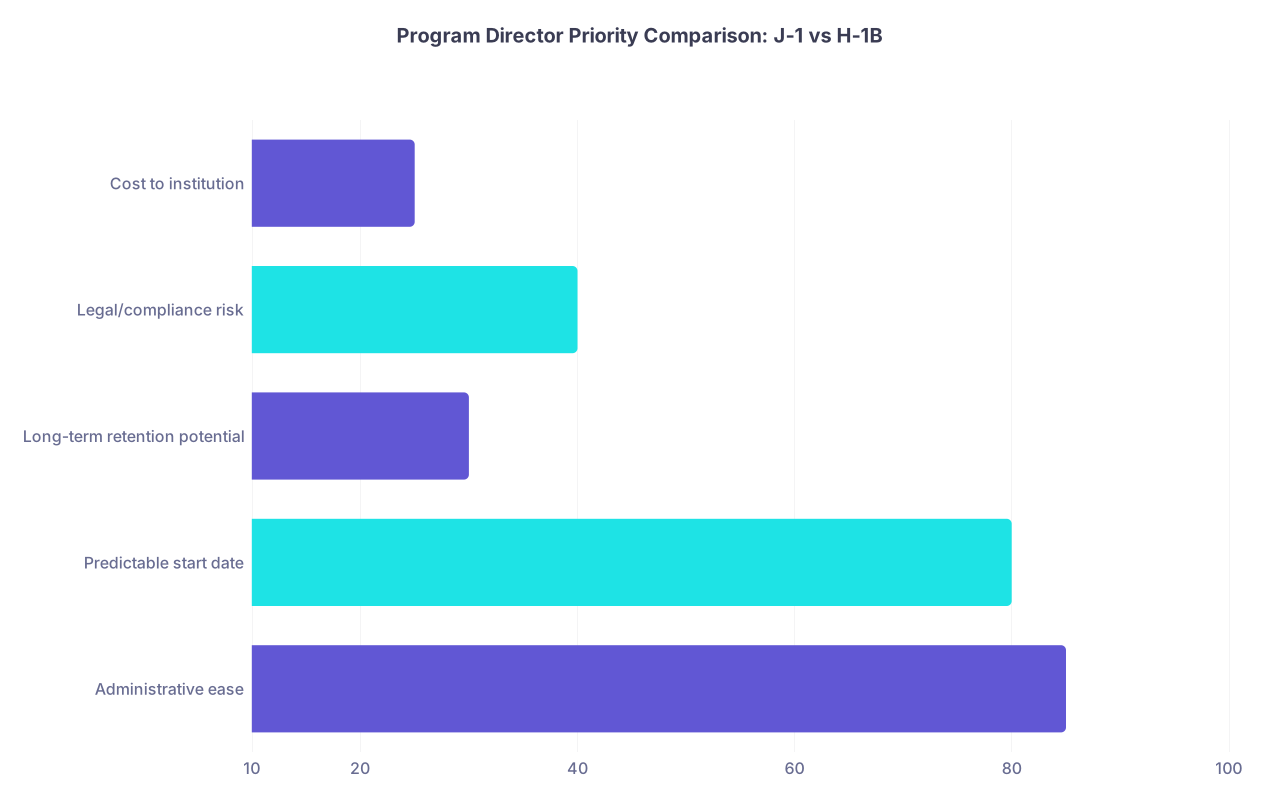
| Category | Value |
|---|---|
| Administrative ease | 85 |
| Predictable start date | 80 |
| Long-term retention potential | 30 |
| Legal/compliance risk | 40 |
| Cost to institution | 25 |
Think of J‑1 as scoring very high on simplicity and predictability, low on long-term retention.
H‑1B is the opposite: more attractive for retention, more expensive and bothersome administratively.
Most programs default to the path of least resistance unless they deeply want to keep you.
When a Program Truly Prefers H‑1B Over J‑1
This is rarer, but it exists.
You see this pattern in:
- Highly academic IM programs that convert a large share of residents to fellows or hospitalists
- Some high-end subspecialty fellowships (GI, cards, heme/onc) that want the option to keep you as junior faculty
- Systems that already have strong institutional immigration counsel and infrastructure
In those places, PDs quietly prefer:
- H‑1B residents they can roll into attending jobs
- Less entanglement with ECFMG bureaucracy
- A more direct employer–employee relationship
I’ve literally heard:
“J‑1 is messier once they want to stay. If they’re strong, I’d rather they be on H‑1B from the start.”
But again, this is a world where they’re playing a different game: talent retention, faculty pipelines, long-term institutional staffing. Not just filling a night float schedule.
FAQ (Exactly 3 Questions)
1. If a program says “we sponsor both J‑1 and H‑1B,” should I tell them I strongly prefer H‑1B?
You can signal a preference, but do it carefully and not as your opening move. Be sure you’re a desirable candidate first. Late in the process or after an interview, a line like, “If possible, I’d be very interested in H‑1B sponsorship given my long-term plans to stay in the US, but I’m flexible with what works best for the program,” is reasonable. Leading with, “Will you give me H‑1B?” early on when you’re not a standout candidate is how you get quietly deprioritized.
2. Do PDs ever rank J‑1 and H‑1B candidates differently just because of visa type?
Yes. Not always, but it happens. If two candidates are similar on paper and fit, their visa “cost” to the program becomes a tiebreaker. At a J‑1-leaning community program, the J‑1 applicant might get bumped up. At a big academic center wanting long-term hires, the H‑1B candidate might seem more attractive. They’ll rarely admit this publicly, but it absolutely comes up in rank discussions.
3. Is it better to take a weaker program on H‑1B or a stronger program on J‑1?
For most people with serious academic or fellowship ambitions, a stronger program on J‑1 beats a mediocre program on H‑1B. Training quality, reputation, and networking open more doors than visa category alone. You can fix visa constraints later with waivers, job choices, or eventually status changes. You can’t retrofit a weak residency into a strong one. The exception is if your absolute, non-negotiable priority is permanent US residence at any cost; then H‑1B at a stable, if not elite, program may be worth more to you personally.
Key takeaways:
- Programs don’t “like” J‑1 or H‑1B in the abstract. They like whichever minimizes risk and admin pain for them given their infrastructure.
- J‑1 is the low-friction default; H‑1B is a selective upgrade usually reserved for high-value candidates or H‑1B-savvy institutions.
- Your real leverage over visa type comes from being someone they genuinely do not want to lose—visa talk without that leverage is just noise to them.


