
Costly J-1 Missteps That Trigger the 2-Year Rule When You Didn’t Need It
What if you find out—after matching, after starting residency—that you accidentally locked yourself into the J‑1 two‑year home residency rule… even though you could have avoided it?
I have watched that happen. More than once. And it is brutal.
Not because J‑1 is “bad” by itself. It is a perfectly valid path. But because many IMGs slide into J‑1 with zero strategy, trigger the 2‑year rule without realizing, and only discover the consequences when they want a fellowship, a job, or a green card. By then, most of the damage is permanent.
This is about avoidable J‑1 mistakes. The errors that quietly turn a flexible future into a narrow corridor with locked doors on both sides.
If you are an IMG heading into residency applications, here is what you absolutely must not screw up.
1. Ignoring Whether You Even Need a J‑1 in the First Place
The most basic mistake: assuming “IMG = J‑1” and never asking if a better option was possible.
I have seen residents say, “My program said they sponsor J‑1, so I took it.” Full stop. No second opinion. No lawyer. No comparison to H‑1B. They wake up three years later trying to get an O‑1 or a waiver job and realize they boxed themselves in for no reason.
You need to understand something very clearly:
J‑1 is not the only visa path for residency.
It is just the most common for IMGs because it is easier for programs, not necessarily better for you.
Here are the most common options IMGs overlook:
H‑1B for residency (most obvious alternative)
Many university programs and some community programs will sponsor H‑1B for residency. But they do not advertise it boldly. Some only do it if you ask early and meet their criteria (usually USMLE Step 3 passed before contract signing, and no need for repeated H‑1B transfers during prelim/advanced splits).O‑1 for exceptional candidates
Rare, yes. But if you have major publications, strong research, and a decent CV, some places will consider O‑1. I have seen research-heavy IMGs in big-name institutions do this, then later move smoothly to green cards with no 2‑year trap.Existing status you never evaluated properly
I have seen people already in the U.S. on F‑1 OPT with a cap‑exempt H‑1B possibility through a university job, who still let themselves be put on a J‑1 for residency because “that’s what the GME office suggested.”
Here is the mistake:
Taking the J‑1 automatically because it is the default, not because it is the best.
| Visa Type | Subject to 2-Year Rule? | Typical Use | Requires Step 3? |
|---|---|---|---|
| J-1 (ECFMG) | Often, yes | Most IMG residencies | No |
| H-1B | No | Some residencies, many jobs | Yes |
| O-1 | No | High-achieving researchers/clinicians | No (but helpful) |
| J-1 Research Scholar | Often, yes | Research positions | No |
The cost of this mistake is not obvious on Match Day. It shows up when you:
- Want a job that only hires on H‑1B (and they tell you “No J‑1 waivers, sorry”).
- Want a fast green card and find out consular processing is blocked by your 2‑year rule.
- Want a subspecialty fellowship at a private program that refuses J‑1 waivers.
If you are applying now, your first “do not screw this up” step is simple:
Ask explicitly:
“Do you ever sponsor H‑1B for residents? Under what conditions?”
And do it before contracts, and preferably before rank lists.
2. Not Checking Whether You’re Actually Subject to the 2-Year Rule
Another nasty trap: assuming that if you are on a J‑1, you are automatically subject to the 2‑year home residency requirement.
That is wrong. But the opposite mistake is worse: being subject and not realizing it.
There are three classic triggers for the 2‑year rule under INA 212(e):
- Your country of last permanent residence is on the Skills List and your activity falls under it.
- Your J‑1 program is funded directly or indirectly by a U.S. or foreign government.
- You received graduate medical education or training in the U.S. (residency/fellowship under ECFMG J‑1).
For clinical J‑1 sponsored by ECFMG, trigger #3 usually applies. You are almost always subject. But people still make mistakes by:
- Trusting what someone told them verbally.
- Ignoring what is printed on their visa or DS‑2019.
- Assuming early research J‑1 time “does not count.”
Here is where people mess up specifically:
You might have had:
- A prior J‑1 research scholar visa in the U.S.
- A short J‑1 observership or research exchange.
- Funding from your government for that research.
You then assume, “That was just research, not residency. So no 2‑year rule.”
Except your DS‑2019 quietly states “Subject to 212(e) – Yes. Government financing.”
Fast forward: you later do residency on H‑1B, and then your green card lawyer tells you, “You still have an unfulfilled 2‑year requirement from that old J‑1. And you never got a waiver.”
That is the nightmare people do not see coming.
How to avoid this mistake
You check documentation. Religiously.
Look at:
- The annotation on your J‑1 visa stamp (if you have one).
- Box 2 on your DS‑2019 forms (all of them, from every J‑1 stay).
- If in doubt, get an advisory opinion from the Department of State before you start planning a different status or green card.
Do not guess. Do not rely on “my friend’s situation was similar.”
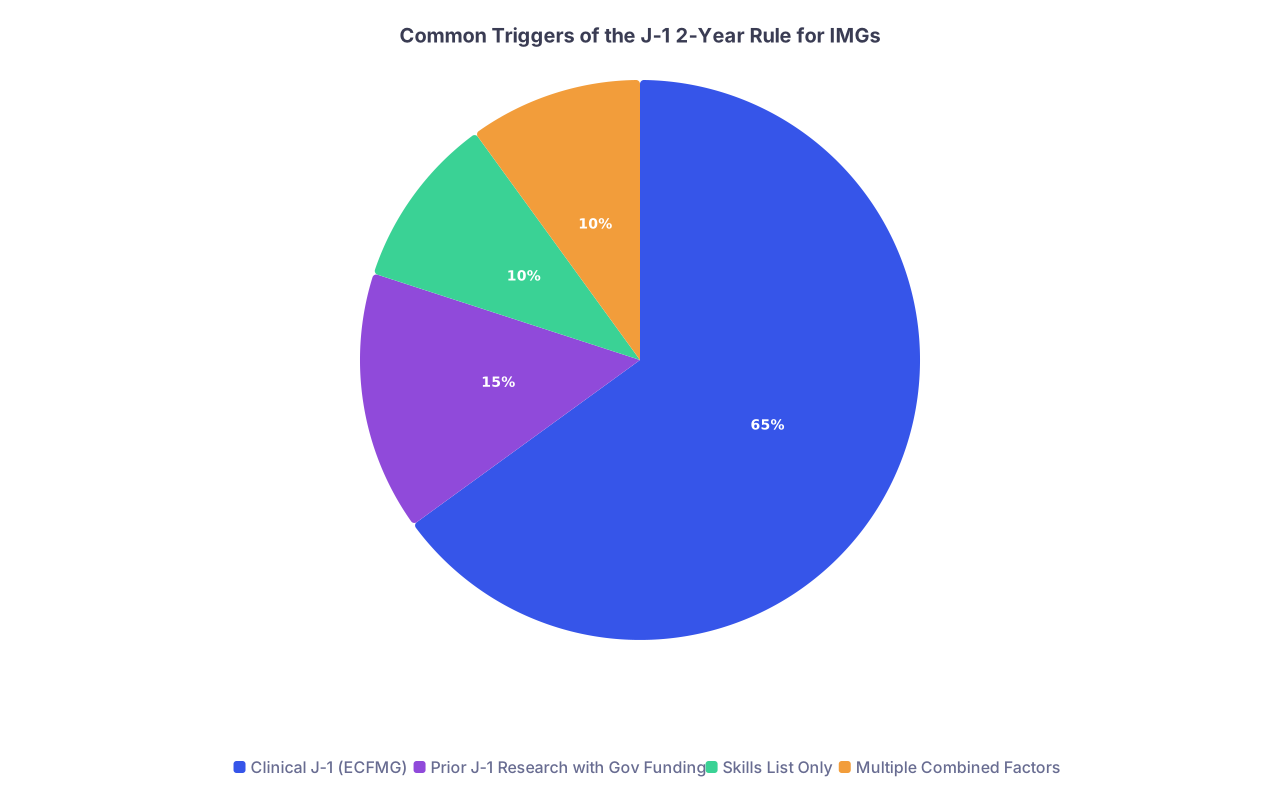
| Category | Value |
|---|---|
| Clinical J-1 (ECFMG) | 65 |
| Prior J-1 Research with Gov Funding | 15 |
| Skills List Only | 10 |
| Multiple Combined Factors | 10 |
If you had any previous J‑1, you double‑check. If you are about to accept J‑1 for residency, you confirm whether that specific program will trigger 212(e) (it almost always will for clinical training, but you verify anyway).
3. Letting Your Home Country Funding or “Skills List” Trap You Quietly
The ugly twist: you may not even need to be subject to the 2‑year rule for your U.S. training, but your home country pushes you into it through funding or the skills list.
Two common ways this goes wrong:
a) Accepting home government funding without understanding the 2-year consequence
I have seen candidates from certain countries brag about having “full government scholarship” for U.S. training. It sounds great. Until you read the fine print:
- Government funds your training.
- Government cooperates with J‑1 sponsorship.
- Government then insists you must go back home for several years as a condition.
You end up with:
- The U.S. 2‑year rule triggered by foreign government funding, plus
- A separate contractual obligation to your government back home.
Can you get a waiver later? Maybe. But it gets much more complicated, sometimes politically impossible.
You should never accept government money for U.S. training without asking:
- Will this be treated as “government funding” for J‑1 purposes?
- Is there a service requirement? For how long? In what setting?
- Can I decline this funding and self‑fund (or use other support) to avoid being tied down?
b) Being on your country’s Skills List and not realizing what field you actually count under
The Skills List is not intuitive. It is old, messy, and poorly explained. People from certain countries are subject to 212(e) just because their field is considered critical to national development.
I have seen IMGs who did research J‑1 in, say, public health or certain clinical specialties, only later realize their field is on the Skills List.
What they thought was a harmless research year locked them into 212(e). Before residency. Before H‑1B. Before green card.
Do not assume your specialty is safe. You confirm:
- Is my country currently on the Skills List?
- Are my proposed duties or research topic listed as critical skills?
- If yes, can I reframe my research description or choose a different track that does not trigger it?
If a mentor casually suggests, “We will put your project under ‘primary care development’ so we look good to the grant agency,” you stop and ask how that interacts with your Skills List entry.
This is where a decent immigration lawyer earns their fee.
4. Locking Yourself Into J‑1 Clinical Training When H‑1B Was Still on the Table
This one hurts the most because it is 100% avoidable.
You had:
- Step 3 passed.
- Decent scores.
- A program that sometimes does H‑1B.
But you:
- Did not ask early.
- Signed your J‑1 paperwork because “GME sent it and I was scared to delay.”
- Or worse, trusted “The program does only J‑1,” when they in fact occasionally bend for strong candidates.
Result: you triggered the 2‑year rule for multiple years of training that could have been on H‑1B.
Let me be blunt: programs often choose J‑1 because it is easier for them, not better for you.
J‑1:
- No prevailing wage compliance mess.
- No H‑1B cap issue (ECFMG is cap‑exempt).
- Less permanent responsibility.
H‑1B:
- More work for their HR and lawyers.
- Potential wage headaches.
So unless you push, many will default to J‑1.
Red flags you ignored if this happens to you
- You never directly asked the GME office, “Under what conditions do you sponsor H‑1B?”
- You did not take Step 3 early, so you removed yourself from H‑1B eligibility.
- You accepted “We don’t do H‑1B” without:
- Asking current residents.
- Checking with previous IMGs.
- Looking at alumni CVs to see if H‑1B residents existed.

| Step | Description |
|---|---|
| Step 1 | Matched to Program |
| Step 2 | Likely J-1 Only |
| Step 3 | Request H-1B Evaluation |
| Step 4 | Proceed on H-1B |
| Step 5 | Program ever sponsors H-1B? |
| Step 6 | Step 3 Passed Before Contract? |
| Step 7 | Program Agrees? |
If H‑1B was realistically not an option—fine. At least you made an informed choice.
The mistake is not even checking and walking blindly into multiple years of 212(e) exposure you did not need.
5. Accepting “Harmless” Pre-Residency J‑1 Research That Quietly Starts the Clock
This one is sneaky.
You come to the U.S. for:
- 1–2 years of J‑1 Research Scholar or Short-Term Scholar.
- A public health master’s with some attached J‑1 research.
- A structured research fellowship in cardiology, oncology, etc.
Nobody explains 212(e) clearly. You think, “It is just research, not clinical training. J‑1 clinical is different.”
Then later:
- You get a great offer for H‑1B residency.
- Or a PhD with H‑1B.
- Or a job that wants you on H‑1B or straight to green card.
But your old J‑1 research was subject to the 2‑year rule because of Skills List or government financing.
Now every future immigration step is harder.
I have personally heard versions of this: “Back home they said, ‘Just go do your research year, then stay in the U.S. for residency.’ Nobody mentioned the 2‑year home requirement.”
Here is the truth:
Not all J‑1 research makes you subject to 212(e). But enough of it does that any J‑1 status should ring alarm bells in your head.
The mistake is treating a J‑1 research stay as irrelevant to your long‑term immigration plan.
Before you say yes to that research J‑1:
- Have an immigration lawyer look at your DS‑2019 wording and funding.
- Ask if there is a different visa you can use (F‑1 with CPT, H‑1B research job, etc.).
- At minimum, confirm whether 212(e) will apply and document that understanding.
6. Mismanaging Waiver Strategy: Timing, False Assumptions, and Burned Bridges
Sometimes you really do need J‑1. Fine. Then the mission is not “avoid J‑1 at all costs” but “do not destroy your waiver options later.”
People sabotage themselves here badly.
Classic waiver‑related mistakes
Assuming you will “just get a J‑1 waiver job later” without checking your specialty and geography.
Waiver jobs are:- Specialty‑dependent.
- Location‑dependent.
- Politically influenced (state Conrad 30 policies vary wildly).
If you are going into a competitive urban subspecialty and you assume there will be a Conrad 30‑eligible job in Manhattan waiting for you, you are dreaming.
Doing multiple J‑1 fellowships and extending the problem.
Every extra year of J‑1 digs you deeper. More waiver years needed, more time while your peers are already in attending jobs with permanent residency.Waiting too long to engage a waiver‑savvy attorney.
People often start thinking about waivers in PGY‑3 for a 3‑year residency and a 3‑year waiver job. That is late, but not catastrophic. Waiting until your final year of a fellowship with zero plan? That is how people get stuck.
If you choose J‑1, you should know:
- Which waiver paths are realistic for your specialty: Conrad 30, federal agencies (VA, HHS, etc.), hardship/persecution for spouse/children.
- Which states are easier for your field.
- Roughly when in training you need to start job hunting for waiver positions.
You do not leave this to “future you.”
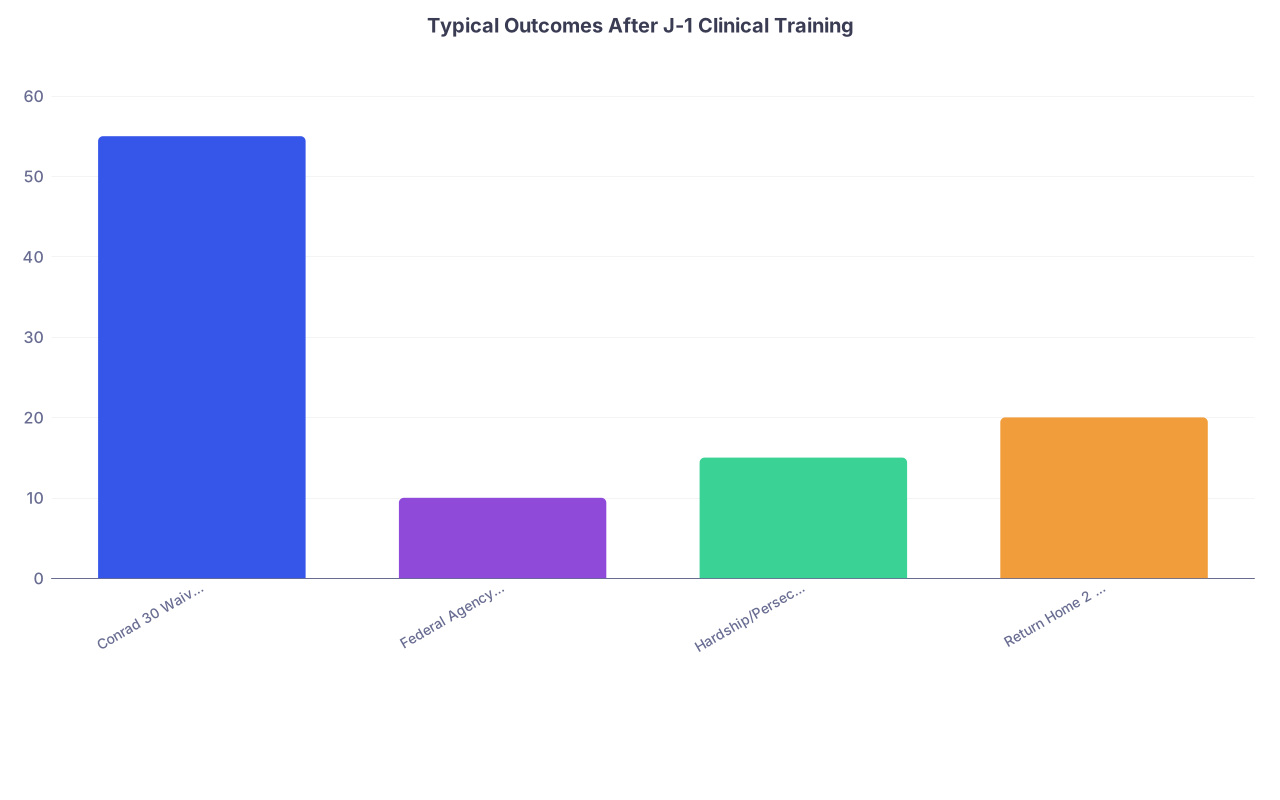
| Category | Value |
|---|---|
| Conrad 30 Waiver Job | 55 |
| Federal Agency Waiver | 10 |
| Hardship/Persecution Waiver | 15 |
| Return Home 2 Years | 20 |
7. Trusting Random Advice Instead of Documentation and Experts
This might be the biggest meta‑mistake: outsourcing your visa thinking to the wrong people.
I have heard all of these, word for word:
- “My senior said J‑1 and H‑1B are basically the same in the end.”
- “The GME office said everyone just does J‑1 and it is fine.”
- “The recruiter told me, ‘We sponsor J‑1, no problem,’ so I assumed it was safe.”
Your senior resident is not an immigration lawyer.
Your program coordinator is not looking at your 10‑year plan.
Your recruiter is optimizing for filling a spot, not securing your future.
The dangerous pattern:
- You listen to non‑experts.
- You do not read your own DS‑2019 carefully.
- You never get a written legal opinion.
- You only talk to an attorney after the damage is done.
You avoid this by doing three very specific things:
Read your own documents. Every DS‑2019. Every I‑797. Every visa annotation. Look for:
- “Subject to 212(e): Yes/No”
- Any mention of funding sources.
- Field/category descriptions.
Use attorneys strategically, not reactively.
Pay for a one‑hour consultation before:- Accepting a research J‑1.
- Switching from one J status to another.
- Choosing between H‑1B and J‑1 for residency.
- Committing to a waiver job offer.
Document every critical immigration conversation.
If a GME office says “We never do H‑1B,” ask politely in writing. If their answer is different from what residents have experienced, that is a red flag. If a government scholarship office claims “This funding has no J‑1 implications,” get it in writing and cross‑check with a lawyer.
8. What You Should Do Before You Lock in Any J‑1 Path
If you are serious about not getting trapped by J‑1 when you did not need to, build a checklist. And actually use it.
Before you accept any J‑1 status (research or clinical):
- Confirm in writing whether you will be subject to 212(e), and why.
- Verify if there is any viable path to avoid J‑1 entirely (H‑1B, O‑1, F‑1 + CPT/OPT, etc.).
- If you already had a prior J‑1, get a DOS advisory opinion if there is any doubt about previous 2‑year rule obligations.
- If you are entering clinical training:
- Check if the program has ever sponsored H‑1B for residents.
- Make sure you know the program’s exact conditions for H‑1B (Step 3 timing, contracts, funding).
- If your home country or an institution is funding you:
- Get the terms and immigration impact in writing.
- Ask if that funding could be treated as “government funding” for J‑1 purposes.

And before you build your entire career plan on a J‑1 foundation, map out:
- Your ideal scenario: fellowship type, job setting, location, green card timeline.
- Whether that ideal path is actually compatible with:
- The 2‑year rule.
- The need for a waiver job in underserved areas.
- The availability of waiver positions in your specialty.
If the answer is “barely,” you think long and hard before taking J‑1.
9. One More Quiet Killer: Overlapping or Changing Fields Without Re-Checking 212(e)
Last subtle trap.
You:
- Start in J‑1 research in public health.
- Later shift to J‑1 clinical.
- Then maybe another research attachment.
Or you:
- Move from one J category to another within the U.S.
- Extend your program with different funding sources.
At each of these changes, the 2‑year rule status can shift:
- From “Not subject” to “Subject.”
- Or add a second independent 2‑year requirement.
- Or change the basis (Skills List vs government funding vs clinical training).
I have seen people surprised by a second 2‑year requirement triggered after a subsequent J‑1 activity. They thought they were overlapping; in reality, they stacked more obligations.
Every new DS‑2019 is a new risk point. You do not assume continuity. You verify.

10. The Bottom Line: What You Must Not Get Wrong
You cannot control everything in U.S. immigration. But you can avoid the most painful, self‑inflicted J‑1 disasters.
Three key points to walk away with:
Do not slide into J‑1 by default.
Always ask whether H‑1B (or another status) is possible, especially for residency. Passing Step 3 early and pressing programs for clarity can save you from years of 2‑year rule complications that you never needed.Never guess about the 2‑year rule—confirm it.
Every J‑1 (research or clinical), every DS‑2019, and every funding source must be checked against 212(e). If there is any doubt, get an advisory opinion or a real lawyer’s assessment before you commit to your next step.If you must use J‑1, treat it like a loaded device, not a toy.
Plan your waiver options early, understand the limits it places on your fellowship and job choices, and avoid stacking extra J‑1 periods or government funding that deepen your obligations.
You cannot afford to discover the 2‑year rule after it is too late to do anything about it.