

What hidden sentence in a residency contract can quietly kill your H‑1B—and your U.S. training plans—before you’ve even stepped into orientation?
If you’re an IMG chasing H‑1B sponsorship for residency, the biggest threat is often not the visa rules themselves. It’s the contract you sign without understanding how a few lines of legalese destroy your options.
I’ve seen it too many times:
- Brilliant IMG matches to a solid university hospital
- Assumes “they sponsor H‑1Bs, so I’m safe”
- Signs the contract in 24 hours, no questions asked
- One buried clause makes H‑1B impossible or extremely risky
- Scramble, panic, sometimes loss of position or forced J‑1
Let’s make sure that’s not you.
1. The “J‑1 Only” Trap Hiding in Your Offer
First mistake: assuming “We sponsor visas” means “We’ll definitely give you an H‑1B.”
Wrong. Many programs:
- Prefer J‑1
- Default to J‑1 unless you fight for H‑1B
- Say “We sponsor visas” but mean “We work with ECFMG for J‑1”
The contract language can quietly lock you into J‑1 and shut the door on H‑1B.
Red-flag language to watch for
Here’s what you do not want to see in your contract:
- “Resident agrees to obtain and maintain J‑1 visa status through ECFMG.”
- “The Program will support J‑1 sponsorship only.”
- “The Hospital does not sponsor H‑1B visas for residency positions.”
- “All international medical graduates must hold J‑1 visa status during training.”
If you sign that, you’ve basically surrendered your H‑1B option.
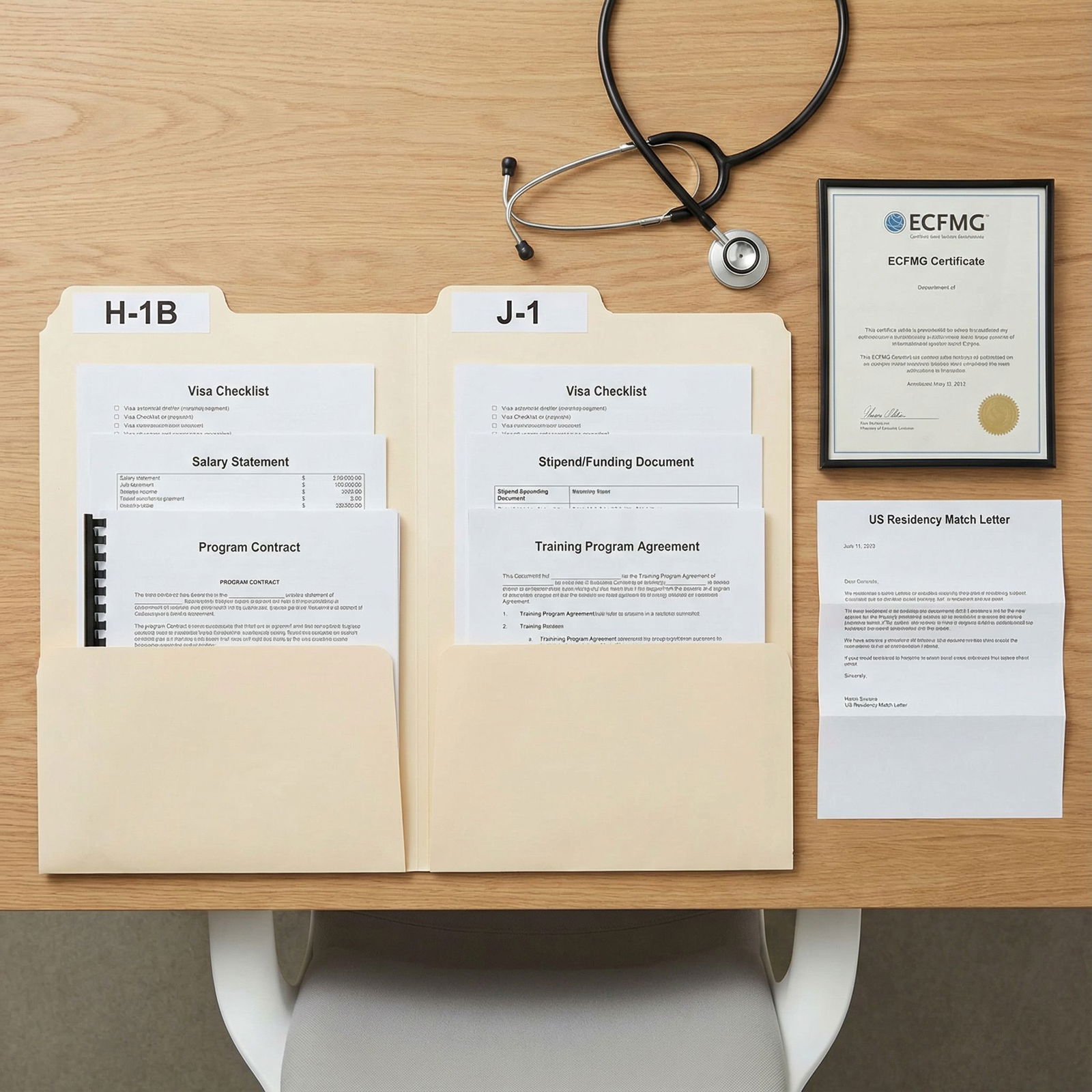
Common mistake
Residents tell me, “But the program director said they sometimes do H‑1Bs.”
Doesn’t matter. If the written contract says J‑1 only, that’s what HR and legal will follow. Verbal reassurances won’t help you when USCIS is involved.
What you want instead
You want the contract to leave room for H‑1B. For example:
- “The Hospital will sponsor an appropriate visa status, which may include J‑1 or H‑1B, at the Hospital’s discretion.”
- Or at minimum: no clause at all specifying J‑1 only.
Better yet, get this kind of language in writing (offer email or contract addendum):
- “Subject to USCIS approval, the Hospital will sponsor H‑1B status for this position.”
If they refuse to put it in writing, that’s a loud warning signal.
2. Malpractice Coverage Dates That Don’t Match H‑1B Reality
You cannot get an H‑1B approval that starts before:
- You have your full, unrestricted state license (for PGY‑2+), or
- All applicable requirements for the temporary license are met (for PGY‑1 in some states), and
- Your malpractice coverage period matches the requested H‑1B start date.
Programs often ignore that last part. USCIS does not.
The nasty clause to watch
Look for language like this:
- “Professional liability insurance will commence on July 15, aligned with resident orientation.”
- “Coverage begins on the first day of active clinical duties.”
But your H‑1B petition is asking for a start date of July 1. That gap looks small to you. It looks fatal to USCIS.
They’ll ask: who covers your liability from July 1–14? Program shrugs. USCIS delays or denies.
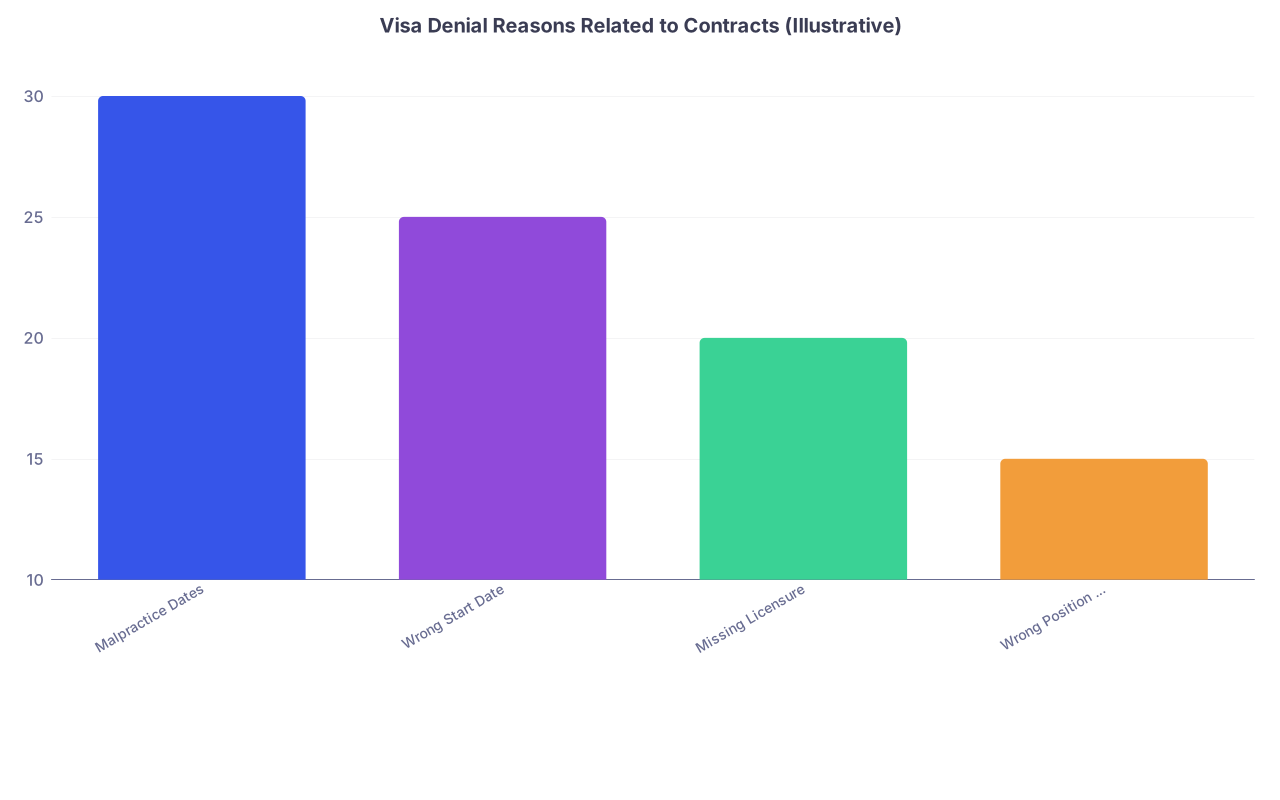
| Category | Value |
|---|---|
| Malpractice Dates | 30 |
| Wrong Start Date | 25 |
| Missing Licensure | 20 |
| Wrong Position Title | 15 |
Classic failure scenario
- Contract: start date July 1
- Malpractice clause: coverage from “first day of clinical duties” (which they internally treat as July 10 after orientation)
- H‑1B petition: requested start July 1
- USCIS RFE: “Provide evidence of malpractice coverage beginning 07/01”
- HR realizes insurance actually starts 07/10
- You: stuck in limbo, possibly forced to switch to J‑1 or delay start
How to protect yourself
You’re not rewriting their entire legal structure. You’re just making sure it matches the H‑1B timeline.
Ask (before signing):
- “On what date does malpractice coverage actually begin—calendar date, not ‘first day of duties’?”
- “Can you confirm that malpractice coverage will begin on my official start date listed in the H‑1B petition?”
If the answer is vague, push for clarification or written confirmation. If they refuse, understand: you’re accepting real H‑1B risk.
3. Wrong Job Title or Duties That Don’t Match H‑1B Requirements
H‑1B is for a specialty occupation. For residents, USCIS expects:
- Job title like “Internal Medicine Resident Physician”
- Duties clearly medical, supervised clinical work and training
- Salary within GME/ACGME norms
Too many contracts use lazy or generic HR titles that do not look like a professional medical role.
Dangerous wording in the position section
Look for clauses that say things like:
- “Position: Clinical Assistant”
- “Position: Graduate Trainee” with no mention of medicine
- “Role: House Staff” with purely generic or administrative duties
Is “house staff” enough by itself? Sometimes. Is “clinical assistant”? Very risky.
USCIS wants to see a direct tie to:
- Medicine
- Residency level
- Requiring an MD/DO (or foreign equivalent)

How this wrecks your petition
I’ve seen this exact mess:
- Contract title: “Clinical Associate”
- Duties section: “May include patient transport, assisting nursing staff, clerical duties”
- USCIS says: this looks like a support role, not a specialty-occupation physician position
- RFE asks program to prove it requires an MD and is a standard resident position
- Program legal gets nervous, HR confused, delays pile up
Sometimes they fix it with letters and amendments. Sometimes they don’t. You do not want your residency start dependent on an HR department’s learning curve.
What your contract should say
Look for:
- “Position: [Specialty] Resident Physician (PGY‑1 / PGY‑2 / etc.)”
- Duties clearly describing participation in supervised patient care, ACGME-based training, etc.
- Requirement: “Requires MD or DO (or foreign equivalent) and ECFMG certification.”
If the title looks vague or non-medical, ask explicitly:
- “For H‑1B purposes, the position title in the contract needs to reflect a resident physician role. Can this be updated to ‘[Specialty] Resident Physician’ or similar?”
If they push back hard on a simple, accurate title change, that tells you a lot about how painful your H‑1B process will be.
4. Contract Start Dates That Don’t Match Visa Reality
This one sounds obvious, but it breaks H‑1B cases every year.
The mismatch problem
Three dates must align:
- Contract start date
- H‑1B requested start date
- GME actual “report for duty” date
If any of these are off—even by a couple of days—USCIS may question or stall the petition.
Watch for:
- Contract: “Start date July 1”
- Program reality: orientation starts July 5; payroll starts July 10
- HR decides to ask for H‑1B start on July 10 to match payroll
- But your contract still says July 1
- USCIS notices the mismatch → RFE for clarification
Or the opposite: they ask H‑1B start July 1 but contract says July 10.
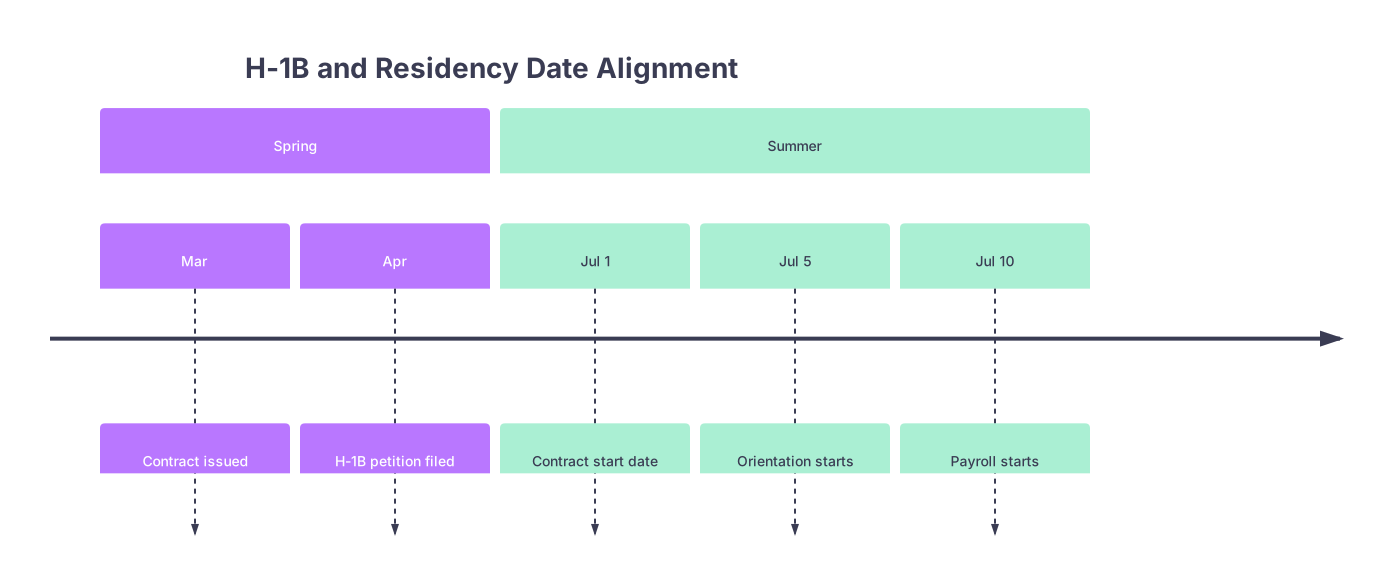
| Period | Event |
|---|---|
| Spring - Mar | Contract issued |
| Spring - Apr | H-1B petition filed |
| Summer - Jul 1 | Contract start date |
| Summer - Jul 5 | Orientation starts |
| Summer - Jul 10 | Payroll starts |
Clauses that create hidden conflict
Watch out for things like:
- “This agreement shall commence on or about July 1.”
- “Exact start date will be determined by the Program.”
- “Start date may be changed at the Program’s sole discretion.”
If they shift your start date after filing the H‑1B, without amending the petition, you’re technically out of sync with what USCIS approved.
What you should do
Before signing, ask:
- “What exact date will be listed as my H‑1B start date?”
- “Will that date match the start date in my contract?”
- “If the program changes the actual start date, will you amend the H‑1B petition accordingly?”
You’re not being difficult. You’re forcing them to think through something that can delay or sink your visa.
5. Repayment, Fees, and Illegal Cost-Shifting onto the H‑1B Resident
This is where things get ugly. Programs sometimes try to push H‑1B costs onto you in ways that are not just unfair—they’re legally dangerous.
The illegal cost mistake
USCIS rules are clear:
- The employer must pay the required H‑1B filing fees
- They cannot deduct these mandatory costs from your wage in a way that drops you below the required wage level
But contracts sometimes say things like:
- “Resident agrees to reimburse the Hospital for all visa-related expenses.”
- “If Resident leaves prior to completion of the contract, they shall repay all visa costs, including H‑1B filing fees and legal fees.”
- “Visa expenses may be deducted from Resident’s salary.”
These clauses can:
- Violate H‑1B wage rules
- Trigger audits or DOL complaints
- Blow back on you if the program gets investigated

There is one narrow exception
A reasonable early-termination penalty for training costs unrelated to visa fees sometimes passes legal review—for example:
- Repayment of sign-on bonus if you leave before a certain date
- Tail coverage costs in some private practice settings after residency
But visa filing fees for the initial H‑1B? Trying to recoup that from you is asking for trouble.
What you should refuse
Do not casually sign clauses that say you must:
- Repay I‑129 filing fees
- Repay ACWIA training fees
- Pay for your employer’s attorney for the H‑1B petition (for the employer’s portion)
- Reimburse “all visa costs” without clear breakdown
You may choose to cover your own optional costs (H‑4 for family, premium processing if you insist, etc.), but the base employer-required fees are their responsibility.
6. Non-Compete and Future Employment Clauses that Choke Your Post-Training Options
Strictly speaking, these don’t “wreck” the initial H‑1B petition, but they can destroy your longer-term immigration path.
H‑1B strategy isn’t just about residency. It’s about:
- Fellowship
- First attending job
- Green card timing
Your residency contract can quietly sabotage all of that.
Problem clauses to watch
Look for sentences like:
- “Resident agrees not to practice medicine within a 50‑mile radius of the Hospital for two (2) years following completion or termination of training.”
- “Resident shall not accept employment with any affiliated faculty practice group or competing hospital without prior written consent of the Program.”
- “Resident agrees not to solicit or accept offers from departments or practices with which they have rotated during training.”
Combine that with:
- H‑1B cap limitations
- The need to stay in cap-exempt or specific geographical areas
- Your green card sponsorship strategy
…and suddenly your hands are tied right when you need maximum flexibility.
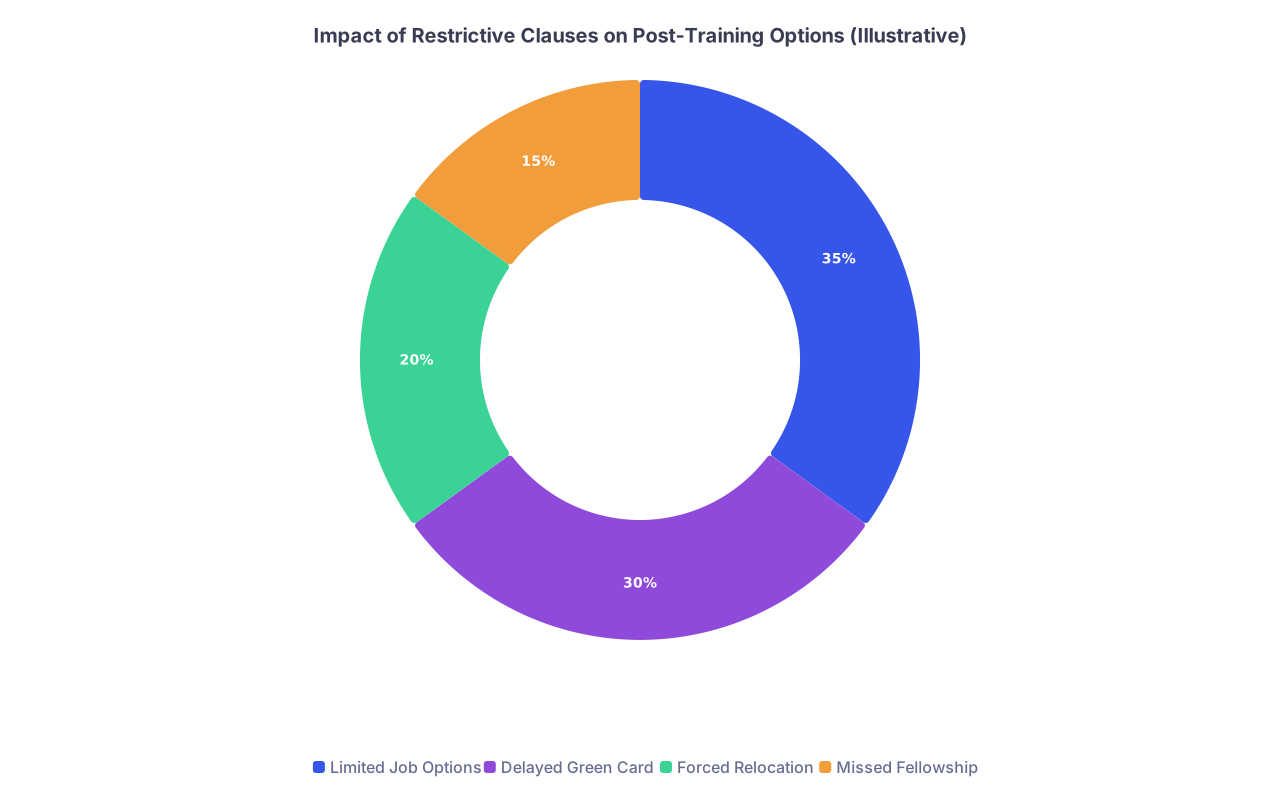
| Category | Value |
|---|---|
| Limited Job Options | 35 |
| Delayed Green Card | 30 |
| Forced Relocation | 20 |
| Missed Fellowship | 15 |
Why this matters for H‑1B strategy
If you’re in a cap-exempt H‑1B during residency (university, major teaching hospital), your best next step is often:
- Another cap-exempt H‑1B for fellowship at the same or nearby institution, or
- A carefully timed transfer to a cap-subject employer with backup plan
If your contract says you can’t work in that area or with those affiliated groups, you may:
- Lose access to cap-exempt follow-up positions
- Be forced into limited, risky options that don’t fit your visa timeline
- Delay or complicate your green card path
You cannot always negotiate these away. But you should at least understand the trap before you walk into it.
7. Waivers, At‑Will, and “We Can Cancel Anytime” Clauses
Another subtle problem: contracts that let the program walk away easily while your H‑1B locks you into very rigid rules.
Language that signals danger
- “This agreement may be terminated by the Hospital at any time, for any reason, with 30 days’ notice.”
- “Continuation of employment is at the sole discretion of the Program and may be ended at any time.”
- “Nothing in this Agreement shall be construed as a guarantee of continued employment.”
Standard “at-will” type lines are common in U.S. contracts. But for H‑1B residents, they create extra risk:
- If they terminate you, you’ve got a short window (often interpreted as 60 days max) to find another H‑1B sponsor
- Training slots in the middle of the year are rare
- Visa transfer mid-residency is legally and practically painful
Combine that with repayment clauses or rigid scheduling, and you’re cornered.
You can’t remove all risk—but you can at least know it’s there
You probably can’t rewrite their whole clause. But don’t ignore it. If a program has:
- Broad termination rights
- Weak due-process or grievance procedures
- No clarity on remediation steps
…you’re taking on huge risk as an IMG on H‑1B, who can’t just “go elsewhere” easily if things go south.

Quick Comparison: Safe vs Risky Clauses for H‑1B Residents
| Topic | Safer Clause Example | Risky Clause Example |
|---|---|---|
| Visa Type | “May sponsor J-1 or H‑1B as appropriate” | “J‑1 visa only” |
| Position Title | “Internal Medicine Resident Physician (PGY‑1)” | “Clinical Assistant / Graduate Trainee” |
| Malpractice Start | “Coverage begins on contract start date (July 1)” | “Coverage begins on first clinical shift” |
| Visa Costs | Employer pays H‑1B filing fees | Resident must repay “all visa expenses” |
| Non-Compete | None or narrow, short radius/time | 2‑year, 50‑mile ban on practicing medicine |
How to Review Your Contract Like Someone Who Wants to Actually Keep Their H‑1B
Here’s how to avoid being the resident who emails me in June saying, “USCIS just denied my petition because of my contract. What do I do now?”
Step 1: Assume nothing
- Don’t assume “we sponsor H‑1Bs” means for you
- Don’t assume the contract language matches what the PD said
- Don’t assume HR understands IMG visa details; many don’t
Step 2: Do a focused visa review
When you get the contract, go straight to:
- Visa/immigration section
- Position title and duties section
- Start date and term section
- Malpractice coverage section
- Repayment / liquidated damages / cost clauses
- Non-compete / limitations on future employment
Scan these for the red flags we just went through. If you spot any, don’t “hope it’s fine.” It rarely is.
Step 3: Ask smart, specific questions—in writing
Examples you can copy-paste:
- “Can you confirm whether the program will support H‑1B sponsorship for this position, subject to eligibility?”
- “The contract mentions J‑1 specifically. For an H‑1B petition, can this be adjusted to allow either J‑1 or H‑1B as appropriate?”
- “For H‑1B purposes, the position title needs to be clearly a resident physician role. Can we specify ‘[Specialty] Resident Physician’ instead of ‘Clinical Associate’?”
- “What is the exact malpractice coverage start date, and will it match the H‑1B start date you plan to request?”
Programs that are used to H‑1Bs respond to these questions quickly and clearly. Programs that stumble or go silent are showing you their competence level.
Step 4: If anything seems off, get an immigration lawyer’s eyes on it
Not a random friend. Not a senior resident. A real immigration attorney who:
- Knows physician H‑1Bs
- Understands cap-exempt rules, GME quirks, ECFMG timing
- Has seen what gets RFEs and denials
Is it annoying to pay for this? Yes. Is it cheaper than losing your spot or being forced into J‑1 when you wanted H‑1B? Absolutely.
FAQ (Exactly 4 Questions)
1. Can I force a program to give me H‑1B instead of J‑1 if they usually only do J‑1?
No. You can request, negotiate, and explain your reasons (long-term immigration plans, home-country obligation problems, etc.), but the program decides what they’ll sponsor. If their written policy and contract say J‑1 only, you either accept J‑1, walk away, or find another program. Do not sign expecting them to change after the match—they almost never do.
2. Is it safe if the contract doesn’t mention any visa type at all?
Often safer than “J‑1 only,” but not automatically good. A visa-neutral contract can work fine for H‑1B, as long as the program is actually willing to sponsor H‑1B and the rest of the contract (title, dates, malpractice, costs) matches H‑1B requirements. You still need explicit confirmation by email or letter that they will pursue H‑1B for you.
3. Can I sign the contract now and fix the language later once they start the H‑1B petition?
Bad idea. Once you sign, you lose leverage. HR and legal will treat the signed contract as final and won’t be eager to reopen it. USCIS also expects the petition to match the contract. If the contract is J‑1 only or has wrong dates/titles, fixing it later becomes a bureaucratic headache and sometimes impossible. Clean it up before you sign.
4. What if the program tells me “don’t worry, we’ve done H‑1Bs before” but the clauses still look risky?
Believe the contract, not the casual reassurance. Past experience doesn’t fix bad language that contradicts H‑1B requirements. Push them to align the written terms with what they claim they’ll do. If they resist simple, reasonable edits or refuse to clarify in writing, assume the risk is on you—and decide if you’re truly willing to carry it.
Key takeaways:
- Never sign a residency contract that quietly commits you to J‑1 only or mislabels your role; your H‑1B depends on precise language.
- Dates, malpractice coverage, and cost/repayment clauses can quietly sabotage your petition even if the program “sponsors H‑1Bs.”
- Read the contract like your visa depends on it—because it does.


