

Most graduating IMGs lose their H‑1B status not because of bad luck in the lottery, but because they had no real transition plan. That is the fixable part—and that is what we are going to fix.
If you are on a cap‑exempt H‑1B in residency or fellowship (hospital, university, or nonprofit) and you want to move into private practice, community hospitals, or industry, you are sitting on a time bomb. The day you leave the cap‑exempt job, you lose the shield that has kept you out of the annual H‑1B cap war.
This is survivable. But only if you treat it like a project and not a hope-and-pray situation.
Below is a blueprint. Step‑by‑step, month‑by‑month, with actual decision trees, not vague “talk to a lawyer” platitudes. You still need a competent immigration attorney. You just will not be walking into their office clueless.
1. Know Exactly Where You Stand (No Guessing)
You cannot build a transition plan if you do not know what you have and what you are missing. Start here.
A. Are you truly cap‑exempt right now?
You are cap‑exempt if your H‑1B is sponsored by:
- A nonprofit hospital that is formally affiliated with a university
- A university or university‑owned hospital
- A nonprofit or governmental research organization
You are cap‑subject (meaning you already went through the lottery at some point) if:
- You ever held an H‑1B with a for‑profit employer that got you selected in the cap (not just filed)
- And you have not been outside the U.S. for a continuous 1‑year period that reset your clock (rare in residency)
If you are not sure, do this:
- Pull your I‑797 H‑1B approval notices from every employer.
- Look at the employer name and type (nonprofit hospital, university, private group).
- Ask your current GME office: “Is my H‑1B cap‑exempt or cap‑subject?” They know. They file dozens of these.
- Have an immigration attorney review your history and confirm.
If you have never been selected in the regular H‑1B lottery with a cap‑subject employer, then your current H‑1B is almost certainly cap‑exempt only. That means you cannot just “transfer” to a private group without dealing with the cap.
B. Cap‑exempt vs. cap‑subject—what it really means for you
You need to get the distinction straight in your head:
| Feature | Cap-Exempt H-1B | Cap-Subject H-1B |
|---|---|---|
| Employer type | University / nonprofit hospital / research org | For-profit practice, private hospital, many health systems |
| Lottery required? | No | Yes (unless recapturing prior cap) |
| Filing timing | Year-round | Strict annual window (Mar/Apr) |
| Portability to most private jobs | No, not without new cap selection | Yes, once counted in cap |
| Common holders | Residents, fellows, academic attendings | Private practice, community hospitalists |
Key point: There is no magical “conversion” of a cap‑exempt H‑1B into a cap‑subject H‑1B. A cap‑subject employer must either:
- Win you in the H‑1B lottery and start you fresh under the cap, or
- Use a loophole where you keep a cap‑exempt tie and add cap‑subject work (more on that later).
If you skip that step, you do not have a true portable H‑1B for the private market.
2. Backward Plan from Your Graduation Date
Your graduation date is not flexible. The H‑1B cap calendar is not flexible. So you plan backwards and see which options are even possible.
A. Understand the basic H‑1B cap timeline
For cap‑subject H‑1Bs (the lottery everyone dreads):
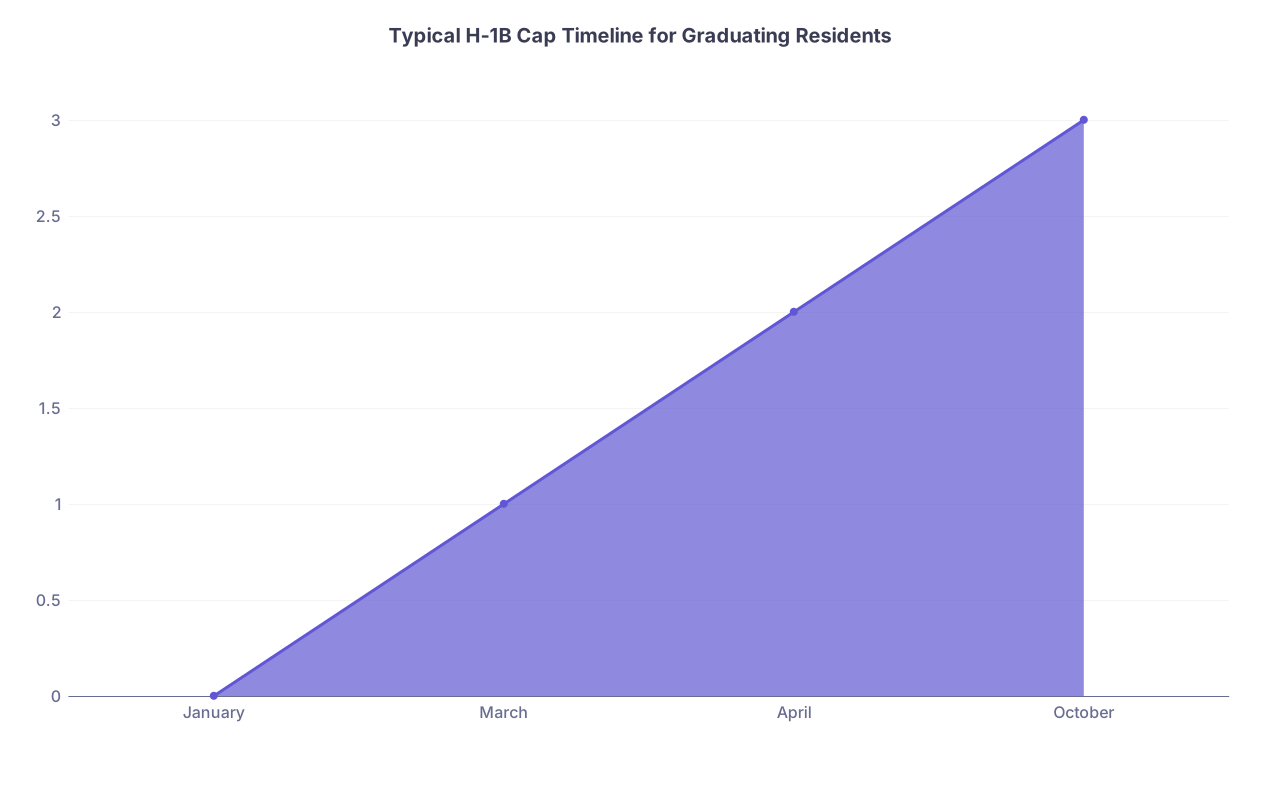
| Category | Value |
|---|---|
| January | 0 |
| March | 1 |
| April | 2 |
| October | 3 |
Interpretation:
- January–February: Employers prepare and register you for the H‑1B lottery (online registration).
- March: USCIS runs lottery, selects registrations.
- April–June: Selected employers file full H‑1B petitions.
- October 1: Typical cap‑subject H‑1B start date for selected cases.
Now overlay that with residency/fellowship graduation.
You finish training:
- June 30 (classic)
- Or sometimes July 31
But your cap‑subject H‑1B, if selected, will usually start October 1. That means there is a gap.
B. Map your dates and windows
Do this on paper or an actual calendar:
Mark:
- PGY completion date (e.g., 30 June 2026)
- H‑1B registration month (March 2025 for October 2025 start, March 2026 for October 2026 start)
- Contract start date for jobs you are eyeing (usually July 1 after graduation)
Now ask:
- “In which H‑1B cap can I realistically participate before or just after graduation?”
- “What will I be on from July 1 until October 1 if my H‑1B start is delayed?”
If your graduation is June 2026, your realistic lottery windows are:
- March 2025 (for cap‑subject H‑1B starting October 2025) while you are still in training; or
- March 2026 (for October 2026 start), which leaves a post‑graduation gap July–September.
That calendar reality will drive everything you do next.
3. Core Strategy Options: Which Path Are You Actually Taking?
I see the same four practical strategies over and over for IMGs moving from cap‑exempt to cap‑subject. Most people stumble into them. You are going to choose deliberately.
| Strategy | Where you work | Lottery dependency | Pros | Cons |
|---|---|---|---|---|
| 1. Pure cap-subject jump | Only private/community employer | High | Clean move into private sector | Lottery risk, timing gaps |
| 2. Dual employment bridge | Keep part-time cap-exempt + add cap-subject | Medium | Start private work sooner, hedge risk | Need cooperative academic employer |
| 3. Stay cap-exempt long-term | Academic/affiliated institutions only | None | Stable status | Limits job geography/options |
| 4. J-1 waiver route then H-1B cap later | HPSA/MUA or VA, often cap-exempt H-1B | Medium | Satisfies waiver, then later cap jump | Longer timeline, still need lottery |
Let me walk through what each looks like in real life and how to execute.
4. Strategy 1: The Straight Cap-Subject Jump (Lottery + Clean Switch)
This is what most people think they are doing. It only works if you actually secure a lottery selection.
A. The basic play
While you are still in residency/fellowship on cap‑exempt H‑1B, you find a cap‑subject employer:
- Private hospitalist group
- Multi‑specialty group
- Telemedicine company
- Large for‑profit health system without cap‑exempt affiliation
That employer:
- Registers you in the H‑1B cap lottery (March)
- If selected, files for October 1 H‑1B start
- Plans your onboarding around that date
You:
- Finish residency in June
- Possibly use a short‑term bridge (locums in limited settings, research, unpaid observerships with caution) until H‑1B start in October
- Or, if the cap H‑1B starts before your residency ends (rare but possible with shorter training end dates), you transition directly.
B. The landmines
- Lottery odds are not your friend. In recent years, selection rates dipped below 25% in some cycles. You do not “deserve” selection because you are a doctor. USCIS does not care.
- Many employers do not understand cap vs. cap‑exempt. I have seen private groups proudly say, “We will just transfer your H‑1B, no lottery needed.” That is wrong if you were never counted in the cap.
- Gap months after graduation are dangerous. If you graduate in June and your cap H‑1B begins October 1, you must have something maintaining your status and authorization in between. That is not an improvise‑in‑August situation.
C. How to execute this without blowing it
Here is the bare‑minimum protocol:
12–18 months before graduation
- Decide if your target jobs are mainly cap‑subject.
- Start interviewing with employers explicitly willing to sponsor cap‑subject H‑1B.
- Use this line: “My current H‑1B is cap‑exempt. For your job, I must go through the cap lottery. Are you able to register and sponsor for the cap on that timeline?”
Ask employers specific questions
- “Have you sponsored H‑1Bs for international physicians in the last 3 years?”
- “Who is your immigration counsel? I want them looped in early.”
- “Do you file for both H‑1B and green card, and at what stage?”
By December before the March lottery
- Have a signed offer letter strongly committing to:
- H‑1B cap registration
- Filing if selected
- Planned start date (often October 1 or as allowed)
- Employer’s lawyer should be prepping your case information.
- Have a signed offer letter strongly committing to:
March – H‑1B registration
- Double‑check you are actually registered:
- Ask for a copy or screenshot of the USCIS registration confirmation.
- If they refuse to show it, red flag.
- Double‑check you are actually registered:
If selected
- Petition filed by April–June.
- Coordinate with current GME/HR and new employer to:
- Align end date of residency
- Plan any gap coverage (possible unpaid time, research role, short extension of cap‑exempt H‑1B if your academic employer agrees and has justification).
If not selected
- Have Plan B already alive, not theoretical:
- Another cap‑exempt attending job
- Fellowship extension
- J‑1 waiver‑qualifying job if you are on J‑1 now (separate track)
- You do not simply “hope next year will be better.”
- Have Plan B already alive, not theoretical:
If you do this correctly, the straight jump can work. But it is a gamble, and you cannot pretend it is not.
5. Strategy 2: The Dual Employment Bridge (Cap-Exempt Anchor + Cap-Subject Add-On)
This is the trick that most residents hear about in vague whispers in the workroom: “Oh, just keep a part‑time academic job and add a private job H‑1B on top.”
It is real, but very specific.
A. The legal concept
USCIS allows “concurrent” H‑1B employment:
- You keep your cap‑exempt H‑1B with, say, University Hospital at 0.3–0.5 FTE.
- A cap‑subject employer files a concurrent H‑1B:
- Because you are still tied to a cap‑exempt role, they can sometimes bypass the cap (under certain interpretations).
- Or they at least have a way to start you earlier while a cap‑subject process is pending.
This is not a DIY move. It must be designed by an experienced H‑1B physician immigration lawyer who understands both:
- The regulations around cap‑exempt concurrent employment, and
- How strict the Service Center is currently interpreting “primarily works at cap‑exempt location / for cap‑exempt entity.”
B. What it looks like practically
Typical setup I see:
- You graduate from residency and accept:
- 0.4 FTE academic hospitalist/assistant professor role at your training institution (cap‑exempt H‑1B extended).
- 0.6 FTE private hospitalist role at a community hospital, with a second H‑1B petition filed as concurrent employment.
You:
- Maintain the academic work in a real, documented way—actual shifts, actual duties.
- Use the private job for majority of income and experience.
Over 1–3 years, you or your employer then:
- Seek a true cap‑subject H‑1B if needed, or
- Push for permanent residency (green card) which, if employment‑based, can eventually free you from H‑1B constraints altogether.
C. Critical constraints
- Your cap‑exempt employer must play ball. Some departments will happily keep you 0.25–0.5 FTE. Others will not tolerate outside clinical work.
- Your work at the cap‑exempt site must be real, not a “ghost job.” USCIS can and does request proof:
- Schedules
- Pay stubs
- Job duties
- The concurrent petition must be carefully drafted. Sloppy petitions get denied and can poison the well.
D. How to implement this
Here is a working template:
9–12 months before graduation
- Approach your program director or division chief:
- “I would like to stay on part‑time as an attending to cover nights/teaching while I also build a role elsewhere.”
- Get a sense if your department:
- Needs part‑time attendings
- Has hiring budget
- Is open to outside clinical work.
- Approach your program director or division chief:
If they are open
- Have them talk to institutional counsel/HR early.
- Explain: “This role is crucial to maintain my cap‑exempt H‑1B while I expand my experience; we will have a second employer file concurrence.”
Once the academic job looks realistic
- Secure a second employer (private job) who:
- Understands concurrent H‑1B strategy.
- Has counsel who has done this for physicians.
- Have both employers’ attorneys communicate. Not negotiate. Communicate. To avoid contradictions.
- Secure a second employer (private job) who:
File sequence
- Extend/convert your current H‑1B with the academic institution for your attending role.
- After that is approved or pending with strong documentation, file the concurrent petition for the private employer.
Maintain documentation
- Keep:
- Detailed schedules
- Payroll records from both employers
- Written contracts specifying FTE and duties
- Keep:
If executed well, this route gives you real income, real private experience, and buys time while you solve the cap‑subject problem long term (either through lottery or green card).
6. Strategy 3: Stay Safely Cap-Exempt (On Purpose)
Not everyone needs to fight their way into cap‑subject land immediately. If your priorities are stability, academic work, and a predictable life, then staying in the cap‑exempt world for a longer period is not “giving up”. It is smart.
When this makes sense
- You like:
- Academic medicine
- Teaching
- Research
- Tertiary/quaternary care centers
- You plan to:
- Pursue a green card through a university sponsor
- Or use routes like EB‑1B (outstanding researcher) or NIW (for some subspecialties and profiles)
Tactical advantages
- You can:
- Extend H‑1B beyond six years in some cases, as cap‑exempt entities have more flexibility when paired with green card processing.
- Avoid the lottery circus entirely for several years.
- Build CV strength, publications, leadership roles—making later immigration options stronger.
Execution
During residency
- Network internally for attending roles.
- Be explicit: “I am on a cap‑exempt H‑1B and want to stay within cap‑exempt employment for now. Are there junior faculty/attending positions that fit my skill set?”
-
- Negotiate:
- H‑1B extensions as needed.
- Employer‑sponsored green card timeline (within first 1–2 years if possible).
- Negotiate:
Immigration goal
- Get to:
- I‑140 approval
- Then either H‑1B extensions beyond 6 years (if needed), or eventually adjustment of status to green card.
- Get to:
From there, once you are a permanent resident, the whole cap‑subject vs. cap‑exempt dance becomes irrelevant.
7. Strategy 4: J‑1 Waiver + H-1B (Then Cap Later)
For many IMGs, the real path is:
- J‑1 in residency/fellowship
- 3‑year waiver job (often underserved area)
- Then re‑evaluate cap‑subject vs cap‑exempt options
I will not re‑teach the entire J‑1 waiver system here, but here is how it intersects with the cap issue.
A. Most waiver jobs are cap‑exempt or quasi‑protected
Common patterns:
- State Conrad 30 jobs in:
- Rural hospitals
- FQHCs
- Safety‑net clinics
- VA hospitals
- Some community hospitals with academic affiliations
Many of these qualify as cap‑exempt H‑1B sponsors or at least have strong immigration counsel.
B. Use the waiver years strategically
During those 3 years:
- Lock in:
- Stable cap‑exempt H‑1B
- Green card process if the employer is willing
- Start planning your post‑waiver life in year 2, not in month 35 of year 3.
C. The post‑waiver fork
When your waiver is nearly done, you have three main paths:
- Stay with the same (often cap‑exempt) employer longer and continue the green card track.
- Lateral to another cap‑exempt institution with a more desirable location or role.
- Try to jump into a pure cap‑subject role via:
- H‑1B lottery, or
- Concurrent H‑1B strategy as described earlier.
The point: Do not treat your waiver job as a dead‑end sentence. It is a 3‑year runway for smarter planning.
8. Practical Timeline Blueprint (Residency to First Attending Job)
Let’s put real dates on this, assuming:
- You graduate residency June 30, 2027.
- You are currently on a cap‑exempt H‑1B through your teaching hospital.
Here is a concrete timeline.
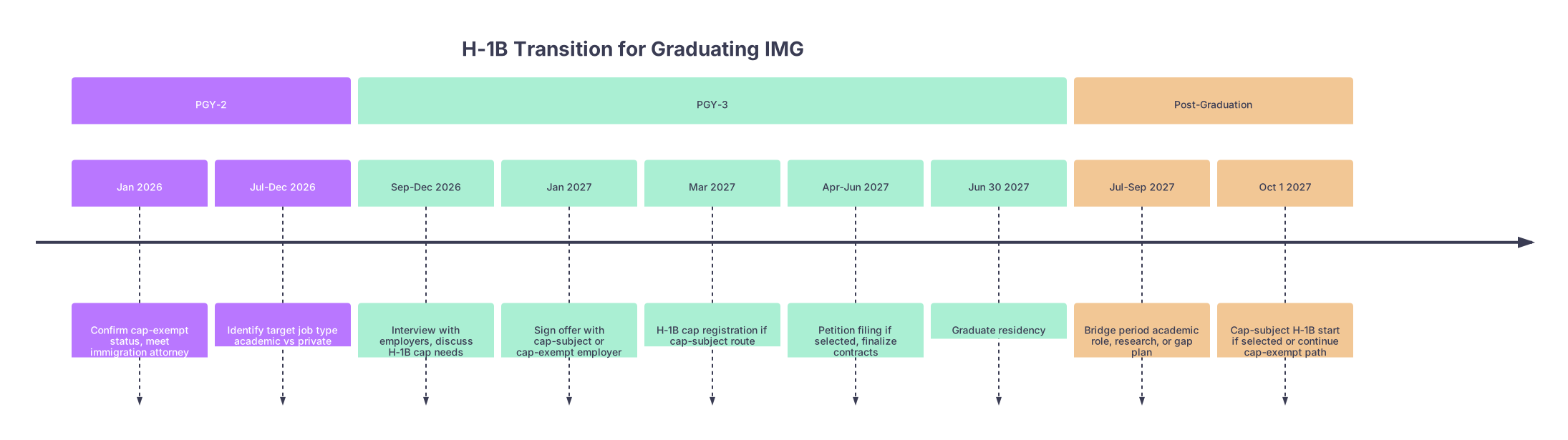
| Period | Event |
|---|---|
| PGY-2 - Jan 2026 | Confirm cap-exempt status, meet immigration attorney |
| PGY-2 - Jul-Dec 2026 | Identify target job type academic vs private |
| PGY-3 - Sep-Dec 2026 | Interview with employers, discuss H-1B cap needs |
| PGY-3 - Jan 2027 | Sign offer with cap-subject or cap-exempt employer |
| PGY-3 - Mar 2027 | H-1B cap registration if cap-subject route |
| PGY-3 - Apr-Jun 2027 | Petition filing if selected, finalize contracts |
| PGY-3 - Jun 30 2027 | Graduate residency |
| Post-Graduation - Jul-Sep 2027 | Bridge period academic role, research, or gap plan |
| Post-Graduation - Oct 1 2027 | Cap-subject H-1B start if selected or continue cap-exempt path |
The most common mistake I see: residents waiting until January of PGY‑3 to even think about immigration. By then, for some specialties, employer recruitment is almost done and the March lottery is two months away.
You are not that resident.
9. Non-Negotiable Rules If You Want This to Work
Let me be blunt. I have watched brilliant IMGs destroy their options by violating these basics.
Rule 1: Never assume “transfer” is possible without checking cap history
If you were never counted in the cap, there is no simple transfer to a pure cap‑subject employer. If HR or a recruiter tells you otherwise, they are either:
- Ignorant
- Or hoping you will not find out until later
You check with a real immigration lawyer before you sign anything.
Rule 2: Do not resign your cap-exempt job before your next status is fully secured
I do not care how toxic your program is. If you walk away without:
- An approved new H‑1B
- Or a viable concurrent arrangement
- Or clear, attorney‑vetted bridge status
You are gambling with your right to stay in the U.S. And USCIS does not care about your story.
Rule 3: Demand to see proof of H‑1B registration and filing
Polite but firm. You say:
“Given my dependence on this petition for my immigration status, I need to retain a copy of the H‑1B registration confirmation and, if selected, the USCIS receipt for my records.”
If an employer or law firm refuses, ask why. That is your life on that application.
Rule 4: Keep your own file
You need a folder (physical or cloud) with:
- All I‑797s (H‑1B approvals)
- All DS‑2019s (if J‑1 in your history)
- I‑94 printouts
- Visa stamps
- Employment contracts
- Pay stubs from each H‑1B employer
When you talk to a lawyer, you bring this. Not vibes. Documents.
10. Choosing the Right Lawyer (Yes, You Need One)
Your hospital lawyer represents the hospital. Not you. Let that sink in.
You need your own immigration counsel if:
- You are designing a dual employment/concurrent H‑1B strategy.
- You are switching from J‑1 to H‑1B + waiver.
- You are planning long‑term green card + cap‑subject positioning.
What to look for
Ask directly:
- “How many physician H‑1B cases do you personally handle each year?”
- “Are you familiar with concurrent H‑1B strategies for cap‑exempt plus cap‑subject employment in academic medicine?”
- “Do you regularly coordinate with hospital GME and HR teams?”
Red flags:
- They talk like every case is the same as a software engineer’s.
- They dismiss your questions with: “We will figure it out later.”
- They have no idea what a J‑1 waiver is or what Conrad 30 means.
A good lawyer will:
- Lay out 2–3 concrete options given your exact training timeline, specialty, and targets.
- Tell you what is possible now and what must wait.
- Give you a document checklist and a rough calendar.
Pay for that. It saves you orders of magnitude in future cost and panic.
11. A Compact Checklist You Can Actually Use
Here is a working checklist for you as a graduating IMG on cap‑exempt H‑1B:
Now (PGY‑2 or early PGY‑3)
- Confirm: Am I currently cap‑exempt or cap‑subject?
- Collect all past immigration documents into one folder.
- Book a 60‑minute consult with a physician‑focused immigration attorney.
- Decide: Do I want academic/cap‑exempt, private/cap‑subject, or a dual setup?
Within the next 3–6 months
- Identify 3–5 target employers that match your immigration needs.
- In every interview, explicitly discuss H‑1B sponsorship and cap status.
- Gauge if your current institution is open to part‑time attending roles.
Before the March lottery of your final year
- If aiming cap‑subject: have signed offer and confirmed registration plan.
- Request proof of H‑1B registration submission.
- Work with lawyer to define backup plans if not selected.
Before graduation
- If concurrent H‑1B: ensure both petitions (cap‑exempt + concurrent) are filed/approved or receipted.
- If pure cap‑subject: clarify your legal status and work authorization between graduation and H‑1B start date.
- Decide if staying cap‑exempt longer with green card track makes more sense.
You are not going to fix U.S. immigration policy. You are not going to make the lottery fair. What you can do is remove “confusion” and “wishful thinking” from the equation.
Your next move is simple: pull up your latest H‑1B approval (I‑797) and your training end date, and write them at the top of a blank page. Then, right below, write: “Am I aiming for cap‑subject, cap‑exempt, or dual?” Decide that today. Everything else flows from that decision.


