
Most IMGs lose years of their career because they treat visas as a form you fill, not a strategy you build. That is a mistake.
If you are serious about a long-term career in the United States, you cannot think “Which visa can I get this year?” You must think “How do O-1, H-1B, and J-1 fit together over 10–15 years so I end up with a green card and real freedom?”
Let me lay this out like a playbook, not a law textbook. I am going to assume three things about you:
- You want U.S. residency or fellowship.
- You want to stay in the U.S. long term if you can.
- You do not want to wake up at 38 with a great CV but no way around a 3‑year service commitment you never planned for.
We will fix that.
Step 1: Understand What Each Visa Is For (Function, Not Just Definition)
Stop memorizing visa definitions. Start understanding what role each category plays at different career points.
| Visa | Core Role | Typical Stage |
|---|---|---|
| J-1 | Training visa | Residency/Fellowship |
| H-1B | Work visa | Residency, attending, academia, private practice |
| O-1 | Talent visa | Fellowship, attending, research-intensive roles |
J-1: The Training Workhorse (with a Sting in the Tail)
Functionally:
- Best for: Many university-based residencies and fellowships that do not want H-1B hassle.
- Advantages: Usually easier for academic programs; predictable for GME offices; works for most specialties.
- Hidden cost: 2‑year home residency requirement (INA 212(e)) for most IMGs. Translation: after finishing J‑1 training, you either:
- Do a 3‑year waiver job in a shortage area (on H‑1B), or
- Go home for 2 years physically, or
- Get a rare waiver (government agency, hardship, persecution).
J‑1 is not “bad.” It just comes with a built-in trap if you are not planning ahead.
H-1B: The Straight-Line Work Visa
Functionally:
- Best for: Programs willing to sponsor you for residency or fellowship; later, for attending jobs.
- Advantages:
- No automatic 2‑year home requirement.
- Dual intent (you can pursue a green card while on H‑1B).
- Bridges nicely into employment-based green cards.
- Constraints:
- Needs USMLE Steps done and sometimes Step 3 before start (varies by state/program).
- Some academic programs refuse to do H‑1B for residents (admin burden, cap worries).
For long-term U.S. careers, H‑1B is usually the cleanest path if you can secure it early.
O-1: The Leverage Visa (Your “Power Card”)
Functionally:
- For individuals with “extraordinary ability” in sciences or education.
- Best for:
- Fellows with strong research profiles.
- Academic attendings.
- IMGs with substantial publications, citations, presentations, or unique expertise.
Why O-1 matters:
- No J‑1 2‑year rule.
- Not subject to the H‑1B cap.
- Gives you leverage with employers: “You do not have to worry about the cap; I bring my own visa.”
Tradeoff:
- You actually need a strong record. Not Nobel-level, but you must be able to prove you stand out among peers.
Step 2: Get Real About Your Profile and Timeline
You cannot design a smart visa strategy without brutally honest self-assessment.
Ask yourself:
What is my research / academic profile today?
- 0–2 minor papers, no conference talks → O‑1 now is fantasy.
- 5–15 papers, 3–4 first‑author, national abstracts / posters → O‑1 is on the horizon with focused work.
- Strong publication record, major journals, invited talks → you should already be thinking O‑1/E‑B1, not just H‑1B.
How aggressive am I about staying in the U.S.?
- “Maybe I will stay if something works out” → you can afford to be more flexible with J‑1.
- “I must stay long-term” → you need to prioritize H‑1B or a J‑1 with a very clear waiver strategy, and build towards O‑1/green card.
What specialties am I targeting?
- Highly competitive and academic (Derm, Rad Onc, Neurosurgery): research and O‑1 potential matter more.
- Primary care fields: J‑1 waiver jobs are easier to find, but you risk geographic restriction.
- Hospital-based specialties (IM, Neuro, Anesthesia): plenty of H‑1B and J‑1 waiver options, but planning still matters.
Step 3: Build 3–4 Realistic Career “Visa Pathways”
Now we combine these visas into actual career paths, not theoreticals.
Path A: “Cleanest” Long-Term U.S. Plan – H‑1B from Day 1
Who this fits: Strong exam scores, decent CV, targeting programs that commonly sponsor H‑1B (large academic centers, some community programs).
Typical flow:
- Residency on H‑1B
- Fellowship on H‑1B (either transfer or extension)
- Attending job on H‑1B with employer starting PERM / EB‑2 or EB‑1 process
- Green card, then free agent
Pros:
- No J‑1 2‑year issue.
- Easy transition to green card.
- You are not tied to 3‑year waiver jobs.
Cons:
- Requires programs willing to sponsor H‑1B.
- Some states want Step 3 before residency start on H‑1B.
- You may reduce the number of programs you can rank if you strictly insist on H-1B.
How to execute:
- On ERAS and interviews, be explicit but strategic:
- “I am able to train on H‑1B and would strongly prefer it if your GME policy allows.”
- Before ranking, email GME offices directly, not just PDs, asking:
- “Do you routinely sponsor H‑1B for residents in my specialty?”
- Create a short list of H‑1B‑friendly programs and rank them aggressively if location and quality are acceptable.
Path B: J‑1 Now, H‑1B Later (With a Planned Waiver)
Who this fits: You matched into a strong residency that only offers J‑1. You care about U.S. long‑term practice, but you did not have H‑1B leverage early.
Typical flow:
- Residency on J‑1
- Fellowship on J‑1
- J‑1 waiver job (3 years) on H‑1B (Conrad 30, VA, or other waiver)
- Employer sponsors green card during or after waiver period
Pros:
- Easy access to many top academic programs using J‑1 only.
- University training, then service commitment, then freedom.
Cons:
- You are locked into a 3‑year service job, often in underserved or less desirable regions.
- Limited negotiation power for salary/location in waiver jobs.
- Geographic flexibility early in your attending years is poor.
How to execute so this does not ruin your life:
During residency / early fellowship, track waiver options by state:
- States with more rural areas (e.g., North Dakota, Kansas) often have open Conrad 30 spots late.
- Coastal / popular states (California, New York, Massachusetts) can fill quickly.
Start the waiver search 18–24 months before your final J‑1 year:
- Reach out to recruiters and hospital systems explicitly saying:
“I am a J‑1 fellow needing a Conrad 30 waiver position starting July [year] in [specialty].”
- Reach out to recruiters and hospital systems explicitly saying:
Prioritize:
- Employers with a history of successfully filing J‑1 waivers and H‑1B.
- Positions where they agree in writing to start green card (PERM / I‑140) early in your waiver period.
Do not assume:
- “Any community hospital will take care of it.” Wrong. I have seen people burn a year because admin had never done a J‑1 waiver before and missed deadlines.
Path C: O‑1 as the “Escape Hatch” or Accelerator
Two major uses for O‑1:
- Alternative to H‑1B when you cannot get an H‑1B due to caps or timing.
- Upgrade path from J‑1 into a status that then supports EB‑1 green cards.
Example flows:
C1: Residency J‑1 → Fellowship O‑1 → Attending O‑1 → EB‑1
Who this fits:
- You built a strong academic record during residency/fellowship: first‑author papers, respected conferences, maybe society involvement.
Flow:
- Residency on J‑1.
- Near the end, you realize your profile is now competitive for O‑1.
- You secure a fellowship or junior faculty job where the institution is comfortable with O‑1.
- O‑1 approved → You are not stuck in the J‑1 cycle for further training.
- Use the same evidence (and more) to aim for EB‑1A or EB‑1B green card.
Caution:
- O‑1 does not automatically erase the J‑1 two‑year rule. That 212(e) requirement needs a separate waiver.
Many IMGs misunderstand this. Switching to O‑1 from J‑1 does not equal “done with home requirement.” - You still need:
- Conrad 30 / federal waiver, or
- Hardship / persecution waiver, or
- Two years home residence.
So O‑1 here is mainly powerful after you have dealt with or planned around 212(e).
C2: Skipping J‑1 Entirely for Fellowship / Attending
Who this fits:
- You already completed residency (maybe abroad or on H‑1B) and now have a strong CV.
Flow:
- Employer (fellowship or hospital) sponsors you for O‑1 instead of J‑1/H‑1B.
- You work as faculty or advanced fellow.
- Employer moves directly to EB‑1B or you build a case for EB‑1A.
This is where O‑1 shines. No H‑1B cap. Strong leverage with academic institutions that hate visa uncertainty.
Step 4: Choose the Right Path for Your Current Phase
Let us break this by where you are today.
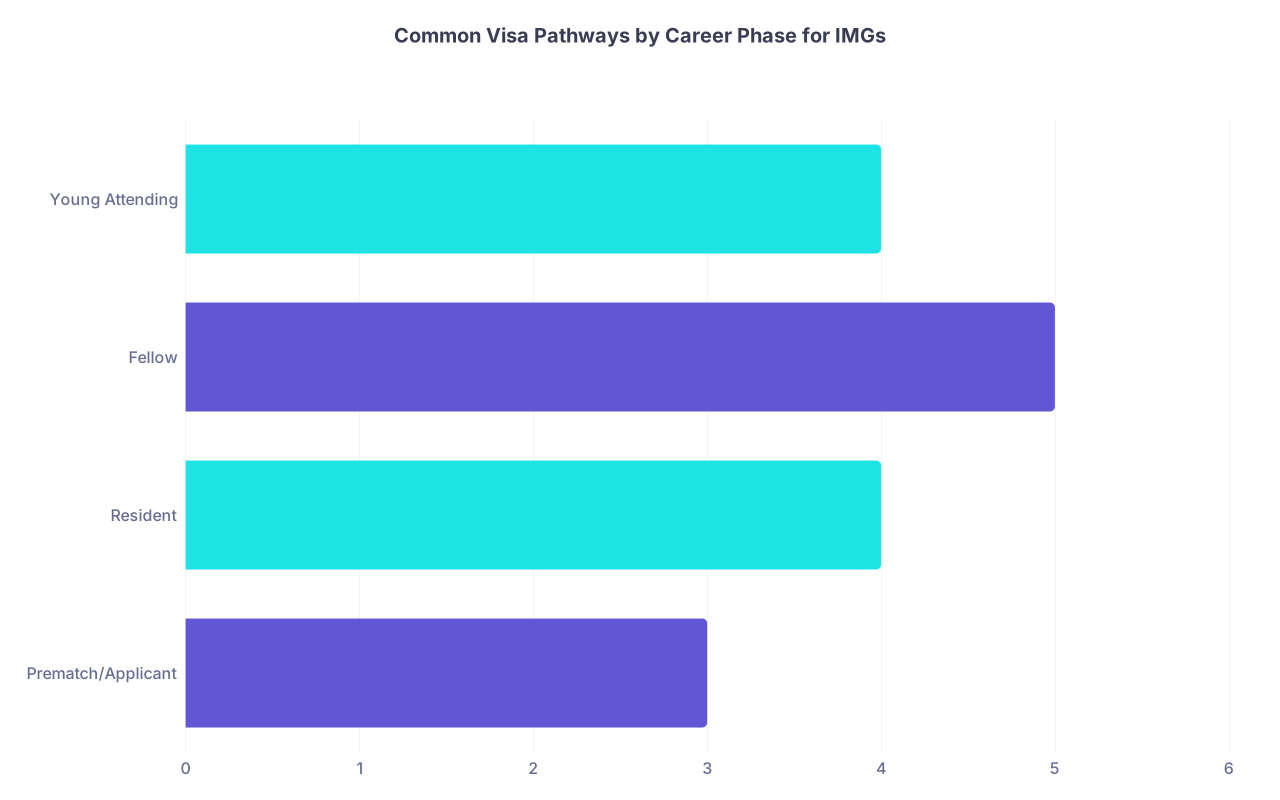
| Category | Value |
|---|---|
| Prematch/Applicant | 3 |
| Resident | 4 |
| Fellow | 5 |
| Young Attending | 4 |
(Values here just indicate number of realistic visa combinations you typically have at each stage—the later you are, the more tools you have, if you prepared.)
If You Are Currently Applying for Residency (ERAS Stage)
Your decisions now affect you for a decade.
Do this:
Split programs by visa type:
- Category 1: H‑1B-friendly.
- Category 2: J‑1 only.
- Category 3: “We will see” (avoid relying on these).
Ask direct questions on interview day:
- “How many residents are currently on H‑1B?”
- “Do you cover H‑1B filing costs?”
- “Have you successfully transitioned residents from J‑1 to H‑1B or O‑1 after graduation?”
Build rank list with a clear strategy:
- If you strongly want to stay in the U.S. long term:
- Prioritize solid programs that reliably do H‑1B.
- Only then mix in J‑1 programs you really love, but go in knowing you are signing up for a J‑1 waiver path later.
- If your main goal is the highest possible training caliber, and you are open to a few years abroad or underserved:
- You can be less strict about H‑1B and accept J‑1 at top-tier institutions.
- If you strongly want to stay in the U.S. long term:
If You Are a Current Resident (Already on J‑1 or H‑1B)
This is where most IMGs either wake up or lose the plot.
Scenario 1: Resident on H‑1B
You are in good shape. Your priorities:
Max out H‑1B duration smartly:
- Normal max is 6 years (there are nuances with prior time abroad or cap-exempt vs cap-subject, but assume 6 for planning).
- Residency + fellowship must fit within or be extended via green card process.
Push your future employers about green card timing:
- For a 3‑year IM residency on H‑1B, then 3‑year fellowship on H‑1B:
- You are essentially at the 6‑year limit.
- Your fellowship employer or future attending job needs to start PERM/I‑140 early so you can extend H‑1B beyond 6 years based on an approved I‑140.
- For a 3‑year IM residency on H‑1B, then 3‑year fellowship on H‑1B:
Build academic capital for O‑1 / EB‑1:
- Even if you stay on H‑1B, a strong CV gives you fallback options.
- O‑1 can be a plan B if something goes wrong with H‑1B timing.
Scenario 2: Resident on J‑1
Two parallel tracks:
Track A: Training / Career Plan
- Clarify: Are you doing fellowship? In what specialty?
- Which geographic regions do you want for eventual practice?
Track B: J‑1 Waiver / O‑1 / Future Visa Plan
- Understand your deadline: J‑1 waiver job must be secured and processed before your status ends.
- Map your target states for waiver jobs early.
- Talk to recent graduates from your program who were J‑1:
- Where did they go?
- Which employers handled waivers well?
If your CV is building up nicely, start an O‑1 evaluation by PGY‑2/PGY‑3:
- Talk to an immigration attorney who does a lot of physician O‑1/EB‑1 cases.
- Have them tell you:
- “You are 18–24 months away if you add A, B, C.”
- Or “No, not realistic unless you significantly upgrade your publications and roles.”
Step 5: Use O‑1 and H‑1B Together, Not As Competitors
O‑1 is not “better” than H‑1B. They are tools for different problems.
Think about them like this:
- H‑1B = Stable employment platform; excellent for straight clinical roles; dual intent.
- O‑1 = Tactical visa for high‑achievers; bypasses H‑1B cap; often leads to EB‑1.
Common combined strategies:
Residency H‑1B → Fellowship O‑1
- Residency program comfortable with H‑1B.
- Fellowship is research-heavy, and institution likes O‑1 for researchers.
- You use fellowship years to strengthen case for EB‑1A or EB‑1B.
Residency J‑1 → (waiver job) H‑1B → O‑1 later
- You do the service commitment but keep publishing, presenting, and staying academically active.
- At some point, you flip to O‑1 if it simplifies job transitions or cap issues.
- Eventually apply for EB‑1 or EB‑2 based on your then-strong track record.
O‑1 first → H‑1B or green card
- If you come in on O‑1 with substantial achievements, an institution may sponsor EB‑1B quickly.
- Once I‑140 is approved, you can extend H‑1B (if you later switch) or remain on O‑1 until green card.
Step 6: Practical Evidence-Building for a Future O‑1 / EB‑1
You cannot “decide” to do O‑1 in your final year and magically produce evidence. You build the case from PGY‑1.
Key O‑1/EB‑1 evidence buckets and how to engineer them into your life:
Publications
- Aim for:
- Several first‑author clinical or research papers.
- Co‑authorships in decent journals.
- Action:
- Attach yourself to a productive attending or lab early.
- Take on “unsexy” retrospective chart reviews; they often get published faster.
- Aim for:
Conference Presentations
- Regional and national meetings in your specialty.
- Action:
- When you complete a QI project, case series, or study, submit abstracts.
- Even posters count. Do multiple.
Peer Reviewing
- Journals love free labor. This is gold for O‑1.
- Action:
- Ask your research mentor if you can co-review papers they receive.
- Once you have a couple of publications, reach out to lower‑impact journals and volunteer.
Society Memberships / Committees
- Not just paying dues. Actual roles.
- Action:
- Apply for trainee committees (education, advocacy, guidelines) in your specialty’s national society.
Awards / Grants
- Even small institutional awards matter.
- Action:
- Submit your work for “best poster” awards, travel grants, etc.
O‑1/EB‑1 is a game of volume and visibility. If you treat research and academic work like optional extras, you will not have this card when you need it.
Step 7: Common Strategic Mistakes and How to Avoid Them
Let me be blunt. I have seen these sink people.

Mistake 1: “I Will Take Any Visa; I Just Want to Match.”
Short‑term thinking.
Yes, matching matters. But if you absolutely know you want to stay in the U.S., you cannot ignore:
- H‑1B availability at programs.
- Long‑term impact of J‑1 + 212(e).
Fix: Before you rank, categorize programs by visa policy and build at least one realistic long‑term path for each outcome.
Mistake 2: Assuming O‑1 Is a Magic Reset Button
Belief: “If I get O‑1 later, my J‑1 2‑year rule disappears.”
Reality: It does not. 212(e) is a separate legal issue. O‑1 does not waive it.
Fix:
- Treat J‑1 home requirement and O‑1 as two different tracks.
- Plan either to:
- Obtain a 212(e) waiver, or
- Physically fulfill 2 years abroad (most do not want this).
Mistake 3: Delegating All Strategy to Employers or Lawyers
Employer priority: fill their staffing gap.
Your priority: protect your long‑term career flexibility.
I have seen employers:
- Delay green card filings until year 4–5 “to see if it works out.”
- Refuse to pay for premium processing, causing you to miss job transitions.
- Misunderstand J‑1 waiver timelines entirely.
Fix:
- You learn the basic rules yourself.
- You ask direct questions:
- “When will you file PERM?”
- “Will you start the green card during my J‑1 waiver period?”
- “Have you successfully obtained waivers for prior IMGs?”
Mistake 4: Waiting Too Long to Build an O‑1 / EB‑1 Profile
You do not build “extraordinary ability” in 6 months.
Fix:
From PGY‑1, you:
- Attach yourself to mentors who publish.
- Present at conferences yearly.
- Ask to review papers.
- Document everything.
Step 8: Map Your Personal 10‑Year Visa Roadmap
Now you put everything together into a simple but concrete map. One page. No fluff.
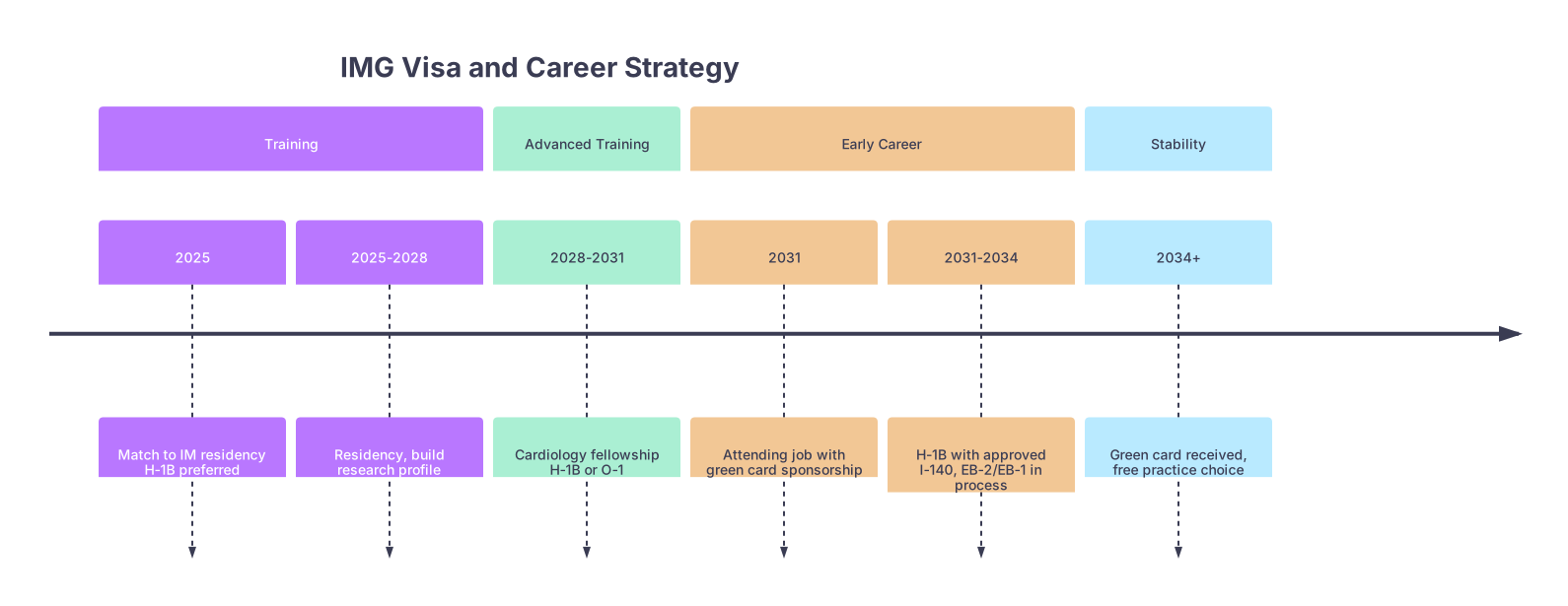
| Period | Event |
|---|---|
| Training - 2025 | Match to IM residency H-1B preferred |
| Training - 2025-2028 | Residency, build research profile |
| Advanced Training - 2028-2031 | Cardiology fellowship H-1B or O-1 |
| Early Career - 2031 | Attending job with green card sponsorship |
| Early Career - 2031-2034 | H-1B with approved I-140, EB-2/EB-1 in process |
| Stability - 2034+ | Green card received, free practice choice |
Your version should answer:
- Residency: J‑1 or H‑1B?
- Fellowship: Same, or switch to O‑1 / H‑1B?
- First attending job:
- Waiver job or free choice?
- H‑1B or O‑1?
- When does green card filing start?
- O‑1 potential:
- When could you reasonably qualify, if ever?
- Green card path:
- EB‑2 via PERM?
- EB‑1A/B if academic enough?
Write it out. One timeline. If it looks chaotic or depends on miracles, you know you need to adjust now, not later.
Step 9: When to Involve an Immigration Attorney (And How)
You do not need to hire an attorney to think strategically. But you do need one to:
- Evaluate O‑1 / EB‑1 potential honestly.
- Handle J‑1 waiver filings.
- Manage complex switches (J‑1 → H‑1B / O‑1; cap‑gap; prior violations, etc.).
Choose attorneys with:
- Real physician/healthcare experience.
- Evidence of O‑1 / EB‑1 approvals in your specialty.
- Clear pricing and timelines.
Ask them pointedly:
- “If I do X this year and Y next year, what are my realistic green card options by year Z?”
If they cannot answer in concrete scenarios, find someone else.
Step 10: Concrete Actions You Can Take This Week

Here is your short punch list.
If You Have Not Matched Yet
- Make a spreadsheet of all programs you are applying to.
- Add columns:
- Visa types they sponsor (J‑1, H‑1B).
- Evidence (website / email confirmation).
- Color‑code:
- Green: routinely sponsor H‑1B.
- Yellow: J‑1 only but high quality.
- Red: unclear / reluctant.
If You Are a Current Resident
- Write your own 10‑year visa + career timeline on paper.
- Ask your PD and GME:
- “Historically, where have J‑1s from this program gone for their waiver jobs?”
- “Do you have alumni on O‑1 or H‑1B I can speak with?”
- Start (or double down on) one concrete academic project that leads to:
- A publication, and
- A conference presentation in the next 12–18 months.
If You Are a Fellow / Young Attending
- Schedule a consult with a reputable immigration attorney specifically to:
- Evaluate O‑1 / EB‑1 potential.
- Design a green card timeline that matches your contract dates.
- Sit with your chair or employer’s HR and ask:
- “What is your standard practice for green card sponsorship for IMGs?”
- “At what year do you typically file PERM or I‑140?”
Your next move is not theoretical. Open a blank page right now and write at the top:
“My 10-Year U.S. Career and Visa Plan”
Under it, draft:
- Year 1–3: Visa status + training.
- Year 4–6: Visa status + training / early career.
- Year 7–10: Visa status + green card plan.
If any year depends on “hopefully” or “maybe,” replace that with a specific visa type and a concrete action you control.