

You are here
You are halfway through a Zoom residency interview. Things are going smoothly. Then the program director leans back, looks at your application again, and asks:
“So… will you need visa sponsorship?”
Your heart rate jumps. You know the wrong answer—or the right answer said the wrong way—can quietly move you from “possible rank” to “too much trouble.”
You mumble something about “being open to options” and “still exploring,” and you watch their face close a bit. The vibe shifts. You finish the interview, but you know that moment did some damage.
This article exists to prevent that from ever happening again.
You are an IMG. Visas are part of your reality. That does not have to be a red flag—if you handle the topic correctly. There is a right way to answer these questions that:
- Makes you look prepared, not needy
- Lowers program anxiety about paperwork and risk
- Keeps you in the “easy to rank” bucket instead of the “complicated candidate” pile
Let’s fix this systematically.
1. Understand exactly what programs worry about
Before we script answers, you need to understand what is happening on the other side of the table.
Most residency programs are not anti-IMG. They are anti‑uncertainty and anti‑administrative headache. Visa questions trigger 4 specific fears in their minds:
Cost and paperwork
- “Will this be extra work for our GME office?”
- “Will we have to pay attorneys, filing fees, premium processing?”
Risk of losing you
- “What if the visa is denied and we lose a resident after Match?”
- “What if they are stuck in administrative processing and arrive late?”
Long-term retention
- “Will this person disappear to another hospital after residency because of visa issues?”
Compliance and oversight
- “Are there caps, rules, or institutional policies that make this difficult or impossible for us?”
Your job in the interview is to lower these fears with clear, calm, specific answers. Not to sound vague. Not to sound desperate. To sound like someone who understands the system and will be low‑risk to support.
2. Know your exact visa story before interview day
You cannot improvise this.
Programs can smell it instantly when an applicant has not done their homework on visas. That is when “visa” becomes a red flag.
You need a one‑page “visa profile” in your own head before interview season:
- What status you are in now
- What you will be in at the time of residency start
- What visa(s) you actually want
- What backup options you have
- Whether your exam/ECFMG timeline fits visa rules
If you do not know this cold, you will sound uncertain and risky.
A. Map your current and future status
Be precise:
- “I am currently on F‑1 with approved OPT starting July 2025.”
- “I am currently outside the U.S., no status yet, will require direct residency visa sponsorship.”
- “I am on H‑4 and will need my own work visa to start residency.”
If you are guessing, fix that now. Talk to:
- Your school’s international office (for F‑1, J‑1 student etc.)
- An actual immigration attorney (even one paid 30‑minute consult can prevent very costly mistakes)
- Your ECFMG account docs (for J‑1 sponsorship timelines)
Do this before interviews start.
B. Decide your primary and acceptable options
Do not go into interviews saying, “I’m open to anything.” It sounds clueless, not flexible.
You need:
- One primary preferred option
- One or two acceptable alternatives
Example:
- Primary: J‑1 via ECFMG
- Acceptable: H‑1B if program requires it and timing allows Step 3 before start
Or:
- Primary: H‑1B (because of J‑1 home residency rule concerns)
- Acceptable: J‑1 if the program only sponsors that and you have a realistic waiver path
Know which camp you belong to.
3. Quick reality check: what visas actually look like to programs
You need a brutally honest snapshot, not myths from WhatsApp groups.
| Visa Type | Who Sponsors | Key Requirement | Program Perception |
|---|---|---|---|
| J-1 (ECFMG) | ECFMG (not program) | ECFMG cert + contract | Easiest admin, very common |
| H-1B | Program/hospital | USMLE Step 3 passed + timing | Heavier admin, more selective |
| F-1/OPT | School, then employer if later H-1B | US grad, OPT work auth | Rare in residency, specific cases |
| No current status | N/A | Need direct J-1/H-1B | Standard for most IMGs abroad |
Program truth:
- Most community and many university programs love J‑1 because ECFMG handles the heavy lifting.
- H‑1B is more work for them, requires Step 3 done early, and is sometimes blocked by hospital HR or GME policy.
- Some institutions have hard policies: “We only support J‑1” or “We do not sponsor any visas.” They are not changing that for you, no matter how charming you are.
Knowing this lets you pitch yourself correctly.
4. Baseline rules for talking about visas in interviews
Here is the communication protocol that prevents red flags.
Rule 1: Never sound surprised by the question
You should answer like this is the 50th time you have been asked, not the first.
Bad:
“Uh yes, I think I’ll probably need a visa, I’m not totally sure which one yet.”
Good:
“Yes. I will require visa sponsorship to train in the U.S. I am currently [status], and for residency my primary option is [visa type]. I have already confirmed eligibility and timeline.”
Calm. Specific. Done.
Rule 2: Be honest but not dramatic
Do not lie. That is how people get flagged or worse.
But you also do not need to dump every detail of your immigration anxieties into a 10‑minute interview.
- State the facts
- Show you understand the process
- Emphasize that you are proactive and organized
Rule 3: Keep it short unless they ask for detail
Your first answer should be 2–4 sentences max. If they want more, they will ask. You are not the program’s immigration seminar.
5. Scripted answers to the 7 most common visa questions
Here is the meat. Use these as templates and adapt to your actual situation.
1. “Will you need visa sponsorship?”
Pick the one that fits your reality and modify numbers/dates.
If you are outside the U.S., aiming for J‑1:
“Yes. I will need visa sponsorship. My primary plan is a J‑1 through ECFMG. I am ECFMG certified / on track for certification before Match, and my timeline fits the usual J‑1 processing window.”
If you are outside the U.S., open to J‑1 or H‑1B:
“Yes. I will require visa sponsorship. I am eligible for both J‑1 and H‑1B. Most of my research suggests J‑1 is the most straightforward for programs since ECFMG manages the process, but if your institution prefers H‑1B and the Step 3 timing works, I am also eligible for that.”
If you are on F‑1 in the U.S., using OPT then J‑1/H‑1B:
“Yes. I am currently on F‑1 and will have OPT work authorization that covers the start of residency. For the longer term, I will still need sponsorship—typically J‑1 via ECFMG, or H‑1B if your institution uses that pathway. I have spoken with my international office and an immigration attorney to make sure the timing is feasible.”
2. “What type of visa are you looking for?”
This is where many IMGs blow it by saying, “Anything is fine.”
J‑1 primarily:
“My primary plan is a J‑1 sponsored by ECFMG. It is the standard pathway for IMGs, and most programs I have looked at are very familiar with it. I am comfortable with the home‑residency requirement and have researched waiver options after training.”
H‑1B primarily (you must have Step 3 timing figured out):
“My preference is H‑1B because I am hoping to avoid the J‑1 home‑residency requirement. I have already passed Step 3 / scheduled Step 3 in [month], which should allow enough time for petition filing if matched. That said, if your institution only supports J‑1, I am also open to that and have looked into that pathway as well.”
You can intentionally signal flexibility without sounding lost.
3. “Have you passed Step 3?” (Usually code for “Are you even H‑1B eligible?”)
If you have passed Step 3:
“Yes. I passed Step 3 in [month/year]. So if your institution sponsors H‑1B, I meet that requirement. I also remain fully eligible for J‑1.”
If you have not passed but are scheduled:
“I have not taken it yet, but I am registered and scheduled for [exact month/year]. That timing allows results before typical H‑1B petition filing if I match at a program that offers H‑1B.”
If you realistically will not have Step 3 in time:
“I will not have Step 3 completed in time for this Match cycle, so my realistic option is J‑1 sponsorship through ECFMG. I have already ensured that my timeline fits ECFMG and consular processing requirements.”
Do not pretend you can do Step 3 in April, get scores in May, and file a perfect H‑1B in June. Programs have seen that movie. It ends poorly.
4. “We only sponsor J‑1. Is that a problem for you?”
This is not the time to launch into a rant about the two‑year rule.
If J‑1 is truly unacceptable to you, be honest and understand the consequences. But if you are “concerned” yet flexible, do not overplay it.
If you are okay with J‑1:
“That is completely fine. I am very familiar with the J‑1 pathway. I understand the two‑year home‑residency rule and the usual waiver options after training. I am comfortable pursuing my career through that route.”
If you strongly prefer H‑1B but would accept J‑1:
“My long‑term preference would be H‑1B because of the home‑residency requirement, but I also understand that many strong academic and community programs only sponsor J‑1. I have researched the waiver process, and I am willing to train on a J‑1 at an institution that is a good fit for my education.”
You are signaling maturity and realism. Not fantasy immigration planning.
5. “Do you anticipate any visa issues or complications?”
The wrong move here is to speculate about edge cases.
Bad:
- “Well, my cousin had 221(g) once…”
- “I applied for a tourist visa before and was denied, maybe that matters?”
If you have no known issues:
“No. I do not anticipate any visa issues. I have no prior denials or status problems, and my timeline aligns with standard ECFMG and consular processing for J‑1 / petition filing for H‑1B.”
If you have a past visa denial or status quirk that could matter, be honest but concise:
“I did have a prior [tourist/student] visa application denied in [year], but that was for a different purpose and I have not had any status violations. I have discussed it with an immigration attorney who did not see it as a barrier to J‑1 / H‑1B sponsorship for residency.”
You are signaling: yes, there was something, but it is understood and managed. Not a mystery.
6. “Will you be able to start on time, given visa processing?”
They are thinking about July 1. They do not want a resident arriving August 15.
This is exactly where being prepared matters.
If you are abroad and targeting J‑1:
“Yes. My ECFMG certification timeline is aligned so that I can start the J‑1 process immediately after Match. Based on current processing times, that leaves a comfortable margin for visa issuance before July 1. I have already reviewed the required documents and steps, so I can move quickly.”
If you are already in the U.S. with status that can bridge:
“Yes. I am already in the U.S. on valid [F‑1 with OPT / H‑4 / etc.] which covers me through the start of residency. The transition to [J‑1/H‑1B] would be processed in parallel, and I have checked typical timelines carefully.”
If there is a real potential delay (late Step 3, late ECFMG, etc.), do not spin it. Programs appreciate realistic planning more than false optimism.
7. “Do you have any questions for us about visa sponsorship?”
This is where you can ask smart, targeted questions without sounding anxious.
Good options:
- “Does your institution sponsor J‑1 only, or both J‑1 and H‑1B for residents?”
- “For residents who required visas in previous years, have they usually been able to start on time?”
- “Does your GME office handle most of the visa process, or do residents need to coordinate directly with attorneys?”
Stay away from:
- “How likely am I to get a waiver after J‑1 if I come here?” (They do not control that.)
- “Will you make an exception to sponsor H‑1B just for me?” (They almost never will.)
6. How to avoid sounding like a “visa risk” even when your case is complex
Maybe your situation is not clean. Maybe you have:
- A previous U.S. overstay
- A tourist visa denial
- A complicated F‑1 history
- Family members with immigration cases in progress
You cannot rewrite your history. But you can control how you present it.
Step 1: Get a real legal assessment before interviews
Not Telegram advice. Not “my friend’s lawyer said.”
Pay for one real consult with a licensed immigration attorney who knows physician immigration. Make them answer:
- “Given my history, is J‑1 realistically viable?”
- “Is H‑1B feasible?”
- “Are there any major red flags programs might worry about?”
Then, base your answers on that.
Step 2: Translate complexity into a simple, confident line
The program does not need your 15‑page immigration story.
They need:
- Are you eligible?
- Any major reason you might be delayed or denied?
Example with a past overstay that has been formally resolved:
“I did have a past status issue that has since been resolved with USCIS / State Department. I have consulted an immigration attorney who confirmed that I remain eligible for [J‑1/H‑1B] sponsorship. I am happy to provide documentation to your GME office if we get to that stage.”
Concise. Honest. Non‑dramatic.
7. Body language and tone when answering visa questions
Yes, tone matters. Programs read your face more than your words.
Here is the non‑verbal protocol:
- Pause half a second after they ask. Look calm.
- Answer in a steady, medium pace, no rapid‑fire nervous talking.
- Keep your face neutral or slightly confident, not worried or apologetic. You are not confessing a crime.
- Avoid big sighs, eye rolls, or head shakes when J‑1 or H‑1B comes up. Those micro‑reactions are noticed.
Practice once or twice on camera before interview day. Record yourself answering:
- “Will you need visa sponsorship?”
- “What type of visa are you hoping for?”
Watch it. If you look like you are bracing for bad news, fix that.
8. Research each program’s visa reality before you interview
Walking into an interview blind about their visa policy is amateur hour.
You want to know beforehand:
- Do they sponsor visas at all?
- If yes, which type(s)?
- Have they taken IMGs recently, and on what status?
Where to check:
- Program website → “International Medical Graduates” / “Visa Sponsorship” page
- FREIDA → often lists visa types supported
- Past residents’ LinkedIn profiles → look at their “J‑1” / “H‑1B” updates
- Email the coordinator before interview if the website is unclear
Your strategy then adjusts:
- If website says “J‑1 only”: do not pitch yourself as H‑1B‑or‑bust.
- If they proudly list “We sponsor H‑1B”: mention your Step 3 and readiness.
- If they say “No visas sponsored”: do not burn energy trying to convince them otherwise. Rank them low or not at all.
9. When and how to bring up visas yourself
You do not always have to wait for them to ask. But do it strategically.
Good moments:
- Near the end, when they ask, “Any questions for us?”
- When talking with the program coordinator or GME person in a separate session
- In email after the interview, if you forgot to clarify something
How to phrase it cleanly:
“I had one logistical question about visa sponsorship. Does your program typically sponsor J‑1, H‑1B, or both for residents?”
Or:
“Given that I will require visa sponsorship, I wanted to confirm your usual pathway for international graduates. I am eligible for [J‑1/H‑1B], and I want to make sure my expectations align with your institutional policies.”
You sound like a responsible adult, not a panicked applicant.
10. Common mistakes that do raise red flags
If you avoid these, you are already ahead of half the field.
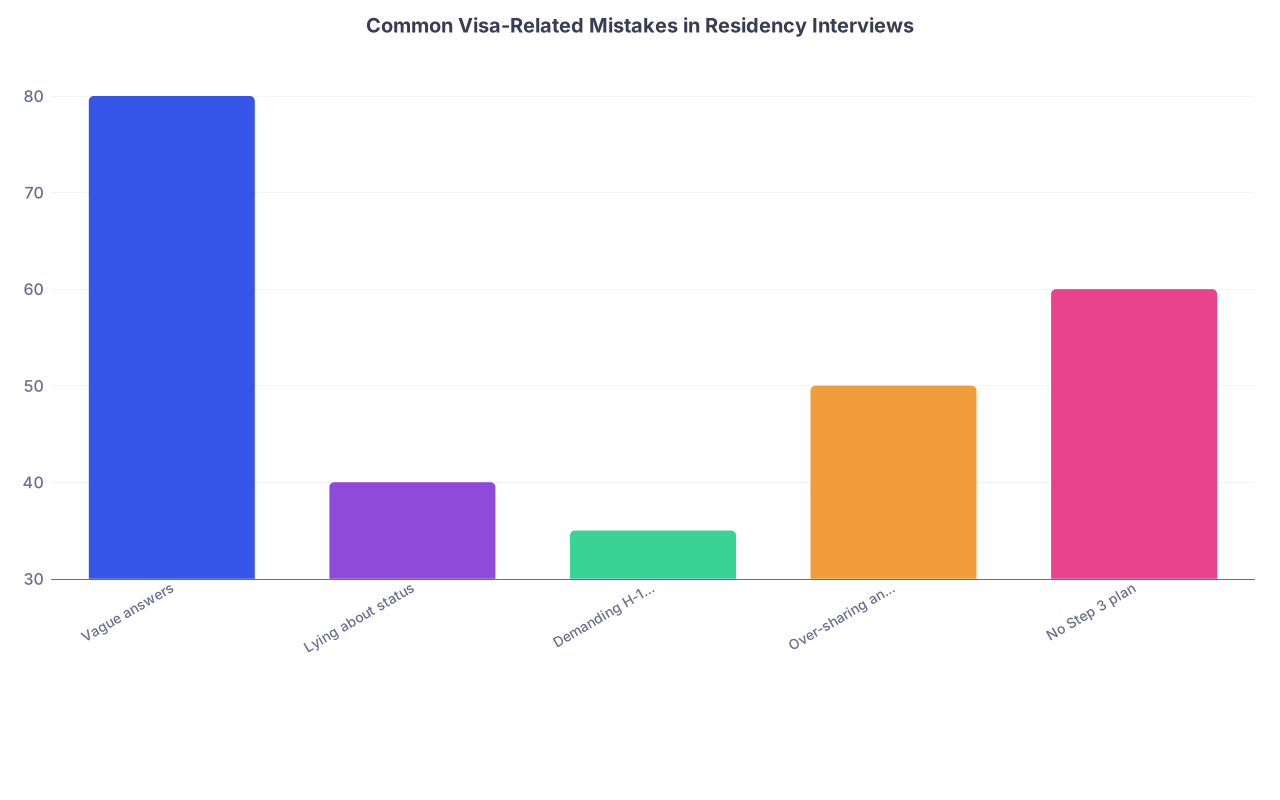
| Category | Value |
|---|---|
| Vague answers | 80 |
| Lying about status | 40 |
| Demanding H-1B only | 35 |
| Over-sharing anxiety | 50 |
| No Step 3 plan | 60 |
Mistake 1: Being vague
“I think I might be eligible for H‑1B, but I am not totally sure. I heard from some people that…”
You have just told them: “If you sponsor me, your GME office will have to figure out my life for me.”
Mistake 2: Trying to hide the need for sponsorship
Some applicants genuinely try: “Maybe if I do not mention it, they will forget.” They will not. And the NRMP / contract process forces the issue. It looks dishonest when it surfaces later.
Mistake 3: Making demands you cannot back with leverage
You are not a fellowship‑trained neurosurgeon with 10 R01s.
Telling a mid‑tier program, “I will only accept H‑1B” when:
- They have never sponsored H‑1B, and
- You have not passed Step 3
…is a good way to drop off their rank list.
Mistake 4: Emotionally over‑sharing
“I am very stressed about visas. I am so afraid I will not be able to stay in the U.S. My whole future depends on this…”
True, maybe. But that is not interview content. That registers as, “This person might panic or break down if we hit any bureaucratic friction.”
Mistake 5: Not aligning your story across interviews
If you tell one program “I absolutely want J‑1 only,” and another “I will only consider H‑1B,” that inconsistency spreads fast. Word travels at conferences and between coordinators. Do not assume they live in separate worlds.
11. A simple practice protocol before interview season
Here is how you make all of this automatic instead of awkward.

| Step | Description |
|---|---|
| Step 1 | Clarify Current Status |
| Step 2 | Decide Primary Visa Plan |
| Step 3 | Confirm Eligibility & Timeline |
| Step 4 | Draft 3-4 Core Answers |
| Step 5 | Record Practice Session |
| Step 6 | Refine Tone & Length |
| Step 7 | Research Program Policies Before Each Interview |
Step 1: Write your four “anchor” sentences
On a physical page, write:
- “I am currently [status].”
- “For residency, I will require [visa type(s)].”
- “My primary plan is [J‑1/H‑1B], and I am also open to [other].”
- “I do / do not anticipate any complications based on discussions with [school/attorney].”
Memorize these. Not word‑for‑word, but concept‑for‑concept.
Step 2: Record 5 minutes of Q&A
Use your phone or laptop. Ask yourself:
- “Will you need visa sponsorship?”
- “What type of visa are you seeking?”
- “Do you foresee any issues?”
Watch it. Fix:
- Rambling
- Nervous laughter
- Over‑complicated detail
Do this twice. By the third time, you will sound like you have done this for years.
12. Final checklists for interview day
Your mental checklist walking into each interview
You should know for that program:
- Do they sponsor visas at all?
- If yes, which type(s)?
- Am I realistically eligible for what they sponsor this cycle (Step 3, timelines)?
- How will I answer in 2–3 clear sentences if they ask about visas in the first five minutes?
Your “don’t do this” checklist
During the interview, do not:
- Change your stated visa preference mid‑sentence
- Ask them to “make an exception” to institutional policy
- Joke about “hoping immigration doesn’t catch me” (yes, applicants have actually said similar nonsense)
- Show visible frustration when they say “We only do J‑1” or “We cannot do H‑1B for categorical positions”
Professional, calm, informed. That is the brand you are selling.
Key points
- Programs are not allergic to visas. They are allergic to uncertainty, extra work, and risk. Speak in a way that lowers all three.
- Go into interviews with a clear, honest, and simple visa story: current status, primary visa plan, eligibility, and timing. No improvisation.
- Keep your answers short, calm, and specific. Confident clarity about visas makes you look like a low‑maintenance, high‑reliability IMG—not a red flag.


