
The biggest H‑1B mistake IMGs make is assuming “someone will figure it out for me.” They won’t. And that assumption quietly kills otherwise solid Match chances every year.
You can have great scores, strong letters, and still sabotage your Match because you misunderstood how H‑1B really works in residency. I’ve watched it happen to people with 250+ scores who thought visa details were a boring footnote, not a strategic requirement.
Let’s walk through the 7 H‑1B assumptions that quietly wreck IMG applications—and how to avoid joining that list.
1. “If a program offers H‑1B, I’m fine.” (You’re not.)
This is the most dangerous one.
You see a FREIDA listing or program website that says:
“Visa sponsorship: J‑1, H‑1B.”
You breathe. You apply. You relax.
That’s how people get burned.
Programs that “offer” H‑1B fall into several very different buckets:
| Program Type | What It Really Means |
|---|---|
| True H‑1B friendly | Routinely sponsors multiple H‑1Bs every year |
| Rare, exception-only | Will do H‑1B once in a while for exceptional candidates |
| Faculty‑only H‑1B | H‑1B used for attendings, not residents |
| Technically allowed, practically avoided | Institution permits it; program almost never uses it |
The mistake:
Treating all four as equal just because the website says “H‑1B: Yes.”
Red flags you’re missing if you only look for the “Yes” box:
- No current residents on H‑1B
- PD says “we prefer J‑1” but you ignore it
- Recent grads on forums reporting “they told me J‑1 only in the interview”
- Institution policy says H‑1B allowed, but GME coordinator quietly steers all residents to J‑1
How to avoid this:
Stalk the current residents page.
Look for IMG names where a J‑1 would be likely—but ask yourself: are any openly listed as H‑1B? If not, that’s telling.Email the right person, with the right question.
Don’t ask: “Do you sponsor H‑1B?”
Ask:
“In the last 3 years, roughly how many incoming residents have started training on H‑1B each year?”Track patterns, not promises.
A single H‑1B five years ago is not a pattern. That’s an exception.
If your whole list is built around programs that are “technically” H‑1B, you’re gambling your Match on a bad assumption.
2. “If my scores are high, they’ll make an exception.” (They usually won’t.)
You’d be surprised how many 250+ applicants quietly tank their chances by assuming their stats override visa discomfort.
Here’s the reality:
Visa category is often an administrative decision, not a “how impressed are we” decision.
Common hidden constraints that your 260 won’t fix:
- Institutional rule: “We sponsor J‑1 for residents. H‑1B only for faculty.”
- Budget limits: H‑1B fees are higher; some programs simply don’t want that cost.
- Compliance fear: Smaller, community programs may be terrified of getting something wrong with USCIS. They default to J‑1 because ECFMG does the heavy lifting.
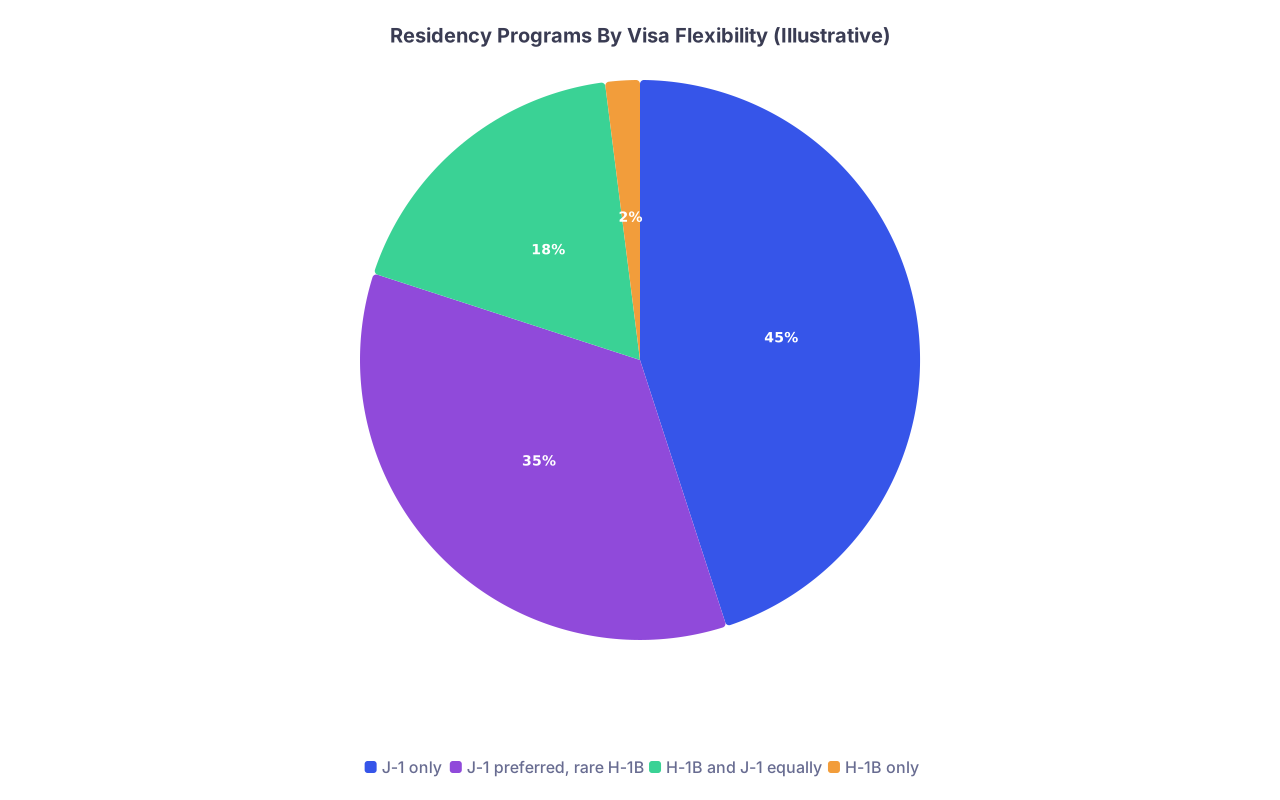
| Category | Value |
|---|---|
| J-1 only | 45 |
| J-1 preferred, rare H-1B | 35 |
| H-1B and J-1 equally | 18 |
| H-1B only | 2 |
(Those numbers are illustrative, but the proportions feel very familiar.)
The toxic mindset:
“I’m so strong they’ll bend their rules.”
What actually happens:
- They rank you, but only as J‑1.
- They like you, but another (J‑1‑willing) candidate is “administratively simpler.”
- They tell you in March: “We loved you, but unfortunately we couldn’t accommodate your visa preference.”
You do not want to hear the word “unfortunately” in March.
How to avoid this:
- If you must have H‑1B (e.g., you truly cannot accept J‑1), then ruthlessly filter programs to those with documented, recent H‑1B residents.
- Be honest with yourself: are you turning down J‑1 for a preference… or a must? The more rigid you are, the more precise your targeting has to be.
Do not rely on “I’m exceptional” as a visa strategy. It’s not a strategy. It’s a fantasy.
3. “Step 3 is optional. I’ll deal with it later.” (For H‑1B, it’s not.)
If you want H‑1B for PGY‑1, Step 3 is functionally not optional.
Most state medical boards and hospital HR departments require a passing USMLE Step 3 before an H‑1B petition for residency can be finalized. That timing collides very badly with people who decide to “just take it after Match.”
The failure pattern looks like this:
- September–November: You apply saying you’re “planning to take Step 3.”
- January: You still haven’t registered.
- March: You Match somewhere that’s H‑1B capable.
- April: You scramble to schedule Step 3 and hope for a seat.
- June: Score is late, or worse, you fail.
- July: No valid visa → start date at risk.
I have seen people lose spots or be forced onto J‑1 simply because they assumed “I’ll handle Step 3 if I Match somewhere H‑1B.”
You don’t control the test center calendar. Or your own nerves.
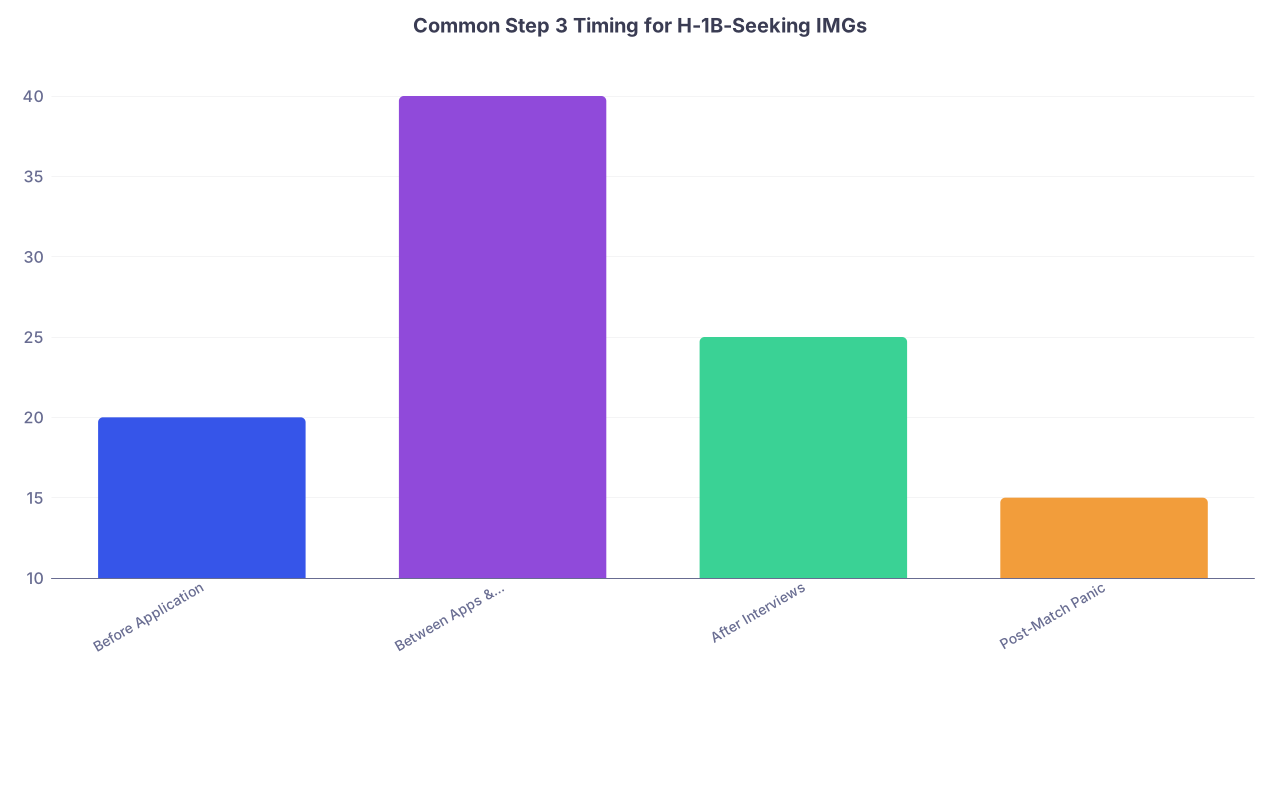
| Category | Value |
|---|---|
| Before Application | 20 |
| Between Apps & Interviews | 40 |
| After Interviews | 25 |
| Post-Match Panic | 15 |
The earlier two bars are safe. The last two are dangerous for H‑1B.
How to avoid this:
- If you’re targeting H‑1B, aim to take Step 3 before ranking programs.
- At minimum, have it scheduled with a realistic date and be explicit in your application: “Step 3 scheduled for [Month, Year].”
Don’t tell yourself, “Lots of people don’t have Step 3 yet.”
Yes, but those people are often fine with J‑1. You’re not them.
4. “All specialties treat H‑1B the same way.” (They don’t.)
You’ll shoot yourself in the foot if you assume visa friendliness is uniform across specialties.
Some specialties are structurally more open to IMGs and H‑1B. Others, frankly, aren’t.
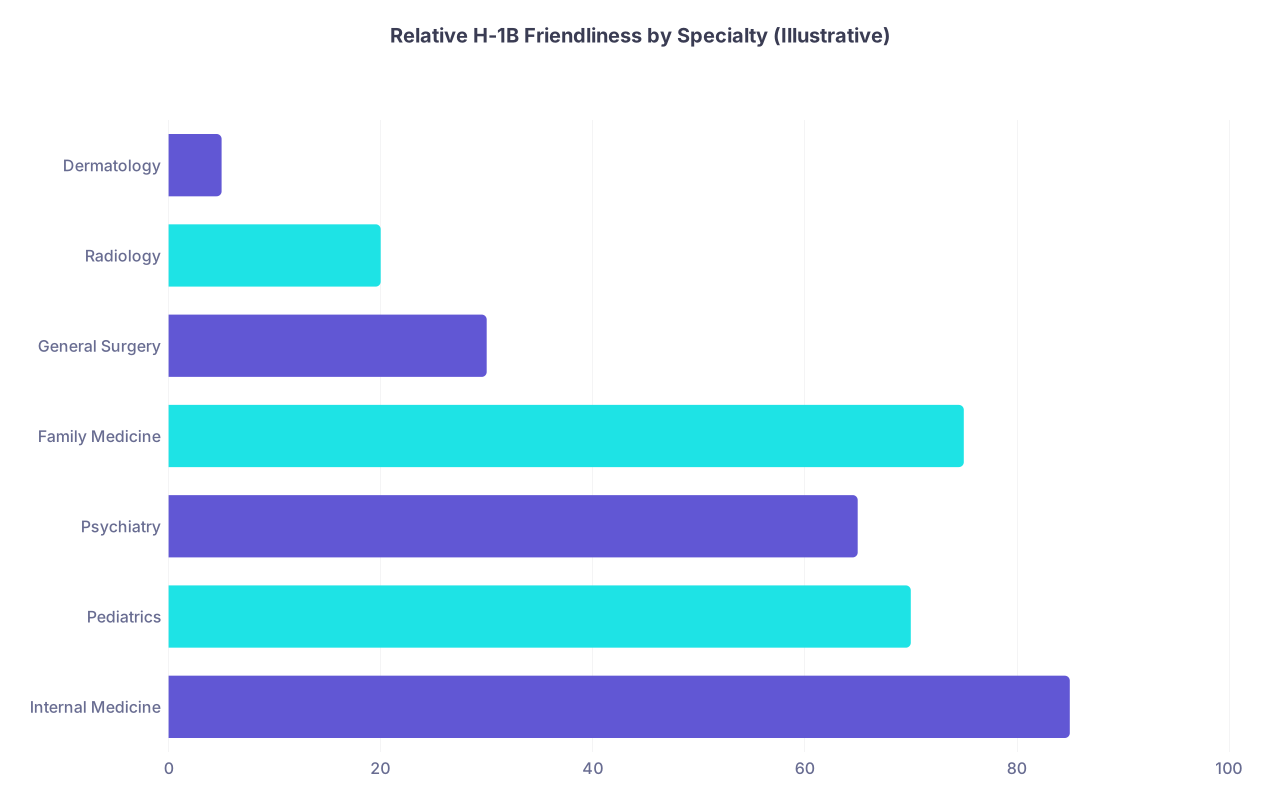
| Category | Value |
|---|---|
| Internal Medicine | 85 |
| Pediatrics | 70 |
| Psychiatry | 65 |
| Family Medicine | 75 |
| General Surgery | 30 |
| Radiology | 20 |
| Dermatology | 5 |
Again, numbers are illustrative—but the ranking is roughly how things look in the real world.
The costly mistake:
An IMG who “needs H‑1B” applies mostly to competitive, low‑IMG, low‑H‑1B specialties, then acts surprised in March.
Reality you have to swallow:
- Competitive specialties already have more than enough U.S. grads who need no visa.
- Programs with high research funding or prestige often prefer the “default” J‑1 research pipeline.
- Smaller community programs in those specialties might not have the administrative courage for H‑1B at all.
If you’re locked to H‑1B, your specialty choice and your visa choice are linked decisions, whether you like it or not.
How to avoid this:
- Look up IMG percentages and current resident rosters by specialty and program.
- Do a brutally honest assessment:
“Is this specialty + visa combo realistic with my scores, YOG, and attempts?”
You don’t have to give up your dream, but you can’t ignore the math. Pretending every specialty is equally H‑1B friendly is an excellent way to go unmatched.
5. “H‑1B gives me total freedom after residency.” (Not exactly.)
A lot of IMGs chase H‑1B because they believe:
- It’s “better” than J‑1.
- It guarantees freedom to work anywhere after residency.
- It’s the “smart” long‑term choice.
That half‑true narrative causes people to reject good J‑1‑friendly programs and then not Match anywhere.
Here’s the nuance most people skip:
H‑1B:
- Dual intent (yes, it’s helpful for green card later).
- No 2‑year home residency requirement.
- But: tied to a specific employer and position. You don’t just wander off post‑residency; you still need an H‑1B‑willing job.
J‑1:
- Has the 2‑year home requirement…
- Unless you get a J‑1 waiver job (Conrad 30, VA, hardship/exceptions).
- Many underserved areas are desperate enough to welcome you on a waiver and help with long‑term immigration.
Plenty of people have built fantastic careers going the J‑1 → waiver job → green card route.
The assumption “H‑1B is always superior” is shallow and sometimes just wrong.

The mistake that hurts the most:
- You decline or don’t rank J‑1 programs that love IMGs.
- You over‑rank marginally H‑1B‑possible programs that are lukewarm.
- You end up unmatched… or in SOAP scrambling for any spot, visa aside.
How to avoid this:
- Talk to immigration lawyers who actually handle physicians, not random YouTube gurus.
- Map two concrete paths on paper:
- H‑1B path: Residency → possible fellowship → job → green card.
- J‑1 path: Residency → waiver → job → green card.
- Compare timelines, risks, and your own specialty realistically.
Don’t romanticize H‑1B and demonize J‑1 based on Reddit threads. Those threads won’t fix your unmatched status.
6. “The program’s GME office will handle all the visa details.” (They’ll handle their side, not yours.)
This assumption is how people miss deadlines, ignore state rules, and get blindsided by document requirements.
GME/HR will absolutely:
- File the actual H‑1B petition (if they’ve agreed to sponsor).
- Coordinate with their institutional legal department.
- Tell you which internal forms to sign.
They will not:
- Chase you for missing Step 3 until it’s dangerously late.
- Interpret state medical board requirements on your behalf.
- Fix it if your passport is expiring soon and delays the process.
- Strategize whether you should change status vs consular processing.
I’ve seen this mess several times:
- Candidate assumes “once I Match, the hospital takes over.”
- Doesn’t check that their OPT, current status, or passport dates align with a July 1 start.
- HR discovers issues in May or June → cue panic, sometimes delayed start or last‑minute J‑1 push.
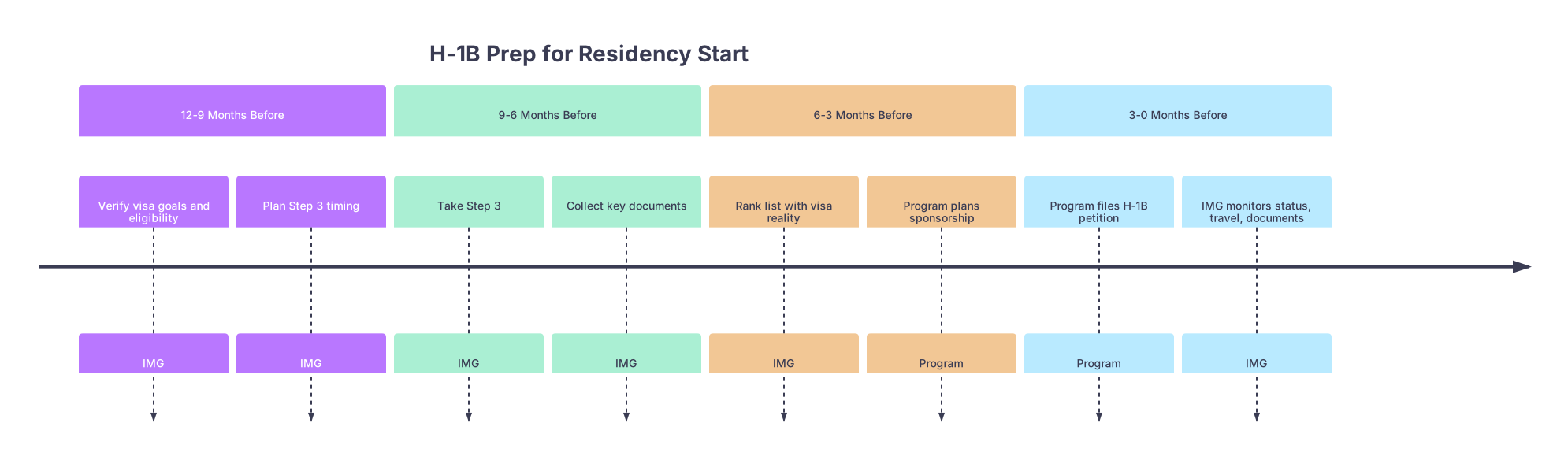
| Period | Event |
|---|---|
| 12-9 Months Before - Verify visa goals and eligibility | IMG |
| 12-9 Months Before - Plan Step 3 timing | IMG |
| 9-6 Months Before - Take Step 3 | IMG |
| 9-6 Months Before - Collect key documents | IMG |
| 6-3 Months Before - Rank list with visa reality | IMG |
| 6-3 Months Before - Program plans sponsorship | Program |
| 3-0 Months Before - Program files H-1B petition | Program |
| 3-0 Months Before - IMG monitors status, travel, documents | IMG |
See all those “IMG” labels? That’s your job.
How to avoid this:
- Before Match:
Confirm with yourself that your Step 3, passport, and current status (if already in the U.S.) can support an H‑1B by July 1. - After Match:
As soon as you match, ask explicitly:- “Will I be on J‑1 or H‑1B?”
- “What’s the latest date by which you need my Step 3 result / documents to proceed with H‑1B?”
- Keep your own folder (digital and physical) with:
- USMLE scores
- ECFMG certificate
- Medical degree and translations
- Passport, prior visas, I‑94, DS‑2019s/I‑20s if applicable
Do not assume someone will email you every requirement with plenty of cushion. That’s not how hospital bureaucracy works.
7. “As long as some programs sponsor H‑1B, I’ll be fine.” (Not if you build a fantasy-heavy list.)
This is how strong IMGs go unmatched: they build an application list that looks impressive on paper but is structurally fragile on visas.
Common self‑sabotaging patterns:
- Overloading on big‑name university programs that “have done H‑1B”… but almost entirely for fellows, not residents.
- Under‑applying to solid community or mid‑tier university programs that routinely take IMGs on H‑1B.
- Having no real backup programs that both:
- Accept your profile (scores, attempts, YOG), and
- Are historically H‑1B‑friendly.
Your brain loves to anchor on names it recognizes: “Cleveland Clinic,” “Mayo,” “Mass General.”
Your visa doesn’t care about brand. It cares about patterns.

To avoid this trap, you need an actual system, not vibes.
Here’s a simple, no‑nonsense structure:
- Rate each program on:
- Historical IMG friendliness (low / medium / high)
- Recent H‑1B resident presence (none / occasional / frequent)
- Competitiveness relative to your profile (reach / target / safety)
Then aim for something roughly like this in your final list (adjust for your competitiveness, of course):
| Category | # of Programs | H‑1B Pattern Requirement |
|---|---|---|
| Safety | 15–25 | High IMG + frequent H‑1B |
| Target | 15–25 | Medium IMG + some H‑1B |
| Reach | 10–20 | Any H‑1B history |
The exact numbers will vary. The principle should not:
You need enough realistic H‑1B‑friendly options, not just famous logos with theoretical sponsorship.
If your list is 80% reach in a low‑H‑1B specialty and you insist on H‑1B only, you’re volunteering for a brutal Match Day.
Frequently Asked Questions
1. Do I have to have Step 3 done before applying if I want H‑1B?
No, but treating Step 3 as optional while chasing H‑1B is a big risk. Many programs and state boards require a passed Step 3 before they can finalize an H‑1B for residency. The safest pattern is: take Step 3 before interviews or at least before you certify your rank list. If you push it to post‑Match, you’re gambling your start date and possibly your visa category.
2. Is J‑1 really that bad compared to H‑1B?
Not inherently. J‑1 has the 2‑year home residency rule, but a large number of IMGs bypass that through J‑1 waiver jobs (Conrad 30, VA, etc.). H‑1B is not magic; you still need a job and an employer willing to sponsor you afterward. A well‑planned J‑1 path can be far better than a “maybe H‑1B” fantasy that leaves you unmatched or stuck in SOAP.
3. How can I tell if a program actually sponsors H‑1B for residents?
Don’t stop at the website checkbox. Look for: current or recent residents openly on H‑1B, past IMG testimonials, or forum posts naming specific programs. Then email the coordinator or PD with a pointed question: “In the past 3 years, about how many incoming residents per year have started on H‑1B?” Vague, non‑committal answers usually mean “rarely, if ever.”
4. If I’m okay with J‑1 or H‑1B, should I say I “prefer H‑1B” in interviews?
Careful. Telling a J‑1‑leaning program you “prefer H‑1B” can quietly lower your rank if they see you as higher‑maintenance. If you’re truly fine with either, it’s often safer to say, “I’m open to either J‑1 or H‑1B, and I’m happy to follow the institution’s standard practice for residents.” Save firm H‑1B demands for programs that clearly, consistently sponsor it.
5. When should I talk to an immigration lawyer about H‑1B vs J‑1?
Before you lock in a strategy. Ideally 9–12 months before Match, especially if you’re debating specialty choices or worried about future green card options. At the very least, speak with a physician‑focused immigration attorney before you start rejecting J‑1‑heavy programs or making hard “H‑1B or nothing” decisions. You want real legal input, not rumors, shaping those calls.
Open your program list right now and mark each one: “Proven H‑1B,” “Unclear,” or “Probably J‑1 only.” If over half your realistic options fall into “unclear,” you’re building on assumptions, not evidence—fix that before it quietly ruins your Match.