
What actually happens if you assume your fellowship H‑1B is “obviously” cap‑exempt… and you are wrong?
You wake up one morning in PGY‑4, HR emails you “USCIS denied the petition – subject to H‑1B cap,” and suddenly you are out of status with:
- No fellowship,
- No easy way back to residency,
- And a very real problem explaining “unlawful presence” to future employers and consulates.
I have watched that train wreck happen. More than once. It is almost never because the physician was careless. It is because nobody clearly explained how fragile cap‑exempt H‑1B status really is when you leave your training hospital and move to a fellowship.
This is the article I wish those residents had read a year earlier.
1. The Core Concept IMGs Miss: Cap‑Exempt vs Cap‑Subject Is Not About You
Most IMGs in residency think: “I am cap‑exempt because I am in a teaching hospital.”
Wrong emphasis. You are cap‑exempt because of your employer, not because of your specialty, credentials, or how noble your mission is.
There are three common cap‑exempt bases for H‑1B in GME:
- You are employed directly by:
- A nonprofit institution of higher education (e.g., “University of X” hospital)
- A nonprofit entity related to or affiliated with such an institution
- You are employed by a nonprofit or governmental research organization.
- You are employed by another entity, but your work predominantly furthers the essential purpose of a cap‑exempt institution under a qualifying affiliation agreement.
The critical mistake: assuming that if the work looks “academic” (fellowship, teaching, research), then the position must be cap‑exempt.
USCIS does not care about your subjective sense of “academic.” It cares about:
- Who is on your paycheck,
- What that entity’s corporate status is,
- Whether the paperwork linking that entity to a university is airtight.
Typical failure scenario
- Residency: H‑1B through “University Hospital” – clearly cap‑exempt.
- Fellowship: Offered at “Regional Heart Center,” a private nonprofit hospital “affiliated with” the same university… according to the brochure.
- HR files H‑1B as cap‑exempt, relying on a five‑page marketing MOU, not a proper USCIS‑grade affiliation agreement.
- USCIS: “This employer does not qualify for cap exemption.” Petition denied.
- Result: You were counting on a July 1st start. There is no backup cap‑subject H‑1B because the lottery was months ago. You have no underlying status after residency ends in June. You are stuck.
You never consciously “chose” to give up your cap‑exempt status. You just joined the wrong employer under the wrong assumptions.
2. The Most Dangerous Transition: University Residency → “Affiliated” Fellowship
The single highest‑risk move for IMGs on H‑1B:
Cap‑exempt university residency → fellowship at a hospital that claims to be “affiliated,” but is not truly cap‑exempt in USCIS’s eyes.
Let me walk through the traps.
Trap 1: Assuming “Teaching Hospital” = Cap‑Exempt
Many community hospitals (especially in large systems like HCA, Ascension, Tenet, etc.) run residency and fellowship programs but are:
- Private,
- Not owned by a university,
- Not formally controlled by a nonprofit university.
They may:
- Host residents from a university program,
- Call themselves a “teaching site,”
- Market “academic affiliation” on the website.
That does not automatically qualify them for cap exemption.
For USCIS, cap‑exempt teaching hospitals need:
- Either to be legally part of the nonprofit university,
- Or to have a formal affiliation agreement satisfying specific regulatory criteria (control, shared board members, etc.), not just a rotation contract.
If HR cannot produce:
- The 501(c)(3) determination letter for the employing entity, and
- A robust, lawyer‑drafted affiliation agreement that has worked for prior physician H‑1Bs,
you are playing roulette with your visa.
Trap 2: Letting Fellowship HR “Figure It Out”
Common conversation I have seen:
Fellow: “Will my H‑1B still be cap‑exempt? I am on H‑1B at University now.”
HR: “We sponsor H‑1Bs all the time. It should be fine.”
Fellow: “So you are cap‑exempt too?”
HR: “We’re an academic center with residents. We’ve never had an issue.”
Translation:
“We have no idea how cap exemption technically works, but previous petitions have not been denied yet.”
Do not rely on:
- Verbal assurances,
- Past practice alone,
- Vague “we work with immigration counsel.”
You need specific answers:
- Are you filing my fellowship H‑1B as cap‑exempt or cap‑subject?
- What is the exact cap‑exempt category you are using?
- Have you successfully obtained cap‑exempt H‑1Bs for new physicians not previously in H‑1B status?
If they cannot answer with precision, that is a red flag.
3. The Hidden Killer: When Cap‑Exempt Status Is Not Portable The Way You Think
A fundamental misunderstanding: “I am already in cap‑exempt H‑1B, so I can transfer to another cap‑exempt employer easily.”
Transfers are possible, but the new employer must independently qualify for cap exemption. Your personal history does not carry the exemption with you.
Think of it this way:
- You are not “personally cap‑exempt” forever.
- Each job’s cap status is analyzed from scratch.
So what can go wrong during fellowship moves?
Scenario A: Cap‑Exempt to Cap‑Subject Without Winning the Lottery
- PGY‑3 Internal Medicine, H‑1B cap‑exempt at State University Hospital.
- Fellowship offer from a private cardiology practice with a one‑year hospital‑based interventional fellowship slot. They say, “We will sponsor H‑1B.”
- They file a “transfer” H‑1B in May, assuming your prior cap‑exempt history means no lottery.
- USCIS reclassifies petition as cap‑subject; there is no cap number available. Petition denied.
- Residency finishes in June. Suddenly you have no status and no fellowship.
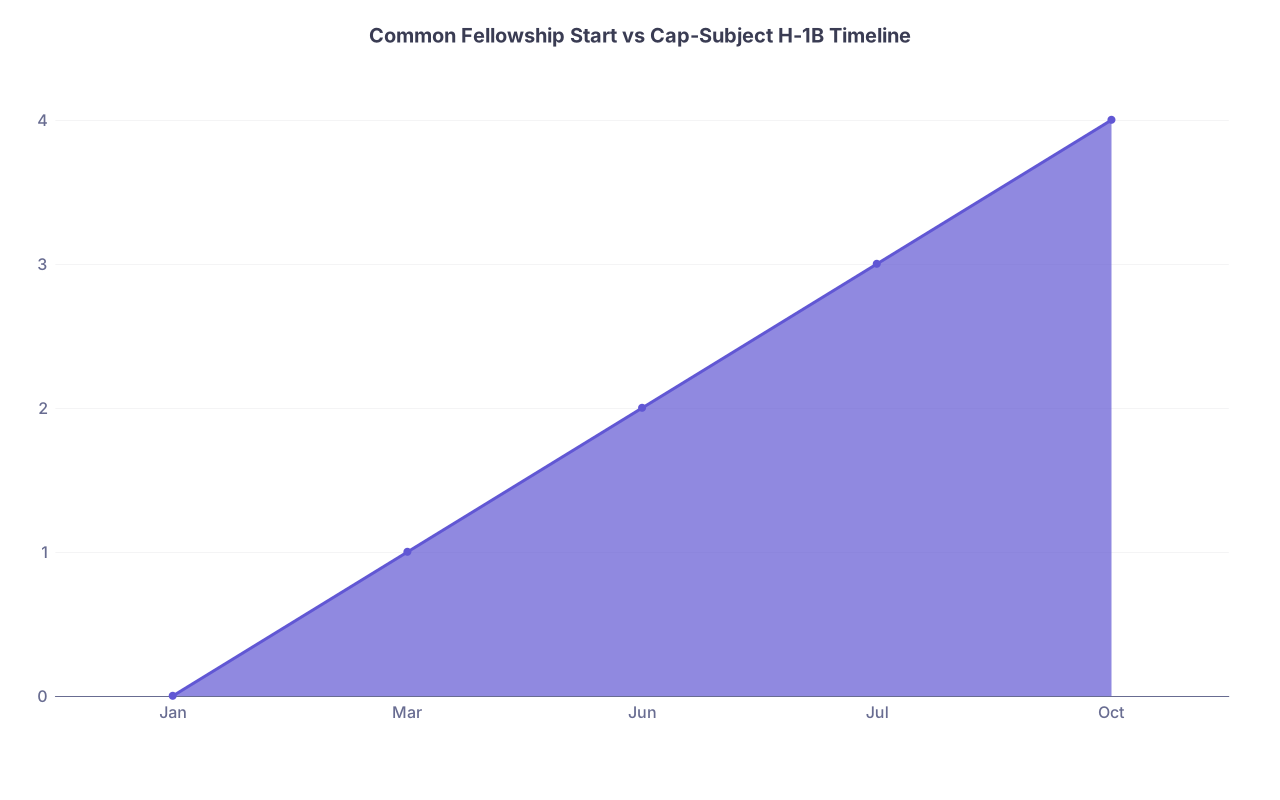
Cap‑subject H‑1B cannot start until:
- It is selected in the lottery (March),
- It is approved,
- And the employment start date (usually October 1).
Fellowships start July 1. See the gap?
| Category | Value |
|---|---|
| Jan | 0 |
| Mar | 1 |
| Jun | 2 |
| Jul | 3 |
| Oct | 4 |
That timeline mismatch alone has destroyed perfectly good fellowship offers.
Scenario B: “Concurrent” H‑1B Misused or Misunderstood
There is a niche strategy: concurrent cap‑subject H‑1B when you keep a cap‑exempt job and add a private employer.
Mistake pattern:
- You reduce time at your university position to 0.1 FTE “moonlighting” role and take a 0.9 FTE fellowship/job at a private hospital or practice.
- The private employer files concurrent cap‑subject H‑1B, leveraging your ongoing cap‑exempt job.
- After a few months, somebody decides to “simplify” things and terminate the cap‑exempt 0.1 FTE role.
- Now the entire basis for the concurrent arrangement collapses. You are effectively working on an H‑1B that should have been cap‑subject from the start, without a cap number.
USCIS can, and will, treat that as invalid employment.
You do not want to be explaining this during a consular interview later.
4. Fellowship Structures That Put Your Status at Risk
Not all fellowships are created equal from a visa perspective. Here is where people stumble.
| Fellowship Employer Type | Typical Cap Risk Level |
|---|---|
| University-owned hospital (true academic center) | Low |
| Nonprofit hospital with strong written affiliation | Moderate |
| Large private hospital system “teaching site” | High |
| Private specialty group running “fellowship” | Very High |
Risky Pattern 1: “Institutional” Fellowships Based at Community Hospitals
These programs may:
- Be ACGME‑accredited,
- Host residents and fellows,
- Advertise NIH grants and “teaching faculty.”
But if the employing entity is:
- A stand‑alone nonprofit hospital with only a loose academic affiliation, or
- A for‑profit hospital system,
then cap‑exempt H‑1B is far from guaranteed.
Warning signs:
- Offer letter uses hospital system name unrelated to the university.
- Payroll and benefits are through a non‑university entity.
- HR admits, “We sometimes use J‑1 instead of H‑1B because H‑1B can be tricky.”
Risky Pattern 2: “Non‑ACGME Clinical Fellowships” in Private Groups
I have seen this with cardiology, GI, pain, even “advanced hospitalist” fellowships.
- Private group says, “We have a one‑year fellowship; we can get you H‑1B, no problem.”
- There is no university ownership or cap‑exempt partner.
- They have never sponsored an IMG H‑1B before.
- They assume your existing cap‑exempt H‑1B makes you “transferable” without lottery.
This is the most common way IMGs accidentally lose cap‑exempt H‑1B status and fall out of the system entirely.
If the fellowship is:
- Non‑ACGME,
- Purely service‑driven,
- Run by a private group,
assume high visa risk until proven otherwise by a solid immigration attorney.
5. How to Protect Yourself Before You Sign Anything
You cannot outsource this entirely to HR. Their incentives are not aligned with yours. If your petition is denied, they shrug and move on to the next candidate. You have to leave the country.
Here is how you lower your risk.
Step 1: Ask Very Direct Questions Early
When you get a fellowship offer, do not wait until March of PGY‑3 to bring up visas. Ask in the interview or immediately after the verbal offer:
- “Do you sponsor H‑1B visas for fellows?”
- “Is my position filed as cap‑exempt or cap‑subject?”
- “Have you successfully obtained H‑1B approval for IMGs in this exact program in the last 3 years?”
If they:
- Hesitate,
- Say “we can look into it later,”
- Or immediately try to steer you to J‑1 without explanation,
treat that as a serious warning sign.
Step 2: Demand Clarity on Who Your Actual Employer Is
You do not work for “Cardiology Fellowship Program.” You work for a legal entity with a tax ID.
Ask for:
- The exact entity name on your future paycheck,
- Whether that entity is:
- A nonprofit institution of higher education,
- A nonprofit hospital/affiliate with a formal agreement,
- A research organization,
- Or a private/for‑profit corporation.
If the answer is fuzzy or jargon‑loaded, push:
“I am currently on cap‑exempt H‑1B. My ability to stay in the U.S. depends on whether the fellowship employer independently qualifies as cap‑exempt. I need the legal entity’s name and its cap‑exempt basis to review with counsel.”
A serious program that has done this correctly will not be surprised by this question.
Step 3: Involve an Independent Immigration Attorney
This is where many residents try to save a few hundred dollars and lose their entire U.S. career.
Do not just rely on:
- Hospital‑paid corporate counsel (they represent the hospital, not you),
- Advice from co‑fellows (“It worked for me, you’ll be fine”).
Pay an independent, physician‑focused immigration lawyer to:
- Review your current H‑1B,
- Review the fellowship offer,
- Analyze cap‑exempt vs cap‑subject risk,
- Lay out your options if the fellowship is not truly cap‑exempt.
That 60‑minute call may save you from a multi‑year forced relocation.
6. Common “Workarounds” That Backfire
There are a few standard shortcuts people try that usually end badly.
Bad Idea 1: “Let’s Just File and See What Happens”
If HR or their attorney says:
“We think it should be cap‑exempt. If USCIS has questions, we will respond to an RFE.”
What they are really saying is:
- They are not certain the employer qualifies,
- They are using your case as a test balloon.
If USCIS says the petition is cap‑subject:
- You will not magically get a cap number in June,
- Your start date will be impossible,
- Your lawful presence may end abruptly.
You do not experiment with your immigration status.
Bad Idea 2: Relying on J‑1 as a Last‑Minute Backup
Some residents think, “If H‑1B fails, I will just switch to J‑1 for fellowship.” Two big problems:
- Timing: By the time H‑1B denial comes, J‑1 deadlines (ECFMG sponsorship, DS‑2019 issuance) may have passed.
- 2‑year home requirement: If you have any plans for:
- H‑1B jobs,
- Waiver jobs,
- U.S. permanent residency soon after,
switching to J‑1 late in training can lock you into a complicated waiver path. Sometimes impossible depending on specialty and location.
J‑1 is not “bad,” but using it as a panic move rarely goes well.
Bad Idea 3: Ignoring Start Date Gaps
If your current cap‑exempt H‑1B ends June 30 with residency, and your cap‑subject H‑1B (lottery‑based) can only start October 1, you do not have automatic permission to:
- Stay in the U.S. and work “once it is approved,” or
- “Use a grace period” for 3 months of limbo.
The 60‑day grace period rule is very specific and not a cure‑all. Do not assume you can linger for an entire summer without clear legal basis.
7. Safe Patterns That Usually Work Better
There are ways to move to fellowship without blowing up your status. Here are some safer patterns physicians have used.
Safer Pattern A: Stay Within the Same Cap‑Exempt University System
If:
- Your residency and fellowship are both directly employed by the same university or tightly integrated health system,
- Previous fellows on H‑1B have transitioned without issue,
then risk is lower. Still not zero, but much better.
Safer Pattern B: Confirmed Cap‑Exempt Affiliated Hospital with Strong History
Some non‑university hospitals genuinely qualify as cap‑exempt due to:
- Board control by a university,
- Shared ownership,
- Or deep, formal affiliation explicitly designed for physician visas.
How to know:
- They can show a track record of multiple H‑1B approvals for fellows/attendings,
- Their counsel can articulate exactly why the hospital is cap‑exempt in regulatory language,
- They know the difference between resident J‑1 sponsorship and H‑1B cap exemption and do not conflate them.
Safer Pattern C: Cap‑Exempt Fellowship, Then Cap‑Subject Job via Lottery
If your long‑term plan is private practice or non‑academic employment:
- Use fellowship years in cap‑exempt H‑1B,
- Proactively enter the H‑1B lottery with a private employer while still in training,
- Become “cap‑counted” once you win, which then allows freer movement between private employers later.
The mistake is waiting until after fellowship to even think about the lottery. At that point, you may have no cap‑exempt safety net.

| Step | Description |
|---|---|
| Step 1 | Residency at Cap-Exempt University |
| Step 2 | Fellowship at Same/Qualified Cap-Exempt Employer |
| Step 3 | Private Employer Files Cap-Subject H-1B in Lottery |
| Step 4 | Becomes Cap-Counted |
| Step 5 | Post-Fellowship Private Practice |
8. Checklist: Before You Accept a Fellowship Offer on H‑1B
Run through this before you sign:
- Do they sponsor H‑1B for fellows, not just attendings?
- Are they filing as cap‑exempt or cap‑subject?
- If cap‑exempt:
- What is the specific basis? (University, nonprofit affiliate, research org)
- Have they used this basis successfully for multiple physicians recently?
- Who is the actual legal employer (entity name and type)?
- Has their immigration attorney reviewed your current H‑1B and confirmed:
- You can extend time if needed (not hitting 6‑year limit),
- There is no gap in status between residency end and fellowship start?
- If cap‑subject:
- How will the lottery timing line up with your fellowship start date?
- What is Plan B if you are not selected?
If any answer is non‑specific, hand‑wavy, or obviously rushed, press pause and get independent legal advice.
FAQ (Exactly 3 Questions)
1. If I am already on cap‑exempt H‑1B in residency, does that mean my fellowship H‑1B is automatically cap‑exempt?
No. Your cap‑exempt classification belongs to the employer, not to you as a person. Every new H‑1B job is evaluated independently. If your fellowship employer does not qualify as cap‑exempt under USCIS rules, then any H‑1B filed by them would be cap‑subject, requiring a lottery slot. Assuming “automatic” cap‑exemption is one of the main ways IMGs lose status.
2. Can I safely switch from a cap‑exempt residency to a private hospital fellowship if they call it a “teaching” or “academic” program?
Not without much deeper verification. The words “teaching hospital,” “academic,” or “affiliated with University X” are marketing terms, not legal categories. Private hospitals often host residents and fellows but remain cap‑subject for H‑1B purposes. Unless there is a strong, legally sufficient affiliation agreement and proven history of cap‑exempt approvals, you should assume there is significant visa risk and consult an immigration attorney before accepting.
3. What if my fellowship H‑1B is denied as cap‑subject and I am not selected in the lottery – can I stay on my current H‑1B while I figure things out?
Only if your current cap‑exempt H‑1B employer is willing and able to continue your employment and extend your petition, and only within the validity limits of your H‑1B. Once your residency contract ends and your H‑1B tied to that job expires, you generally cannot just remain in the U.S. waiting for something else to work out. There is a limited grace period, but it is not designed for multi‑month gaps or speculative plans. That is why you must resolve the cap‑exempt vs cap‑subject issue long before your current status ends.
Key points to walk away with:
- Cap‑exempt H‑1B is employer‑based, not a permanent personal privilege you carry into any fellowship you like.
- “Affiliated” or “teaching” language does not guarantee cap exemption; only a proper legal structure and history of approvals do.
- You must interrogate the fellowship’s visa plan early and involve independent counsel, or you risk losing your status at the exact moment you thought you were advancing your career.