

It is March 15th. Match Day. You just opened your email, saw “Congratulations, you have matched,” and you are shaking with relief. A month later, the program coordinator sends a short, cold message:
“We are unfortunately unable to proceed with your H‑1B petition due to missed filing timelines. We can only sponsor J‑1 at this point. Please confirm if you are willing to switch to J‑1.”
This is where many IMGs realize they were never playing the same game as their American classmates. They thought “I matched, so the visa will sort itself out.” It will not. Not for H‑1B. And the timing errors IMGs make at this phase are brutal because they are often irreversible.
Let me walk you through the traps I see over and over. The ones that quietly kill H‑1B possibilities months before anyone says it out loud.
1. Misunderstanding the Two Completely Different H‑1B Worlds
The first mistake is conceptual, and it infects every other decision: thinking there is just “an H‑1B visa,” as if it is one single process.
There are actually two very different H‑1B pathways:
- H‑1B under the cap (lottery) – used mostly for private employers
- Cap‑exempt H‑1B – used by most residency programs (universities, teaching hospitals, non‑profits)
Why you should care: the timelines, strategy, and deal‑breakers differ. If you do not know which world your future employer lives in, you cannot plan your deadlines.
| Feature | Cap (Lottery) H-1B | Cap-Exempt H-1B |
|---|---|---|
| Typical Employer | Private practice, community hospital | University, teaching hospital, non-profit |
| Annual Limit | 85,000 total | No annual cap |
| Main Filing Window | March (for Oct 1 start) | Year-round, but program-specific deadlines |
| Used For | Post-residency jobs | Most residencies/fellowships |
Where IMGs mess up:
- Assuming “lottery timelines” (March registration, October 1 start) apply to residency visas. Most residency H‑1Bs are cap‑exempt, so they do not use the March lottery, but they do have internal hospital deadlines that can be just as unforgiving.
- Not realizing that even cap‑exempt H‑1Bs take months to assemble and file correctly. Program coordinators are not magicians.
If you are targeting H‑1B for residency, you are almost always in the cap‑exempt lane. That does not make you safe. It just replaces public USCIS deadlines with invisible, program‑specific internal ones that no one will chase you to meet.
2. The USMLE Timing Trap That Quietly Blocks H‑1B
If you remember nothing else, remember this: late USMLE Step 3 kills more H‑1B residency options than any other single mistake.
Most programs that sponsor H‑1B for residency require:
- ECFMG certification completed
- Passing USMLE Step 3 before they will even start an H‑1B petition
The deadly timing pattern I see:
- You take Step 2 CK late (e.g., November of final year).
- You wait for the score.
- You then book Step 3 in April/May.
- Score comes out in May or June.
- Your program wanted to file H‑1B in May. You just missed the cut.
At that point, the program has two realistic options:
- Switch you to J‑1
- Withdraw your offer because they cannot get you in on time
And yes, programs do this. I have seen emails that literally say, “We cannot wait any longer for H‑1B processing.”
Here is the rough reality for Step 3 timing when H‑1B is your goal:
- You want Step 3 done and passed no later than February–March of the Match year
- That usually means taking it by January at the latest so that:
- Score is back in 3–4 weeks
- You can send proof to programs before rank lists or right after Match
- The hospital lawyers have 2–3 months to assemble the petition
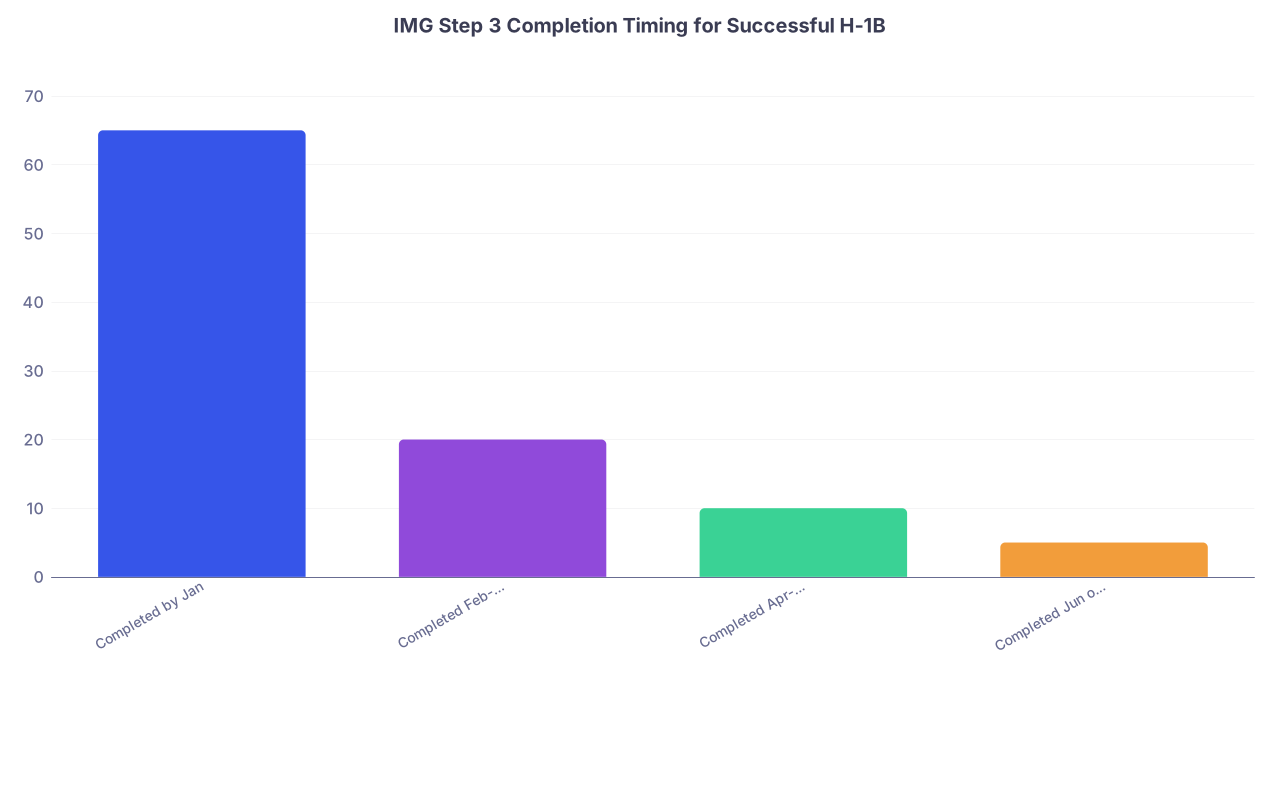
| Category | Value |
|---|---|
| Completed by Jan | 65 |
| Completed Feb-Mar | 20 |
| Completed Apr-May | 10 |
| Completed Jun or later | 5 |
If you are still in med school or early in your application cycle, the “no excuses” move is:
- Front‑load Step 2 CK
- Book Step 3 at the earliest date you reasonably can after CK
- Do not let fear of failing delay you past January/February
Delaying Step 3 because you want a 250 instead of a 225 is how people end up on J‑1 when they never wanted it.
3. Missing the Program’s Internal H‑1B Cutoffs (Not Publicly Posted Anywhere)
USCIS lets cap‑exempt employers file H‑1B year‑round. That does not mean your program can or will. Hospitals run GME start dates like a military operation. They need your visa approval by a specific date or they move on.
Typical reality:
- Programs aim for all visa petitions filed by May or June for a July 1 start
- Many require your documents 4–8 weeks before their filing target
- Legal departments batch all the petitions together and do not have flexibility for “one late file”
Common internal milestones (rough ballpark):
| Step | Approx Time (Match Year) |
|---|---|
| Match Day | Mid-March |
| Program Sends Visa Packet | Late March–Early April |
| Applicant Deadline for Docs | Late April–Mid May |
| Hospital Targets Filing Date | May–June |
| Preferred USCIS Approval By | June–Mid July |
Where IMGs blow it:
- Ignoring or delaying the visa packet because “I am busy moving / finishing rotations.”
- Taking weeks to respond to coordinator emails.
- Sending partial documents (“I will send the rest later”) and assuming they will keep the slot warm.
If a coordinator says, “Please return all documents by May 1,” treat that as an immovable deadline. Not a suggestion.
Three specific timing sins that cause chaos:
- You start collecting documents only after receiving their checklist. That is already too late.
- You procrastinate on getting transcripts, diplomas, ECFMG letters, Step 3 proof—items with lead times.
- You assume “premium processing” can fix everything, so you are casual with your part. It cannot. There is no premium processing for your missing signature, unissued diploma, or national license letter stuck with some ministry.
I have seen programs reverse H‑1B plans and push residents to J‑1 simply because “the file is incomplete and GME cutoffs are here.”
4. The DS‑2019 vs H‑1B “Silence Trap” After Match
Huge, common, and preventable: the silence after Match.
Here’s how it plays out:
- You match at a program that “supports J‑1 and H‑1B.”
- You assume they will automatically put you on H‑1B if your scores are fine.
- They assume that if you really want H‑1B, you would explicitly tell them early, and that if you say nothing, you are fine with J‑1.
- Their default workflow is J‑1 because it is faster, cheaper, and simpler for them.
- They quietly initiate a DS‑2019 request with ECFMG.
- By the time you ask “What about H‑1B?” they say:
“We have already processed your J‑1 paperwork. It is too late to switch this year.”
That is not malice. It is expediency. GME offices run on templates and standard operating procedures.
Your job, if you genuinely want H‑1B:
- Within 1–2 weeks of Match, email your coordinator and program director. In writing.
- Clearly state:
- That you are seeking H‑1B sponsorship
- That you have (or will have) Step 3 by [date]
- That you are willing to shoulder any reasonable extra cost / paperwork
- Ask directly: “What are your internal deadlines and requirements for H‑1B?”
If you let April pass without a clear, documented conversation, you are rolling the dice. Programs will default to J‑1 to make their lives easier unless H‑1B is explicitly requested early with a realistic timeline.
5. Overlooking Degree, ECFMG, and Licensing Timing Requirements
H‑1B is not just “send them my scores.” There are structural timing requirements tied to:
- Your medical degree issuance
- ECFMG certification
- Any required state training license
Three common timing traps:
a) Late graduation / diploma issuance
Some schools issue diplomas in August or September. Your residency starts July 1.
For J‑1, ECFMG can often work with final transcripts and a letter of completion. H‑1B is stricter:
- The hospital often must show you already have the degree
- State licensing bodies may not issue a training license without your final diploma
If your graduation is after July 1, you are already in the danger zone for H‑1B in PGY‑1. You may be limited to:
- J‑1 for residency
- H‑1B only later (fellowship / job) after you have the paper degree
b) Late ECFMG certification
If you finish Step 2 CK late, trip over OET, or have paperwork delays, ECFMG certification can slip into spring or even early summer.
H‑1B petitions usually require you to prove:
- MD/MBBS equivalence
- ECFMG certification
If your certification letter appears in June, the legal team may not have time to pull everything together for a July 1 start. That pushes you toward J‑1 again.
c) State licensing bottlenecks
Some states (e.g., California, Texas, New York) have slow or picky licensing boards. Training licenses can take 8–12 weeks or more.
If your program’s legal department needs proof of a pending or issued state license to file H‑1B, late licensing applications kill the timeline.
You avoid this by:
- Asking the GME office as soon as you match:
“What is your state’s timeline for training licenses, and when should I submit my application?” - Treating their licensing packet with the same urgency as your visa packet
If the state license is delayed, the hospital may not risk H‑1B and may default to J‑1. Again.
6. Assuming Your Current Status Buys You Extra Time
If you are already in the US—on F‑1, F‑1 OPT, J‑1 research, or some other status—there is a special timing trap: you think you have more flexibility than you actually do.
Two common scenarios:
a) F‑1 / OPT ending around residency start
Timeline disaster pattern:
- You finish a research or MPH program in May
- OPT ends in May or June
- Residency starts July 1
- You assume H‑1B “can just be filed quickly before OPT ends”
Reality:
- Legal teams may need months. Not weeks.
- If your OPT expires before H‑1B is approved and effective, you may face:
- A gap in work authorization
- Forced early exit from the US to get a visa abroad
- Program discomfort with the risk → they default to J‑1 instead
You must tell programs early: “My F‑1/OPT ends on [date], and I will need a smooth H‑1B transition.” Then ask what they realistically can do.
b) J‑1 research / observer to H‑1B residency
If you are here on J‑1 already (research scholar, short‑term, etc.), there are extra timing and eligibility landmines:
- Two-year home residency requirement may apply (212(e))
- You might need a J‑1 waiver before H‑1B is possible
Waivers can take many months. Sometimes longer than the entire residency hiring cycle.
Delay starting that process and you will discover, in April, that you are not even eligible for H‑1B in July. At that point, your only timely option may be J‑1 for residency (again, if ECFMG will sponsor).
7. Trusting “Last‑Minute Premium Processing” To Fix Everything
This one is seductive and wrong: “If it is late, we can just pay for premium processing.”
Premium processing only speeds up USCIS’s decision once a complete petition is filed. It does not magically compress:
- Your Step 3 scheduling and scoring timeline
- School diploma printing
- ECFMG certification processes
- State license committee meetings
- The hospital HR and legal department workload
I have had residents tell me, “We thought the hospital would just use premium processing” as if that is a universal override. It is not. Some hospitals refuse to use premium processing for cost or policy reasons. Others will use it, but only if they receive a complete file by their internal cutoff.
If your part is late, there is nothing to “premium process.”
8. Not Matching Your Specialty Choice to Real H‑1B Timing Reality
Certain specialties are structurally less H‑1B friendly, and a lot of that is timing and volume pressure.
Examples:
- Highly competitive fields (Derm, Plastics, Ortho) often have less experience processing IMG H‑1Bs. Many of these programs simply do not want visa complexity.
- Smaller community programs may sponsor J‑1 only, or H‑1B only under very strict internal deadlines and requirements.
What does this have to do with timing? Everything:
- If you need H‑1B, you cannot wait until interview season to ask. By then, their rank lists are forming.
- You should be filtering programs before you apply based on:
- Historical H‑1B sponsorship
- Explicit Step 3 deadlines
- State and institutional processing timelines
If a program answers your pre‑application email with, “We only consider H‑1B if Step 3 is passed by November 1,” and you know your exam is in January, do not waste your time. You will not be their H‑1B resident.
9. A Visual of How You Should Actually Run Your Timeline
You want something more concrete? Here is how a “H‑1B serious” IMG should time the critical steps relative to Match.

| Period | Event |
|---|---|
| Pre-Application - Step 2 CK done and passed | -18 to -12 months |
| Pre-Application - Step 3 scheduled target | -10 to -8 months |
| Pre-Application - Research H-1B-friendly programs | -12 to -6 months |
| Application Season - Submit ERAS | -9 months |
| Application Season - Complete Step 3 ideal | -6 to -4 months |
| Application Season - Get Step 3 result | -5 to -3 months |
| Match Year - Rank lists submitted | -1 month |
| Match Year - Match Day & contact program about H-1B | 0 |
| Match Year - Program sends visa/licensing packets | +0.25 to +1 month |
| Match Year - Return all documents no delays | +0.5 to +2 months |
| Match Year - Hospital files H-1B | +2 to +3 months |
| Match Year - H-1B approval target | +3 to +4 months |
| Match Year - Residency start July 1 | +3.5 months |
If you are way off this curve—Step 3 in May, ECFMG in June, silence with programs until April—your H‑1B odds drop sharply.
10. Concrete Ways To Avoid Killing Your Own H‑1B Option
Let me be direct. If H‑1B is important to you, here is what you do differently from the average IMG:
- Decide early that H‑1B matters. Do not wait until after Match to start caring.
- Schedule Step 3 aggressively. Treat “completed by January of Match year” as your internal law.
- Pre‑screen programs. Only seriously target programs with a track record of H‑1B sponsorship and clear policies. Ask them directly by email before you apply.
- Communicate right after Match. Within a week, tell the program (in writing) that you are seeking H‑1B and ask for deadlines.
- Return every document early. Not on the deadline. Early. Assume their internal cutoff is sooner than they admit.
- Respect licensing timelines. Start training license applications the moment the program allows it.
- Do not rely on your current US status as a cushion. Time your transitions; do not assume others will bend for you.
- Stop believing “premium processing” is a magic wand. It is speed, not resurrection.
You cannot control everything. But almost every H‑1B failure I have watched up close had visible red flags 4–8 months earlier—usually involving delayed exams, silence with programs, or casual responses to strict paperwork timelines.

FAQs
1. If I pass Step 3 in May or June of Match year, is H‑1B for PGY‑1 still possible?
Technically, sometimes yes. Practically, often no. By May or June, many hospitals have already:
- Finalized their visa strategy
- Started J‑1 DS‑2019 paperwork
- Set or passed their internal H‑1B filing deadlines
Some programs may still push an H‑1B through with premium processing, especially if they have strong legal support and a flexible GME office. But relying on this is reckless. If H‑1B is important, aim to have Step 3 done and scored by February or March at the latest.
2. Can I switch from J‑1 to H‑1B after starting residency?
Sometimes. But the timing headache just shifts:
- You might switch for PGY‑2 or PGY‑3 once you:
- Have Step 3 (if you did not earlier)
- Have licensing and ECFMG issues fully cleared
- The program must be willing to pay for a new petition and do the paperwork
- Visa status changes mid‑residency need coordination to avoid gaps in work authorization or issues with moonlighting, pay, and malpractice
Many programs will simply say, “We keep residents on J‑1 for the entire training.” If your long‑term plan really depends on H‑1B, do not assume you can fix it later. Try to secure it from PGY‑1 if possible.
3. My school only issues diplomas in August, but residency starts in July. Does that block H‑1B?
It might. For H‑1B, hospitals often must prove you already hold the required degree and meet licensing criteria. If your MD/MBBS diploma does not exist on paper until after training starts:
- Some states will not issue a training license on time
- The legal team may refuse to file an H‑1B based on “future” degree completion
In that situation, J‑1 is often more workable for PGY‑1. You can sometimes pursue H‑1B later (fellowship or post‑residency job) once your degree is formally issued and licensing is straightforward.
4. I am already in the US on J‑1 research with a two‑year home requirement. Can I still do H‑1B residency?
Not directly, not without solving the 212(e) problem. If you are subject to the two‑year home residency rule, you generally need either:
- To complete two years in your home country after J‑1, or
- To obtain a J‑1 waiver based on one of the allowed categories (e.g., Conrad 30 hardship, persecution, interested government agency, etc.)
Those waiver processes can take many months, often longer than a residency hiring cycle. If you plan to use H‑1B for residency, you must start waiver discussions very early—ideally before you even apply through ERAS. Otherwise, you will likely need to use J‑1 for residency instead.
5. Does every H‑1B residency petition require premium processing?
No. Many cap‑exempt H‑1B petitions for residency are filed with regular processing and still get approved in time, if:
- The petition is filed early (often by May or early June)
- USCIS is not heavily backlogged that year
- There are no RFEs (Requests for Evidence) that stall the file
Premium processing is a tool to speed USCIS’s decision to about 15 calendar days after receipt. Programs use it when they are late, when July 1 is approaching, or when USCIS is moving slowly. But it is not required, and you should not structure your entire timeline assuming that everyone will pay to rush your case.
Key points:
- H‑1B for residency is possible for IMGs, but it is extremely sensitive to timing—especially Step 3, ECFMG certification, and internal program deadlines.
- Silence kills options. If you want H‑1B, communicate that early, return every document fast, and do not assume programs will default to it.
- You cannot fix a broken timeline with “last‑minute premium processing” or blind optimism. Build your application year around H‑1B timing if you want H‑1B.


