

It’s January of your PGY-2 year. You’re on night float, it’s 2:15 a.m., and between admits you’re rewriting a draft email to your favorite cardiology attending:
“Dear Dr. S, I was wondering if you’d be willing to write me a strong letter of recommendation for cardiology fellowship…”
You stare at the cursor after the word “fellowship.”
You do not write the next sentence, but it’s sitting in your head:
“…and just so you know, I’m on a J‑1 visa / H‑1B visa.”
You know your visa matters. What you don’t know—because nobody will ever say it in an official meeting—is how much that one detail quietly shapes:
- Which attendings agree to write for you
- How strong they make the letter
- What they say behind closed doors when fellowship programs call
I’ve sat in those rooms. I’ve seen the emails. I’ve heard the offhand comments from PDs and senior faculty when the candidate leaves the Zoom interview.
Let me walk you through what actually happens.
The Part Nobody Tells You: Attendings Do Think About Your Visa
Official line from programs and faculty:
“We evaluate candidates holistically. Visa status does not affect the strength of letters.”
Reality:
Attendings absolutely factor immigration into how they think about your future.
They may not even realize they’re doing it. But you can hear it in the language.
I’ve seen these exact phrases in emails and heard them on rank meetings:
- “Outstanding IMG, but on a J‑1, so placement may be more complicated.”
- “On H‑1B, interested in staying in the US long‑term, likely to pursue academic career.”
- “Excellent clinically, but will face visa limitations for certain sub-specialties.”
Do these lines make it into the actual letter? Sometimes a softened version.
Do they come out when the fellowship PD calls for a “back‑channel reference”? Almost always.
Why faculty care about your visa at all
Because when they agree to write your letter, they’re really betting on a story:
“This person is going to go far. My name is attached to them.”
Visa category shapes that story:
- Are you realistically going to match in this highly competitive subspecialty as a J‑1?
- Will you be stuck in waiver jobs in rural areas for 3–5 years instead of joining big academic centers?
- Are certain programs legally barred or institutionally “discouraged” from sponsoring your visa type?
- Are you likely to stay in the US long-term and build a career that makes their letter “age well”?
None of this is in the ERAS brochure. But it’s in every closed-door conversation.
J‑1 vs H‑1B: How Each One Changes the Letter Calculus
Let’s be blunt. Here’s how attendings actually think about the two main visas for residency and fellowship.
| Factor | J-1 Visa | H-1B Visa |
|---|---|---|
| Fellowship eligibility | Fewer programs, more hoops | More programs, but some limits |
| Long-term US career | Uncertain (waiver needed) | Seen as “more stable” |
| Academic career path | Viewed as harder, but possible | Viewed as more straightforward |
| Administrative hassle | Often routed through ECFMG | Direct institutional legal involvement |
| PD/faculty gut reaction | “Great candidate, but visa issues” | “Serious long-term US commitment” |
This is perception, not always truth. But perception is exactly what shapes letters.
How J‑1 status colors your letters
For J‑1 residents applying to fellowship, here’s what plays in the background of faculty minds:
Fellowship sponsorship limitations
Some fellowships—especially smaller, community, or non-university programs—simply do not want to touch J‑1 administrative work, or they only take J‑1s for certain tracks.So when an attending hears: “I’m J‑1, and I want interventional cardiology at a big-name program,” a quiet doubt switches on:
“Is this realistic? If I oversell them, will they just get rejected everywhere?”
The waiver question
Everyone behind the scenes knows the script: J‑1 → fellowship → 3‑year waiver job in the middle of nowhere.Some faculty see that as a noble pathway.
Others worry: “Will they disappear into a waiver job and never build the academic profile I’m promising in this letter?”Implicit bias about “commitment”
I’ve heard this line exactly from a senior cardiology attending:
“He’s on a J‑1, so who knows where he’ll have to disappear for a waiver after fellowship. Hard to build a long-term mentorship story there.”It’s unfair. But that’s how the calculation happens.
So what changes in the letter?
Attendings may avoid strong future‑oriented claims:
Instead of: “I have no doubt she will be a leader in academic nephrology,”
you get: “She has the potential to succeed in nephrology training.”They hedge about your trajectory:
“Given the right environment, he can continue to develop…”
Translation: “Visa + system issues = I’m not sure where he’ll land.”
Good letters love certainty. J‑1 status makes some people nervous about promising too much.
How H‑1B status changes the tone
Now flip it.
When an attending hears “I’m on an H‑1B” or “The institution will sponsor H‑1B for fellowship,” a different switch flips:
- “This person is clearly trying to stake out a permanent US career.”
- “They’ve already cleared more restrictive bars.”
- “We don’t have the two-step J‑1 + waiver headache.”
What that does in letters:
Faculty are more comfortable saying “will” instead of “could”:
“He will make an excellent gastroenterology fellow and future colleague.”They’re more willing to describe leadership potential and long-term contributions to US medicine:
“I expect her to be on the faculty of a major academic center.”
Is this rational? Not entirely. I’ve seen brilliant J‑1s outrun every barrier.
But from the writer’s chair, H‑1B often “feels” more stable, so the language becomes bolder.
The Quiet Sorting: How Visa Status Affects Who Will Write for You
Before we even get to the content of the letter, visa choice affects your very first step: getting the letter at all.
What attendings will not tell you, but I’ve heard them say to each other in workrooms:
- “I’m not getting involved in another visa mess; last time legal emailed me 6 times about forms.”
- “Great resident, but if he’s J‑1 and wants cards, I don’t know what programs can actually take him.”
- “If she’s planning to leave the US eventually, I’m not sure my name on the letter does much.”
Here’s how this actually plays out.
For J‑1 residents
You’ll see three types of attendings:
The true mentors who do not care about the visa
They know the system, they’ve seen J‑1s succeed, and they are willing to go all in. Their letters read exactly as strong as they would for any US grad.These people are gold. You know who they are because they’ve already written for prior IMGs.
The cautious cheerleaders
They like you. They’ll say yes. But there’s hesitation.
They’ll write you a supportive, polite letter that never quite takes the gloves off.The avoiders
They’ll delay, “forget,” or suggest you ask someone else.
Official reason: “You’ve worked more closely with Dr. X.”
Actual reason: “I don’t want to sign up emotionally for a fight with a system stacked against you.”
For H‑1B residents
Different pattern:
The career investors
They see you as a long‑term US colleague. That makes them more likely to open doors, email people, and use phrases like “top 1–5% of residents I’ve worked with.”The logistics‑averse
Some attendings hate H‑1B because of the higher institutional legal involvement and caps. A minority, but they exist. They’ll grumble about “too much immigration paperwork in general.”
But overall, more faculty feel comfortable backing an H‑1B applicant for competitive fellowships.
What Actually Gets Written: The Lines That Change With Visa Status
Let’s talk language. Because fellowship PDs know how to read between the lines.
Common J‑1‑flavored phrases in letters
Here are patterns I’ve seen in letters for strong J‑1 candidates:
- “Given the numerous systemic barriers faced by IMGs, her achievements are especially impressive.”
- “Despite visa limitations, he has remained committed to a career in academic medicine.”
- “I hope that she is given the opportunity to continue her training in the United States.”
Translation in a PD’s mind:
“Strong candidate, visa will be a headache, but still worth a look.”
Some attendings explicitly bring up the visa in support of you:
- “He will require J‑1 sponsorship, but he has demonstrated the resilience and adaptability to overcome these hurdles.”
This can cut both ways. Some fellowship programs appreciate the context; others see “visa” and move you into the “only if we have extra spots” pile.
Common H‑1B‑flavored phrases in letters
Patterns in H‑1B letters:
- “He is committed to a long-term career in US medicine and is pursuing H‑1B sponsorship to continue this path.”
- “She has already successfully secured H‑1B sponsorship at our institution, demonstrating both her value and our confidence in her.”
PD reading this hears: “No ECFMG-J‑1 bureaucracy; more stable; we can invest in this person.”
The Back-Channel Reality: Phone Calls and WhatsApp Messages
The real truth is not always in the written letter.
It’s when your future fellowship PD calls your program director. Or texts a friend:
“Hey, you trained Dr. A, applying to our pulm/crit spot. What’s the story with his visa?”
Those conversations are brutally frank in a way letters will never be.
I’ve heard versions of all of these:
- “Look, he’s on a J‑1. Brilliant, but my sense is he’ll get stuck in waiver jobs after. Depends how much you care about long-term collaboration.”
- “She’s on H‑1B and absolutely dead set on staying in academics here. You won’t regret taking her.”
- “Visa situation will be complicated.” That’s the kiss of death line. PD-speak for “we like him, but there are headaches attached.”
Your visa category shapes how those off-record comments sound.
Strategy: How You Talk to Attendings About Visa Without Killing Your Letter
Here’s what kills letters: you drop “I’m J‑1” on an attending in June of PGY‑3 and ask for a letter “for a few competitive subspecialties, not sure yet,” and they realize you haven’t done your homework.
You get a generic, cautious letter.
Instead, you need to manage the story of your visa when you ask.
If you’re J‑1
Your goal is to reassure and focus them.
When you ask for the letter, you should already know:
- Which subspecialties actually take J‑1s regularly
- Which programs have recent J‑1 fellows
- What your realistic competitiveness is with your scores / CV
So when you approach an attending, the conversation sounds like this (and yes, I’ve coached residents to say almost exactly this):
“Dr. K, as you know I’m on a J‑1. I’ve looked into this a lot, and I’m focusing on nephrology programs that have a track record of taking J‑1s—places like [X, Y, Z]. I’m fully prepared for the waiver path afterward. What I’m hoping is that your letter can speak very specifically to my clinical judgment and reliability, since those are what programs emphasize most when they’re willing to take on a visa situation.”
That does three things for the attending:
- Shows you’re realistic; they’re not backing someone delusional.
- Signals you’ve accepted the waiver reality; they don’t have to wrestle you into it.
- Gives them a clear brief: focus the letter on strengths that outweigh visa headaches.
If you’re H‑1B
Your angle is different. You underline stability and institutional support.
“Dr. S, as you know I’m currently on H‑1B sponsored by our institution. I’m applying to cardiology and targeting mostly academic programs with a history of H‑1B sponsorship. If you’re comfortable, it would help me a lot if your letter could highlight not only my current performance but also your sense of my trajectory as someone planning to stay in US academic cardiology long-term.”
You’re nudging them to write the kind of forward-looking, “future colleague” letter that H‑1B status makes more believable in their minds.
How Visa Choice Early in Residency Locks or Opens Fellowship Paths
Most IMGs make their visa choice at the match stage without really grasping how it will echo in fellowship.
Let me spell out the downstream effects from the faculty side.
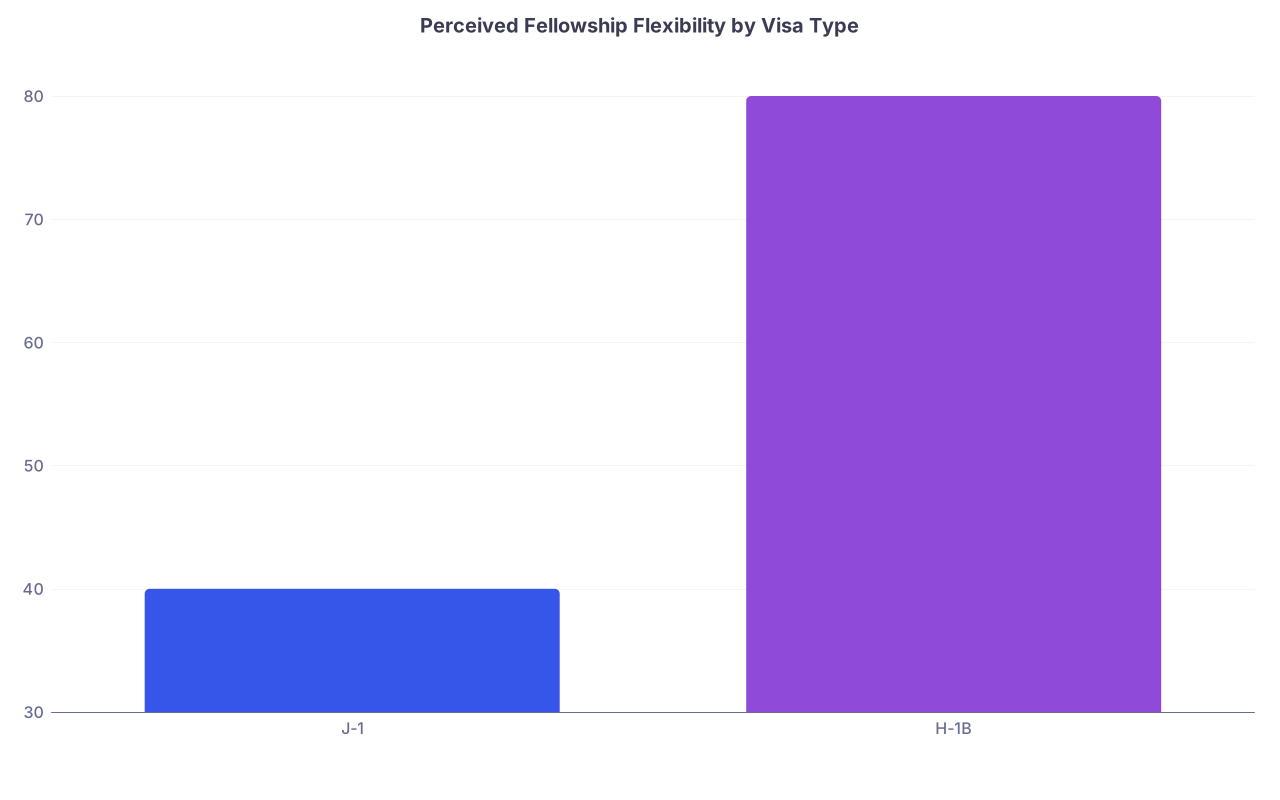
| Category | Value |
|---|---|
| J-1 | 40 |
| H-1B | 80 |
That bar chart is not data from a paper. It’s a picture of how many academic attendings act, on average, when they think about fellowship flexibility and your visa.
Common patterns I’ve seen
J‑1 residents who want hyper-competitive fields (cards, GI, onc, pulm/crit) often get quiet pushback:
“Have you considered hospitalist or general IM first?”
That affects how bold the letters are.H‑1B residents going for those same fields get less resistance. Attendings are more willing to say:
“She is in the top handful of residents I have worked with in 20 years and will excel in any top cardiology program.”J‑1 residents aiming for less visa-resistant fields (nephro, endo, rheum, heme-onc at certain places) do much better. Letters are sometimes even stronger because faculty see them “overcoming barriers.”
What no one tells you on Day 1: by choosing J‑1 vs H‑1B at the start of residency, you’re not just choosing a visa. You’re unconsciously choosing a default setting for how heavily your mentors will be willing to invest emotional and reputational capital in your fellowship story.
How to Still Win: Concrete Moves That Change What Attendings Write
You can’t change the immigration system. You can change the way your attendings frame you inside that system.
Here’s what actually moves the needle behind closed doors.
1. Make your path look inevitable, not fragile
Faculty write their strongest letters when they feel they’re just describing something that’s already obviously happening.
If you’re J‑1 and want cardiology, and by early PGY‑2:
- You’ve done a cards elective
- You’re on a couple of abstracts with the cardiology team
- You’ve presented at least one poster in the field
- You treat every cards rotation like an audition
Then when you ask for a letter, they see momentum.
That’s when you get phrasing like:
- “He has already demonstrated commitment to a career in cardiology through ongoing research with our cardiology division and national presentations.”
…instead of:
- “He has expressed interest in cardiology and will explore research opportunities.”
2. Control the visa narrative in your personal statement and CV
Attendings often skim your personal statement and CV before writing the letter. If all they see is: “IMG, J‑1, wants cards,” they fill in the blanks with their own anxieties.
If instead they see:
- Clear explanation of your long-term plan with J‑1/waiver, or
- Clear statement of your H‑1B status and intention to remain in the US
They’re more comfortable writing future-oriented language.
3. Give them language that acknowledges, but doesn’t obsess over, your visa
You can explicitly offer faculty a one-paragraph “visa context” summary. I’ve watched that dramatically improve letters.
Something like:
“I’m currently on a J‑1 visa sponsored through ECFMG. I’m aware that after fellowship I’ll likely pursue a three-year waiver position, and I’m committed to doing that within [your specialty]. My goal is to ultimately return to an academic center in the US, building on the same strengths I’ve demonstrated here: [list 2–3].”
They can paraphrase that. Or they can at least internalize it.
What they will not do is go research this on their own at 10 p.m. after clinic. If you don’t feed them the story, their letter will be fuzzy.
What Attendings Say When They’re Being Honest
Let me give you a cleaned-up version of comments I’ve personally heard from attendings and PDs in IM, cards, GI, and pulm/crit when talking about IMG fellows and visa:
“If I know up front they’re J‑1 and they’ve clearly accepted the waiver path, I’m more willing to go to bat for them. The worst is the candidate who acts like the rules don’t apply.”
“Some of my best fellows have been J‑1s. I just don’t have the energy to fight with legal every time anymore. So I reserve that energy for the ones who are already clearly exceptional.”
“With H‑1B, I feel more comfortable saying ‘future colleague’ in my letter. With J‑1, I avoid promising that because I don’t know where they’ll have to land for a waiver.”
“If a resident understands the visa landscape better than I do and can tell me, ‘These programs will take me,’ that makes me much more comfortable writing a strong letter. I’m not guessing in the dark.”
Read that again. None of it is in any ACGME policy. But all of it leaks into your letters.
Where This Leaves You Right Now
If you’re early in residency and still have some control over your visa path, now you understand the real tradeoffs—not just what the immigration lawyer says, but how your PD and attendings will unconsciously shape your future through their letters.
If you’re already locked into J‑1 or H‑1B, the game isn’t over. It just has rules:
- As J‑1, you must be hyper-specific, realistic, and proactive so that attendings don’t feel like they’re gambling when they write for you.
- As H‑1B, you should lean into the narrative of long-term US contribution and academic trajectory, because that’s exactly what attendings are more comfortable endorsing.
Your visa is not just a stamp in your passport. It’s a lens that every attending uses when they decide how hard to push for you—and what they’re willing to write with their name under it.
You can’t fully erase that lens. But you can decide whether they see a risky unknown, or a clear, coherent story that they’re proud to endorse.
Get that part right, and the next time you open that 2 a.m. email draft asking for a letter, you won’t be whispering “I’m on a J‑1/H‑1B” like a confession. You’ll be stating it as just one more piece of a trajectory that makes sense.
And once your letters are lined up, then comes the next arena where your visa changes the rules: how fellowship programs rank you—and what happens when NRMP meets immigration law. But that’s a conversation for another night.


