

Program directors don’t look at all residents the same way.
Visa status quietly changes the rules of the game.
Nobody tells you this on Zoom info sessions or glossy program websites. But in PD meetings, hallway conversations, and rank list discussions, your visa type is not a footnote. It’s a filter. It shapes how faculty think about you, what they expect from you, and how much “slack” you get.
Let me walk you through what actually happens behind closed doors.
The First Reality: You’re Not Just a Resident, You’re a Risk Category
In most programs, when your file comes up, three things are on the screen: your name, your scores, and your visa status. That last line changes the entire tone of the conversation.
I’ve heard versions of this more times than I can count:
“She’s strong, but she’ll need H‑1B. Are we ready for that headache?”
“He’s on J‑1. Good worker, but he might be gone in three years anyway.”
No one says this in public. Nobody writes it in emails. But in the conference room, it’s routine.
Here’s the part applicants never understand: once you are in the program, those same unspoken concerns shift into expectations. Faculty do not treat a US citizen resident on the same mental track as a J‑1 or H‑1B resident. They expect different things from you, sometimes better, sometimes worse, often just more.
Let’s break it down by visa type, because the expectations are not the same.
J‑1 Residents: “Reliable Workhorse, Short-Term Asset”
If you’re on a J‑1, faculty see you as valuable but temporary. That colors everything.
They know three things about you:
- You’re leaving in a few years, unless a waiver miracle happens.
- You must maintain good standing or you’re in real trouble.
- Most of your leverage is zero.
That creates a specific expectation profile.
The Unspoken J‑1 Expectations
First, faculty expect you to say yes. To calls. To last-minute coverage. To schedule changes.
Why? Because they know you’re scared to rock the boat. They know a bad evaluation is not just “uncomfortable” for you — it’s immigration risk. I’ve heard attendings say flat out:
“He’s J‑1, he’ll cover. He’s not going to complain.”
Is this fair? No. Does it happen? Constantly.
Second, they expect you to be hyper professional. J‑1s get less margin for error in:
- Attendance
- Paperwork
- Communication tone
- Minor professionalism issues
A citizen resident with occasional lateness might get a “hey, fix this.”
A J‑1 doing the same thing gets: “Is she a liability? Do we really want this risk?”
And behind that word “liability” is your visa.
Performance Standards for J‑1: Higher Floor, Same Ceiling
Nobody will say “we expect J‑1s to perform better.” But watch what happens on Clinical Competency Committee (CCC) day.
Two PGY‑1s. Similar scores. Similar performance. One is J‑1, one is green card.
The US citizen gets: “Still adjusting, but he’ll get there.”
The J‑1 gets: “I expected more by this point. We need to see a bigger jump.”
Why? Because the faculty mindset is: “If we took on the visa headache, you’d better be excellent.” The baseline is higher. They want proof that you’re “worth it.”
They won’t articulate it like that. But I’ve watched the language change in the room. Words like:
- “Consistent”
- “Safe”
- “No red flags at all”
come up a lot more when they’re talking about J‑1s they’re comfortable keeping.
Academic and Research Expectations: The Quiet Push
Programs know that J‑1s often want (and need) strong CVs to chase fellowships or waiver jobs. Some faculty quietly expect you to be “hungrier”:
“He’s on J‑1, he should be pushing for more research.”
“She wants cards on J‑1, I expect posters from her this year.”
If you’re not active academically, some attendings will interpret that as lack of seriousness, not “just tired” or “burned out.” Again, smaller margin for being average.
H‑1B Residents: “High Investment, High Scrutiny”
H‑1B is a different beast. Programs that sponsor H‑1B usually have had internal debates and legal consultations before they even interview you.
By the time you’re hired, the unwritten narrative is:
“We spent extra time and money to get this person here.”
That directly affects expectations.
The H‑1B Premium: Prove You Were Worth It
H‑1B residents are often expected to be “top tier” within the class. If you’re H‑1B and you’re just okay, faculty feel cheated, even if they don’t say it.
On CCC days and attendings’ side conversations, you hear stuff like:
“If we go through H‑1B again, it has to be for someone like her, not another mediocre performer.”
“He’s fine, but honestly not H‑1B-level impressive.”
That’s the bar now. Not “are you a competent resident,” but “are you justifying the extra institutional effort.”
So what does that translate to, practically?
- They expect you to hit the ground fast. Shorter “adjustment” grace period.
- They expect very strong fund-of-knowledge and exam performance.
- They expect you to volunteer for leadership, teaching, or QI roles.
You may not even realize you’re being compared to an invisible “H‑1B worthiness” standard, but it happens.
Procedural and Subspecialty Expectations
Here’s a nuance you won’t hear on forums: For H‑1B residents, procedural faculty (surgery, anesthesia, cards, GI) sometimes see you as a long-term investment only if they think they can retain you.
So you’ll see two patterns:
Programs that think they might hire you after residency:
They push you hard, train you aggressively, throw you into cases. Because they’re training a future colleague.Programs that know they won’t keep you:
They’ll still train you, but the urgency is lower. They still hold you to a higher performance standard (because of the visa cost) but the strategic investment may not be there.
That gap shows up at evaluation time: “We’ll train him, but I wouldn’t hire him on H‑1B.” Those are not the words you want floating around your file if you’re aiming to stay.
Green Card / US Citizen IMGs: “Less Risk, More Forgiveness”
I’ve seen international graduates with green cards be shocked at how differently conversations go when their visa line reads “N/A” or “permanent resident.”
The vibe in the room shifts from “risk management” to “normal resident.” There are fewer administrative worries:
- No DS‑2019 or SEVIS anxiety
- No H‑1B cap fears
- No waiver logistics
So what changes in expectations?
You get more space to struggle early. Faculty can say:
“He’s struggling, but we can work with him.”
“She’s taking longer to adjust, but no visa issues, we’ll support her.”
For the exact same level of performance, a permanent resident might be seen as “salvageable with support” while a visa-dependent resident is seen as “concerning.”
Let me be blunt: stability of immigration status buys you emotional and administrative patience. That doesn’t mean you can be sloppy. It just means your mistakes are framed as “problems to fix,” not “threats to the program.”
How Visa Status Affects Trust, Autonomy, and Responsibility
This is the part nobody explains clearly. Visa status shapes who gets early trust.
Autonomy: Who Gets Cut Loose Faster
Faculty are always asking themselves: “Who can I leave alone on nights or in a busy clinic without worrying?”
For visa-dependent residents, they’re subconsciously thinking two extra thoughts:
- “If this goes badly and there’s an incident, immigration consequences make it messier.”
- “If we put them on corrective action, what happens to their status?”
So early in training, many programs are more cautious with autonomy for J‑1/H‑1B residents. You may:
- Get fewer early “stretch” opportunities
- Be watched more closely on difficult services
- Need more proof over time before they treat you like a “safe pair of hands”
Once you prove yourself, that can flip. When a faculty member tags you as “the reliable J‑1/H‑1B,” they’ll lean on you heavily because they know you cannot disappear overnight and you’re highly motivated not to.
Responsibility: Who Gets the Extra Work Dumped on Them
Different but related point: when faculty need something done—slides made, a QI project submitted, an abstract finished—visa-dependent residents are often their first call.
Why?
- They assume you’re more driven.
- They know you need CV currency.
- They know you’re less likely to say no.
I’ve literally heard: “Give it to the H‑1B guy, he’s hungry.”
You can use that. Or get crushed by it. Depends how strategically you pick your “yes” and your “no.”
How Visa Status Influences Evaluation Language
Let’s talk about the game behind the evaluations. Because visa status lives between the lines.
Attendings don’t write “she’s on J‑1 so I expect more.” That’s obvious. What they do write is:
- “Must maintain consistent performance to continue training safely.”
- “Given her circumstances, we expect continued improvement without regression.”
- “Would be hesitant to recommend for unsupervised practice at this time.”
Those phrases are loaded when you’re on a visa. Program leadership reads them with immigration risk in the back of their minds.
Now compare that with what shows up for citizens/green cards at the same performance level:
- “Shows potential, needs more time.”
- “Developing fund-of-knowledge; improvement seen this block.”
- “With continued support, should become a strong independent practitioner.”
Same reality. Different framing. Visa status shapes which narrative feels “safer” for the program to adopt.
What Faculty Expect From You, Visa by Visa
Let me put this into a compact view, because this is where the expectations quietly diverge.
| Aspect | J‑1 Resident | H‑1B Resident | Green Card / Citizen IMG |
|---|---|---|---|
| Risk perception | Medium administrative | High administrative | Low |
| Early autonomy | Cautious | Cautious-selective | More flexible |
| Performance floor | Higher | Highest | Standard |
| Leniency for errors | Low | Very low | Moderate |
| Extra work requests | Frequent | Frequent | Variable |
Notice the theme. Visa = risk. Risk = tighter expectations and less tolerance for ambiguity.
How This Plays Out During The Match vs During Residency
Another thing you probably don’t see: the “visa talk” in two distinct phases—before you match and after you sign your contract.
Before Match: Cautious Optimism, Legal Questions
In selection meetings, it’s mostly:
- “Can we sponsor this visa?”
- “Have we had problems with J‑1/H‑1B in the past?”
- “Are they strong enough to be ‘worth’ the visa?”
Lot of hand-wringing. Some programs just say no to certain visa types across the board, because they don’t want to think about any of this.
After You Start: Expectation Inflation
Once you’re in, the tone shifts:
- “We invested in you; now show us why.”
- “We can’t have any issues documented on this resident.”
- “He’s on J‑1, so we can’t have any probation talk without serious consequences.”
So they secretly expect you to avoid putting them in positions where they have to formally remediate you. Which is another way of saying: they expect you to self-correct fast, quietly, and decisively.
You’re not just managing your learning. You’re managing their risk appetite.
How To Survive (And Actually Use This To Your Advantage)
You can’t change your visa type with wishful thinking. But you can absolutely control how faculty categorize you inside your visa group.
Your real competition isn’t “all residents.” It’s “other J‑1s,” “other H‑1Bs.” They will mentally rank you inside that subgroup, whether they admit it or not.
Here’s how people I’ve seen succeed actually play it.
1. Become Boringly Reliable Early
The fastest way to reduce the “visa risk” narrative is to be utterly predictable:
- Show up early. Every time.
- Answer pages promptly.
- Close all your charts.
- Don’t miss deadlines. At all.
You want your name to trigger “no drama” in an attending’s mind. A boring J‑1/H‑1B is gold. Because then faculty only have to think about your medical competence, not your administrative footprint.
2. Choose Your “Yes” Carefully
Yes, you’ll get more requests. But you’re not a martyr. You’re building a story.
Say yes to things that create visible value: presentations, QI with your name on it, research where you’re clearly first author, leadership roles that end up in official titles.
Learn to say: “I’d like to, but my current projects won’t allow me to do this well. Could we revisit this next block?” That sentence, said calmly, scares attendings less than you think—especially if your performance is already strong.
3. Over-Communicate With Leadership About Visa Timelines
Program directors hate visa surprises. If they feel blindsided—late Step 3 for H‑1B, DS‑2019 timing issues, waiver confusion—they subconsciously file that under “extra work this resident caused.”
Those residents just lost points.
If you’re the opposite—the one who emails early, clarifies what’s needed, shows up to GME meetings prepared—then your PD starts to think: “This is the kind of visa resident I don’t have to worry about.”
That mental category is your safety net when you have an off rotation.
A Brief Reality Check By Specialty
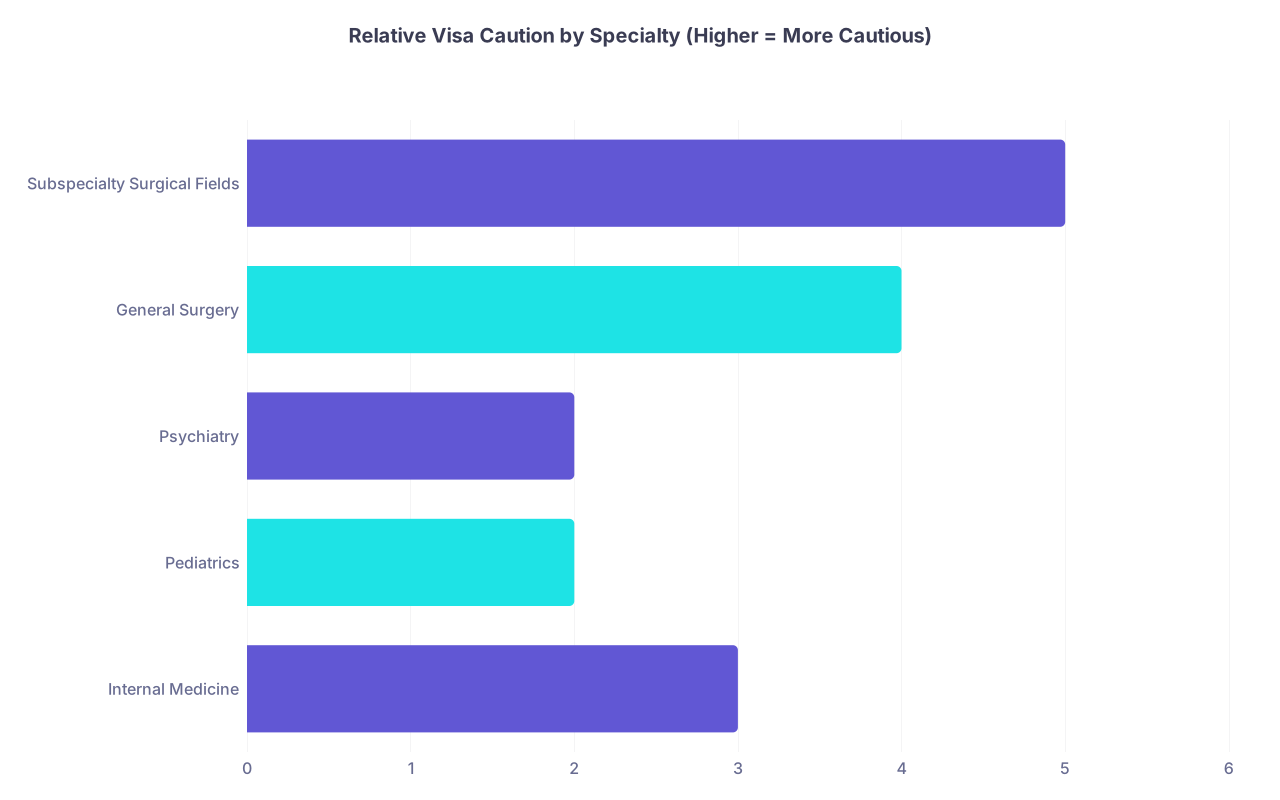
Different specialties handle this differently. Faculty might not say it publicly, but here’s what they actually think.
| Category | Value |
|---|---|
| Internal Medicine | 3 |
| Pediatrics | 2 |
| Psychiatry | 2 |
| General Surgery | 4 |
| Subspecialty Surgical Fields | 5 |
1 = least cautious, 5 = most cautious.
- Internal Medicine, Pediatrics, Psychiatry: more used to visa residents, expectations still higher but less hysterical.
- General Surgery: much more wary, especially about H‑1B. Higher threshold for autonomy, less forgiveness.
- Subspecialty surgical fields (ortho, urology, ENT, neurosurgery): often minimal visa tolerance; expectations are brutal if they do sponsor.
In the surgical world especially, an H‑1B resident who is anything less than “outstanding” becomes the cautionary tale that kills H‑1B for years in that program.
What Faculty Will Never Tell You Directly
Let me lay out three sentences faculty think but rarely say to your face:
- “Because you’re on a visa, if there’s a serious performance problem, it’s simpler for us to just not renew your contract than to drag this out.”
- “We’re harsher in your evaluations because we want unambiguous documentation that you’re either clearly solid or clearly unsafe—no gray zone.”
- “If you self-correct quickly, we will pretend some of your early struggles never happened, because we do not want the immigration headache either.”
They’re not monsters. They’re balancing patient safety, institutional risk, and your career, with immigration law hovering over every decision involving you.
Understand that, and their behavior suddenly stops feeling random.

| Stage | Activity | Score |
|---|---|---|
| Early Residency | J-1 | 3 |
| Early Residency | H-1B | 4 |
| Early Residency | Green card/citizen IMG | 2 |
| Mid-Residency | J-1 | 4 |
| Mid-Residency | H-1B | 4 |
| Mid-Residency | Green card/citizen IMG | 3 |
| Graduation Planning | J-1 | 5 |
| Graduation Planning | H-1B | 5 |
| Graduation Planning | Green card/citizen IMG | 2 |
FAQ: Visa Status and Faculty Expectations
1. Do faculty consciously “grade harder” for visa residents?
Often they won’t admit it, but yes, I’ve seen it. The thinking is: “If this ends up in court or in an immigration query, our documentation has to show we were careful and honest.” That leads to sharper language and less benefit of the doubt if you’re underperforming. The flip side: if you’re doing well, many will over-document how strong you are to protect you.
2. Is it ever a mistake to push for H‑1B instead of J‑1?
Sometimes, yes. If your program only rarely sponsors H‑1B and seems nervous about it, they will expect almost flawless performance from you. If you’re borderline on exams or clinical speed, the H‑1B path can amplify pressure. A J‑1 in a supportive, experienced program can actually be a safer and more predictable experience than a grudging H‑1B in a nervous one.
3. Can a visa issue really affect whether a program puts me on remediation?
It can influence the threshold. Some programs are reluctant to formally remediate visa residents because of the immigration implications, so they either bend over backward to fix things informally—or, if problems are serious, they jump straight to non-renewal rather than a prolonged middle ground. That’s why early, quiet self-correction is critical.
4. Do PDs talk to fellowship directors differently about visa vs non-visa residents?
Yes. The conversation about a visa resident often includes, “He’s on J‑1/H‑1B, but he’s absolutely worth the effort,” or “She’s an easy resident to sponsor, very low-risk.” The fellowship director is not just asking “Is she smart?” They’re asking, “Is she smart enough to justify immigration work?” Your PD knows that and frames you accordingly.
5. What’s the single most protective thing I can do as a visa resident?
Make your PD’s life easy. That means: no surprises, clean evaluations, closed charts, early exam passes (especially Step 3 for H‑1B), and proactive communication about visa deadlines. When leadership sees you as low administrative friction and high clinical value, your visa label stops dominating the conversation, and faculty expectations shift from “don’t let this blow up” to “how can we help this person go far?”
If you remember nothing else:
Your visa status changes how faculty perceive risk, and that changes their expectations.
Your job is to be so reliable and so clear in your performance that your visa becomes a detail, not your defining feature.


