
The biggest mistake J-1 IMGs make is waiting until fellowship or PGY-3 to “start figuring out” the waiver. By then, the best jobs are gone and you are stuck with whatever is left.
You cannot afford that.
If you are on a J-1 or very likely going J-1, your waiver job search is a parallel project to residency – not something you do after. Let me walk you through a concrete, step‑by‑step plan that starts as early as MS4 and ends with a signed, strong waiver contract before you hit panic mode.
Step 1: Get Clear On Your J-1 Reality (Now, Not Later)
Forget the hopeful “maybe I will get an H‑1B” talk you hear on rounds. For most IMGs, especially in competitive urban programs, J‑1 is the default. Plan like you will be J‑1. If you later secure H‑1B, great. But do not bet your life plans on an exception.
What J-1 Actually Means For You
- You must return home for 2 years after training
unless you obtain a J‑1 waiver. - The most realistic path for nearly all J‑1 IMGs =
Clinical waiver job + Conrad 30 or similar program. - That job will:
- Be in a shortage area (HPSA/MUA), or
- Serve a high‑need population (e.g., FQHC, RHC, safety‑net hospital).
- You are committing to 3 years full‑time at that job, usually:
- At least 40 hours/week
- At least 4 days/week
- Mostly direct patient care
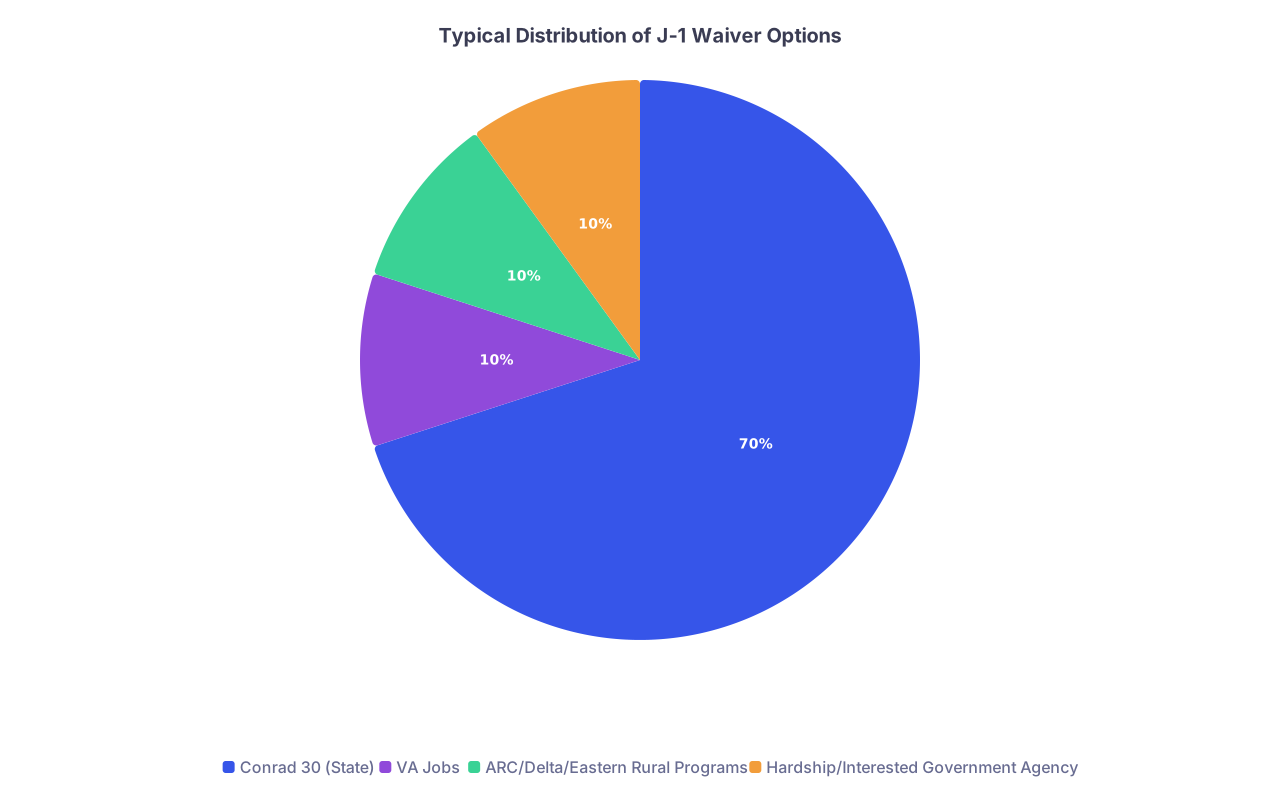
| Category | Value |
|---|---|
| Conrad 30 (State) | 70 |
| VA Jobs | 10 |
| ARC/Delta/Eastern Rural Programs | 10 |
| Hardship/Interested Government Agency | 10 |
If you understand nothing else, understand this: your waiver job options are controlled by:
- Your specialty
- Your state targets
- Your readiness to move fast when positions open
Step 2: Map Out Your Timeline From Day 1
You need a working timeline in your head early – ideally in PGY‑1. Not a vague “I’ll deal with it later.”
Here is what a solid J‑1 waiver prep timeline looks like for a categorical resident (3-year program like IM, Peds, FM):
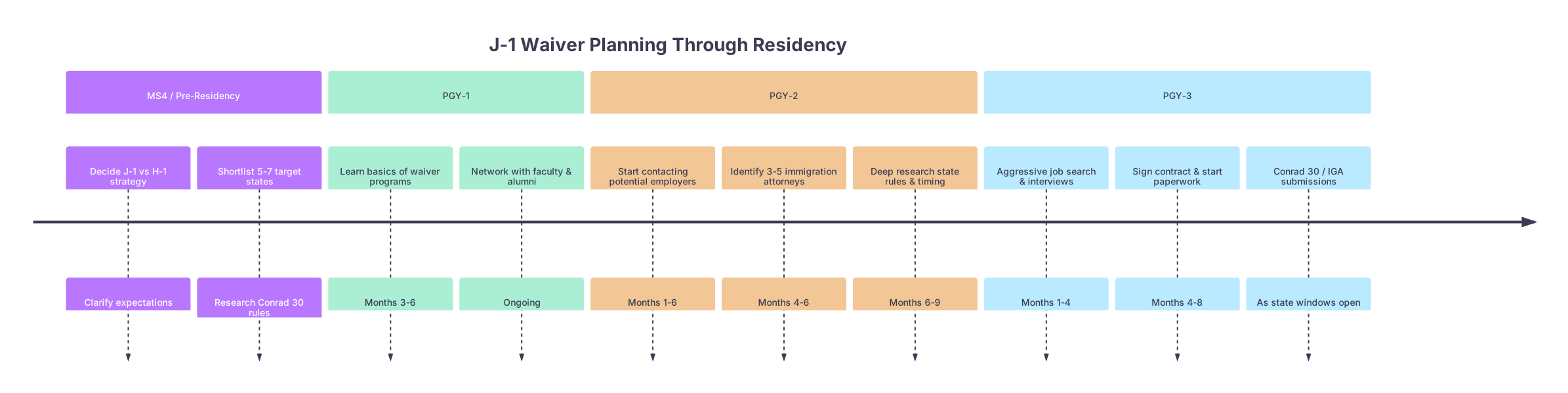
| Period | Event |
|---|---|
| MS4 / Pre-Residency - Decide J-1 vs H-1 strategy | Clarify expectations |
| MS4 / Pre-Residency - Shortlist 5-7 target states | Research Conrad 30 rules |
| PGY-1 - Learn basics of waiver programs | Months 3-6 |
| PGY-1 - Network with faculty & alumni | Ongoing |
| PGY-2 - Start contacting potential employers | Months 1-6 |
| PGY-2 - Identify 3-5 immigration attorneys | Months 4-6 |
| PGY-2 - Deep research state rules & timing | Months 6-9 |
| PGY-3 - Aggressive job search & interviews | Months 1-4 |
| PGY-3 - Sign contract & start paperwork | Months 4-8 |
| PGY-3 - Conrad 30 / IGA submissions | As state windows open |
If you are in a longer program (e.g., 5‑year surgery, or you plan a fellowship), shift everything 1–2 years earlier. You want your first serious waiver job conversation 18–24 months before graduation.
Step 3: Choose Your Target States Strategically
Stop saying “anywhere is fine” unless you actually mean it. Some states will quietly kill your chances; others are basically built for you.
You should shortlist 5–7 states by early PGY‑2. Here is how to judge them:
3.1 Key Factors To Compare
- Specialty friendliness
- Some states are IM/FM-heavy, some open to subspecialties, some rigid.
- Conrad 30 usage
- Are they filling all 30 slots? Or leaving some empty every year?
- Flexibility
- Do they allow FLEX slots (employer not in a HPSA but serving underserved)?
- Do they accept specialists or only primary care?
- Timeline
- Rolling vs fixed start date?
- First‑come‑first‑served vs competitive scoring?
- Location realities
- Will you and your family actually live there for 3+ years without going crazy?
| State | Fills All 30 Slots? | FLEX Slots? | Specialist-Friendly? | Typical Start of Window |
|---|---|---|---|---|
| Texas | Yes | Yes | Yes | Sept–Oct |
| North Dakota | No (often 10–20) | Limited | Yes | Rolling |
| New York | Yes | Yes | Very | Early Nov |
| Kansas | Often < 30 | Yes | Yes | Rolling / early Fall |
| Mississippi | Sometimes < 30 | Limited | Mostly Primary Care | Rolling |
Action step for this week:
Look up “[STATE NAME] Conrad 30 J‑1 waiver program” for 3 states you might actually live in. Open and bookmark their official PDFs with:
- Eligibility criteria
- Application window
- Requirements for employer and physician
That is your starting map.
Step 4: Fix Your Profile For Waiver Employers (While You Train)
J‑1 waiver jobs are not academic dreams. They are service jobs for real patients in high‑need communities. Employers want:
- Reliability
- Productivity
- Basic competence
- Someone who will not quit mid‑contract and cause them problems
So while you are in residency, quietly build a profile that employers like.
4.1 What Actually Matters To Waiver Employers
- Program reputation and training
- Solid, ACGME‑accredited residency.
- For primary care jobs: strong clinic experience, continuity clinic logs.
- Letters from attendings who can say:
- You show up.
- You handle volume.
- You cooperate with staff.
- No big disciplinary issues
- No repeated professionalism warnings.
- No pattern of major complaints from nurses/patients.
- Clear commitment to underserved work
- Volunteer clinics
- Community health projects
- Quality improvement in safety‑net settings
You do not need to win a Nobel prize. You need to look like someone they can plug into a busy clinic or hospital tomorrow without disaster.
Step 5: Start Quiet Market Research (PGY-1 to Early PGY-2)
Do this before you “need a job.” That is when you are still relaxed and can learn the landscape without pressure.
5.1 Build a Running “Waiver Intel” File
Create a simple document or spreadsheet with:
- Target states
- Main health systems and large groups in each
- FQHCs, rural hospitals, community clinics
- Notes on:
- Prior J‑1 hires
- Visa policies
- Geographical areas
Start collecting:
- Job descriptions that mention:
- “J‑1 waiver candidates welcome”
- “Conrad 30”
- “Visa candidates accepted”
- Names of recruiters and practice managers
- Any alumni from your program working in underserved or rural roles

5.2 Ask The Right Questions (Quietly)
When a visiting attending, locum physician, or alum talks about their rural/FQHC job, ask:
- “Do you see J‑1s or other visa people at your site?”
- “Does your group sponsor Conrad 30 often?”
- “Who handles recruitment for your clinic/hospital?”
Write down names. You are building a referral network without saying, “I am desperate for a visa.”
Step 6: Line Up The Right Immigration Help Early
You do not need to pay a lawyer in PGY‑1. But you should identify 2–3 solid immigration attorneys who:
- Have actual J‑1 waiver experience (not just family green cards)
- Have handled your specialty and your target states
- Are willing to do a brief consult about:
- Your overall plan
- Typical problems in your scenario
By late PGY‑2, ideally you have:
- Confirmed you are indeed J‑1 subject (some people are wrong about this)
- Understood the basic sequence:
- Job offer → Contract → State waiver filing → DOS → USCIS → H‑1B
- Clarified any red flags:
- Prior out‑of‑status history
- Multiple J‑1s
- Home country funding
Step 7: Launch a Serious Waiver Job Search (PGY-2 to Early PGY-3)
This is where most IMGs fail. They either start too late (after December of PGY‑3) or too passive (“I will just apply online and wait”).
You must treat this as a targeted campaign.
7.1 Build a Sharp, J‑1‑Ready CV
Your CV needs to make you easy to understand at a glance.
Sections:
- Name and contact
- Education (med school, residency/fellowship)
- Visa status: one line, clear
“Current visa: J‑1 (ECFMG sponsored), subject to 2‑year HRR; seeking J‑1 waiver/H‑1B sponsorship starting [month/year].” - USMLE scores (optional but often expected)
- Clinical experience
- Research (short)
- Languages
- Community/underserved work
7.2 Your Initial Email Template (Use This)
You do not send a novel. You send something clear and direct:
Subject: Internal Medicine J‑1 Waiver Candidate – Available July 2027
Dear [Name],
I am a PGY‑2 Internal Medicine resident at [Program, State], graduating in June 2027 and currently on an ECFMG‑sponsored J‑1 visa. I am seeking a J‑1 waiver position starting July 2027 in [state/region], ideally in a community or underserved setting.
I am particularly interested in [outpatient IM / hospitalist role / mix], and I am open to locations in [rural/urban/range of cities]. I would like to ask whether your organization hires J‑1 physicians through Conrad 30 or other waiver programs.
I have attached my CV for your review. I would be happy to schedule a brief call to discuss potential opportunities and your timeline for visa‑sponsoring hires.
Sincerely,
[Name, PGY level]
[Program]
[Phone]
[Email]
You send this to:
- Hospital recruiters
- FQHC HR contacts
- Clinic practice managers
- Any alum who might forward internally
Expect: some rejections, some silence, but a few promising leads. That is enough.
Step 8: Understand the Employer’s “Visa Pain” and Fix It For Them
Most community hospitals and clinics are nervous about J‑1s because they do not understand the process. Your job is to:
- Reassure them that this is doable and common
- Bring structure and occasionally an attorney to guide them

8.1 What Employers Need To Hear From You
You should be able to say, with confidence:
- “Yes, this is a Conrad 30‑type waiver.”
- “Your main role is to sign a contract, support the application, and provide some documents.”
- “The lawyer can handle the paperwork. Your costs are mostly legal fees and filing fees.”
- “Other hospitals in this state do this every year.”
If you sound vague and confused, they assume it is risky and will drop you.
Step 9: Time Your Contract and Waiver Filing Correctly
This is where people get burned. Every state has its own:
- Application opening date
- Required documents
- Rules for when the contract must start
You must match:
- Your graduation date
- Employment start date (often July–September)
- Conrad 30/IGA program window
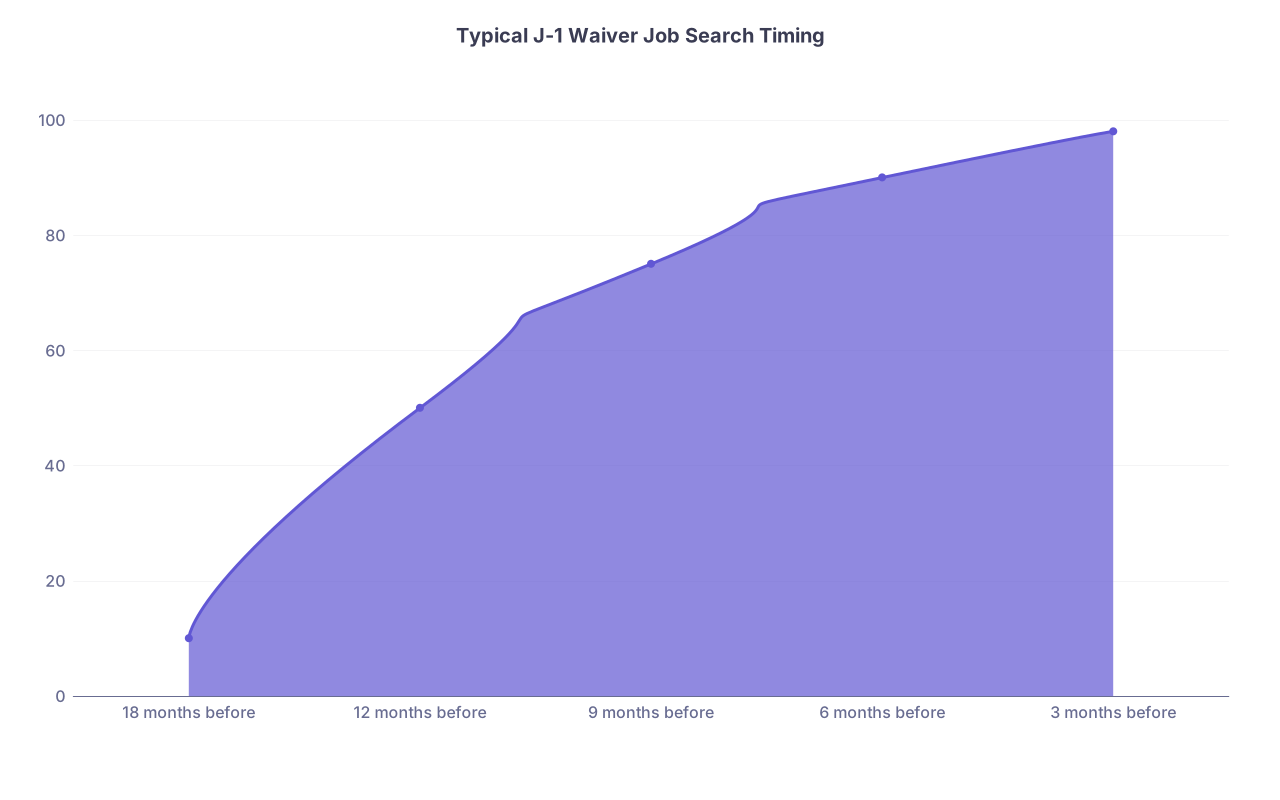
| Category | Value |
|---|---|
| 18 months before | 10 |
| 12 months before | 50 |
| 9 months before | 75 |
| 6 months before | 90 |
| 3 months before | 98 |
(Values represent percent of strong waiver candidates who already have at least one serious lead or signed offer.)
9.1 Example: State With Oct 1 Opening (Competitive)
Say you graduate June 2027 and your top state opens Conrad 30 applications Oct 1, 2026.
Your timeline should look like this:
- Jan–Apr 2026 (PGY‑2)
Interview with employers in that state. - By June–July 2026
Have a signed contract with a waiver‑eligible employer. - July–Aug 2026
Employer and lawyer prepare waiver application package. - Oct 1, 2026
Application sent on day 1 of the state window.
If you are signing contracts in January of your PGY‑3 while others filed in October, you are behind – especially in competitive states like NY, TX, FL, CA.
Step 10: Evaluate Waiver Contract Quality (Before You Lock Yourself In)
Desperation leads many J‑1s to sign awful contracts: oppressive non‑competes, low pay, abusive call expectations. You have leverage if you start early.
10.1 Contract Red Flags
Be very cautious if you see:
- Insane non‑compete
“No practice within 50–100 miles for 2 years after leaving.” - Unclear call responsibilities
No cap on number of nights/weekends. - Automatic pay cuts or RVU traps
Very low base salary with unrealistically high RVU thresholds. - One‑sided termination clause
Employer can terminate “without cause” on short notice; you cannot.
- Visa‑related clauses (who pays for what, what happens if waiver denied)
- Termination terms
- Non‑compete scope
Sometimes you accept a less‑than‑perfect contract to secure the waiver, but walk in with open eyes.
Step 11: Use Other Waiver Paths As Backup (But Not As Fantasy)
The core plan should be: strong Conrad 30 waiver job, early search, clean execution.
But you should be aware of backup routes:
- VA J‑1 waivers
- For jobs at Veterans Affairs facilities
- No Conrad 30 cap
- Interested Government Agency (IGA) waivers
- HHS for primary care/mental health in specific sites
- ARC, Delta Regional Authority for certain rural regions
- Hardship/persecution waivers
- Based on US citizen or LPR spouse/child hardship, or your own risk in home country
- Very fact‑specific, often long and stressful
These can be lifesavers, but they are not substitutes for proactive planning. Treat them as Plan B/C, not Plan A.

Step 12: Common Failure Patterns (And How To Avoid Them)
I have seen the same three disasters repeat every year:
12.1 The “Late Realization” Resident
- Starts job search in January–March of PGY‑3
- Wants big city, academic, no call, top pay, H‑1B only
- Outcome: scrambles into last‑minute job in an unwanted location with terrible terms, or ends up leaving the US
Fix: Start serious outreach in PGY‑2. Accept that compromise is part of the deal.
12.2 The “Non‑Realistic Geographic” Candidate
- “I will only work in NYC, LA, Chicago, or Houston.”
- Refuses rural or even small‑city options.
- Forgets those cities are flooded with applicants who do not need waivers.
Fix: Pick 3 “dream” states and 3 “likely” rural‑friendly states. Apply to both. Do not let pride close every door.
12.3 The “I’ll Just Wait For H‑1B” Gambler
- Does not prepare waiver plan
- Declines good waiver offers, chasing a rare urban H‑1B job
- Then loses both
Fix: Build waiver plan as if H‑1B is impossible. If a real, written H‑1B offer appears later, then you can reassess.
Step 13: Concrete Month-By-Month Action Plan
Here is a stripped‑down, action‑only plan you can overlay on your training.

| Step | Description |
|---|---|
| Step 1 | Start Residency |
| Step 2 | Month 1-6: Understand J-1 rules |
| Step 3 | Month 6-12: Shortlist 5-7 states |
| Step 4 | PGY-2 Early: Build target employer list |
| Step 5 | PGY-2 Mid: Contact recruiters & employers |
| Step 6 | PGY-2 Late: Identify immigration attorney |
| Step 7 | PGY-3 Early: Interview & secure contract |
| Step 8 | PGY-3 Mid: File Conrad 30 / IGA applications |
| Step 9 | PGY-3 Late: Transition to H-1B waiver job |
If You Are:
- MS4 / Pre‑residency
- Understand J‑1 vs H‑1B at your likely programs.
- Ask matched seniors where they went for waivers.
- PGY‑1
- Learn basics of J‑1 waiver options.
- Shortlist states and start mild intel gathering.
- PGY‑2
- Build CV, start real outreach.
- Narrow to 3–5 strong employers.
- Do a legal consult.
- PGY‑3
- Push to sign contract early in the year.
- Prepare and file state waiver applications as early as allowed.
FAQs
1. Can I sign a waiver job contract in one state and then later switch to another state’s Conrad 30 if a better job appears?
You can sometimes switch before filing a Conrad 30 application, but after submission it gets messy. States and employers do not like being “backup options.” Also, your DS‑3035 (the DOS waiver application) will be tied to one sponsor and one job. If you plan to use a state’s Conrad 30 slot, do it with a job and employer you are truly prepared to commit to. Treat contract‑hopping as a last resort; it can backfire and leave you with no slot at all.
2. Is it possible to get an academic / university job as my J‑1 waiver position?
Sometimes, yes – but only if:
- The university hospital sits in or serves a designated shortage area
- The state allows FLEX slots and uses them for academic centers
- The department is willing to go through the process
For most IMGs, pure academic “research‑heavy” roles are poor waiver candidates. If you want academia, a common path is: 3‑year waiver job in community/rural/FQHC → transition to academic job on H‑1B or green card. That route is much more reliable.
3. What if I genuinely start late and I am already in the second half of PGY‑3 with no waiver job?
You still have options, but you need urgency and flexibility. Steps:
- Immediately expand your geographic tolerance to any state that did not fill its 30 slots last year (Midwest, Great Plains, some Southern states).
- Contact multiple attorneys who actively do last‑minute Conrad placements. They often know which hospitals are still searching.
- Apply aggressively to VA jobs and FQHCs that accept J‑1s.
- If married to a US citizen or LPR, or if you have serious country‑specific risks, have a hard conversation with a lawyer about hardship/persecution waivers as Plan B.
Your life gets much harder once your training ends and your J‑1 grace period starts, so treat this like a full‑time project until you secure something.
Open your calendar right now and mark a 60‑minute block this week labeled: “J‑1 Waiver Strategy Session.” In that hour, shortlist 5–7 states, bookmark their Conrad 30 pages, and draft one outreach email template. That small step changes you from “hoping it works out” to actually running a plan.