

The biggest mistake IMGs make about H‑1B visas is acting like they are the only ticket into their dream residency. They are not. And if you insist on “H‑1B or nothing,” you will quietly lock yourself out of excellent programs for no good reason.
You want strategy, not superstition. So let us fix this.
This is about what to do when your dream program “does not sponsor H‑1B.” How to work around it. How to use their constraints to build your long‑term plan instead of walking away.
I am going to assume you already know the basics of J‑1 vs H‑1B vs green card. You do not need more theory. You need a playbook.
1. Reality check: why some programs refuse H‑1B (and how that helps you)
Before you start hacking workarounds, you need to understand the real game.
Programs say “we do not sponsor H‑1B” for a few common reasons. I have heard all of these, usually mumbled in hallways after interviews:
- “HR will not touch H‑1B, too complicated.”
- “We had a disaster with an H‑1B transfer and legal fees.”
- “We are purely J‑1. GME office policy.”
- “We need Step 3 before residency start and most IMGs do not have it in time.”
Translated: It is not about you. It is about:
- paperwork risk
- timing risk
- institutional inertia
That means you can often still:
- Match there on a J‑1
- Come back for fellowship on H‑1B
- Use other non‑cap H‑1B routes later (VA, universities, some nonprofits)
- Position yourself for waiver jobs that unlock green cards
Your job is not to bully a program into an H‑1B. Your job is to:
- Identify what they do reliably support now.
- Tie that to a visa strategy that still gets you where you want in 5–10 years.
So if your dream program is “J‑1 only,” your question changes from:
“How do I force them to give me H‑1B?”
to
“How do I exploit J‑1 there and still end up with a green card and my ideal job?”
That is a solvable problem.
2. Understand your real constraints (not the imaginary ones)
Too many IMGs build plans around myths. You need a clean snapshot of your actual constraints.
Step 1: Map your personal profile
Grab a sheet and be brutally honest:
- Step 1: __ / Step 2 CK: __ / Step 3: done or not?
- Visa history:
- Never been in the U.S.
- Previously on F‑1 (US medical school, MPH, etc.)
- Previously on J‑1 (research scholar, observer)
- Any prior J‑1 subject to 212(e)? (home residence requirement)
- Country of citizenship:
- India/China (green card backlog matters)
- Other
- Long‑term goal:
- Academic career?
- Private practice in big city?
- Community medicine / rural?
- Specific geographic regions (NYC, Cali, Texas, Midwest etc.)
Now note your non‑negotiables vs preferences:
Non‑negotiable example:
- Must eventually get green card.
- Cannot return to home country for 2 years.
Preference example:
- Prefer New York area.
- Prefer not to do rural medicine forever.
Circle the non‑negotiables. Those drive your visa strategy.
Step 2: Understand how visa type hits your goals
Here is the core trade‑off, simplified:
| Factor | J-1 (ECFMG) | H-1B (Residency) |
|---|---|---|
| Availability in programs | Very common | Limited, program-dependent |
| Step 3 required before start | No | Yes (almost always) |
| 2-year home rule (212e) | Yes, usually | No |
| Need waiver job after | Yes, typically 3 years | No (can move directly to new H-1B) |
| Green card path timing | After waiver job begins | Earlier, if employer sponsors |
If you absolutely cannot accept the J‑1 2‑year rule and you refuse any waiver job, then certain “dream programs” that are J‑1 only are simply off the table. And that is fine. That is not a workaround problem; that is a values conflict.
But most IMGs, when they really sit with it, realize this:
- They do not mind 3 years in a good waiver job if current training is top‑tier.
- They just fear being trapped or misinformed.
Once you separate fear from reality, more strategic paths appear.
3. Use J‑1 at your dream program without wrecking your future
If your dream program does not do H‑1B but is solid with J‑1 sponsorship, you have a powerful, underused route: Accept J‑1 now, design your waiver and green card plan early.
Step 1: Confirm J‑1 support is real and stable
You need clear facts from the program’s GME office:
Ask (politely, directly):
- “Do you routinely sponsor ECFMG J‑1 visas for categorical residents?”
- “Have there been any recent changes in institutional policy regarding J‑1?”
- “Do you have a dedicated person handling ECFMG paperwork?”
- “Do any of your current senior residents or fellows hold J‑1?”
If the answers are confident and there are current J‑1 residents walking around, you are on solid ground.
Step 2: Accept J‑1 with eyes open, not blind
Here is what you must understand before signing:
- You will almost certainly be subject to the 212(e) 2‑year home requirement.
- In practice, most physicians avoid going home and instead use a J‑1 waiver job:
- Conrad‑30 (state health department sponsorship)
- VA facilities
- HHS waivers for some primary care
Your plan becomes:
- J‑1 residency at Dream Program.
- Possibly J‑1 fellowship.
- Waiver job on H‑1B for 3 years.
- Employer files green card during that job.
- You move wherever you want after waiver + green card steps align.
This is not theoretical. It is the standard IMG pipeline in many specialties.
Step 3: Start designing your waiver profile during residency
You avoid being trapped by planning your “post‑J‑1 life” early.
During PGY‑1 and PGY‑2, focus on:
Marketable profile for waiver jobs:
- Strong letters.
- Some leadership or QI work.
- Evidence you can function independently in underserved settings.
Networking with past J‑1s from your program:
- Ask where they did their waivers.
- Which states were friendly.
- Which hospital systems sponsor green cards aggressively.
You will hear things like:
- “Texas was fast, but heavy volume.”
- “North Dakota gave quick interviews if you had solid letters.”
- “Our alumni are clustered in XYZ health system; they love taking our grads.”
Write these down. That is your real strategy map.
Step 4: Narrow your future waiver targets
By mid‑PGY‑2, you should have:
5–8 target states that:
- Consistently use Conrad‑30 slots.
- Are friendly to your specialty.
- Are okay locations for 3 years of your life.
A short list of employer types:
- FQHCs
- Community hospitals
- Regional health systems aggressively recruiting IMGs.
This is how you turn a “J‑1 only” dream residency into a fully controlled multi‑step career plan instead of a black hole.
4. When to play the “H‑1B later” card strategically
Sometimes the program that will not give you H‑1B for residency is absolutely fine giving H‑1B for fellowship. That difference matters.
Here is how the timeline often plays out:
- Residency: J‑1 (because GME office has a cookie‑cutter ECFMG workflow).
- Fellowship (same institution or another academic center): H‑1B.
- Post‑fellowship job: H‑1B transfer + green card process.
This is common in competitive subspecialties:
- GI, Cards, Heme/Onc, Pulm/CC, etc.
You use the J‑1 years to:
- Gain U.S. training credibility.
- Crush boards.
- Build a CV that gets you into top fellowships that do run H‑1Bs.
Concrete example
You match Internal Medicine at “Dream Program A” on J‑1. They do not do H‑1B for residency.
But:
- Their GI and Cardiology fellowships are top‑tier.
- Their fellows are often on H‑1B.
- They have a strong hospital legal team for faculty visas.
Your path:
- Do IM residency there on J‑1.
- Target their own subspecialty fellowships (or others that support H‑1B).
- Switch to H‑1B at fellowship.
- After fellowship, you are no longer tied to 212(e) if you had a prior J‑1 that was research only and not subject, or you handle waiver along the way. In most standard ECFMG J‑1 clinical cases, you still need a waiver, but your H‑1B can be used for the waiver job and then rolled into a green card.
The point: sometimes the H‑1B “no” is temporary and scope‑limited. You exploit that by planning your next institutional move early.
5. Non‑cap H‑1B: the underused secret weapon
You are obsessing over residency H‑1Bs and forgetting there are non‑cap H‑1B jobs that bypass the giant lottery headache entirely.
Non‑cap H‑1Bs are typically at:
- Universities / higher‑ed institutions
- Nonprofit hospitals affiliated with universities
- Some research institutes
- Certain nonprofits with specific IRS designations
If your long‑term goal is academic or hospital‑based work, you can:
- Accept J‑1 for residency at your dream program.
- Possibly do fellowship, even on J‑1.
- Take an academic or affiliated hospital job that qualifies as cap‑exempt H‑1B.
- Let them file a green card (often EB‑2).
No H‑1B lottery. No panic.
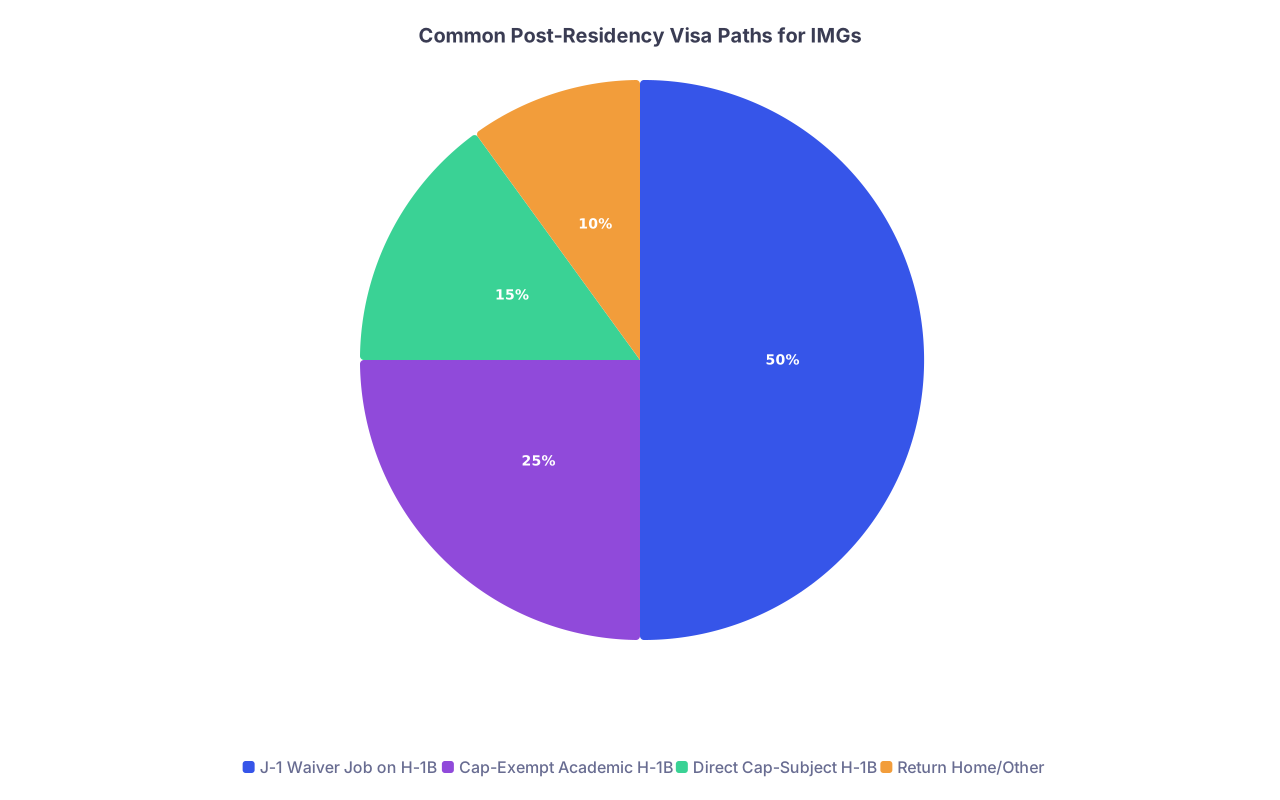
| Category | Value |
|---|---|
| J-1 Waiver Job on H-1B | 50 |
| Cap-Exempt Academic H-1B | 25 |
| Direct Cap-Subject H-1B | 15 |
| Return Home/Other | 10 |
This is why you must stop treating “no H‑1B for residency” as the end of the story. For many IMGs who want academic careers, it barely matters whether residency was J‑1 or H‑1B. The real key is where you land after.
6. Tactical communication: what to say (and not say) to programs
You will be talking to program coordinators and PDs. This is where people sabotage themselves with clumsy visa questions.
Wrong approach
- “I will only accept H‑1B; can you sponsor it for me?”
- “Will you make an exception for me this year?”
- “I do not want J‑1. Can you talk to GME and change policy?”
You sound like a problem. Not like someone they want to fight HR for.
Better approach
Your goal is to:
- Clarify policy.
- Signal you understand the system.
- Show you will not create surprises.
During interview or over email, ask:
- “I saw on your website that you sponsor J‑1 visas. Do you currently sponsor H‑1B for any residents or fellows, or is the institution J‑1 only?”
- “If I pass Step 3 before the rank list deadline, would that change the visa options at all, or do you follow a strict J‑1 policy for residency?”
- “Do any of your fellowship programs at the same institution use H‑1B regularly for subspecialty training?”
You are not demanding. You are gathering intel.
If they say “J‑1 only,” you reply along the lines of:
- “Thank you for clarifying. I am comfortable with J‑1 and planning long‑term around a waiver and eventual green card, so your policy aligns with my expectations.”
They hear:
Low risk. Knows the system. No surprise meltdown at contract signing.
That increases your chances of being ranked, even if the visa is “less ideal” on paper.
7. Deciding when to walk away from a “no H‑1B” dream
Let me be blunt. Sometimes the workaround is: Do not go there.
You walk away if:
- You already have a prior J‑1 subject to 212(e) that cannot be waived easily, and adding another clinical J‑1 will complicate your situation beyond reason.
- You are absolutely unwilling to do a waiver job or return home. Not “nervous.” Actually unwilling.
- The program’s J‑1 handling looks sloppy:
- Coordinator “not sure” about ECFMG processes.
- Recent chaos with residents’ visas.
- No current J‑1s despite saying they sponsor.
In those cases, your strategy may be:
- Focus only on programs with clean H‑1B records.
- Delay application cycle, pass Step 3, then re‑apply into a more H‑1B‑friendly map.
- Consider a research year on J‑1 or F‑1/OPT at a strong academic center that routinely transitions researchers to residents on H‑1B.
Want an at‑a‑glance sanity check? Use this:
| Situation | Likely Best Play |
|---|---|
| No Step 3, strong dream J-1 program | Take J-1, plan waiver early |
| Step 3 done, multiple H-1B options | Prioritize stable H-1B programs |
| Prior J-1 with 212(e) already active | Avoid stacking J-1s if possible |
| Academic career goal, open to waiver | J-1 fine, aim for cap-exempt job |
If you are in the “Step 3 done + multiple H‑1B programs + no emotional attachment” group, it is perfectly rational to skip a J‑1‑only dream program in favor of a H‑1B‑friendly solid one.
But most IMGs are not actually in that ideal scenario.
8. Advanced angle: Using F‑1 / research tracks as a bridge
Some IMGs try to force H‑1B at residency when a smarter, more resilient path exists: enter the system on F‑1 or J‑1 research, then adjust later.
This is not for everyone. But it is powerful if:
- You are willing to do 1–2 years of research.
- You want a strong academic CV.
- You are applying to very competitive specialties or programs.
Sample pathway
- Research position at a U.S. university on J‑1 or F‑1 (if degree‑granting like MPH).
- Crush research:
- Publications.
- Strong U.S. letters from known PIs.
- When you are deeply embedded and valued, that department may:
- Push GME and legal to open H‑1B options for you as a resident.
- Or sponsor you for H‑1B as a research employee, then help you transition into residency under the same institution’s cap‑exempt status.
This is not guaranteed. It depends heavily on:
- How badly the department wants you.
- How flexible the institution is.
But the point is: if a program will not give you H‑1B as a random outside applicant, they might feel very differently about a known quantity who has already worked there for two years.
I have seen this happen at big‑name institutions that are “J‑1 only” on paper.
9. Practical steps: what to do this month
Let us turn this into a concrete action list.
1. Build a visa‑aware program list
Divide your target programs into:
- Group A: H‑1B‑friendly
- Documented history of H‑1B for residents.
- Clear website information or direct confirmation.
- Group B: J‑1‑only but top‑tier / dream
- You would go there even on J‑1 if strategy works.
- Group C: Vague or chaotic visa info
- Only consider if desperate or as backup.
You are not deleting J‑1‑only programs. You are classifying them.
2. Book a paid consult with an immigration attorney who does physician work
Not generic “immigration law.” You want someone who does:
- J‑1 waivers
- Physician H‑1Bs
- EB‑2 physician NIWs
Bring:
- Your CV
- Exam scores and dates
- Prior visa history
- Shortlist of your dream programs
Your key questions:
- “If I do residency at X on J‑1, what are my realistic waiver and green card paths?”
- “Any red flags with my history for stacking J‑1s?”
- “Should I be prioritizing H‑1B now, or is a J‑1 + waiver route just as strong in my case?”
One focused hour here can save you years of stress.
3. Decide your “floor” and “ceiling” on J‑1 usage
You need a firm internal rule like:
- “I am okay with J‑1 for residency and fellowship, but I must have a clean waiver and green card plan laid out before PGY‑2 ends.”
Or
- “I will use J‑1 for residency only. Fellowship must be on H‑1B or I pivot.”
Write down your rule. Otherwise, you will drift and panic later.
4. Start conversations with current J‑1 residents
Not on Reddit. Inside actual programs.
Ask them:
- “How smooth was your ECFMG process with this institution?”
- “Any classmates hit major issues with travel, renewals, or 212(e) interpretation?”
- “Where are recent graduates going for waiver jobs?”
- “Do you feel supported, or are you constantly fighting GME?”
If three J‑1 residents in a row at your dream program say “GME is solid, paperwork is smooth, alumni get good waiver jobs,” the J‑1 there is an asset, not a trap.
10. The bottom line: shift from “visa type” to “career architecture”
If you remember nothing else from this, remember this shift:
Stop asking:
“Can I get H‑1B at this program?”
Start asking:
“If I train at this program on any visa they offer, what does my 10‑year path look like?”
Sometimes that 10‑year path is:
- H‑1B at residency.
- H‑1B transfer for job.
- Straight to green card.
Sometimes it is:
- J‑1 residency.
- J‑1 fellowship.
- 3‑year waiver job on H‑1B.
- Green card, then full freedom.
Sometimes it is:
- J‑1 residency at big‑name center.
- Cap‑exempt H‑1B academic job.
- EB‑2 or EB‑1 green card from university.
All three can end with you:
- Board‑certified.
- Permanent resident.
- Working in a place and specialty you actually want.
“H‑1B at my dream program” is nice. But it is not the only way to win.
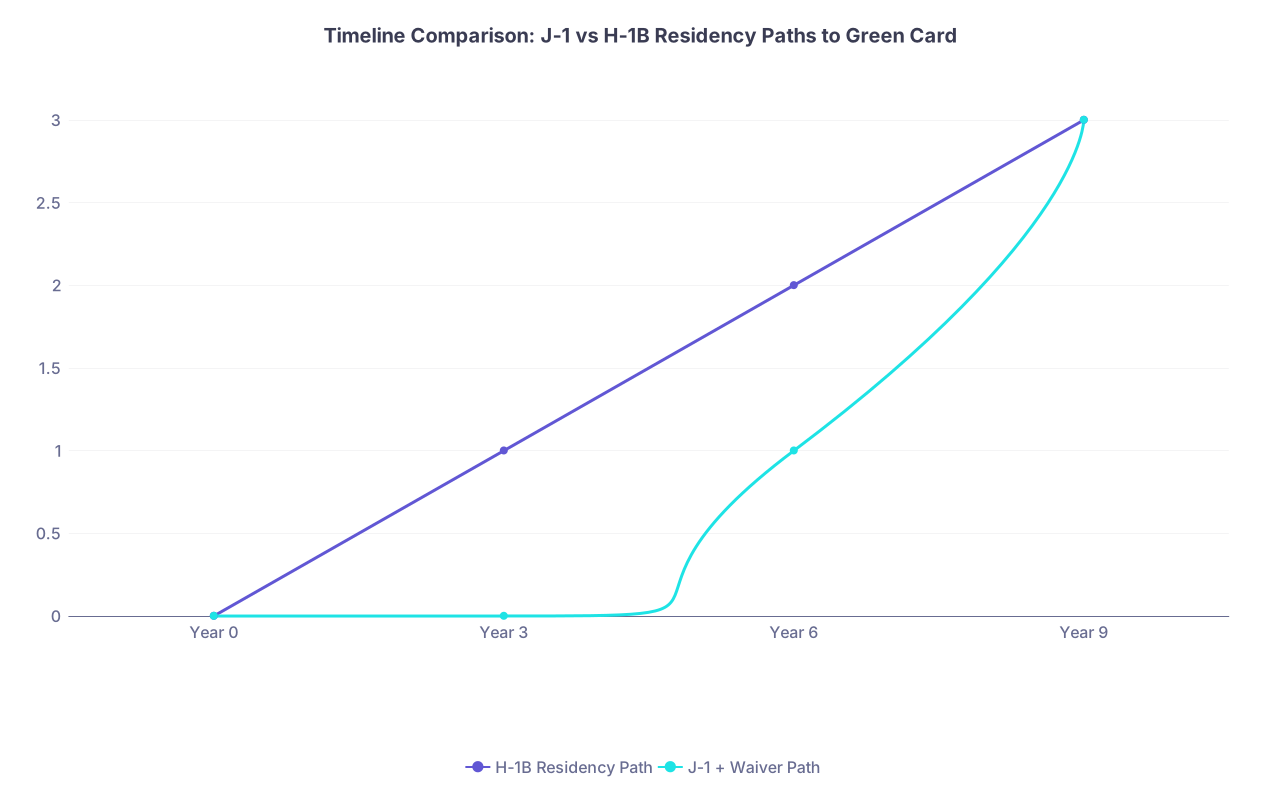
| Category | H-1B Residency Path | J-1 + Waiver Path |
|---|---|---|
| Year 0 | 0 | 0 |
| Year 3 | 1 | 0 |
| Year 6 | 2 | 1 |
| Year 9 | 3 | 3 |
The J‑1 path often simply shifts your green card a few years later. It does not kill it—if you plan properly.

| Step | Description |
|---|---|
| Step 1 | Dream Program No H-1B |
| Step 2 | Deprioritize Program |
| Step 3 | Prioritize H-1B Programs Only |
| Step 4 | Map J-1 Waiver & GC Plan |
| Step 5 | Network with J-1 Alumni |
| Step 6 | Target Waiver States/Employers |
| Step 7 | Execute J-1 → Waiver → GC Path |
| Step 8 | J-1 Offered? |
| Step 9 | Comfortable with Waiver Job? |
Now, do something concrete:
Open your current residency/fellowship program list and mark each program with one label: “H‑1B‑friendly,” “J‑1‑only but acceptable,” or “Too risky/unclear.” Then pick one J‑1‑only dream program and sketch a realistic 10‑year timeline from Match Day to green card. If that timeline looks achievable on paper, stop letting “no H‑1B at this program” scare you away from a place that could launch your entire career.


