

It’s late. You’ve got 12 tabs open: ERAS, NRMP, hospital websites, a random Reddit thread from 2017 that’s now stressing you out, plus the State Department J-1 page written in that legal-robot language.
You keep seeing the same phrase: “J-1 two-year home residency requirement.”
And your brain is screaming: If I take a J-1, am I basically exiling myself from the US for two years after residency? Am I trashing my chances at fellowship? At a US career? Did I just ruin everything before even matching?
Let me be blunt: the rule is annoying, restrictive, and can absolutely blow up your plans if you don’t understand it.
But it’s not the automatic life sentence people on forums make it sound like.
Let’s unpack this like someone whose entire future feels like it depends on getting this right. Because that’s how it feels, right?
1. What the J-1 Two-Year Rule Actually Means (Not the Horror-Movie Version)
Here’s the core of the panic:
On a J-1 for residency, you’re usually subject to something called the “two-year home-country physical presence requirement” (INA 212(e)).
Translation, in normal-people words:
- After you finish your J-1 program (residency / fellowship),
- You’re supposed to go back to your home country for a total of 2 years,
- Before you can:
- Get an H-1B visa
- Get a fiancé(e)/spousal immigrant visa (K, immigrant visa, etc.)
- Get a green card (PR)
- Change status from J-1 to most other long-term statuses inside the US
Key subtle point people miss:
You can still visit the US in other statuses (like B-1/B-2 tourist or maybe F-1) if the consulate and CBP allow it. The rule doesn’t ban you from stepping on US soil. It blocks certain immigrant/dual-intent visa paths and status changes until those 2 years are done (or waived).
Most residency J-1s are subject to the rule because of government involvement and “skills list” issues. So yes, if you’re doing residency on J-1, you should assume the rule applies unless you have very specific documentation saying otherwise.
Is that terrifying? A little.
Is it the end of your US dream by default? No.
2. How Bad Is It Really For Your Career? (Unfiltered Answer)
Let’s be honest about what you’re actually afraid of:
- “If I take a J-1, I’ll never get a fellowship.”
- “No one will hire me because of the waiver stuff.”
- “I’ll be stuck in some remote clinic forever.”
- “Everyone smart takes H-1B; J-1 is the desperate option.”
Here’s the real picture, pulled from watching this play out over and over:
Scenario A: You want a US residency + US fellowship + permanent career in the US
Is J-1 a death blow?
No. But it forces you onto a different path:
- Residency on J-1
- Fellowship also often on J-1
- Then a J-1 waiver job (usually Conrad 30, other federal waivers, etc.)
- Then H-1B with that waiver employer
- Then eventually PERM/green card or other route
It’s not smooth. It’s not as “clean” as doing H-1B from day 1. But thousands of IMGs have done exactly this.
Where it hurts:
- If you’re dead-set on a super-competitive fellowship + elite academic career in a big coastal city, the waiver requirement can really box you in.
- You often need to work 3 years in an underserved or rural-ish area for the waiver.
- You have fewer choices. You negotiate less from a position of power.
But in terms of: “Will I be unemployable?”
No. In fact, some places love J-1 waiver candidates because they’re hard to recruit otherwise.
Scenario B: You want US residency, then you’re okay going home or elsewhere
If you’re actually fine going back to your home country to work after training?
The two-year rule is… mildly annoying paperwork. That’s it.
You finish training. You go home or to a third country that allows you to work. You do your 2 years (or more, you’re working there anyway). If you later want to come back to the US for some reason, then you deal with the waiver or the rule. But it doesn’t burn you in the short term.
For this group, J-1 is usually fine. Sometimes ideal.
Scenario C: You want the option to marry a US citizen or get a green card fast
This is where it stings.
If you’re on a J-1 subject to 212(e), marrying a US citizen doesn’t “solve” it. You still have to:
- Satisfy the 2-year home-rule or
- Get a waiver approved
I’ve seen people completely blindsided by this. They marry, they assume adjustment of status is easy… then the lawyer says, “You’re stuck until we resolve the J-1 issue.”
That’s…rough. Especially emotionally.
3. Waivers: Your Escape Hatch (But Not a Magic Door)
The good news:
The two-year rule can be waived in many cases.
The bad news:
It’s not automatic. It’s not guaranteed. It’s not quick.
Here are the main waiver routes in plain English:
| Waiver Type | Who Uses It Most | Core Requirement |
|---|---|---|
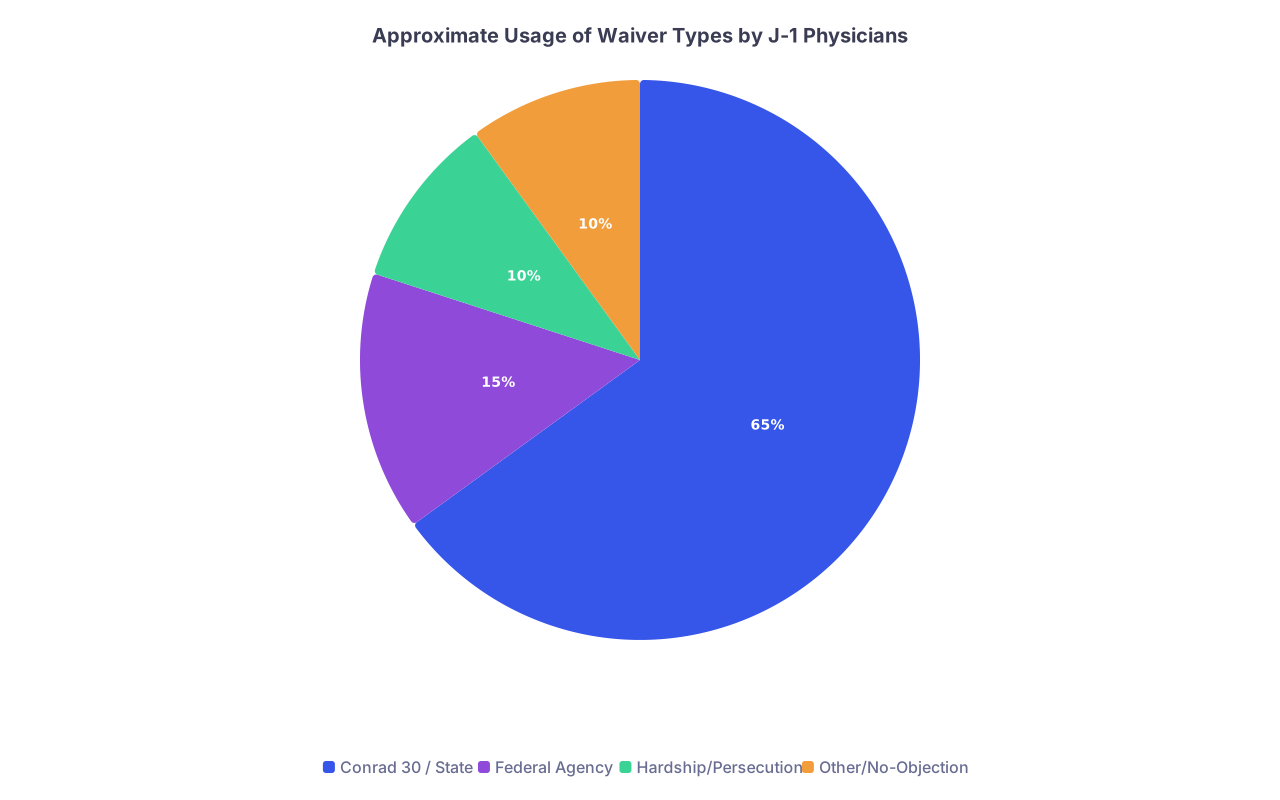
| Conrad 30 (State) | Most J-1 IMGs | 3 years in underserved area |
| Federal Agency | Subset of IMGs | Sponsorship by VA, HHS, etc. |
| Persecution | Rare | Risk if returning home |
| Hardship to USC/LPR Spouse/Child | Family-based IMGs | Extreme hardship proof |
| No-Objection | Mostly non-medical J-1s | Home gov’t no objection |
| Category | Value |
|---|---|
| Conrad 30 / State | 65 |
| Federal Agency | 15 |
| Hardship/Persecution | 10 |
| Other/No-Objection | 10 |
The one everyone talks about: Conrad 30
Each US state can sponsor up to 30 J-1 physicians per year to stay in the US instead of going home, in exchange for working 3 years full-time in a designated underserved area.
The stressful parts:
- Some states fill up fast (e.g., Texas, New York). Others don’t fill at all.
- Specialties like FM, IM, Psych usually do better. Super subspecialties can struggle.
- You have to line up an employer who is:
- In the right region
- Willing to sponsor your waiver
- Ready to deal with the timing mess
But this is the standard route for a huge number of J-1 IMGs who stay in the US long-term. It’s not fringe. It’s almost routine at this point in many states.
Family-based hardship waivers
If you have a US citizen or green card-holding spouse or child, you might qualify for a waiver based on the hardship they’d face if you had to leave.
Keyword: hardship, not just “inconvenience.”
These cases are highly lawyer-dependent and evidence-heavy. But they’re real. People win them.
No-objection letters?
For physician J-1s, the US usually does not accept simple “no objection” letters from your home country as the basis for a waiver. That’s more common with non-medical J-1s (students, researchers).
So if someone tells you, “Don’t worry, just get a no-objection letter later,” that’s… not how it works for residency J-1s.
4. Fellowship on J-1: Does the Rule Restart the Clock?
Huge source of confusion.
You do residency on J-1. Then fellowship on J-1. Then, what, 4 years of going home?
No. The two-year rule is not “per program”. It’s tied to your J-1 status as a whole.
If you do:
- 3 years IM J-1
- 3 years Cardiology J-1
You still owe a total of 2 years at the end, not 4. It doesn’t stack.
Where people get burned is timing:
- If you apply for a waiver too early, some consulates/programs don’t like it because it “signals” you’re abandoning return-home intent.
- If you apply too late, it messes up the start of your waiver job or H-1B transfer.
There’s strategy here. This is absolutely where I’d say: don’t DIY this timeline. Get an immigration lawyer who actually does J-1 physician waivers regularly, not some random “general” immigration guy.
5. How J-1 Compares to H-1B for IMGs (And Why Programs Push J-1)
Let’s be real: you’re not just asking, “Is J-1 bad?”
You’re asking, “Is J-1 worse than H-1B, and did I just get stuck with the bad option?”
| Factor | J-1 Visa | H-1B Visa |
|---|---|---|
| Two-Year Home Rule | Usually yes | No |
| Max Duration | Generally 7 years for training | 6 years (complex rules) |
| Who Sponsors | ECFMG + program | Directly the program |
| Fellowship | Usually J-1 again | Often H-1B if program allows |
| Waiver Needed Later | Yes, to stay/work long-term | No J-1 waiver, but other hurdles |
Here’s the ugly truth:
Many programs prefer J-1 because:
- It’s standardized. ECFMG handles a lot.
- It’s predictable. They know the process.
- It doesn’t commit them to long-term H-1B headaches.
H-1B is more paperwork, more cost, more legal complexity for them.
So if you’re obsessing over “smart applicants get H-1B,” that’s not quite right. A lot of spots simply won’t offer H-1B at all, no matter how stellar you are. It’s not about you. It’s about their institutional laziness/risk tolerance.
Does H-1B give you a cleaner, simpler post-residency path? Yes, usually. No two-year rule. Easier transition to green card in many cases.
But J-1 isn’t automatically the losing lottery ticket. It’s a different game board. More constrained, but not unwinnable.
6. Worst-Case Scenarios (Because That’s What You’re Actually Playing in Your Head)
Let’s walk through the nightmares you’re replaying:
Nightmare 1: “I finish residency and can’t get a waiver job. I’m forced to leave.”
This can happen. Especially in:
- Super niche subspecialties
- Hyper-saturated urban markets
- States where Conrad 30 slots are insanely competitive
But what actually happens in practice?
- Many people cast a wide net and find jobs in less-sexy locations (think rural Midwest, deep South, etc.).
- Some pivot to broader fields (e.g., general IM instead of only Cards for the waiver years).
- A small number actually do end up leaving the US and working abroad or back home for a bit.
Is it comfortable? Not at all.
Is it common? Not as common as Reddit horror stories make it sound.
Nightmare 2: “I marry a US citizen and still get stuck / separated.”
This one is rough but real.
If you’re subject to 212(e), marriage doesn’t erase that. You either:
- Get a waiver (hardship, etc.)
- Or do your 2 years
That can absolutely mean:
- Temporary long-distance marriage
- Career disruption
- Waiting years longer than you expected for a green card
It’s survivable, but emotionally brutal.
This is why it’s sane to factor your actual life plans (not just CV) into the J-1 vs H-1B choice if you have one.
Nightmare 3: “I get blacklisted or denied everywhere because I’m a J-1 person”
No. Programs are full of J-1s. Hospitals are full of ex-J-1 waiver docs. You’re not some tainted category.
The real issue is not “blacklisting.”
It’s immigration friction: extra steps, fewer options, more dependence on employers who know this system.
7. So, Should You Avoid J-1 At All Costs?
My honest take, after watching dozens of IMGs agonize over this:
Avoid J-1 at all costs IF:
- You currently have (or realistically expect) strong H-1B options
- You’re deeply committed to:
- Competitive subspecialty
- Big-city academic medicine
- Minimal geographic compromise
- You know you want fast-track PR / US-citizen spouse options with minimal drama
J-1 is totally reasonable IF:
- Your choice is: J-1 residency vs. no US residency
- You’re okay doing 3 years in an underserved area later
- You can tolerate some geographic and job flexibility after training
- Your long-term plan isn’t 100% tied to staying in NYC/L.A./Chicago forever
What’s insane is people saying “Never take J-1” like it’s poison.
For many IMGs, J-1 is literally the only route into US training. Turning that down on principle can be career suicide if you don’t have alternatives.
8. What You Should Do Now, Not in a Panic 3 Years From Now
You can’t control everything. But you’re not powerless.
Here’s what I’d do in your shoes, today:

| Step | Description |
|---|---|
| Step 1 | Get Interview Invites |
| Step 2 | Research their J-1 history |
| Step 3 | Ask about real H-1B chances |
| Step 4 | Decide if J-1 tradeoff is acceptable |
| Step 5 | Match list: balance visa + training quality |
| Step 6 | Program Visa Type? |
List your programs and their visa policies.
Not just “they say they sponsor H-1B,” but: do they do it routinely or rarely? Ask current residents. You’ll get the real answer in like 2 messages.Be brutally honest about your competitiveness.
210 Step 2, 1 publication, average app? You may not have real H-1B leverage. Don’t build fantasies on that.Talk to at least one immigration lawyer who regularly handles J-1 physician waivers.
Emphasis on “regularly handles.” Not your cousin’s friend who does family petitions.Ask current or former J-1 residents/fellows what they actually did for waivers.
Not what they heard. What they did. Look for patterns.
FAQ (Exactly 6 Questions)
1. If I do residency and fellowship on J-1, do I owe 4 years back home?
No. You owe a total of 2 years, not 2 per program. The home-residency requirement is attached to your overall J-1 status, not each individual training block. Multiple J-1 programs don’t stack the time.
2. Can I get a green card while still subject to the two-year rule?
You generally cannot adjust status to permanent resident or get an immigrant visa abroad until you’ve either:
- Completed the 2 years physically in your home country, or
- Obtained a J-1 waiver.
You can sometimes start parts of the process in parallel, but that’s strategic-lawyer territory.
3. Is it true I can’t marry a US citizen and stay if I’m J-1?
You can marry, but marriage alone doesn’t erase 212(e). If you’re subject to the rule, you still need to either do the 2 years or get a waiver (often a hardship-based one in this context). People do succeed with hardship waivers, but it’s not automatic and takes real legal work.
4. Are Conrad 30 jobs all in the middle of nowhere with terrible conditions?
Not all. Some are in very rural places, yes. Some are in small cities. A few are in surprisingly decent metro-adjacent areas. The quality varies a lot by state and employer. It’s a tradeoff: more desirable areas fill faster and are more competitive, but you’re not automatically doomed to a clinic with no support and unsafe workload if you’re selective and start early.
5. What if I just go home for 2 years after training—can I come back easily later?
If you truly complete the 2-year home presence, then yes, you’re no longer blocked by 212(e). You can be sponsored for H-1B or immigrant visas normally. The question becomes less immigration and more: will US employers want you after you’ve been away for 2+ years? Some will, especially if you’ve been practicing in your field and keeping your skills/current certifications.
6. Is taking a J-1 for residency a “mistake” if my end goal is to stay in the US?
Not automatically. It’s a constraint, not a mistake by definition. If your only realistic path to US training is J-1, then refusing it can be a bigger mistake. Could H-1B be cleaner for long-term US plans? Yes. But between “J-1 with hassle and waivers” and “no US residency at all,” choosing J-1 is often the rational move. The real mistake is taking J-1 blindly without understanding waiver options and planning early.
Here’s one concrete thing you can do today:
Open a spreadsheet and make 3 columns: Program, Visa Policy (J-1/H-1B), and “Real Story” (what current residents say actually happens).
Message 3 current or recent IMGs from your top programs and fill that “Real Story” column in.
You’ll feel less like you’re walking into a trap and more like you’re making a choice—with your eyes open.


