

It’s late. You’ve got five tabs open: Conrad 30, J-1 waiver horror stories, physician scarcity in rural America, a random Reddit thread from 2017, and an email draft to your program coordinator that you keep deleting.
You’re an IMG, you’re thinking about matching on a J-1, and the math in your head sounds like this:
J-1 → 2-year home residency requirement → waiver → “service obligation” → middle-of-nowhere job → stuck forever → never get back to cities, academics, or a life that feels like yours.
And the question you’re actually asking is:
If I take a J-1 waiver job, am I basically signing away my future?
Let me be blunt: no, you’re not trapped forever. But there are ways to absolutely make your life miserable for a few years if you don’t understand what you’re signing.
So let’s walk through this like two tired people in a hospital call room, looking at worst-case scenarios and what’s actually real.
First: What Does the J-1 Waiver Actually Require?
Let’s strip this down to the core, because the rumors online get dramatic fast.
If you’re an IMG on a J-1 visa for residency/fellowship, the default rule is: after training, you must go back to your home country for 2 years before you can get an H-1B or green card in the U.S.
A J-1 waiver says:
“We’ll waive that 2-year home rule if you agree to work in an underserved area or in a designated job for 3 years full-time.”
Most people are talking about the Conrad 30 program when they say “J-1 waiver job.”
Here’s the actual basic structure:
- You finish residency/fellowship on a J-1.
- You get a job offer from a qualifying site (often rural or underserved).
- A state (or another waiver sponsor, like a federal agency) sponsors a waiver on your behalf.
- If approved:
- Your J-1 home residency requirement is waived.
- You switch to H-1B (usually) and start working for that employer.
- You must work 3 years full-time (usually 40 hrs/week, clinically heavy).
- After those 3 years:
You are free. To change jobs. To move to a city. To pursue another H-1B. To apply for a green card. Whatever your next step is.
Is that 3-year obligation serious? Absolutely. You can’t just walk away halfway. But “forever”? No.
Where the “Trapped Forever” Fear Comes From
You’re not imagining things. A lot of this fear comes from real, specific issues I’ve seen IMGs run into:
- Employers who abuse the “visa leverage” and pile on RVU requirements.
- Contracts that make it financially painful to leave early.
- Misunderstanding of how hard it is to move during the 3-year waiver period.
- Confusion between the 3-year J-1 waiver service and separate green card sponsorship obligations.
You’re probably worried about at least one of these:
- “If I go to rural Kansas on a Conrad waiver, will I ever be able to get out?”
- “What if I end up stuck at a terrible job, with no leverage because of my visa?”
- “If I get a green card through this employer, will that chain me to them for 10 more years?”
- “Will academics or big-city hospital systems even look at me after a rural gig?”
These are not dumb fears. They’re all rooted in real scenarios that happen to IMGs every year.
The key: what’s temporary pain vs what’s truly limiting your entire career.
The Reality: What You Can and Can’t Do During J-1 Waiver Service
Let’s talk constraints, because that’s what your brain is spinning on.
What’s basically non-negotiable
During your required 3-year waiver service (usually on H-1B with that employer):
- You must work at the approved site(s) that are listed on the waiver.
- You must meet the “full-time” requirement (often 40 hrs/week, mostly clinical).
- You cannot just randomly switch employers without going through a second waiver or some form of transfer process (which is not guaranteed and can be messy).
- If you quit or get fired without a backup plan:
You are in serious immigration trouble. Clock ticking. Status at risk.
So yes, during those 3 years, you are pretty locked in.
What’s not true (but everyone assumes)
- You are not banned from ever working in a city again.
- You are not banned from academic jobs forever.
- You are not required to stay with that employer after the 3 years are done.
- You are not permanently “rural coded” in the system.
After those 3 years, your options open significantly.
Some people even over-correct and end up with more options because:
- They’ve made money (rural often pays well).
- They’ve had leadership roles earlier (small hospitals throw responsibility at you).
- They’ve gotten strong letters from medical directors used to writing for IMGs.
What Happens After the 3-Year Waiver? Are You Actually Free?
This is the part nobody explains clearly to you during residency.
After you finish your 3-year waiver commitment, usually you’re in one of these buckets:
- Still on H-1B, but done with service
- Already in the green card process (PERM/I-140 approved or pending)
- Green card approved (best-case but slower in some countries, like India/China)
From that point, you can:
- Switch jobs to another H-1B employer (cap-exempt if hospital/academic, or cap-subject if private practice but with strategy).
- Move to a city, suburban group, or academic center.
- Take a fellowship (if they can sponsor your H-1B and timing makes sense).
- Change specialties within reason (if you’re board-eligible and someone will hire you).
So no, the waiver doesn’t stamp “forever rural” on your forehead.
The actual bottleneck after the 3 years is usually:
Immigration paperwork and timing — not the waiver itself.
The Real Traps: Where You Can Get Stuck Longer Than You Planned
Now, here’s where your worst-case brain is actually onto something. There are a few real traps:
1. Employer-tied green card sponsorship
Many waiver employers will say something like:
“We’ll sponsor your green card if you commit to stay X years beyond your J-1 waiver service.”
Looks innocent. It’s not.
That “X years” can be:
- 2 more years (reasonable, maybe)
- 3–5 more years (now you’re talking potentially 6–8 years total in one place)
If the contract says they can withdraw green card sponsorship if you leave early, your leverage is gone.
2. Huge repayment clauses
You’ll see things like:
- $50k–$150k “liquidated damages” if you leave before the end of the contract.
- Payback of signing bonus, relocation, immigration fees.
Some of that is negotiable. Some is predatory. If you sign without understanding:
You can leave legally (immigration-wise) but be crushed financially. That definitely feels like being trapped.
3. Bad planning for timing and visas
If your waiver job drags their feet on H-1B transfers, extensions, or green card steps, you can get stuck simply because the alternative paths are risky.
This is why you see IMGs on year 7 in the same tiny town saying, “I didn’t plan for how long this would take once PERM got delayed.”
Rural vs “Underserved”: Not Always the Same Thing
Another thing: “rural” is not one single image.
Some sites are truly in the middle of nowhere. Population 3,000. One grocery store. One stoplight.
Others are:
- 45 minutes outside a major city
- Suburban but federally designated as underserved
- Inner-city FQHC clinics that count as underserved but are very urban

You’re not automatically exiled to cornfields just because you’re on a J-1 waiver.
Some states use their Conrad 30 slots for:
- City-adjacent outpatient clinics
- Suburban hospitals
- Behavioral health centers in metro areas
The idea that J-1 waiver = isolated farmland forever is just too simplified.
Quick Reality Check: Pros and Cons of J-1 Waiver Jobs
Let’s be very honest and not sugar-coat.
| Aspect | Pros | Cons |
|---|---|---|
| Location | Often higher need, sometimes near cities | Can be remote, socially isolating |
| Pay | Often higher base + loan repayment | Sometimes tied to heavy RVU expectations |
| Visa | Waives 2-year home rule, clear path to H-1B | Locked into 3 years at one employer |
| Career | Early autonomy, leadership opportunities | Less academic exposure, fewer mentors |
| Green Card | Many employers willing to sponsor | Sponsorship sometimes used as leverage |
Does this look like “forever trapped”? No. It looks like “3 intense years with tradeoffs.”
What About Switching Jobs During the 3-Year Waiver?
This is the nightmare scenario in your head:
You sign. You move. Job is toxic. Admin is awful. Volume is insane.
You’re burned out and feel used, but your H-1B and waiver depend on them.
Can you ever leave before 3 years?
- Possible? Yes, in some cases.
- Easy? No.
- Guaranteed? Absolutely not.
You’d usually need:
- Another qualifying underserved employer willing to take over.
- Sometimes a second waiver or state approval.
- Clean immigration timing so you don’t fall out of status.

| Step | Description |
|---|---|
| Step 1 | Unhappy in waiver job |
| Step 2 | Stay and complete 3 years |
| Step 3 | Consult immigration lawyer |
| Step 4 | Transfer H-1B & waiver |
| Step 5 | Is there another qualifying employer? |
| Step 6 | Can state/agency approve change? |
I’ve seen it done. I’ve also seen people try and fail, then have to crawl back and finish where they started.
So yes, you should go into a waiver job assuming:
“I need to be able to tolerate this for 3 years.”
Not love it. But tolerate it without wrecking your mental health.
Will a Rural / J-1 Waiver Job Kill My Chances at Academics or Fellowship?
This is where your inner catastrophizer really has fun:
“I’ll never be competitive again. They’ll look at my CV and see ‘rural clinic’ and throw it away.”
Reality:
- Plenty of people finish J-1 waiver jobs and then move into:
- Hospitalist roles in cities
- Academic teaching positions
- Fellowship (especially in fields that still take practicing physicians)
What actually matters more:
- Did you keep any scholarly work going? (Even small QI projects, case reports.)
- Did you get strong letters from people who can actually describe your clinical excellence?
- Did you stay board-certified, engaged, and current?
For some super-competitive fellowships right out of training, yes — going straight from residency may be cleaner. But if you’re talking:
- Cards, GI, heme/onc, etc. after a service obligation?
It’s still possible, especially if you network and maintain some academic ties.
Many IMGs doing J-1 waivers do sacrifice some academic momentum early. But that’s not the same as being banned for life.
So… Is It Worth It? Or Should I Avoid J-1 Entirely?
If you’re looking for a magic answer, here it is:
There isn’t one. But I’ll tell you how I’d frame it if I were in your shoes.
A J-1 waiver is usually worth it if:
- You don’t have an easy path to H-1B during residency.
- You’re okay with 3 tough years if it means getting rid of the 2-year home rule.
- You choose your waiver job strategically (location, contract, employer reputation).
- You go in with eyes open: this is a trade, not a gift.
It becomes “I feel trapped” when:
- You sign a terrible, one-sided contract because you’re desperate.
- You ignore the fine print on green card sponsorship or repayment clauses.
- You pick any job that offers you a waiver, not one you can actually survive mentally.
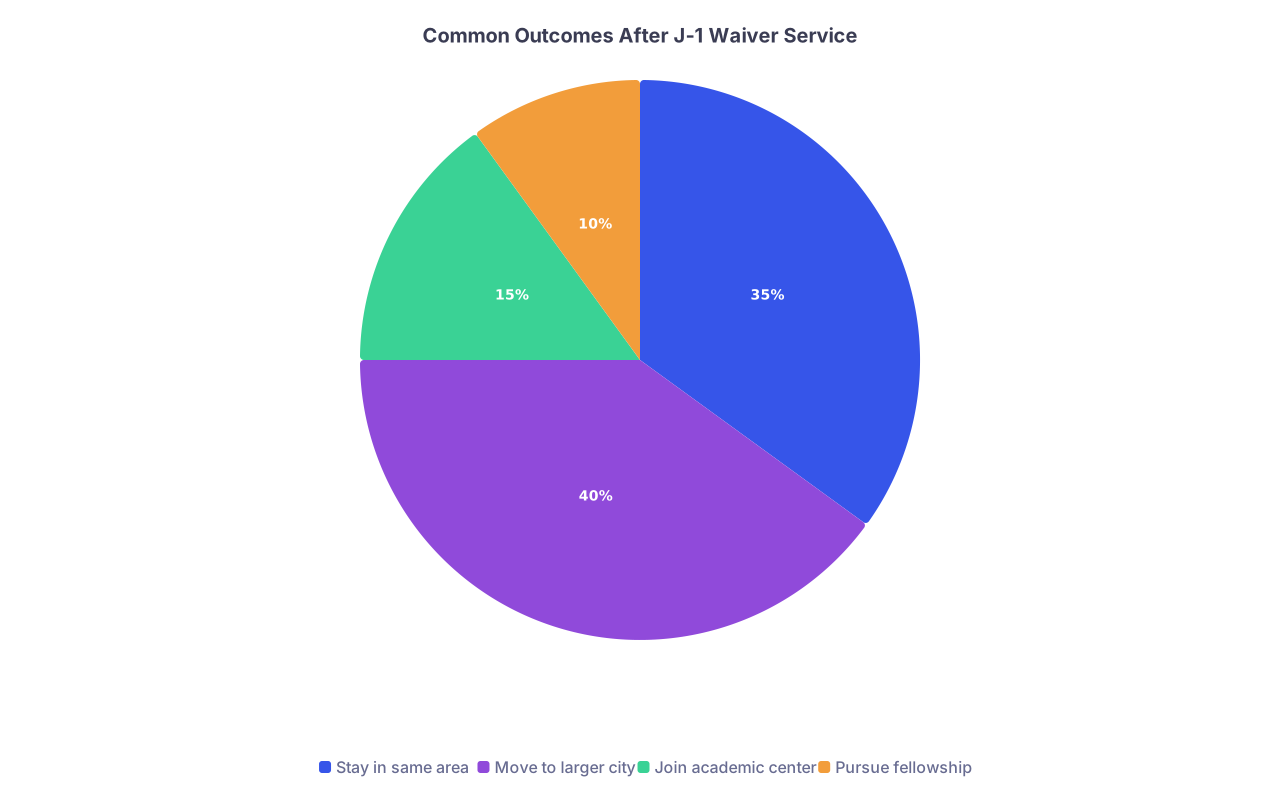
| Category | Value |
|---|---|
| Stay in same area | 35 |
| Move to larger city | 40 |
| Join academic center | 15 |
| Pursue fellowship | 10 |
Are these exact percentages? No. But they match what I’ve seen informally:
Most people move on. They don’t vanish into rural America forever.
How to Protect Your Future Before You Sign Anything
Here’s where your anxiety can actually be useful: it makes you cautious. Use that.
Minimum steps before accepting a J-1 waiver job:
- Get the full written contract before verbally committing.
- Have it reviewed by:
- An immigration lawyer who actually works with J-1 waivers.
- A physician contract lawyer.
- Ask blunt questions:
- “What happens if I want to leave before 3 years?”
- “What are the exact repayment obligations and on what timeline?”
- “When will you start my green card process, and what timeline do you typically see?”
- Try to find one IMG who actually works or worked there and talk to them off-the-record.

If an employer pressures you to “decide fast” or refuses to let you have legal review?
Red flag. Huge one.
You Are Not Signing Away Your Whole Life — Just 3 Intense Years
I’m not going to minimize it: three years in a place you don’t like, with people you don’t respect, can feel like a lifetime.
But that’s the point: choose very carefully so it’s not miserable.
Your future self is not doomed to be “that rural doc who never left.”
Your future self can absolutely be:
- In a city hospital.
- On faculty.
- In a subspecialty.
- Closer to family or community you actually relate to.
The waiver is a phase, not your identity.

FAQ (Exactly 4 Questions)
1. If I do a J-1 waiver job, can I ever move to a big city?
Yes. After you complete your 3-year waiver service, you can absolutely move to a big city job if you can find an employer willing to sponsor your H-1B/continue green card process. Many IMGs go from rural/underserved waiver jobs to urban hospitalist roles, outpatient clinics, or academic centers. The waiver doesn’t ban you from cities; it just forces your first job to be in a qualifying area.
2. Can I change employers during my 3-year waiver period?
Sometimes, but it’s complicated and not guaranteed. You’d need another qualifying underserved employer, state or agency approval (depending on who sponsored the waiver), and a clean H-1B transfer. It’s not like switching a regular job; there are extra regulatory hoops. You should go into your first waiver job assuming you’ll need to realistically stay the full 3 years.
3. Does taking a J-1 waiver job hurt my chances at getting a fellowship later?
It can delay or complicate the timing, but it doesn’t automatically kill your chances. Some competitive fellowships prefer applicants straight out of residency, but others accept people after practice, including from rural or underserved settings. Your competitiveness will depend more on your letters, board performance, any scholarly work you kept up, and your networking than on the simple fact that you did a waiver job.
4. How do I know if a J-1 waiver contract is “bad” or risky?
Red flags: huge repayment clauses if you leave early, vague language about hours and duties, no clear commitment to start your green card process, or green card sponsorship tied to extra years beyond the 3-year waiver. Also: employers who won’t let you have a contract lawyer or immigration attorney review the agreement, or who pressure you to sign “within 24–48 hours.” If it feels like they’re using your visa status as leverage, they probably are.
Today, do one concrete thing:
Pull up one sample J-1 waiver job posting and pretend you’re about to sign it. Then write down 10 blunt questions you’d ask about the contract, visa, and your exit options. That list will be your starting script when real offers start coming in.


