

Last week I was on a Zoom call with another IMG who’d just come out of an interview at a solid IM program. She thought it went fine… until the very end. The PD asked, “So, you’ll need H‑1B?” She said yes. He went quiet, said “Okay, we’ll see,” and ended the call. She’s been replaying that 5‑second pause for days, convinced it killed her shot.
If you’re staring at your spreadsheet of programs, sorting by “H‑1B sponsored” and watching the list shrink to almost nothing, you’re not crazy to worry. The fear is real: what if they reject me just because I need H‑1B?
Let me walk through the real scenarios, not the sugar‑coated ones.
The ugly truth: yes, some programs will reject you because of H‑1B
I’m not going to pretend otherwise. There are programs that:
- Flat-out do not sponsor H‑1B
- Technically sponsor it, but almost never actually use it
- Quietly blacklist H‑1B‑needing applicants unless they’re absolute superstars
And they usually won’t say this on the website. Or even in emails. You just get: silence. Or the classic “Due to the large number of applications, we’re unable to offer you an interview at this time.”
Here’s the harsh bottom line:
- If a program explicitly says “J‑1 only” → your H‑1B need is an automatic no.
- If a program says “H‑1B considered” → they’ll often default to J‑1 unless you:
- Have Step 3 passed
- Have no visa issues in your history
- Are otherwise extremely strong on paper
- If the website says nothing about visas → assume they don’t sponsor H‑1B unless proven otherwise.
So yes, some rejections you get will be only because you need H‑1B. You’ll never know which ones. That’s the part that makes it maddening.
Why programs actually hesitate with H‑1B (it’s not always “they hate IMGs”)
You and I both know there’s bias out there. But a lot of the H‑1B hesitation is… boring. Administrative. Money and paperwork and fear of audits.
Typical reasons I’ve heard from coordinators and PDs:
- “Our GME office only wants J‑1. They said it’s simpler.”
- “We had a bad experience with an H‑1B processing delay once and our resident almost couldn’t start on time.”
- “HR said H‑1Bs need prevailing wage attestation and they freaked out about it.”
- “We don’t have the budget or staff to deal with H‑1B right now.”
They care about:
- Cost: attorney fees, filing fees
- Timing risk: H‑1B approval not in time for July 1
- Commitment: H‑1B is for work, not “training,” so they feel more exposed legally
- Institutional policy: some hospitals or universities simply say no
So when you’re terrified they “hate you personally,” they probably don’t. They’re just avoiding what they see as a hassle and risk.
That still doesn’t help you emotionally, I know. But it does mean: if they already sponsor H‑1B regularly and their GME is used to it, your risk is much lower.
Realistic scenarios: what actually happens when you need H‑1B
Let’s go through what this can actually look like in a Match cycle.
Scenario 1: You get quietly filtered out pre‑interview
You apply to 120 programs. Maybe 40 list H‑1B somewhere on their website.
They run filters in ERAS:
- Must be US citizen/GC/J‑1 only → auto-reject
- Must not need visa → auto-reject at some places, even if they don’t say it publicly
- H‑1B allowed, but visa‑requiring applicants go to a separate pile
What you see:
You get 4–6 interviews, all at programs that clearly state they support H‑1B/J‑1 or at least J‑1 but are IMG‑friendly.
What’s really happening:
Yes, some programs probably eliminated you the second they saw “Needs visa: yes” and “H‑1B preferred.” You’ll never see that explicitly.
Is this survivable? Yes. People match every year with 4–6 interviews. But it’s anxiety‑inducing, because you’ll always wonder, “If I had a green card, would I have 12 invites?”
Scenario 2: You interview… and then they freeze when they hear “H‑1B”
This one’s painful because you did everything right.
You’re in an interview. Things go well. Then:
PD: “What’s your visa status?”
You: “I’ll need H‑1B. I’ve passed Step 3.”
PD: “Ah… okay, we typically sponsor J‑1. I’ll have to check with GME.”
What might happen after:
- They do check, and GME says no → your rank drops or disappears
- They decide “too much hassle” compared to a similarly ranked J‑1 candidate
- They rank you, but below many other applicants, and it doesn’t line up
But there’s also this version:
- PD really likes you
- They go to GME and push
- You get ranked in a realistic spot
- You match, and GME suddenly becomes very good at H‑1B paperwork
I’ve seen all of these.
Scenario 3: You say “J‑1 or H‑1B, I’m flexible”
For some of you, it’s not “H‑1B or I die.” You prefer H‑1B but would accept J‑1.
This slightly changes the game. When they ask visa preference, you can say something like:
“I’d prefer H‑1B if possible, but I’m completely open to J‑1 and understand many institutions favor it. My main priority is training here.”
What that does:
- Removes the red flag of “this person will be a paperwork headache”
- Lets them know you’re not going to be rigid
- Gives the PD flexibility to discuss with GME: “Can we try H‑1B? If not, J‑1 is okay.”
Will programs still reject you for “needs visa”? Yes. But you’ve removed the extra barrier of “H‑1B or nothing.”
Programs by attitude: how they actually behave toward H‑1B
Here’s the mental model I use. There are 3 broad buckets.
| Program Type | H‑1B Behavior | Your Realistic Chance |
|---|---|---|
| H‑1B Friendly | Sponsor regularly, clear on website, used to IMGs | Best |
| H‑1B Tolerant | “Maybe” with Step 3, prefer J‑1 | Medium |
| H‑1B Avoidant | J‑1 only or silent but never sponsor | Very low |
Most of your energy should go into the first two groups.
You can roughly guess which is which by:
- Their current resident list (are there IMGs with H‑1B mentioned online?)
- Their past residents on LinkedIn (H‑1B → green card stories)
- Direct coordinator replies (“We sponsor J‑1 and H‑1B” vs. “We only sponsor J‑1”)
- How transparent their website is about visa types
If you need H‑1B and you’re only applying to places that “might” sponsor but never actually have any H‑1B residents… you’re walking into a trap.
How much will H‑1B actually hurt my chances?
The question you really care about: is this a 5% penalty or a 70% penalty?
There’s no neat number, but here’s what I’ve actually seen the H‑1B requirement do:
- It shrinks your viable program list. That’s the biggest impact. Your pool is smaller from the start.
- Inside H‑1B‑friendly programs, if you have Step 3 and solid scores, the penalty is smaller than you think. They’re used to it.
- In mid‑tier and lower‑tier IM programs that rely heavily on IMGs, visa need (even H‑1B) is often “normal,” not a big red mark.
The real catastrophic scenario is:
- You insist on H‑1B only
- You refuse J‑1 under any circumstances
- You apply to too few truly H‑1B‑friendly programs
- You don’t have Step 3 yet
That combo? Very high risk. That’s how good applicants end up unmatched and baffled.
Hard but helpful: rank list strategy when you need H‑1B
You can’t control their internal visa politics. You can control your list.
Some grounded rules:
Know who truly sponsors H‑1B NOW, not 5 years ago.
Check current residents, recent graduates, talk to seniors from your med school, ask in IMG groups (with caution). Old data is dangerous.Step 3 is almost mandatory if you want real H‑1B chances.
Not optional. Not “nice to have.” For many programs, it’s the line between “possible” and “no way.”Mix of program types on your rank list matters.
Don’t rank 10 borderline H‑1B programs and call it a day. You want some:- Solid H‑1B‑friendly community programs
- J‑1‑friendly, IMG‑heavy programs (if you’re open to J‑1)
- At least a few realistic “safeties” truly known to rank IMGs needing visas
Emailing to clarify visa policy is not stupid.
A short, respectful email to the coordinator like:“Dear [Name],
I’m an IMG applying this cycle who will require H‑1B sponsorship and has passed USMLE Step 3. Could you please confirm whether your program is able to sponsor H‑1B for incoming residents, or if you only sponsor J‑1?
Thank you very much for your time,
[Name, AAMC ID]”It won’t magically get you an interview, but it will save you from totally hopeless apps.
What if they reject me only because I need H‑1B?
Let’s play out the nightmare thought that wakes you up at 3 a.m.
You’re an otherwise competitive IMG:
- USCE, LORs, good Steps, research maybe
- You applied broadly
- You get fewer interviews than your peers
- You suspect it’s “because of H‑1B”
Real talk:
- Yes, some rejections were only that.
- No, you can’t fix it mid‑cycle.
- And yes—you can still match if you take your remaining options seriously.
Where people really get screwed is in how they respond emotionally:
- They decide H‑1B is the villain and don’t engage with their actual interviews.
- They fixate on the programs that ghosted them, not the ones that showed up.
- They don’t broaden to J‑1 next cycle, even if that’s objectively the better path for their situation.
You’re allowed to grieve the loss of “easy” H‑1B access. But don’t let that grief turn into self‑sabotage.
Visual: where visa issues hit hardest in the pipeline
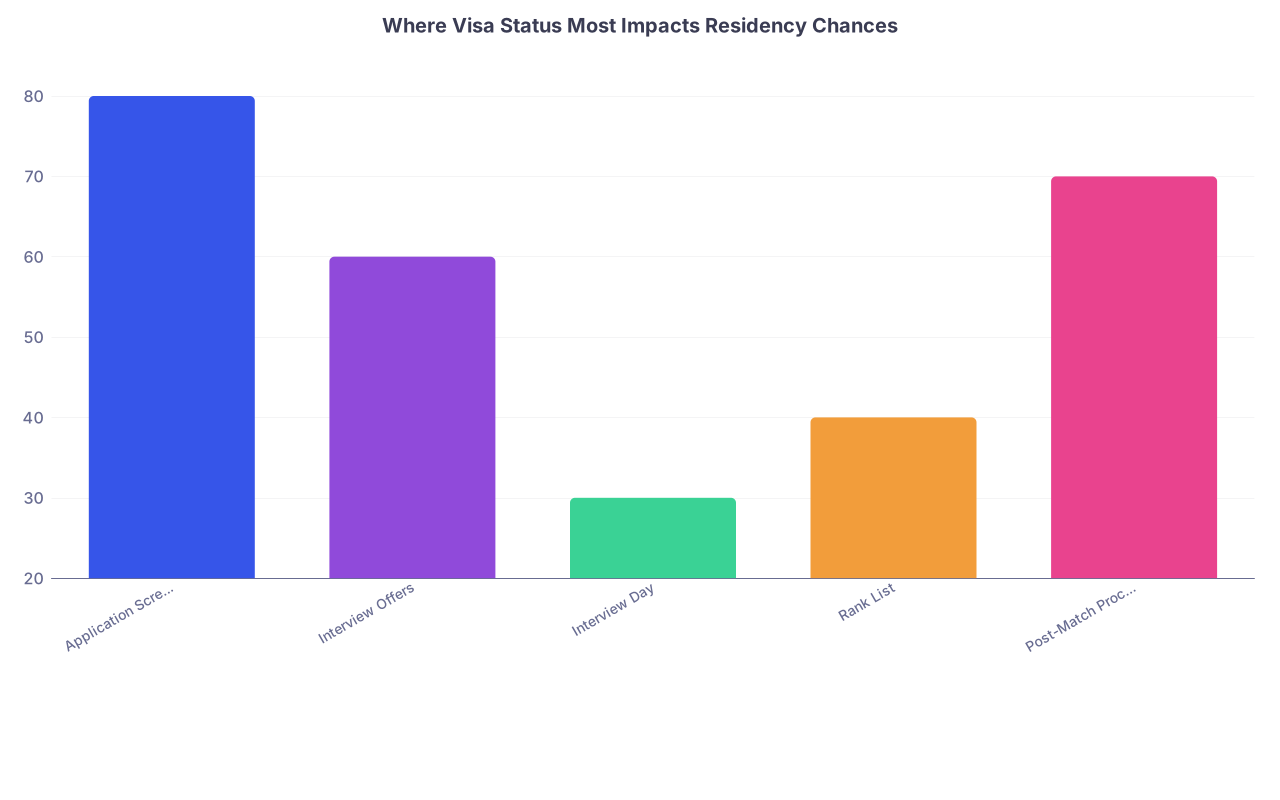
| Category | Value |
|---|---|
| Application Screening | 80 |
| Interview Offers | 60 |
| Interview Day | 30 |
| Rank List | 40 |
| Post-Match Processing | 70 |
Biggest hits: early screening and post‑match paperwork. Interview day and rank list matter, but if the system is set up to block H‑1B from the start, you never even get there.
If you’re truly H‑1B‑or‑nothing: how to reduce the damage
Some people can’t accept J‑1 for valid reasons (family, home country return rules, long‑term career plans). Then you have to play this like a high‑risk strategy, not a casual preference.
You’ll need to:
- Have Step 3 done before application opens
- Target every single genuinely H‑1B‑friendly IM/psych/FM program you can find
- Accept that you might need multiple cycles
- Seriously consider transitional routes (research years, observerships that make you more attractive, etc.)
- Keep an eye on alternative statuses (for some, O‑1 later in fellowship, or different immigration plans entirely)
This isn’t “you’re doomed,” but it’s not a one‑and‑done game. It’s a long fight.
Small things you can control that actually help
A few concrete moves that make programs less nervous:
Clean, simple visa story in your personal statement or ERAS
Don’t make them dig or get confused by your status history.Fast responses to any document/HR emails
The stereotype is “visa stuff causes delays”. Be the opposite: the lightning‑fast responder.Ask residents quietly
On interview day, if you meet an IMG on H‑1B, ask, “How was your H‑1B process here?” If they roll their eyes and say it was a mess, that’s a clue.Don’t sound demanding about H‑1B on interview day
Ask, “What is your experience sponsoring H‑1B?” Not “I must have H‑1B, can you guarantee it?” Same content, different vibe.
What to do today (not in 6 months)
You can’t fix US immigration. You can tighten your own side.
Today, you can:
- Make a list of every program you’re considering and add a “Visa” column with:
- J‑1 only
- H‑1B friendly (confirmed)
- H‑1B unknown
- Check 5 programs’ resident rosters and see if any current residents openly list H‑1B on LinkedIn or bios
- Draft that short email to coordinators asking for H‑1B vs J‑1 clarity
- If you don’t have Step 3 yet and you’re serious about H‑1B, open a Step 3 prep plan. Now.
Don’t just sit with the dread. Translate at least part of it into concrete action.

| Step | Description |
|---|---|
| Step 1 | Need H-1B |
| Step 2 | H-1B Friendly Programs |
| Step 3 | Very Limited H-1B Options |
| Step 4 | More Realistic H-1B Chance |
| Step 5 | Higher Unmatched Risk |
| Step 6 | Broader Program Pool |
| Step 7 | Narrow Program Pool |
| Step 8 | Step 3 Passed? |
| Step 9 | Open to J-1? |
FAQ (exactly 5 questions)
1. If a program says “We sponsor J‑1 and H‑1B,” does that mean my H‑1B is safe?
No. It means they can sponsor H‑1B, not that they will for you. Many such programs still prefer J‑1 by default. Your H‑1B chances improve a lot if you’ve passed Step 3, are otherwise strong, and they’ve recently sponsored H‑1B for other residents. Always look for evidence in their current or recent residents, not just the line on the website.
2. Should I hide that I prefer H‑1B until after I match?
You can’t. Your visa need and preference usually come up on ERAS and definitely in onboarding. Lying or “hiding” it backfires badly when HR gets involved. What you can do is phrase it flexibly: “I’d prefer H‑1B if possible, but I understand many institutions use J‑1 and I’m open to that as well,” if that’s true for you. If it’s H‑1B‑or‑nothing, you have to own that risk honestly.
3. Is it pointless to apply if I don’t have Step 3 but want H‑1B?
Not absolutely pointless, but close to it in many programs. Some places insist on Step 3 before even considering H‑1B. Without Step 3, you’re heavily dependent on rare, very IMG‑friendly programs willing to take the extra risk. If you’re serious about H‑1B, Step 3 should be your top priority before or early in the cycle. Otherwise, accept that your odds drop sharply.
4. Can a program change from H‑1B friendly to H‑1B hostile mid‑cycle?
Yes. Sadly. A new GME director, hospital policy shift, or one bad experience can make them suddenly stop sponsoring H‑1B. That’s why relying on 5‑year‑old anecdotes is risky. The best you can do is: check current info, talk to recent residents, and not put all your hopes in 1–2 “favorite” programs. Diversify your list so one policy change can’t destroy your entire Match.
5. If I go J‑1 now, am I completely stuck forever?
No, but it complicates your path. J‑1 comes with the 2‑year home‑country requirement unless you get a waiver (often through underserved work like Conrad 30). Loads of IMGs do J‑1 → waiver job → later green card or H‑1B. It’s not smooth or easy, but it’s a real path. H‑1B from the start is cleaner, but if that door is nearly closed for you, a well‑planned J‑1 route is far better than staying unmatched year after year.
Open your program list right now and add one more column: “Real visa situation (based on evidence, not hope).” Start filling it in for at least 10 programs. Don’t trust the vague line on the website until you’ve cross‑checked it with actual residents or recent outcomes. That one exercise alone will make your fear less abstract and your strategy a lot sharper.


