
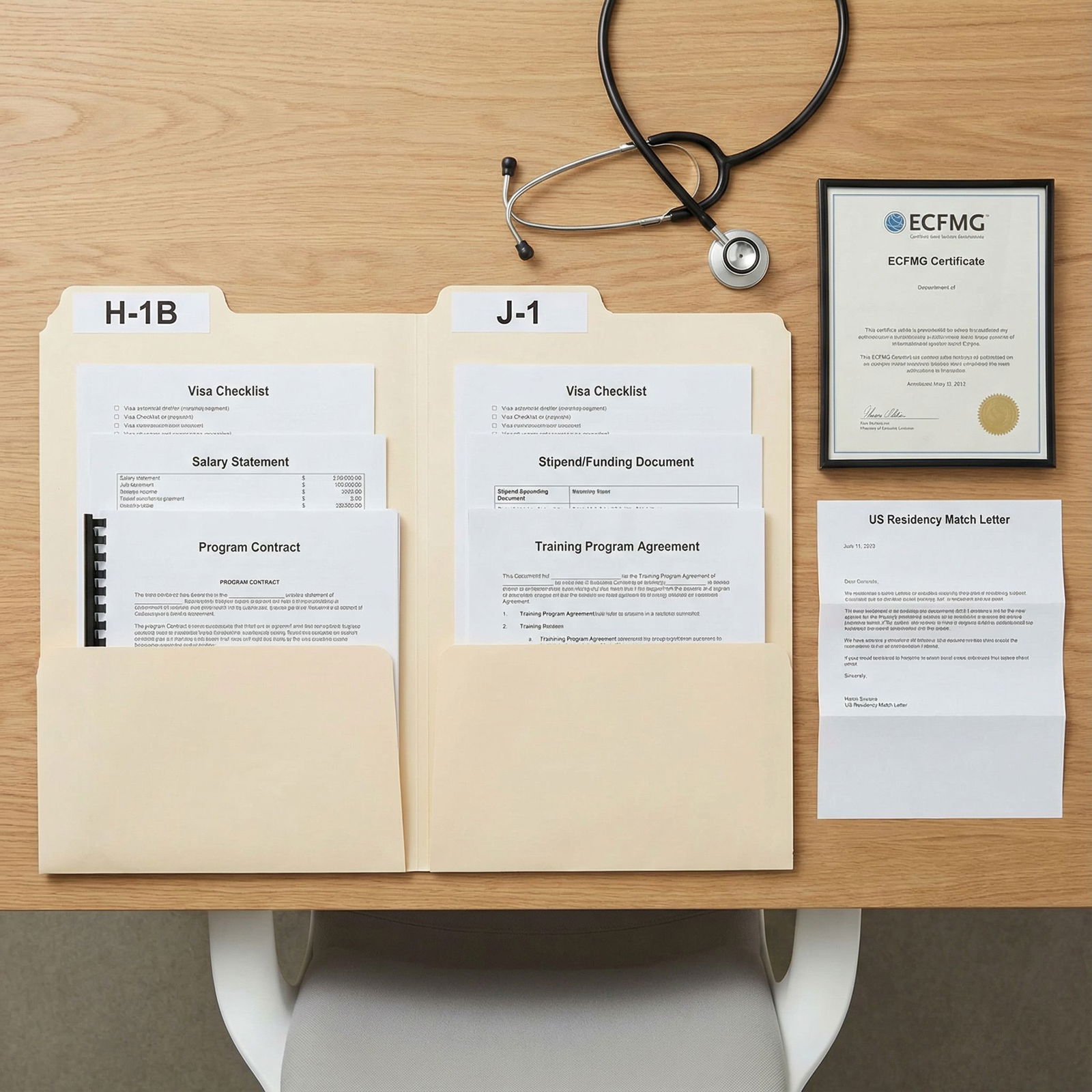
Most international grads have the power dynamics of H‑1B vs. J‑1 exactly backwards.
You’ve been told “H‑1B is better,” “PDs love H‑1B,” “J‑1 will trap you.” That might be how applicants talk. That is not how program directors and GME offices think when the doors close and the committee starts flagging files.
Let me walk you through how this really plays out in residency meetings, contract negotiations, and quiet side conversations between PDs, coordinators, and the GME office. The stuff nobody puts on the website.
The First Uncomfortable Truth: PDs Don’t Lead on Visas — GME and Legal Do
Here’s the part applicants almost never understand: your PD is not a free agent when it comes to visas.
That friendly PD who told you “we’re supportive of H‑1Bs”? At most institutions, they’re repeating what their GME office and legal department allow. The real decisions are made by:
- The institutional GME office
- The hospital’s legal/immigration counsel
- The finance people looking at cost and risk
The PD can advocate. They cannot overrule.
Behind closed doors, the sequence is usually:
- PD loves your file. Strong letters, good scores, good interview.
- Coordinator checks your demographics: non‑US grad, needs visa.
- Email or call to GME: “Are we allowed to sponsor H‑1B this year? What are the caps/limits?”
- GME replies with a policy that might be as simple and blunt as:
- “We only sponsor J‑1 for categorical residents.”
- “H‑1B only for fellows.”
- “H‑1B only if Step 3 done, and only X spots per year.”
At that point, most PDs stop fighting. They know where their power ends.
So when you ask, “Does your program sponsor H‑1B?” and the PD hedges — “Well, it depends… sometimes… case-by-case…” — what’s really happening is: they’re bumping up against institutional policy they don’t fully control, and they know better than to promise you anything.
They may like you. They may want you. They are not going to war with their GME office over your visa.
How PDs Actually Compare H‑1B vs. J‑1: The Mental Checklist
When you’re in the applicant pool and your name comes up in the meeting, the discussion is not “Is H‑1B better or J‑1 better?” It’s “What will this cost us, what are the risks, and what headaches will this cause over the next 3–7 years?”
Here’s the quiet mental checklist most PDs and coordinators run through.
1. Cost and Institutional Hassle
Programs rarely spell this out, but they talk about it internally all the time.
J‑1 (ECFMG-sponsored):
The institutional line is: cheap and standardized.
ECFMG handles most immigration documentation. There’s a clear playbook. The hospital isn’t the primary visa sponsor; ECFMG is. Less legal time. Less uncertainty.H‑1B:
The institution is the sponsor. Legal gets involved. There are filing fees. There are prevailing wage calculations. There’s the specter of audits. The PD may never see the invoice, but GME does, and they remember.
In meetings, you’ll hear things like:
“If we take more H‑1Bs, legal will scream at us again.”
“We burned half our legal budget last year on one H‑1B transfer; let’s just stick to J‑1s.”
They won’t tell you this on interview day. But they absolutely discuss it internally.
2. Timeline and Step 3
Here’s where many H‑1B seekers get quietly cut.
H‑1B for residency nearly always requires:
- Passing Step 3 before starting PGY-1 (or before the visa filing window)
- Enough time for filing and approval before July 1
Programs are burned every year by:
- Applicant says: “I’m planning to take Step 3 in March.”
- Scores get delayed. Or they fail. Or they never register properly.
- Suddenly, the visa can’t be filed in time.
Once a PD has lived through the panic of, “We matched this amazing IMG for H‑1B and now they might not get cleared by July,” they get cautious. Sometimes permanently.
Behind closed doors, I’ve heard:
“If they don’t already have Step 3 done, we’re not touching an H‑1B.”
“We lost a slot last year waiting on Step 3 results — never again.”
So yes, your Step 3 status changes how your visa preference is perceived. Dramatically.
If you want to be H‑1B competitive in the eyes of most PDs and GME:
- Step 3 passed before rank list certification. Earlier is even better.
- Clean record, no visa denials, no major immigration complications in your history.
Without that, many programs mentally default you to J‑1, even if they sponsor H‑1Bs on paper.
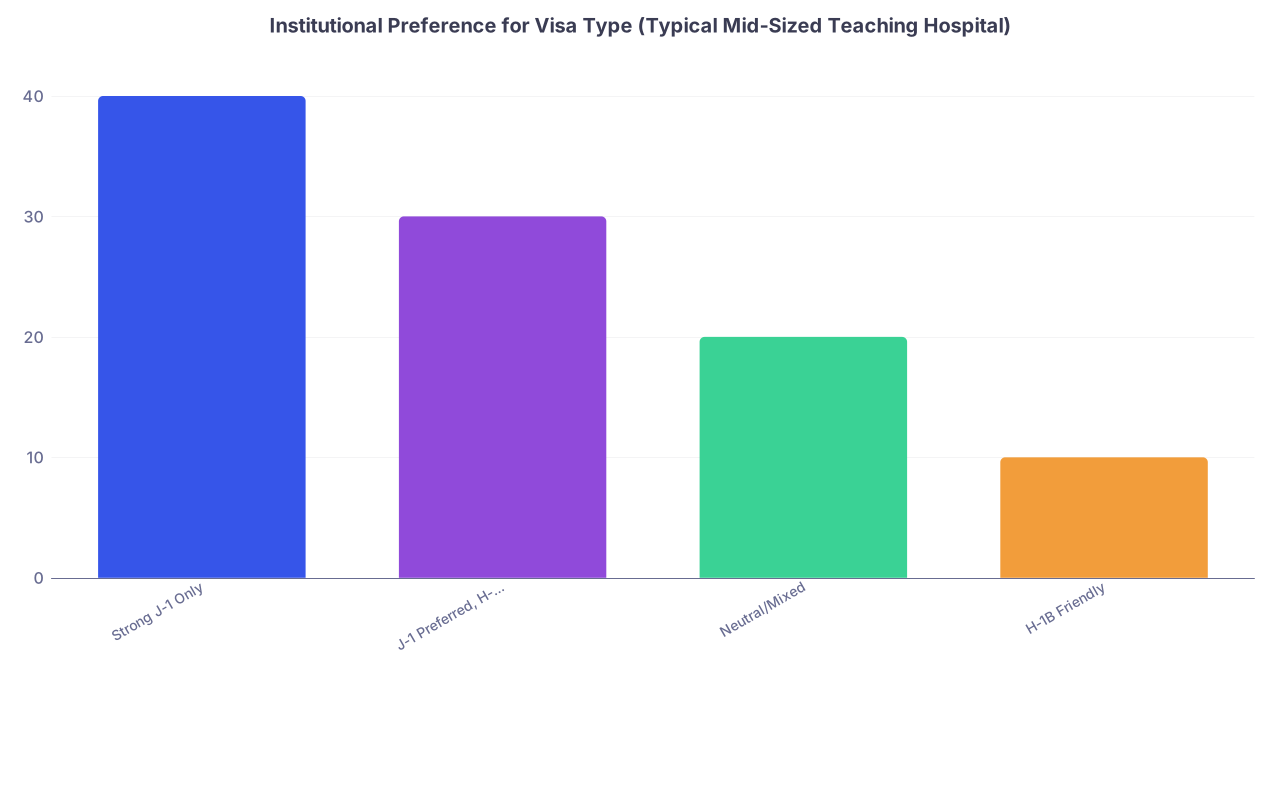
| Category | Value |
|---|---|
| Strong J-1 Only | 40 |
| J-1 Preferred, H-1B Limited | 30 |
| Neutral/Mixed | 20 |
| H-1B Friendly | 10 |
How Risk Looks From the PD’s Chair
You’re worried about your future job, waivers, green card. PDs are worried about something else: Will you finish training on time without creating administrative firestorms?
Let me translate the risk calculus.
J‑1: Predictable but “You’re Leaving”
Inside PD brain:
Pros:
- ECFMG structure. Paperwork template.
- Almost no risk of you “settling in” long‑term and getting stuck mid-visa fight with the institution.
- The 2‑year home residence rule is your problem, not theirs.
Cons (from their angle):
- You’re probably gone after residency or fellowship. Long-term faculty retention? Unlikely unless they’re at a big academic center with waiver positions.
- You’ll need a J‑1 waiver job. PDs at community programs know they may never see you again.
The blunt truth: most PDs do not lose sleep over what happens to you after graduation. They’re focused on covering call schedules, not your eventual green card.
So J‑1 often looks like the safest choice: structured, time-limited, low institutional entanglement.
H‑1B: Attractive if You’re a Long-Term Prospect, Scary if You’re a Wildcard
From the PD’s perspective:
Pros:
- You can potentially stay on as faculty or a hospitalist.
- No 2‑year home rule complicating post-training employment — easier to hire you directly after graduation.
- For highly specialized fields, they like the option of keeping you.
Cons:
- Institutional legal exposure.
- More cost.
- More moving parts (transfers, extensions, cap issues if they’re not cap-exempt).
- If your visa goes sideways mid-training, they’re in the mess with you.
So H‑1B can be viewed as the “investment visa.” PDs will push harder for it for residents they think can become future chiefs, fellows, or faculty. For everyone else, they sometimes quietly prefer J‑1.
I’ve sat in meetings where someone literally said:
“If we really want her as future faculty, we can justify H‑1B. Otherwise, J‑1 is safer.”
That’s the real hierarchy.
What PDs Say Publicly vs. Privately
Programs massage the language on their websites for a reason. They’re trying to keep options open without committing to every applicant’s favorite scenario.
Let’s decode.
| Website Language | Likely Internal Reality |
|---|---|
| "We accept J-1 and H-1B visas." | H-1B only if Step 3 done early, limited slots, GME approval needed. |
| "We sponsor J-1 visas through ECFMG." | J-1 only. H-1B is either forbidden or an extreme exception. |
| "Visa sponsorship considered on a case-by-case basis." | No one wants to write a clear policy. PD will fight for rare H-1Bs, but most IMGs will end up J-1. |
| "We have had residents on H-1B visas." | Past tense is doing a lot of work. Might not be true this year. |
| "We adhere to institutional visa policies." | Translation: PD has limited power. GME/Legal makes the real decision. |
On interview day, when you ask, “Do you sponsor H‑1B?” watch how they answer:
Clear: “We only sponsor J‑1 for residency.”
Believe them. That’s policy.Vague: “We’ve had some H‑1Bs in the past… it depends… you’d need Step 3…”
That means: you might get it, but only if you are top tier and you check every institutional box.Overly enthusiastic: “Oh yes, we love H‑1Bs!”
I’ve seen PDs promise this, only to be blocked by GME later. Ask: “How many H‑1B residents do you currently have in the program?” If that number is zero or one, calibrate your expectations.
Do not confuse “possible” with “probable.”
Specialty and Program Type: Who Actually Fights for H‑1Bs?
Not all programs behave the same. Some will genuinely go to bat for H‑1B candidates. Others will block it silently.
Big Academic IM Programs vs. Smaller Community Programs
Large academic internal medicine (think: university hospitals):
They often have both J‑1 and H‑1B. They also have legal infrastructure and cap‑exempt status, especially if tied to a university. These are the programs that may actively plan for a few H‑1Bs per year for research‑heavy or star candidates.Community programs:
Often J‑1 dominant. They may say H‑1B is “possible” but hate doing it. They don’t have the bandwidth, or they’re under a health system that says no.Surgical fields:
Often much more visa-averse in general, not just anti‑H‑1B. They see visas as risk layered on top of already high demands. The default is often: “US citizen/green card first, visas only if absolutely exceptional.”
Fellowship Pipeline Programs
Where I’ve seen genuine H‑1B advocacy:
- Programs that view you as a future fellow, chief, or junior faculty
- Institutions that are building long-term subspecialty pipelines
They will say internally:
“If we invest in an H‑1B now, we can keep them for cardiology fellowship and maybe as faculty.”
If you’re clearly fellowship-bound and strong on paper — high Step scores, strong research, good letters — your H‑1B ask lands differently. You’re not just a 3‑year cost; you’re a 10‑year asset.
Misconceptions IMGs Have About H‑1B vs. J‑1
Let me be blunt about a few myths I hear from IMGs every single year.
Myth 1: “If I ask for H‑1B, they’ll think I’m demanding and won’t rank me.”
Most PDs are not that fragile. What they actually think is:
- “Does this candidate understand our actual policy?”
- “Are they realistic?”
- “Do they know they need Step 3?”
The mistake isn’t asking. The mistake is:
- Insisting when they’ve clearly said “we’re J‑1 only.”
- Acting like H‑1B is a right, not a favor.
- Making visa type the only topic you want to discuss.
The mature, insider way to ask is:
“I’m eligible for both J‑1 and H‑1B and I’ll have Step 3 completed by [date]. Does your program currently sponsor H‑1Bs for residents, or is it J‑1 only in practice?”
That tells them you’re prepared and not naïve.
Myth 2: “Programs prefer H‑1B because they can keep me long-term.”
Some do. Many don’t care.
Here’s the harsh truth: a lot of programs assume you’re leaving whether you’re on J‑1 or H‑1B. Either for fellowship elsewhere, private practice, or another state. Long-term retention is a bonus, not a guarantee.
For many PDs, the priority is filling service needs for the next 3 years with the least administrative hassle. That skews them toward J‑1, not H‑1B, unless you’re a standout.
Myth 3: “If they list H‑1B on their website, I have a good chance.”
No. You have a non-zero chance.
I’ve seen programs list: “We sponsor J‑1 and H‑1B.” Then at the rank meeting:
“We already have our H‑1B quota filled this year.”
“Let’s not trigger another H‑1B case; stick to J‑1 for the rest.”
Website language reflects historical capability, not current-year appetite.
How PDs React to Red Flags in Your Visa Story
Something you never hear about on forums: how much visa “baggage” matters.
PDs and GME get nervous when they see:
- Prior visa denials
- Multiple status changes and gaps
- Work history that looks out of status or sketchy
- Long US stay without clear legal continuity
They will not tell you this directly, but immigration history can kill H‑1B possibilities fast. J‑1 is somewhat more compartmentalized through ECFMG, but even there, prior messes can spook people.
The safer your paperwork looks, the easier it is for a PD to say:
“Let’s go for H‑1B; low risk, clean record.”
If they sense complexity, they think: more emails, more delays, more chances something blows up mid-year. And suddenly, your H‑1B dream becomes a J‑1 recommendation.
What Smart IMGs Actually Do With This Information
Let’s talk strategy, not fantasy.
Map programs by real, not advertised, behavior.
Ask current or recent residents (especially IMGs):- “What visa types are current residents on?”
If you see zero H‑1B residents in the last 3–5 years, that “H‑1B friendly” line is mostly fiction.
- “What visa types are current residents on?”
Front-load Step 3.
If you’re serious about H‑1B, Step 3 is not optional. It’s your ticket into the conversation. Without it, most PDs mentally drop you into the J‑1 bucket immediately, even if they never say that out loud.Stop thinking in moral terms: ‘good’ vs. ‘bad’ visa.
PDs don’t see J‑1 as “worse.” They see it as simpler. You might hate the 2‑year home rule. They don’t. It’s not their problem. Adjust your expectations accordingly.Treat H‑1B as a privilege, not baseline.
The programs that will fight for your H‑1B are looking for something in return: excellence, long-term potential, or a unique skillset. If you’re average on paper, they will not spend political or financial capital on your visa preference.Be brutally honest with yourself about competitiveness.
If your scores, CV, and letters are solid but not stellar, mass‑targeting strict H‑1B programs is how you end up unmatched. Plenty of very strong IMGs train on J‑1, get waivers, and build good careers.

Bottom Line: How They Really See You, H‑1B vs. J‑1
Strip away the myths, and PD thinking boils down to this:
- J‑1 = predictable, cheaper, less institutional risk, easier for GME to manage.
- H‑1B = higher cost and complexity, worth it only for candidates who clearly justify the extra work — academically, clinically, or strategically.
When your file hits the table, they’re not asking, “Does this person deserve H‑1B?” They’re asking:
- “Is this the kind of resident I’d go to war with GME for?”
- “Do I see them as a long-term asset to this institution?”
- “Is their visa path clean and low risk, or a magnet for problems?”
If the answers are all yes, your H‑1B chances are real. If not, J‑1 is where you’ll be steered, even if no one ever spells that out.
So here’s what you should walk away with:
- Programs default to institutional safety. J‑1 usually wins that fight unless you’re truly exceptional.
- Step 3 and a clean visa history are your leverage. Without them, you’re arguing from a weak position.
- Website language is marketing. Watch what programs actually do, not what they claim they “support.”


