
The official story about J‑1 vs H‑1B is sanitized. The way many programs actually behave is not.
Let me spell it out: some residency programs put “J‑1 only” on their website, or “J‑1 sponsored, H‑1B considered,” then behind closed doors quietly favor H‑1B candidates—especially strong IMGs—while publicly pretending they do not. Others do the opposite: list both, then systematically filter out H‑1B applicants because they do not want the hassle.
You will not hear this on an info session. You will not get a straight answer in most emails. But the pattern is obvious if you sit in enough recruitment meetings. I have.
This is what really happens.
The Official Line vs The Real Behavior
On paper, the messaging is clean and simple:
- “We sponsor J‑1 visas through ECFMG.”
- “We sponsor J‑1 and H‑1B visas for eligible applicants.”
- “We accept only J‑1 visa candidates.”
Then rank meeting rolls around. PD, APD, a few core faculty, maybe a GME rep. Spreadsheet up on the projector. And suddenly the conversation is:
“She’s amazing… but she’s J‑1 and probably gone in three years.”
“He’s H‑1B eligible, that’s a big plus for our hospital.”
“We’re over our J‑1 cap; next one better be H‑1B if possible.”
Same program. Different truth.
Here’s the core contradiction: programs want flexibility, loyalty, and long‑term retention. J‑1 structure pushes you out of the US (or at least into specific waiver jobs) after training. H‑1B gives you a cleaner path to stay and work in the same health system.
So they say “J‑1” publicly to keep things simple and safe with GME and legal. But internally, especially for high‑value IMGs, they lean H‑1B whenever they can get away with it.
Why Programs Publicly Emphasize J‑1
You need to understand why J‑1 is the “safe” public answer.
1. GME Offices Like Standardization
Most institutional GME offices hate complexity. They have 30+ programs, hundreds of residents. They do not want each PD freelancing visa strategies.
J‑1 is standardized. ECFMG handles most of the bureaucracy. Templates, checklists, predictable timelines. From a hospital administrator’s viewpoint, that’s a dream.
So GME often tells programs:
- Default to J‑1
- Limit H‑1B use
- Do not promise H‑1B in writing
- Keep website language generic and conservative
You’ll see that reflected on many official pages—very J‑1 heavy, H‑1B hedged or barely mentioned.
2. Legal Liability & Risk Aversion
In internal meetings, legal will say things like:
“We prefer residents on J‑1 because we don’t carry the long‑term immigration obligations.”
“H‑1B comes with wage rules, caps, specialty occupation definitions… more ways to get in trouble.”
J‑1 risk is shared with ECFMG and is time‑limited. H‑1B is the employer’s full responsibility with USCIS.
So the cautious corporate line: “We sponsor J‑1 through ECFMG. H‑1B may be considered on a case‑by‑case basis and is not guaranteed.” That line is in some version in dozens of program manuals.
3. Historical Inertia
A lot of programs that are “J‑1 only” just never updated their culture. The old PD retired, the new PD inherited the “we do J‑1” stance, and everyone just kept repeating it.
Then a few years later, they quietly start making exceptions for star applicants. But the website and official policy? Never updated. Why rock the boat?
Why They Quietly Favor H‑1B For Strong IMGs
Now let’s talk about why H‑1B quietly gets favored in certain rooms.
1. The Retention Game
Here’s the part nobody tells you at info sessions: programs are not just training you. They are building their future attending workforce.
Administrators openly say things like:
“We need people who can stay on as hospitalists after graduation.”
“We lose too many J‑1s to waiver jobs in rural nowhere; that kills our recruitment.”
That’s the fear behind J‑1: you match them, train them, love them… then they are basically forced to leave the academic center to do a J‑1 waiver in some underserved area, often outside your network. You’ve just spent three years creating a very competent physician for someone else.
H‑1B, from their perspective, is a long‑term investment:
- They can keep you as a hospitalist, fellow, or junior faculty without the J‑1 waiver constraints.
- They can move you inside the same health system with less friction.
- They can plan for you in their staffing models 5–10 years out.
In rank meetings, the phrase “more likely to stay” gets said. A lot. And it’s often code for “on H‑1B / US citizen / green card.”
2. Internal Politics with the Hospital
This is the piece applicants routinely underestimate.
Many big hospital systems are starving for stable, visa‑independent (or at least long‑term viable) physicians. Primary care, hospitalist medicine, certain subspecialties—they need bodies, and they want people who can stick around.
So behind closed doors, you hear:
“If we bring in H‑1B residents, we can transition them to staff later.”
“Our department chair wants more attendings who can stay. Not J‑1s who disappear.”
Residency becomes part of the pipeline strategy. H‑1B IMGs are seen as candidates who can realistically become part of the long‑term workforce.
J‑1s? Often seen as temporary—no matter how much they love you.
3. Perception of Commitment and Stability
This one is a bit ugly, but it’s real.
There’s a perception in some committees that IMGs on H‑1B are:
- More “serious” about living in the US long‑term
- More likely to commit to the institution
- Less likely to be forced into remote waiver jobs
Totally unfair generalization. But people make decisions off heuristics, not fairness.
I’ve heard statements like:
“He’s H‑1B eligible, married with kids here, they’re not leaving. That’s huge for us.”
“She’s J‑1 and probably aiming for Canada or a waiver job; we may never see her again after graduation.”
Those phrases show up in actual rank-list discussions.
The Quiet Middle: Programs That Play Both Sides
Plenty of programs sit in the gray zone. Publicly J‑1 dominant. Privately flexible for the right candidate.
Typical scenario:
- Website: “We sponsor J‑1 visas. H‑1B is not routinely sponsored. Exceptional cases may be reviewed.”
- Reality: If your Step scores are strong, your letters are glowing, and you present as a future fellow/academic/hospitalist star, suddenly H‑1B is “possible.”
I’ve seen this play out dozens of times:
Applicant emails coordinator: “Do you sponsor H‑1B?”
Reply: “We mainly sponsor J‑1 via ECFMG. H‑1B is rare and not guaranteed.”Applicant crushes the interview. PD is impressed. At rank meeting:
“If she wants H‑1B, we can take it to GME. She’s worth the hassle.”GME/legal reluctantly agrees for a small number of H‑1Bs, often 1–3 per year.
The official stance never changes. But the actual behavior quietly shifts for top‑tier IMGs.
Here’s how that looks structurally:
| Aspect | Public Message | Private Behavior for Top IMGs |
|---|---|---|
| Website language | J‑1 emphasized | H‑1B quietly allowed |
| Coordinator emails | Cautious, J‑1 first | “Case‑by‑case” hints |
| Rank list discussion | Rarely mention visa type | Visa strongly influences rank |
| Final decision power | “GME policy” blamed | PD + chair often override |
The Filtering You Do Not See
Let’s be blunt about something uncomfortable: a lot of the “we accept both J‑1 and H‑1B” language is technically true but operationally misleading.
Here’s what often happens in the ERAS filter phase:
- Some programs filter out all H‑1B‑requiring applicants, regardless of strength, because GME said “keep H‑1B minimal.”
- Others do the opposite: they flag H‑1B‑eligible IMGs as “priority” because of retention strategy.
- Many claim they “review everyone holistically” while quietly using a visa type flag next to your name when deciding interview offers.
They rarely say this out loud because it sounds discriminatory. But in closed meetings, I’ve seen faculty scroll down the candidate list and literally say:
“Too many J‑1s already.”
“Let’s not overload on H‑1B; legal will scream at us.”
“Flag this one—H‑1B eligible, strong research, we should push for him.”
That is the actual working reality.
The Money Angle Nobody Explains To You
You’re probably thinking: H‑1B is more expensive, so why would they favor it?
Here’s what you do not see from the outside.
Yes, H‑1B has:
- Attorney fees
- Filing fees
- More HR time
But if the hospital is thinking long‑term, that cost is trivial compared to:
- Recruiting a new attending
- Paying locums coverage
- Losing continuity in key services
I’ve sat in meetings where the CFO basically shrugged at visa legal fees and said:
“If we can get even one long‑term hospitalist out of this class, the H‑1B cost is irrelevant.”
They do not do that for everyone. But for a handful of “high‑yield” IMGs? The math works.
Why Some Programs Really Do Avoid H‑1B
Now, balance this with the other side: some programs absolutely do not want H‑1B, no matter how great you are.
You will typically see this in:
- Small community hospitals with minimal legal support
- Programs under strict corporate policies (system‑wide “no H‑1B for trainees”)
- Residencies that got burned by a messy H‑1B case in the past
Inside those programs, you hear:
“We cannot handle the compliance risk.”
“HR said no more H‑1B; it’s final.”
“Our contract with the law firm doesn’t cover trainees.”
Those places will list “J‑1 only” and mean it. Occasionally they’ll still interview H‑1B‑requiring IMGs because someone didn’t screen properly, then you get the classic vague rejection: “We are unable to support your visa needs at this time.”
Translation: HR said absolutely not.
How You, As an IMG, Should Read Between the Lines
You cannot change internal politics. But you can stop playing blind.
1. Decode the Website and the Fine Print
A few patterns:
- “We sponsor J‑1 visas” with no mention of H‑1B: probably J‑1‑only reality, but sometimes they will bend for a superstar if the department chair fights for you.
- “We sponsor J‑1. H‑1B may be considered for exceptional candidates”: this is the middle ground. H‑1B possible, but you must be clearly above their usual threshold.
- “We sponsor both J‑1 and H‑1B visas” with no caveats: more likely they genuinely do both, but volume may still be limited by GME.
If a program lists only J‑1 and explicitly says “we do not sponsor H‑1B,” do not waste time hoping to “convince” them. They’ve already lost internal battles you cannot see.
2. Email Smart, Not Needy
If you ask “Do you sponsor H‑1B?” you’ll almost always get a cautious, generic answer. That’s by design.
A better approach:
- Show that you know the basics.
- Frame it as clarification, not a demand.
- Don’t make your first interaction with a program purely about visa needs.
For example:
“I understand from your website that your institution primarily sponsors J‑1 visas through ECFMG, with occasional H‑1B support. For strong IMG candidates who meet all USMLE and ECFMG requirements, is H‑1B ever supported at the residency level, or is that reserved only for fellows/attendings?”
Even if they still send a non‑committal reply, the way they phrase it usually gives you clues:
- “We almost exclusively use J‑1” → treat as J‑1 only.
- “H‑1B has been sponsored in limited cases in the past” → there’s a door, but it’s narrow.
3. Listen Carefully on Interview Day
If you pass the filter and get in the room (or Zoom), pay attention.
Interview‑day phrases that mean something:
- “Most of our IMGs are on J‑1” → but maybe not all. Ask a senior resident privately.
- “We’ve had a few residents on H‑1B in recent years” → clear proof it’s possible.
- “You’d have to discuss visa specifics with GME if you match” → usually PD is either constrained or hedging.
The most reliable intel is from current residents. Ask them off‑camera or by email:
“Has anyone been on H‑1B in the last five years?”
“Did anyone enter on J‑1 and change to H‑1B later in fellowship within the same system?”
Those answers will tell you more than any glossy slide deck.
Strategic Takeaways for IMGs Choosing Between J‑1 and H‑1B
Here’s the unvarnished advice I give IMGs privately.
If You’re Competitive Enough for H‑1B:
By “competitive,” I mean something like:
- Solid scores (e.g., Step 2 in the 240s+ if scored; strong pass if pass/fail era with other strengths)
- Strong US clinical experience
- Solid letters from US attendings
- Clear long‑term interest in academic or hospitalist careers
Then:
- Apply broadly to programs that explicitly mention both J‑1 and H‑1B.
- Include some “J‑1 primary, H‑1B occasional” places where your profile will stand out.
- During interviews, quietly probe about prior H‑1B residents.
You’re playing the long game. H‑1B gives you better continuity with the same institution post‑residency.
If You Are J‑1‑Only (By Circumstance or Timeline):
Then maximize what J‑1 actually offers:
- Huge number of programs willing to sponsor
- Shorter ramp‑up for paperwork (ECFMG does a lot for you)
- Reasonable pathway: J‑1 waiver job → H‑1B → later green card through employer
In that case, don’t obsess about chasing one or two maybe‑H‑1B programs that send mixed signals. Lock in a solid training program first. Visa optimization comes second.
The Bottom Line
Programs publicly lean J‑1 because it’s clean, standardized, and keeps GME and legal happy. But when they look at their real needs—retention, staffing, long‑term pipeline—they quietly start to favor H‑1B for certain IMGs they see as future colleagues, not just temporary trainees.
You will almost never see that written anywhere. But you will see it in who actually gets ranked highly, sponsored, and hired back.
Your job is not to argue with their politics. It’s to read them accurately, choose where to spend your energy, and line up your visa path with your long‑term goals instead of chasing vague promises.
Years from now, you will not remember the exact wording on a program’s visa page. You will remember whether you understood the game early enough to make it work for you instead of against you.
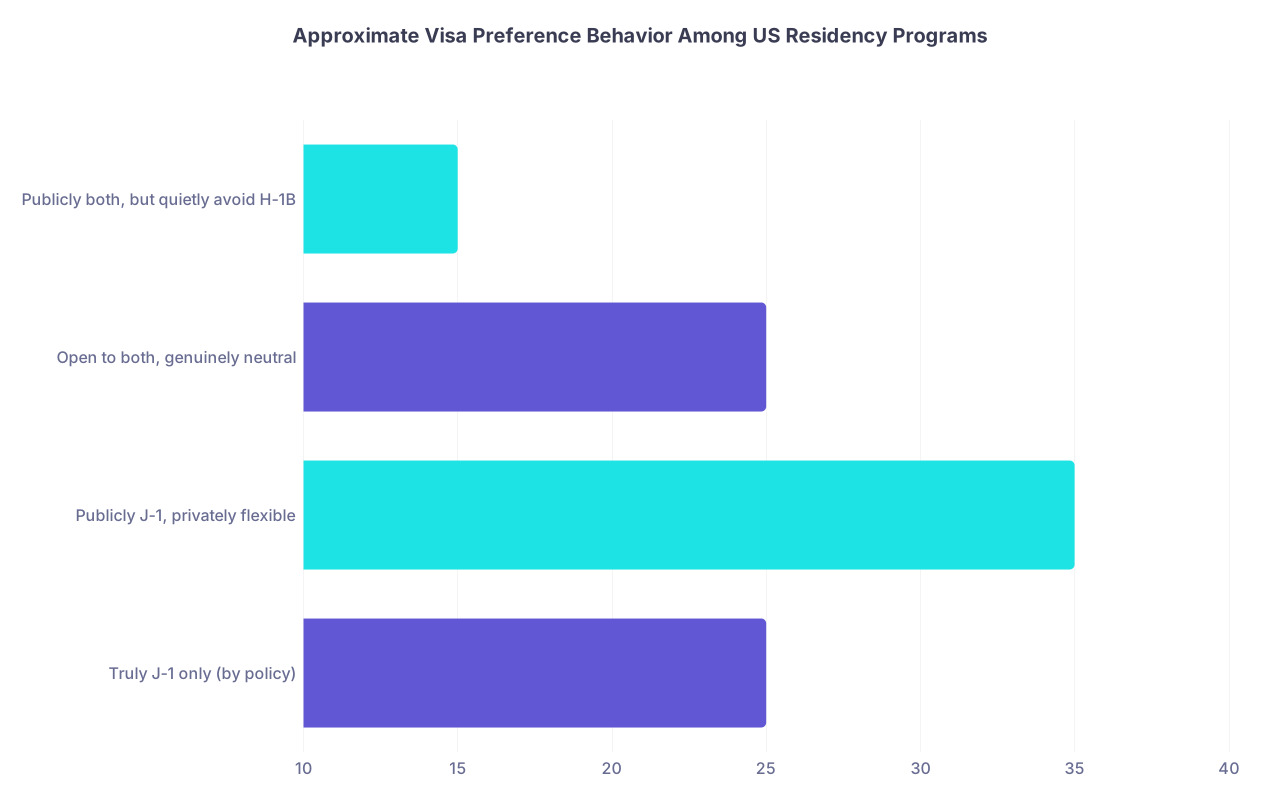
| Category | Value |
|---|---|
| Truly J-1 only (by policy) | 25 |
| Publicly J-1, privately flexible | 35 |
| Open to both, genuinely neutral | 25 |
| Publicly both, but quietly avoid H-1B | 15 |

| Step | Description |
|---|---|
| Step 1 | Applicant Reviewed |
| Step 2 | Reject or Low Rank |
| Step 3 | High Rank - No Issue |
| Step 4 | Approve H-1B & Rank High |
| Step 5 | Push to J-1 or Lower Rank |
| Step 6 | Prefer H-1B Next Time |
| Step 7 | Rank Based on Merit |
| Step 8 | Strong Candidate? |
| Step 9 | Visa Type? |
| Step 10 | GME/Legal Limits? |
| Step 11 | Need Long-Term Retention? |


FAQ (Exactly 5 Questions)
1. Why would a program list only J‑1 on the website if they sometimes do H‑1B?
Because GME and legal want a simple, conservative public stance. “J‑1 via ECFMG” is low‑risk and standardized. But when a truly exceptional candidate appears, the PD or department chair may quietly push for an H‑1B exception, especially in institutions desperate for long‑term recruits. They keep the website generic so they are never obligated to offer H‑1B to everyone.
2. Is it ever smart to ask directly in an interview, “Will you give me H‑1B if I match?”
No. That comes across as transactional and makes people nervous. You can and should ask about past patterns: “Have you had residents on H‑1B in the last few years?” or “How do prior IMG residents usually handle their visa status?” That gives you real information without sounding like you’re issuing demands before you’ve even matched.
3. Do programs ever rank H‑1B IMGs higher than equally qualified J‑1 IMGs?
Yes, absolutely, in some places. When leadership is focused on retention and future staffing, an IMG who can realistically stay in the same system (H‑1B) is seen as more valuable than someone who will almost certainly have to leave for a J‑1 waiver job. I’ve seen tie‑breakers in rank meetings go in favor of the H‑1B‑eligible candidate purely for that reason.
4. If a program says “We mainly sponsor J‑1, H‑1B is rare,” should I still apply as someone who needs H‑1B?
Apply only if you’re a very strong candidate relative to their usual pool and you’re applying broadly enough overall. When they say “rare,” what they usually mean is “we do it when it’s clearly worth the political capital.” If you’re an average or borderline applicant for that program, don’t count on being the exception.
5. Does choosing J‑1 close the door on staying in the US long‑term?
No. It makes the path more structured and sometimes more geographically constrained, but not closed. Many J‑1 IMGs complete waivers in underserved areas, transition to H‑1B, and then to green cards. What J‑1 does often close off is the option to seamlessly stay at the same academic center right after residency. That’s why some programs quietly prefer H‑1B for people they see as future faculty or long‑term hospitalists. Years later, plenty of J‑1s are still in the US—just not always where they initially trained.