

The biggest myth about H‑1B in residency is that program directors decide who gets it. They don’t. The GME office does. And their rules are much harsher than anything you’ll ever see on a website or in a webinar.
If you’re an IMG counting on H‑1B, you’re not up against “the program.” You’re up against the institution’s lawyers, the DIO, and a spreadsheet of risk categories you’ll never be allowed to see. Let me walk you through how those conversations really go when you are not in the room.
The Power Structure: Who Actually Controls Your H‑1B
In residency, visa sponsorship is not a democracy.
Program directors love to tell you “we’re H‑1B friendly” or “we’ll support the right candidate.” That sounds nice. It’s only half true.
Here’s the hierarchy in almost every teaching hospital:
- Program Director (PD): Wants the best candidate, often willing to sponsor.
- Department Chair: Cares about staffing, money, and not annoying GME.
- GME Office: Cares about compliance, institutional risk, and ACGME rules.
- Institutional Legal/Immigration Counsel: Cares only about federal compliance and liability.
- HR/Payroll: Cares that you’re on the right visa classification, on time.
The real veto power usually sits with GME plus legal. PDs can advocate, they can beg, they can say “we’ve always done this.” But a fair number of times each year, GME tells them no.
I’ve sat in those meetings. The PD says: “I really want this applicant. We can switch one of our J‑1s to an H‑1B spot.” The GME administrator opens their spreadsheet and responds: “This specialty is capped at X H‑1Bs. We’re at the cap. Also, they haven’t taken Step 3 yet. So no.”
End of discussion.
You have to understand: by the time your name comes up in those conversations, 80% of the decision is already made by policy. You’re not being evaluated as a person. You’re being checked against rules.
The Unwritten Rules GME Offices Use
Officially, an institution will say: “We sponsor J‑1 and occasionally H‑1B for qualified candidates.” Meaningless. Behind the scenes, they use a far more detailed rulebook.
Let me spell out the patterns that don’t get posted on websites.
1. Step 3 is not “preferred.” It’s a hard filter.
On paper: “H‑1B sponsorship requires successful completion of USMLE Step 3 before start date.”
In the room: “If they don’t have Step 3 at rank time, we will not rank them for H‑1B.”
There’s almost no flexibility here. Why?
Because the H‑1B petition has to be filed with evidence of licensure eligibility. For physicians, that means:
- ECFMG certification, and
- Passing Step 3.
The GME office has been burned enough times by “I’ll take Step 3 in March, I promise.” If you fail or the score is delayed, the petition stalls. Now they have a matched resident they can’t onboard legally. It’s a nightmare for everyone.
So they moved the line back in time: many institutions quietly require Step 3 passed by rank list certification, not by July 1. Programs will tell you “we encourage you to have Step 3.” GME tells the PD: “Do not rank them for an H‑1B slot without Step 3 already done.”
2. Specialty risk matters more than your CV
There’s a hierarchy of how much hassle GME is willing to take on for an H‑1B.
Tight staffing, service-heavy specialties where losing one resident is a disaster? They’re more willing to play ball: internal medicine, family medicine, pediatrics in some places, sometimes psych.
Highly competitive specialties with plenty of US grads and no trouble filling? They are stingy with H‑1Bs: dermatology, ortho, ENT, ophtho, many surgical subspecialties. They simply don’t need to deal with the risk and administrative overhead.
I’ve watched GME offices flat-out say: “We’ll do up to 3 H‑1Bs per year in IM, 1 in psych, none in surgery except exceptional circumstances.” That never shows up on their website.
| Specialty | Internal H-1B Attitude |
|---|---|
| Internal Medicine | Common, but numerically capped |
| Family Medicine | Variable, often limited |
| Psychiatry | Rare but possible |
| General Surgery | Very rare, often discouraged |
| Derm/Ortho/ENT | Almost never for residency |
3. J‑1 first, H‑1B only when forced
Most academic centers have a default position: J‑1 is the standard IMG visa. Why? Because it offloads part of the compliance burden to ECFMG, keeps training clearly temporary, and historically has been stable.
So the internal conversation often starts with:
“Can this person do a J‑1?”
If the answer is yes, GME will ask why on earth they should bother with an H‑1B. They know all the extra work: wage determinations, LCA, prevailing wage, H‑1B caps in other contexts, amendment filings when you change sites or rotations.
Good luck convincing them to voluntarily choose the more complex path when there’s an easier, standardized one.
Here’s when they do move toward H‑1B:
- The applicant is already on H‑1B at the institution (research) and converting to clinical.
- The department has a track record of sponsoring H‑1Bs and pushes hard.
- The institution is in a location that struggles to recruit, and they need every strong candidate.
But baseline: they start from “J‑1 is our default.”
Not what most IMGs applying for residency want to hear, but it’s the reality in those closed-door meetings.
The Real Checklist: How GME Screen Your File for H‑1B
Let’s strip out the marketing and talk about what boxes the GME and legal teams literally tick off before saying yes.
](https://cdn.residencyadvisor.com/images/articles_svg/chart-relative-weight-of-h-1b-decision-factors-in-gme-of-3605.svg "Relative Weight of H-1B Decision Factors in GME Offices")
| Category | Value |
|---|---|
| Institutional Policy | 35 |
| USMLE Step 3 Status | 25 |
| Program Director Advocacy | 15 |
| Candidate Strength | 15 |
| [Timing & Logistics](https://residencyadvisor.com/resources/visa-options-imgs/visa-timing-traps-deadlines-imgs-miss-that-kill-h-1b-possibilities) | 10 |
Roughly, this is how it goes.
Step 1: Institutional policy gate
Before a single human opinion matters, they check:
- Does our institution sponsor H‑1B for residents at all?
- If yes, is this specialty allowed H‑1Bs?
- Do we have any H‑1B “slots” left this year under our internal cap?
- Are there pending changes from legal/administration restricting sponsorship?
If the answer at this step is “no” or “we’re full”? You’re done, no matter how incredible you are.
Step 2: Eligibility check
For those who pass step 1, they look at:
- Step 3: Passed? Documented? USMLE transcript available?
- ECFMG: Certified or guaranteed by start date (GME hates uncertainty here).
- Prior US immigration history: Any prior H‑1B? Out‑of‑status issues? F‑1/OPT complications?
- Country of citizenship: Not officially discriminated, but they know who triggers 221(g) “administrative processing” delays more often.
Problem applicants in this stage are the “almosts”:
Step 3 scheduled but not passed. ECFMG pending one exam result. Visa history with a prior overstay.
These go to a separate mental pile labeled “too risky for H‑1B, J‑1 only if PD insists.”
Step 3: PD advocacy – the only time your name really matters
This is where your actual application enters the picture.
The PD will come to GME with something like:
“We really want Dr. X. They’re our number 1 IMG on the list. We’re OK sponsoring H‑1B. We did it last year.”
GME’s reaction depends on the category they’ve already put you in:
- Low‑risk candidate + policy open + Step 3 passed = “Fine, we’ll support.”
- Borderline policy + they’re not clearly stronger than a J‑1 candidate = “Why this one? Can they do J‑1 instead?”
- Policy resistant (specialty where H‑1B is discouraged) = “We’d prefer not. Can you rank them only for J‑1?”
I’ve heard the exact phrase: “He’s not H‑1B‑level strong.” That’s how blunt some internal discussions get. Not offensive, just cold calculus.
So yes, your strength matters. But only after you clear the institutional and eligibility filters.
Why Some GME Offices Secretly Hate H‑1Bs
You need to understand the psychology on the other side of the desk. Because they’re not anti‑IMG. They’re anti‑hassle and anti‑risk.
Legal exposure
Every time a hospital files an H‑1B, it’s signing legal statements about wage levels, job duties, and compliance. If something is wrong or challenged, the institution is on the hook.
A single badly managed H‑1B can trigger audits, back‑pay issues, or accusations of underpayment. GME offices remember every scare story. They don’t forget.
J‑1? That risk is partly on ECFMG’s shoulders. Simpler.
Administrative burden
H‑1Bs mean:
- Prevailing wage determinations
- LCAs
- Petitions
- Amendments if your rotation changes to a substantially different site
- Coordination with payroll and legal
All on tight timelines… while they’re also onboarding 100+ residents, updating ACGME data, managing CCCs, etc.
So when you ask for H‑1B, you’re essentially asking: “Can you add a multi‑month immigration project to your already overloaded spring schedule… just for me?”
Unpredictable delays
They’ve lived through this scenario:
- Fantastic IMG, Step 3 passed, petition filed early.
- Case goes to “administrative processing” at the consulate.
- July 1 hits. No visa.
- The program is short a resident for 1–3 months. The whole call schedule blows up.
After two or three of those, any GME director will quietly push back on H‑1Bs unless the PD screams.
Timing: The Part Nobody Explains to You
If you’re thinking about H‑1B after interview season, you’re already late.
The decisions start much earlier and follow a rough timeline inside the institution that you never see.
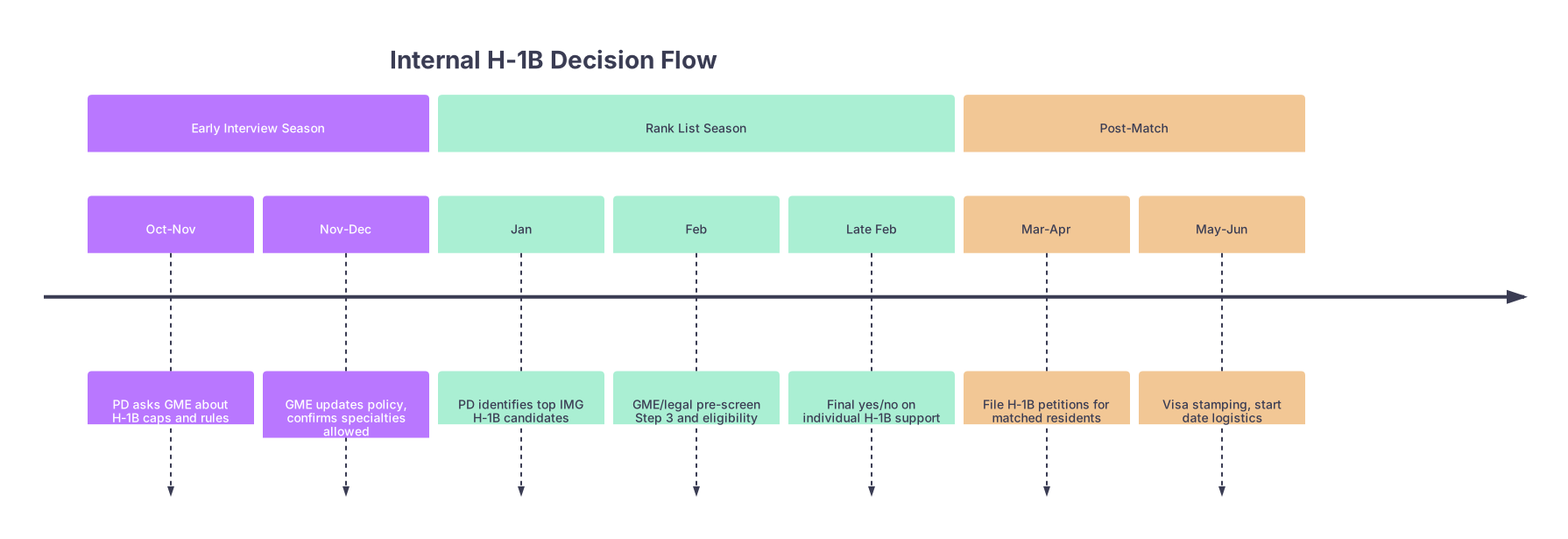
| Period | Event |
|---|---|
| Early Interview Season - Oct-Nov | PD asks GME about H-1B caps and rules |
| Early Interview Season - Nov-Dec | GME updates policy, confirms specialties allowed |
| Rank List Season - Jan | PD identifies top IMG H-1B candidates |
| Rank List Season - Feb | GME/legal pre-screen Step 3 and eligibility |
| Rank List Season - Late Feb | Final yes/no on individual H-1B support |
| Post-Match - Mar-Apr | File H-1B petitions for matched residents |
| Post-Match - May-Jun | Visa stamping, start date logistics |
Here’s the ugly truth: whether you get H‑1B support is often decided by February. Long before Match results. Long before you can “convince” anyone.
The steps you think matter—writing a nice email in April begging for H‑1B—do almost nothing. At that point, GME is in execution mode, not decision mode.
Why Two Applicants With the Same Profile Get Different Answers
You’re going to hear stories:
- “My friend got H‑1B with no Step 3 yet.”
- “At X program they converted a J‑1 spot to H‑1B after the Match.”
Yes. Those things happen. But you’re not seeing the whole board.
Four major behind‑the‑scenes factors change everything.
Factor 1: Historical memory
Institutions remember good or bad experiences with H‑1Bs for years.
If last year they filed three H‑1Bs:
- One got delayed,
- One had a wage issue,
- One withdrew mid‑contract—
They’ll quietly clamp down. You won’t see that on a website. You’ll just hear “unfortunately, we can’t this year.”
Flip side: if a department has smoothly sponsored H‑1Bs for years, and their previous IMG H‑1Bs are now beloved faculty, GME will bend further. Relationships matter more than formal policy.
Factor 2: PD political capital
Program directors have a limited bank of favors they can ask from GME.
Some PDs will spend that capital on you (an exceptional IMG needing H‑1B). Others will spend it on extra positions, faculty support, funding for a chief year. Or they’re new and don’t want to push.
GME will absolutely do H‑1B for some programs they’d flatly deny for others, purely because the PD knows how to push and when.
Factor 3: Funding source
If your salary comes from:
- Standard GME cap funding = more scrutiny
- Hospital or departmental funds (e.g., off‑cycle position, research‑to‑clinical) = sometimes more flexibility
I’ve seen exceptions granted where a department chair said: “We will fully fund this H‑1B position from departmental accounts.” Magically, a prior “we never do H‑1B in this specialty” became “we’ll make a one‑time exception.”
Factor 4: Your backup plan
This one is subtle but real.
When GME knows you can accept J‑1, they feel safer saying no to H‑1B. They know they’ll still fill the spot; you’ll likely still come.
If you’re truly H‑1B‑or‑nothing (due to future immigration plans, family, prior J‑1, etc.), some institutions quietly categorize you as “high risk for backing out” if they deny H‑1B. That cuts both ways. Some will just not rank you. Others will work harder if you’re clearly essential.
What Smart IMGs Do Before They Bank on H‑1B
You cannot control GME politics. But you’re not powerless either. The savvier IMGs—especially those I’ve seen actually secure H‑1Bs—do a few things right early.
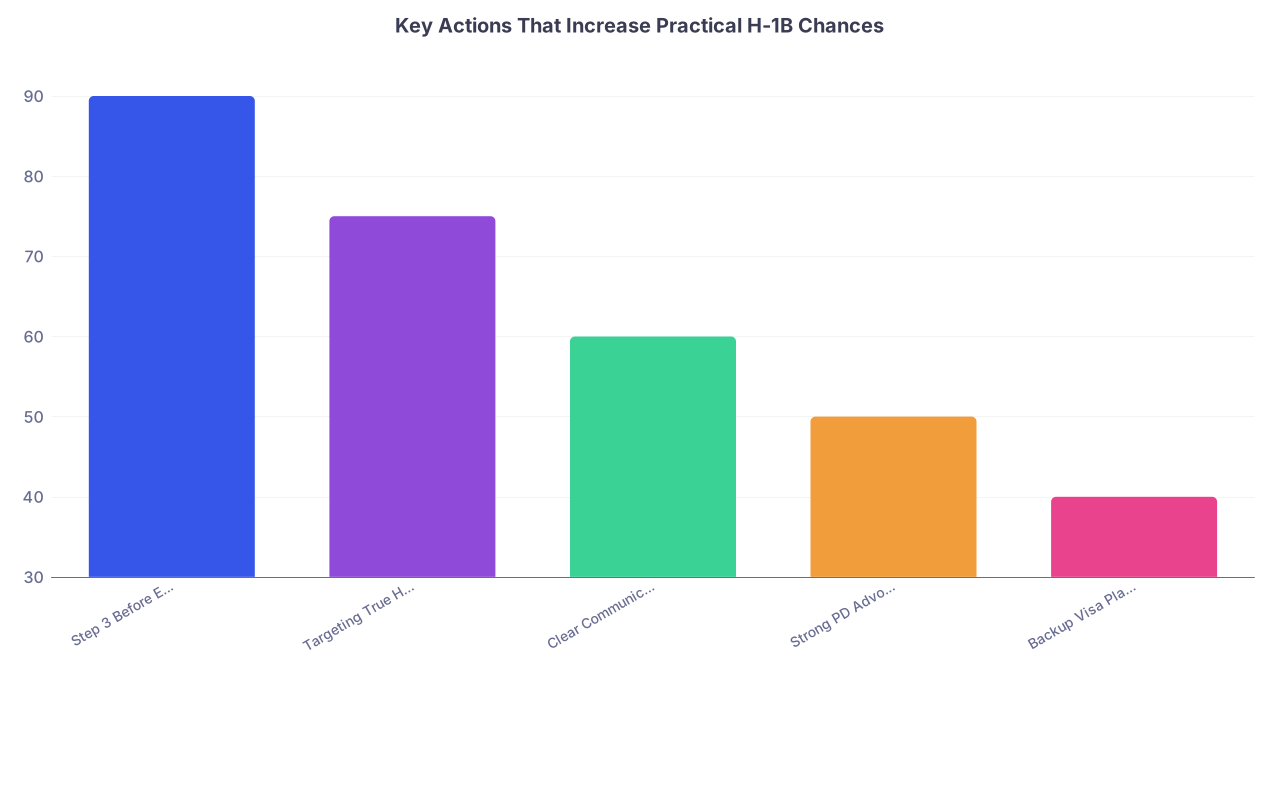
| Category | Value |
|---|---|
| Step 3 Before ERAS | 90 |
| Targeting True H-1B Programs | 75 |
| Clear Communication Early | 60 |
| Strong PD Advocacy | 50 |
| Backup Visa Planning | 40 |
Notice which bar is highest.
They don’t treat Step 3 as optional
If you want H‑1B, Step 3 is your entrance ticket. Serious applicants finish it before or early in application season.
You’re competing against IMGs who know this game and show up with:
- Step 1 and 2 done
- ECFMG certified or nearly there
- Step 3 passed by the time interviews start
They make the GME decision easy. If you’re aiming for H‑1B and taking Step 3 “sometime in spring,” you’re already behind.
They interrogate programs, politely but directly
Not: “Do you sponsor H‑1B?” Too broad. Everyone will say “it depends.”
Instead, on interview day or via email:
- “How many H‑1B residents are currently in your program?”
- “In the last 3 years, how many incoming residents actually started on H‑1B?”
- “Does your GME have a cap on H‑1Bs per year or per specialty?”
- “Do you require Step 3 passed before ranking for H‑1B?”
Applicants who ask these questions quickly discover that “we sponsor H‑1B” often means “we sponsored exactly one person five years ago as an exception.”

They align their story with institutional risk
Savvy applicants don’t send GME long emotional pleas. They send clarity.
For example, when asked about visa needs, they respond:
“I’m ECFMG certified and have already passed Step 3 (score XXX). I’m eligible for both J‑1 and H‑1B. Long‑term I’m interested in staying in the US, so H‑1B is my preference, but I understand institutional policies.”
This tells GME three things immediately:
- No Step 3 problem
- No ECFMG uncertainty
- They have a backup (J‑1) if institutional policy is strict
That makes you a less frightening file on the GME spreadsheet.
On the flip side, if your entire pitch is “I need H‑1B because of my immigration plans,” but you don’t have Step 3 done and you’re not markedly stronger than other IMGs, you get labeled as high‑maintenance risk with little upside.
How the Final H‑1B Decisions Actually Get Made Post‑Match
After Match Day, you think the drama is over. It isn’t—for the GME office, that’s when the real work begins.
For H‑1B‑bound residents, there’s usually a post‑Match triage meeting.
I’ve sat in those. They pull up a list:
- All matched residents flagged for H‑1B
- Their Step 3 status
- Their credentialing and licensing timeline
Then they ask two blunt questions:
- “Do we have any we need to push to J‑1 because timing won’t work?”
- “Do we have any cases that are too risky to file H‑1B for this year?”
Sometimes they quietly call PDs and say: “We know you expected H‑1B, but we’re going to have to do J‑1 instead this year due to timing.” Or: “We can file H‑1B, but if there’s any delay, they may need to start late.”
Occasionally, they go the other way: a candidate who expected only J‑1 gets an offer for H‑1B because they’re already H‑1B with the same institution or have extremely clean paperwork and the department pushed hard.

This is another behind‑the‑scenes reality: not every PD is kept fully in the loop on the visa back‑and‑forth. By the time you hear “we can do H‑1B for you,” several internal reversals and debates may have already happened.
The Hard Truths You Need to Accept
Let me strip it down.
First: no matter how good you are, you do not “deserve” H‑1B. It’s an institutional decision balancing risk, cost, and convenience. You may be phenomenal and still be steered to J‑1, or not ranked at all if you insist on H‑1B only.
Second: what’s written on websites is a watered‑down version of what GME is actually enforcing. Most of the real decision rules live in email threads and policy memos you’ll never see.
Third: your best leverage is before the rank lists and before the internal GME caps are emotionally locked in for the year. That means planning Step 3 early, choosing target programs intelligently, and asking the right questions during interviews—not praying for exceptions in April.

If You Remember Nothing Else
Keep these three things lodged in your brain:
GME, not the PD, decides who gets H‑1B. They follow internal caps, risk rules, and prior experiences you will never see on any website.
Step 3 is the real gatekeeper. If you’re serious about H‑1B, treat Step 3 as mandatory before rank lists, not optional “sometime before July.”
Most places default to J‑1 and only move to H‑1B when the upside is obvious and the risk is low. Your job is to make yourself look like the easiest, cleanest H‑1B file that GME will see all year.
Everything else—the personal statements, the warm fuzzy interview conversations—is secondary.
You’re not just applying to a residency program. You’re applying to an institution’s risk tolerance. Act accordingly.


