Understanding the Visa Landscape for Tri-State Residency Programs
The Tri-State Area—New York, New Jersey, and Connecticut—is one of the most popular destinations for international medical graduates (IMGs). With a high density of teaching hospitals, diverse patient populations, and many academic medical centers, it is also one of the most complex regions for residency visa planning.
For IMGs targeting tri-state residency programs, intelligent visa navigation is just as important as a strong ERAS application. Program directors in New York, New Jersey, and Connecticut often receive hundreds of IMG applications; misunderstanding J-1 vs H-1B, applying to programs that do not sponsor your preferred status, or missing key visa-related deadlines can quietly undermine an otherwise competitive profile.
This article lays out a step-by-step, IMG-focused roadmap to navigating residency visa issues specifically in the New York New Jersey Connecticut residency market, with practical strategies you can apply immediately.
Core Visa Options for Residency: J-1 vs H-1B
Most IMGs in U.S. residency training will be on either a J-1 (ECFMG-sponsored) visa or an H-1B (employer-sponsored) visa. A few may train in other statuses (e.g., green card holders, EAD holders), but for the majority of non–U.S. citizens/PRs, the real decision is J-1 vs H-1B.
J-1 Physician Visa (ECFMG-Sponsored)
What it is:
A non-immigrant exchange visitor visa for graduate medical education, sponsored by ECFMG, not your individual hospital. Almost all academic and community programs in the Tri-State Area are familiar with it and accept J-1 residents.
Key features:
- Sponsor: ECFMG (Educational Commission for Foreign Medical Graduates)
- Typical duration: Length of residency and fellowship, renewable annually
- Exam requirement: Must have passed USMLE Step 1 and Step 2 CK (or equivalent if still valid in your timeline) and meet ECFMG certification requirements
- English proficiency: Required by ECFMG, typically proven via USMLE/ECFMG pathways
- Two-year home residency rule (212(e)):
- Most J-1 physicians are subject to a two-year home country physical presence requirement after training
- You must return to your home country for an aggregate of two years or obtain a J-1 waiver (e.g., Conrad 30, federal agency waivers) before applying for H-1B or permanent residency (green card), with limited exceptions
Advantages of J-1 for Tri-State residency applicants:
Broad availability:
- The vast majority of teaching hospitals in New York, New Jersey, and Connecticut sponsor or accept J-1 visas.
- If your primary goal is to maximize interview opportunities, J-1 is the most flexible path.
Streamlined oversight:
- ECFMG provides a standardized, well-established process.
- Immigration teams at tri-state hospitals are very familiar with ECFMG procedures; fewer “surprises” compared with complex H-1B cases.
Easier for programs to manage:
- No prevailing wage or complex Department of Labor filings are required from the hospital.
- Less financial and administrative burden on the institution.
Disadvantages of J-1:
Two-year home return requirement:
- This is the most significant constraint and heavily influences long-term career planning.
- You will likely need a J-1 waiver job (often in underserved or rural/urban shortage areas) after residency/fellowship if you want to stay in the United States.
Less direct pathway to permanent residency:
- You cannot typically move straight to a green card from J-1 without dealing with the 212(e) requirement.
- Planning for J-1 waiver and later adjustment of status demands deliberate strategy.
Dependents’ work limitations:
- J-2 spouses can apply for work authorization (EAD), but this adds cost and processing time.
- Schooling for children is possible but must align with local regulations and finances.
H-1B Visa for Residency
What it is:
A dual-intent, employment-based visa for specialty occupations. Some residency programs in the Tri-State Area (especially larger academic centers) sponsor H-1B for eligible IMGs—but far fewer than those that accept J-1.
Key features:
- Sponsor: The hospital/health system (employer), not ECFMG
- Typical duration: Up to 6 years total (including time from prior U.S. employment or J-1→H-1B switches if applicable)
- Exam requirement: Must have passed USMLE Step 3 before H-1B filing in most states/programs
- Licensing requirement: Needs at least a temporary or training medical license in the sponsoring state
- Dual intent: It is compatible with immigrant intent and long-term plans for U.S. permanent residency.
Advantages of H-1B for Tri-State residency:
No J-1 two-year home residency requirement:
- You’re not subject to 212(e); this gives much more flexibility for future employment and green card pathways.
More straightforward long-term immigration planning:
- Easier to transition from H-1B to employer-sponsored green card (EB-2/EB-3) while continuing to work.
- Attractive if you are certain you want to build your career in the U.S. after training.
Perception in some competitive fields:
- Certain subspecialty fellowships and academic roles may slightly prefer candidates already on H-1B (not a universal rule, but sometimes observed).
Disadvantages of H-1B:
Limited availability in Tri-State programs:
- Many New York New Jersey Connecticut residency programs do not sponsor H-1B for residents due to cost, administrative burden, or institutional policy.
- Depending on your specialty, the list of H-1B-friendly programs can be significantly shorter.
USMLE Step 3 timing pressures:
- You need Step 3 results early enough for the hospital to file the H-1B petition and receive approval before residency start (July 1).
- If you’re still preparing for Step 2 CK close to ERAS season, Step 3 before Match may be unrealistic.
Cap and timing complexities:
- Many residency programs are exempt from the regular H-1B quota (“cap-exempt” as nonprofit/academic institutions), but you still must go through formal petition processes.
- Transferring from a cap-exempt H-1B (e.g., academic hospital) to a cap-subject employer later (e.g., private practice) can be complicated.
Dependents:
- H-4 dependents typically cannot work unless they meet specific exceptions (e.g., spouse with an approved I-140 in some scenarios).
Tri-State Specific Realities: How Visa Policies Vary by State and Institution
Each state in the Tri-State region has its own licensing rules, workforce needs, and historical patterns with IMGs. Within each state, individual institutions adopt their own visa policies. You must understand both layers: state-level context and program-level rules.

New York: High IMG Density, Wide Range of Policies
New York State hosts one of the largest numbers of IMGs nationwide. From massive academic centers in New York City to community programs in upstate regions, policies vary widely.
Typical patterns:
J-1 dominance:
- Most New York residency programs readily accept J-1 visas for IMGs.
- ECFMG/ECFMG-Exchange-Visitor Sponsorship is extremely routine for NY GME offices.
H-1B pockets:
- Certain large teaching hospitals and university-affiliated programs (especially in NYC and some regional centers) do sponsor H-1B for residency and fellowship.
- Often limited to highly competitive candidates and/or to particular specialties (e.g., internal medicine, some surgical specialties, subspecialty fellowships).
Licensing considerations:
- New York’s limited permit/training license requirements and timelines can influence when they can finalize an H-1B petition.
- Programs may prefer J-1 if they anticipate any delay in Step 3 or licensure documentation.
Implication for you:
If you’re applying broadly to New York, assume J-1 will be the standard option unless a program explicitly advertises H-1B sponsorship or responds affirmatively to your inquiry.
New Jersey: Growing Opportunities, Varied Sponsorship Policies
New Jersey’s health systems have expanded their residency offerings significantly in the last decade, with many community and university-affiliated programs.
Typical patterns:
Strong J-1 acceptance:
- Many New Jersey programs, especially community-based or smaller academic centers, primarily sponsor J-1.
- They rely heavily on ECFMG processes and may lack internal immigration staff for H-1B complexity.
Selective H-1B sponsorship:
- Some of the larger New Jersey health systems or universities (e.g., those with major academic affiliations) are open to H-1B for residents/fellows.
- These opportunities may be more common in internal medicine, family medicine, and some subspecialties.
Implication for you:
If you need H-1B, research program-by-program. For J-1, you’ll find relatively easier entry into New Jersey compared with some other U.S. regions, especially in primary care and internal medicine.
Connecticut: Smaller Market, More Policy Variability
Connecticut has fewer residency programs overall compared to New York and New Jersey, but several are highly reputable academic centers.
Typical patterns:
Mixed visa approaches:
- Many Connecticut programs accept J-1.
- A subset of major academic institutions and health systems will consider H-1B, especially for long-term recruitment prospects.
Tighter competition:
- With fewer total residency positions, and many being highly competitive, visa policies may change year-to-year depending on institutional goals, funding, and workforce needs.
Implication for you:
Check current-year visa policies directly on program websites or via email; don’t rely on old forum posts or outdated lists when planning your Connecticut applications.
Practical Strategy: How to Research and Align Visa Choices With Tri-State Programs
Your goal is to align your personal immigration needs with realistic program options in the Tri-State Area. That means doing intentional visa research alongside your typical residency research.
Step 1: Clarify Your Own Priorities
Before you dive into program websites, ask yourself:
Is staying long-term in the U.S. after training a top priority?
- If yes, an H-1B strategy (when feasible) may be attractive, but you must weigh it against the risk of limiting your program pool.
- J-1 is still compatible with a long-term U.S. career, but usually via J-1 waiver jobs followed by later green card processes.
How strong is my current application profile?
- Excellent USMLE scores, U.S. clinical experience, strong letters, and solid research can increase your chances of securing H-1B sponsorship at selective programs.
- If your profile is more average or has red flags, applying mostly to H-1B-only programs is risky—you may want to stay flexible with J-1.
Can I realistically pass USMLE Step 3 before Match or by early spring?
- If you’re still working on Step 2 CK or ECFMG certification close to ERAS opening, planning for widespread H-1B sponsorship is often impractical.
- For many IMGs, J-1 first, future H-1B via J-1 waiver job is a more realistic path.
Step 2: Systematically Check Program Visa Policies
You need to treat visa research like any other serious component of your residency strategy.
Where to look:
Program websites:
- Most tri-state programs list “Eligibility & Visa Sponsorship” or “International Medical Graduates” sections.
- Language to look for:
- “We sponsor J-1 visas only.”
- “We sponsor J-1 and H-1B visas.”
- “We do not sponsor any visas.”
- “We consider visa sponsorship on a case-by-case basis.”
FREIDA and official program directories:
- Often include basic visa information, but these entries can be outdated. Always confirm via the program’s own website or direct contact.
Direct email (professionally written):
- If the website is unclear, email the program coordinator or GME office with a concise question:
- “Could you please confirm whether your program sponsors J-1 and/or H-1B visas for residency?”
- Avoid long personal stories; keep it factual and courteous.
- If the website is unclear, email the program coordinator or GME office with a concise question:
Red flags and nuances:
“We currently accept only J-1 visas”
- Means H-1B is not an option; applying on the assumption of negotiating H-1B post-interview is almost always unrealistic.
“We may consider H-1B for exceptional candidates”
- Requires a very competitive profile and timely Step 3.
- Do not rely on this unless you can comfortably pass Step 3 early and have strong credentials.
“We do not sponsor or accept any visas”
- These programs are usually limited to U.S. citizens/permanent residents only.
Step 3: Build a Tri-State Application List With Visa Filters
Construct your tri-state residency application strategy using filters like:
Category A: J-1 only programs
- Broad pool in NY, NJ, and CT
- Good base for candidates comfortable with J-1 pathways
Category B: J-1 + H-1B programs
- Prioritize these if you are aiming for H-1B and can meet Step 3 deadlines
- Provide maximum flexibility (you can be considered for J-1 if H-1B doesn’t work)
Category C: H-1B-preferring programs
- Often fewer and may be highly competitive
- Apply if your credentials are strong enough to realistically compete
A balanced list might look like:
- 50–70% programs that accept J-1 (including those that also allow H-1B)
- 20–40% programs that explicitly sponsor H-1B, if that is your long-term preference and Step 3 is feasible
- A small number (0–10%) of “reach” programs with case-by-case H-1B sponsorship, if you’re a very strong candidate
Timing, Documentation, and Common Pitfalls
Visa issues can derail your plans even after a successful Match if you are not proactive. Here is how to avoid the most common problems for tri-state residency.
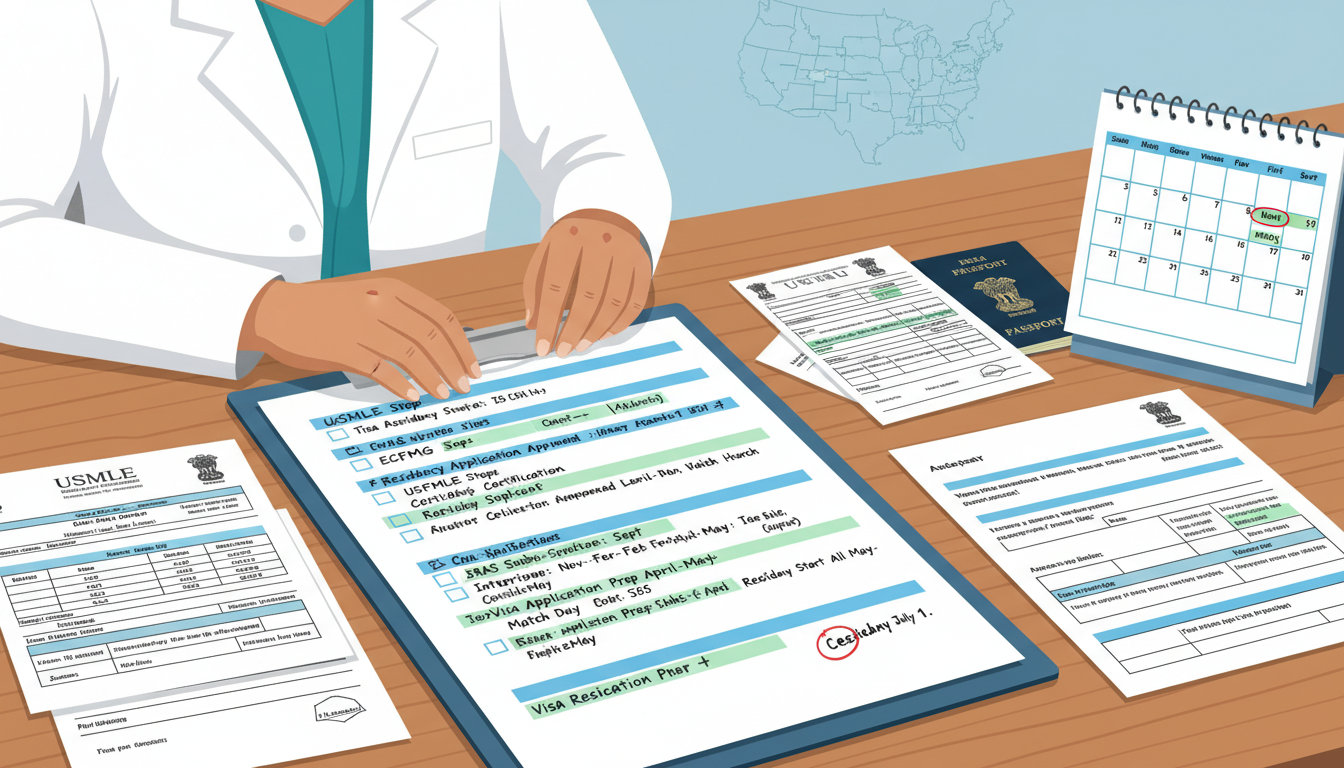
For J-1 Applicants
Key documents and steps:
ECFMG Certification:
- Must be completed before ECFMG can issue a Form DS-2019 (necessary for J-1 visa interview).
- Ensure all exam results and primary source verifications are finalized well before spring.
Program sponsorship forms:
- After Match, your program submits sponsorship forms to ECFMG.
- Delays can occur if you’re slow in providing documents (passport copy, CV, medical diploma, etc.).
Consular appointment timing:
- J-1 visa interview at the U.S. consulate can have variable wait times, especially in busy locations.
- Once you have DS-2019, book an appointment as soon as possible.
Common pitfalls to avoid:
Late ECFMG certification:
- If your certification is delayed into late spring, DS-2019 might be issued very late, risking your ability to start on time.
- Prioritize completing required exams and paperwork before Match if possible.
Misunderstanding the 212(e) rule:
- Some applicants are surprised post-residency that they cannot easily change to H-1B or adjust status.
- Plan early: understand J-1 waivers, potential underserved job locations, and long-term paths.
For H-1B Applicants
Critical timelines:
USMLE Step 3 completion:
- Aim to pass Step 3 before or very soon after Match Day.
- This gives your program sufficient time to file the petition and receive approval by July.
State training license:
- New York, New Jersey, and Connecticut all have specific forms and requirements for training permits.
- Programs cannot finalize H-1B petitions without evidence you can be licensed in that state.
Immigration coordination:
- Stay in close contact with the program’s GME office and their immigration attorney or HR.
- Respond quickly to document requests (passports, CV, diplomas, prior visa history, etc.).
Common pitfalls to avoid:
Overestimating H-1B availability:
- Many IMGs assume they can negotiate H-1B post-interview. In reality, most programs stick firmly to stated visa policies.
- Apply strategically to programs that actually sponsor H-1B, instead of hoping to “convince” others.
Ignoring prior status issues:
- If you previously held J-1 or other statuses in the U.S., consult an immigration attorney; prior status can impact new H-1B filings.
- Disclose any prior overstays or visa problems early to avoid denials late in the process.
Long-Term Career Planning From a Visa Perspective
Your residency visa choice in the Tri-State Area will shape your early career trajectory in important ways. Think beyond just “getting into residency.”
J-1 Path: From Tri-State Residency to J-1 Waiver Job
Most IMGs on J-1 who wish to remain in the U.S. follow a sequence like:
- Tri-State residency (J-1)
- Optional fellowship (J-1, extended with ECFMG sponsorship)
- J-1 waiver job—often in a Conrad 30 or another service-based waiver program
- Transition from waiver job to H-1B and then green card, or direct green card pathways via employer sponsorship
Tri-State–specific considerations:
- Many J-1 waiver jobs are outside major metro areas. Completing a residency in New York, New Jersey, or Connecticut does not guarantee a waiver job in the same region.
- Some states aggressively recruit J-1 waiver physicians; you might eventually work in a different state before returning to the Tri-State later with permanent residency or H-1B portability.
H-1B Path: Residency to Direct Employment and Green Card
For H-1B residents:
- Tri-State residency (H-1B, cap-exempt in many academic hospitals)
- Transition to fellowship (often still cap-exempt H-1B) or
- Direct move into employment in a cap-subject or cap-exempt employer
- Many pursue EB-2 or EB-3 green card sponsorship while working, eventually obtaining permanent residency
Challenges:
- Moving from cap-exempt (hospital) to cap-subject (private group) may require careful timing with the H-1B lottery.
- Your H-1B six-year limit must be managed with green card timelines in mind.
When to Seek Professional Legal Advice
While residency programs and ECFMG can guide you on standard processes, there are situations where consulting an independent immigration attorney is wise:
- Complex prior immigration history (e.g., prior J-1 on a different category, overstays, denied petitions)
- Spouses/children with separate or complicated immigration timelines
- Long-term strategy for academic careers, multiple fellowships, or concurrent research appointments
- Borderline or changing policies around J-1 waiver options tied to your country or specialty
Programs in New York, New Jersey, and Connecticut may offer general guidance but are not your personal legal representatives. For serious long-term planning and risk management, having your own counsel is often beneficial.
Frequently Asked Questions (FAQ)
1. Is J-1 or H-1B better for residency in the Tri-State Area?
Neither is universally “better.” In the New York New Jersey Connecticut residency market:
- J-1 is more widely available and provides more program options, especially for average or moderately competitive applicants.
- H-1B is more restrictive in terms of program availability but offers more flexibility for staying in the U.S. after training without a two-year home return or J-1 waiver.
Your choice should depend on your long-term immigration goals, exam timeline (especially Step 3), and competitiveness.
2. Can I start residency on J-1 and later switch to H-1B in the same program?
Normally, if you are subject to the J-1 two-year home residency requirement (212(e)), you cannot simply switch to H-1B without first fulfilling the requirement or obtaining a J-1 waiver. Some limited exceptions may exist, but they are narrow and fact-specific.
Most residents complete all of their GME (residency + fellowship) on J-1 and then pursue a J-1 waiver job (typically on H-1B) after training. If you are considering any mid-training status change, consult an immigration attorney early.
3. Do all Tri-State residency programs sponsor visas for IMGs?
No. While many New York, New Jersey, and Connecticut programs do sponsor J-1 (and some H-1B), there are:
- Programs that sponsor only J-1
- Programs that sponsor both J-1 and H-1B
- Programs that do not sponsor any visas and accept only U.S. citizens or permanent residents
Always check each program’s website or contact them directly before applying if visa sponsorship is essential for you.
4. When should I take USMLE Step 3 if I want H-1B for residency?
Ideally, you should have Step 3 passed before or shortly after ERAS submission, but practically:
- For most H-1B residency sponsorships, you need Step 3 passed by early spring (around March–April) so that your program can process your H-1B petition and receive approval before the July 1 start date.
- If passing Step 3 by then is unrealistic, strongly consider applying with a J-1 strategy or targeting only a small number of H-1B programs as a bonus instead of your primary plan.
Visa navigation for residency in the Tri-State Area is not just about ticking boxes; it’s about aligning your career goals, immigration realities, and program opportunities. By understanding the nuances of J-1 vs H-1B, researching tri-state residency visa policies carefully, and planning ahead for your long-term pathway, you can maximize your chances of both matching and building a sustainable future in the U.S. medical system.