
The visa path that makes the most sense if you want a long-term career in U.S. academia is usually: J‑1 for residency/fellowship → H‑1B (cap‑exempt) for junior faculty → employment-based green card (EB‑2 or EB‑1).
That’s the clean, realistic route for most people in academic medicine.
Let me walk you through what actually works, what backfires, and how to choose smartly now at the residency application stage so you don’t trap your future self.
Step 1: Pick the Right Visa for Residency
This is where you can either make your future academic life easy or dig yourself a hole.
For IMGs going into residency or fellowship, your realistic options are:
- J‑1 (ECFMG-sponsored)
- H‑1B (institution-sponsored)
- Rare edge cases: O‑1, dependent visas (H‑4, F‑2, etc.) – not the main pathway
Here’s the reality:
If your goal is U.S. academic medicine, J‑1 is often the most strategic starting point, even though everyone on forums screams “Avoid the J‑1 two-year home requirement!”
Why? Because:
Far more residency programs sponsor J‑1 than H‑1B
Especially academic/university programs. So if you insist on H‑1B only, you may:- Cut out a ton of strong academic programs
- End up matching at a community program with weak academic output
- Hurt your long-term academic CV (fewer publications, weaker mentors, no big-name institution on your resume)
Most serious academic centers know how to get you off the J‑1 track later
- J‑1 waiver jobs
- Moving to H‑1B after waiver
- Then sponsoring a green card as faculty
J‑1 gives clean, standardized rules
- ECFMG sponsor
- Clear requirements
- Predictable for GME offices
- No “we ran out of H‑1B slots” drama
So unless you’re absolutely certain you can secure H‑1B at a top teaching program that fits your academic goals, J‑1 is not your enemy. It’s usable, and thousands of academic physicians started that way.
Let’s compare residency visa options quickly:
| Visa Type | For Residency? | Typical Sponsor | Main Pros | Main Cons |
|---|---|---|---|---|
| J‑1 | Yes, very common | ECFMG | Widely accepted, predictable | 2-year home rule or waiver needed |
| H‑1B | Yes, less common | Hospital/University | No home rule, direct path to green card | Fewer programs sponsor, more complex |
| O‑1 | Extremely rare | Institution | No cap, flexible | Hard to qualify during residency |
| F‑1/OPT | Almost never for GME | N/A | — | Not realistic for residency |
If you’re in the Residency Match and Applications phase and you want a U.S. academic career, use this decision rule:
- If a strong academic program offers you J‑1 → that’s often better long-term than a weaker program offering H‑1B.
- If you can get H‑1B at a university program with real research, NIH funding, fellowships, and a track record of academic careers → that’s gold. Take it.
Step 2: Understand the J‑1 “Trap” – and Why It’s Manageable
The J‑1 issue everyone panics about is the two-year home-country physical presence requirement.
Basic facts:
- Most J‑1s in residency have to either:
- Go home for 2 years, or
- Get a waiver (e.g., Conrad 30, federal waiver like VA/NIH, hardship, persecution)
Academic-minded IMGs often say:
“If I take J‑1 now, I’ll be forced to go home and I’ll lose my U.S. academic momentum.”
Not necessarily.
Here’s where smart planning matters.
Common J‑1 waiver paths that still support academia
Conrad 30 waiver (state-based)
- You work in a designated underserved area for 3 years after training.
- Usually on H‑1B.
- Many of those jobs are community-heavy and not super academic. But:
- Some are at university-affiliated sites
- Some states are flexible
- You can still publish, teach, and build your CV if you’re intentional
Federal agency waivers (e.g., VA, NIH, HHS)
- Work for a federal entity or a qualifying research/clinical program
- These can be highly academic:
- VA hospital affiliated with a university
- NIH research roles
- Very compatible with a long-term academic career
Hardship or persecution waivers
- Fact-specific, based on family hardship or fear of persecution
- Unpredictable, need serious legal help
- Don’t build your entire career plan around this unless it’s clearly relevant to you
Once your J‑1 waiver is approved and you’ve completed the required service (usually 3 years), the home-country requirement disappears. At that point you’re just another H‑1B physician who can:
- Move to another academic institution on H‑1B (cap-exempt if it’s a university or affiliated hospital)
- Start the green card process (EB‑2 or EB‑1 depending on your CV)
So the “J‑1 means I’ll be stuck outside academia forever” narrative is exaggerated. You just have to budget 3–5 years of being more constrained, then pivot.
Step 3: Why Cap‑Exempt H‑1B Is the Sweet Spot for Academics
Once you’re done with residency/fellowship (whether you started on J‑1 or H‑1B), your ideal academic work visa is:
H‑1B with a cap‑exempt employer.
That usually means:
- A university or
- A non-profit hospital affiliated with a university, or
- A non-profit research institution
Why cap‑exempt matters:
- No lottery.
- No October 1 start limitation.
- You can extend beyond 6 years while green card is pending (with I‑140 + waiting for priority date).
- Academic HR offices know this pathway inside-out.
If you’re already on J‑1 and complete a waiver job (often also H‑1B), your next jump should be into this cap‑exempt academic H‑1B setting as faculty or research-track physician.
Step 4: The Endgame – Green Card Routes That Actually Work for Academics
If you want to stay in U.S. academia long-term, your real endpoint is permanent residency.
The main routes that fit academic physicians:
EB‑2, employer-sponsored (PERM)
- Most common for assistant professors, clinician-educators, clinician-researchers
- Steps:
- PERM labor certification (prove no U.S. worker is displaced)
- I‑140 immigrant petition
- I‑485 status adjustment when your priority date is current
- Needs some institutional commitment, but not superstar level
EB‑2 National Interest Waiver (NIW)
- No labor certification
- Can be self-petitioned or employer-supported
- Very good fit for IMGs with:
- Strong research
- Public health impact work
- Underserved area service plus academic activities
- Often used by physicians in underserved / waiver jobs plus publications, teaching, guidelines, etc.
EB‑1 (Extraordinary Ability or Outstanding Professor/Researcher)
- For high-performing academic physicians:
- Multiple first-author papers in solid journals
- Consistent citations
- Grants or significant funded projects
- Peer-review work, editorial roles, conference invitations
- Faster, avoids the long queue if your country of birth has backlogs
- For high-performing academic physicians:
If you’re serious about academia, design your CV around EB‑2 NIW or EB‑1:
- Publish early (even case reports > nothing).
- Ask explicitly to be involved in research projects.
- Get teaching responsibilities and document them.
- Join guideline committees, specialty societies, or quality improvement efforts if possible.
All of that turns into evidence later.
How Your Current Phase (Residency Match & Application) Should Guide You
You’re not filing a green card right now. You’re filling out ERAS and talking to programs. So what do you actually do today?
Here’s the framework.
1. Be flexible on J‑1 vs H‑1B, but strategic
- Don’t blacklist J‑1 programs if they’re academic powerhouses.
- Do ask this at interviews:
- “What percentage of your IMG residents are on J‑1 versus H‑1B?”
- “Do you sponsor H‑1B for residents or fellows?”
- “Where do your international graduates typically end up long-term? Academia? Community practice? Abroad?”
Programs that have a track record of IMGs staying in the U.S. academic system are more important than the visa label on day one.
2. Look for institutional patterns, not one-off promises
I’ve seen this too often:
- Program says: “We’re open to H‑1B.”
- When match time comes, GME or legal says: “Actually, we’ll only do J‑1 for categorical residents.”
So when you’re interviewing, ask:
- “How many current residents are on H‑1B?”
- “How many IMGs in the last 5 years have stayed here or moved to other U.S. academic positions?”
If their answer is one vague example from 2013, don’t build your life around their “flexibility.”
Academic vs Private Practice: Visa Logic Is Different
Since you’re explicitly aiming for academia, I’ll be blunt: your priorities are different from someone chasing private-practice money.
A private-practice-focused IMG might prioritize:
- Immediate H‑1B
- Fast jump into outpatient work
- High income, location flexibility
You, aiming at academia, should prioritize:
- Brand-name training institution
- Strong research infrastructure
- Mentor support
- A path from GME → fellowship → junior faculty → green card
That means:
Sometimes a big-name J‑1 residency > small community H‑1B residency
Because 10 years later, your CV and networks from that academic powerhouse matter more for getting an EB‑1 or NIW approved and landing a tenure-track or major teaching role.
Putting It All Together: The Most Common Successful Path
For IMGs who end up with stable U.S. academic careers, the path usually looks like this:
Residency:
- J‑1 at a solid academic IM program (or neurology, psych, etc.)
- Build research, present at meetings, find mentors
Fellowship (often still J‑1):
- Subspecialty at another or the same academic center
- More publications, first-author work, teaching experience
J‑1 Waiver Job:
- 3-year job (Conrad 30, VA, HHS, or federal research) on H‑1B
- Keep research going if possible, collaborate with academic sites, publish
Academic H‑1B Faculty Position (Cap-Exempt):
- Assistant professor / clinical instructor at university-affiliated hospital
- Start EB‑2, NIW, or EB‑1 process
Green Card Granted → Continue Academic Career
- Promotion to associate, leadership roles, or major research grants over time
Alternate version if you start on H‑1B in residency: same structure, but you skip the waiver step and go straight into fellowship/academic roles on H‑1B, then to green card.
Quick Reality Checks and Pitfalls
A few hard truths I’ve seen derail people:
Chasing H‑1B at the cost of training quality
You end up with weak letters, no research exposure, and zero path to EB‑1 or NIW. Not worth it.Ignoring the J‑1 waiver issue until PGY‑3
Then you’re scrambling. Start asking about waiver pathways during fellowship, not at the end.Relying on “I’ll just do an O‑1 later” without building the CV
O‑1 and EB‑1 want receipts: impact, citations, leadership, peer review, etc. You can’t fabricate that in 6 months.Staying in a purely service-heavy job with no academic output for too long
After several years of 100% clinic with no publications or teaching, it’s very hard to pivot back into serious academia or make a strong NIW/EB‑1 case.
One Visual to Keep in Mind
Here’s how your time often ends up split across the journey if you stay academic:
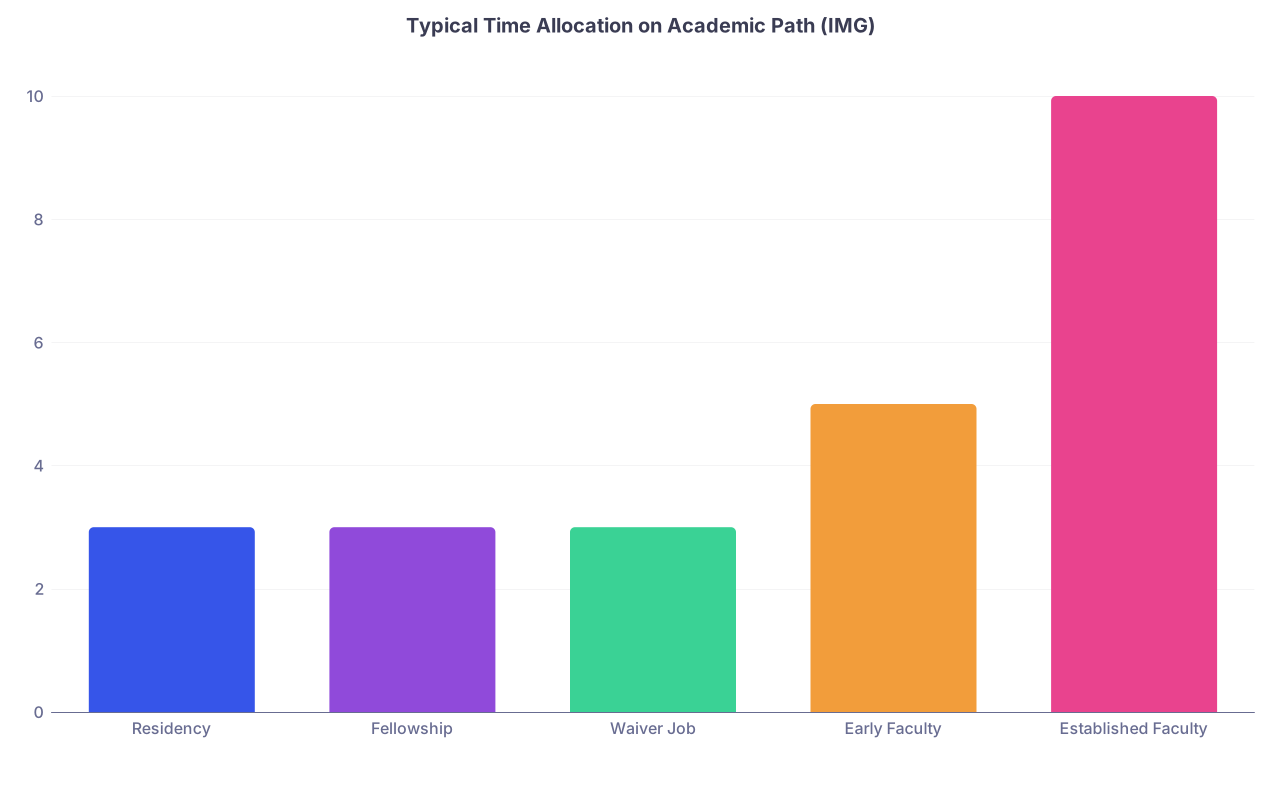
| Category | Value |
|---|---|
| Residency | 3 |
| Fellowship | 3 |
| Waiver Job | 3 |
| Early Faculty | 5 |
| Established Faculty | 10 |
Years stack fast. Where you spend them – and under what visa – matters.
Actionable Step for Today
Open your list of target residency programs right now. For each one, add two notes:
- Visa type they actually sponsor most commonly (J‑1, H‑1B, both, neither).
- Evidence that their IMGs have gone on to U.S. academic careers (yes/no + examples if you can find them).
If a program can’t give you a clear story on both of those, it’s a red flag for someone who wants to stay in U.S. academia.