
The biggest mistake many IMGs make is assuming “I’ll figure out my green card later.” You can’t. Your visa choice in residency (J-1 vs H-1B) directly shapes how, when, and sometimes if you can realistically get a U.S. green card.
Let’s answer your core question directly, then break down paths, timelines, and strategy.
Short Answer: Yes, But the Rules Are Completely Different for J-1 vs H-1B
Here’s the blunt truth:
On J-1 as a physician (ECFMG-sponsored):
- You are almost always subject to the 2‑year home residency requirement (INA 212(e)).
- You cannot get a green card (or H‑1B, or L‑1) until:
- You complete 2 years physically in your home country after finishing J‑1, or
- You get a J‑1 waiver approved.
On H‑1B as a physician:
- Yes, you can actively pursue a green card while on H‑1B.
- You can:
- File PERM + I‑140 and later adjust status (I‑485), or
- File EB‑1/NIW and then I‑485 (if your priority date is current).
- H‑1B is a dual intent status. That’s exactly what you want if your long‑term plan is a green card.
So the real question isn’t “can I?” It’s “what does a smart green card strategy look like on J‑1 vs H‑1B as a physician?”
Let’s walk that out.
Core Concept: Dual Intent vs Home-Residence Requirement
You have to keep two phrases straight in your head:
Dual Intent (H‑1B)
- You can say, “Yes, I plan to stay long term.”
- You can file immigrant petitions (I‑140, EB‑2 NIW, EB‑1, etc.) while you’re in H‑1B.
- Consulates generally won’t punish you for “immigrant intent” if you’re returning in H‑1B.
2‑Year Home Residency Requirement (J‑1 physicians)
- Almost all ECFMG-sponsored J‑1 physicians are subject to 212(e).
- If you’re subject:
- You cannot adjust status to permanent resident (green card) in the U.S.
- You cannot change status to H‑1B or L‑1 in the U.S.
- You cannot get an immigrant visa abroad.
- Until you:
- Serve 2 full years physically in your home country (the country of last residence before J‑1), or
- Get a waiver approved.
So:
- On H‑1B, the green card process is a question of timing and category.
- On J‑1, the green card process is a question of waiver or 2‑year return.
Can I Start Green Card Steps While on J‑1 as a Physician?
Yes and no. Here’s the nuance people get wrong.
You can:
- Build your CV and profile for future green card categories (NIW, EB‑1).
- Network with waiver employers (state Conrad 30, VA, HHS, etc.).
- Sometimes even file an I‑140 immigrant petition (for certain categories) while you’re J‑1, depending on your long‑term plan and how conservative your lawyer is.
You cannot:
- Actually get a green card (I‑485 approval) while 212(e) applies and you’re inside the U.S.
- Change status to H‑1B inside the U.S. unless you’ve cleared 212(e).
Practically, what most J‑1 physicians do:
- Finish residency/fellowship on J‑1.
- Get a J‑1 waiver job (usually underserved area, 3 years, full-time, H‑1B).
- Switch from J‑1 to H‑1B via consular processing after waiver approval.
- Once in H‑1B and working the waiver job, start green card process (PERM/EB‑2 or NIW, sometimes EB‑1).
So yes, you can “pursue” a green card conceptually on J‑1, but the actual execution almost always waits until you’re on H‑1B and your 212(e) issue is solved.
Green Card While on H‑1B as a Physician: This Is Where It’s Straightforward
On H‑1B, the answer is simple: yes, you can and often should start ASAP.
Main pathways physicians use:
- EB‑2 via PERM labor certification
- EB‑2 National Interest Waiver (NIW)
- EB‑1A (Extraordinary Ability) – rare but possible for star researchers
- EB‑1B (Outstanding Researcher/Professor) – more for academic physicians
The two most common for IMGs in clinical practice: EB‑2 PERM and EB‑2 NIW.
Typical Timelines on H‑1B
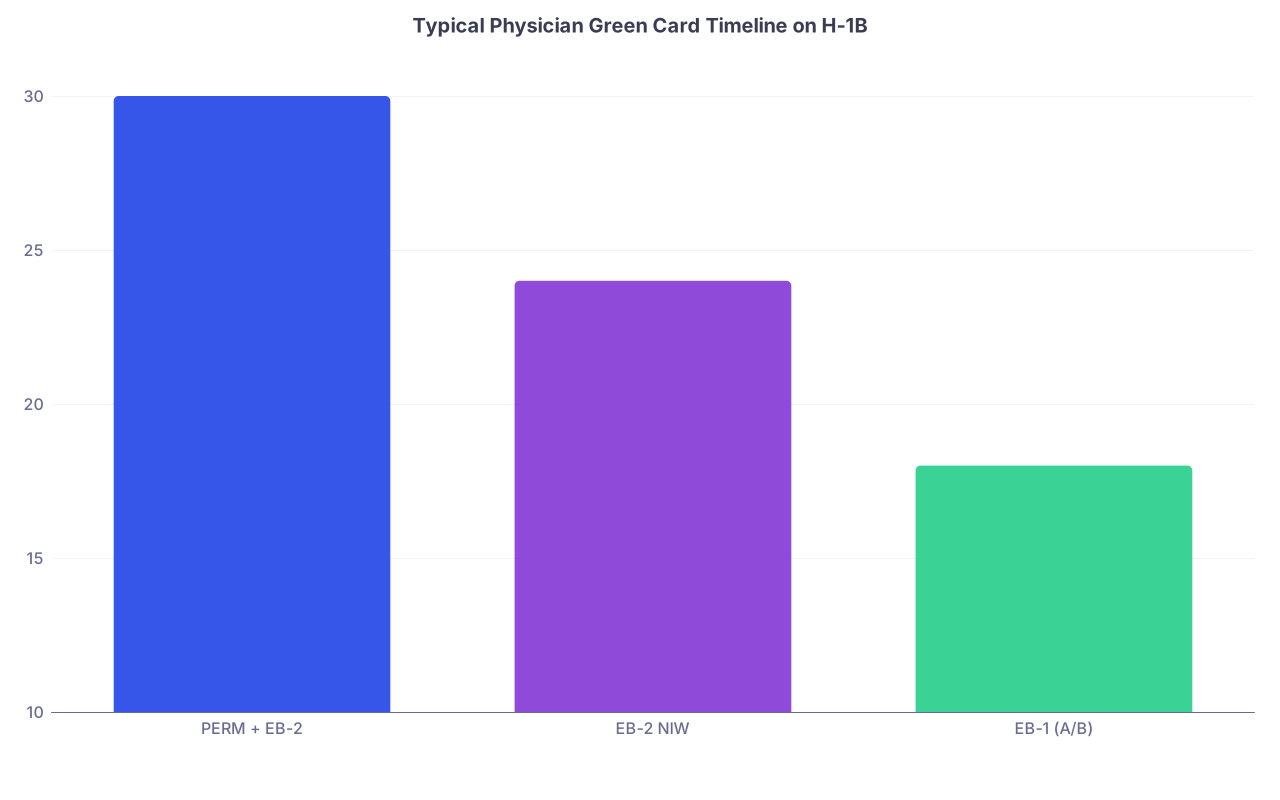
| Category | Value |
|---|---|
| PERM + EB-2 | 30 |
| EB-2 NIW | 24 |
| EB-1 (A/B) | 18 |
(Values = approximate months from start of process to green card, assuming priority date is current. This varies by country.)
Rough structure:
Year 1–2 on H‑1B:
- Employer starts PERM or you start NIW.
- File I‑140 once PERM is approved or NIW packet is ready.
If your priority date is current (often for non‑India/China applicants):
- You can file I‑485 (adjustment of status) together with I‑140 or soon after.
- Advanced parole (AP) and EAD card often arrive ~6–10 months later.
- Green card 12–24 months after filing, depending on backlogs.
If priority date is backlogged (e.g., India, China):
- You might spend years on H‑1B with an approved I‑140.
- You extend H‑1B in 3‑year chunks beyond 6‑year cap based on AC21 rules.
Key point: Nothing about being a physician on H‑1B blocks a green card. The only limit is your country of birth, your category, and the willingness of you/your employer to start the process.
J‑1 Waiver vs H‑1B Track: How It Affects Your Green Card Game
Let’s lay out the two big roads you can travel:
| Factor | J-1 (ECFMG) | H-1B (Residency/Fellowship) |
|---|---|---|
| Dual Intent Allowed? | No | Yes |
| Subject to 2-year home rule? | Almost always | No |
| Can file I-140? | Sometimes, but tricky | Yes, common |
| Can file I-485 while on status? | No, until 212(e) cleared | Yes, if PD current |
| Typical first job after training | J-1 waiver H-1B in underserved area | Any H-1B job (hospital, private, academic) |
If You’re Currently on J‑1
Your realistic sequence if you want a U.S. green card:
Confirm if you’re 212(e) subject.
- Check your DS‑2019 and J‑1 visa stamp.
- If there’s any doubt, get a “212(e) advisory opinion” from the Department of State.
If subject (likely), you need to choose:
- Return home for 2 years (and maybe later come on H‑1B or immigrant visa), or
- Apply for a J‑1 waiver through:
- Conrad 30 (state program)
- Federal programs (VA, HHS, ARC, DRA, etc.)
- Hardship or persecution claims
Once your waiver is approved:
- You get an H‑1B for a specific 3‑year job (typically underserved).
- Then you can start a green card process similar to any other H‑1B physician.
During your waiver job:
- Many physicians file EB‑2 NIW (physician NIW for service in underserved areas) or
- EB‑2 with PERM through the waiver employer.
Bottom line for J‑1: your first green card step is actually your waiver strategy, not your I‑140.
Common Green Card Strategies by Scenario
Let’s break this down by where you are in the pipeline.
Scenario 1: You’re a Medical Student or Pre‑Match IMG
You’re choosing between programs that sponsor J‑1 only vs some that offer H‑1B.
My opinion:
If your long‑term goal is U.S. permanent residence, and all else is equal, H‑1B is strategically better than J‑1. Every time.
Why?
- You avoid the 2‑year home requirement mess.
- You can start your green card process during residency or fellowship.
- You don’t lock yourself into a waiver‑job requirement later.
But there are real‑world constraints:
- Many academic residencies only sponsor J‑1.
- H‑1B residencies may require USMLE Step 3 before start.
- Some programs just don’t want the extra H‑1B paperwork.
So the actual decision framework:
- If you have strong options that offer H‑1B → seriously consider prioritizing them.
- If your only realistic matches are J‑1 programs, J‑1 is still fine — you just need to understand that you’re signing up for:
- A future waiver job,
- Then H‑1B,
- Then green card later.
Scenario 2: You’re in Residency on J‑1 Right Now
What can you do today that affects your green card picture?
Start learning waiver options early (PGY‑2, PGY‑3).
- Research Conrad 30 states, underserved areas, employer types.
- Figure out where you’d be willing to live for 3+ years.
Build a profile that helps with both:
- A strong waiver job (community need, flexible employer, willing to do H‑1B and possibly green card later).
- A potential NIW case (working in HPSA/MUA, primary care, psychiatry, etc.).
Don’t obsess over green card forms yet.
- Your first immigration “boss fight” is the waiver, not I‑140.
You can talk to an immigration attorney now, but the action items will mostly be strategic, not immediate filings.
Scenario 3: You’re in Residency/Fellowship on H‑1B
This is where you actually can move on green card steps.
You should be thinking:
Who will sponsor me and how soon?
- Academic hospital, community hospital, private group?
What category will I use?
- PERM EB‑2 via employer
- EB‑2 NIW physician
- EB‑1 (if you have major research profile)
A common play I’ve seen:
- Resident on H‑1B goes to an employed hospital job.
- Employer starts PERM in year 1.
- Files I‑140 in year 2.
- If country isn’t backlogged, files I‑485 soon after.
Parallel track: some hospitalists/primary care/psychiatrists also file EB‑2 NIW based on service to underserved areas.
Physician NIW: The Bridge Between Waiver and Green Card
If you’re planning to work in a Health Professional Shortage Area (HPSA) or Medically Underserved Area/Population (MUA/P) or a VA, the physician National Interest Waiver is your friend.
Core idea:
- You commit to work full-time in a designated underserved environment for 5 years (can overlap with J‑1 waiver years).
- In exchange, USCIS “waives” the labor certification requirement (PERM).
So for many IMG physicians:
- If you did a J‑1 waiver job → that 3‑year service often counts toward the 5 years for physician NIW.
- You can:
- Move from J‑1 → H‑1B waiver job
- File EB‑2 NIW during that job
- Finish 5 total years of service
- Get green card approved once service is complete and your priority date is current.
It’s one of the cleanest green card paths if you’re willing to serve in shortage areas for several years.
Pitfalls That Screw Up Green Card Plans for IMGs
I’ve watched people make the same avoidable mistakes over and over:
Totally ignoring 212(e) on J‑1.
They assume: “I’ll just switch to H‑1B after residency.”
Then discover late PGY‑3 that 212(e) blocks that without a waiver.Taking a J‑1 for a super‑specialized fellowship without thinking about waiver jobs.
Example: interventional cardiology J‑1, then struggling to find a rural waiver employer who can support that type of work.Waiting too long on H‑1B to start PERM or NIW.
Burn 4–5 years on H‑1B with no green card steps, then get stuck when an employer changes or you want flexibility.Assuming one employer will “take care of everything.”
Some will. Many won’t unless you push. Your immigration plan is your job, not HR’s.
What You Should Do Today (Based on Your Status)
Let’s end with concrete, no‑nonsense next steps by category.
If You’re Not in the Match Yet
- Make a list of programs you’re targeting.
- Mark which ones:
- If possible, prioritize programs that will do H‑1B, especially if your long‑term goal is U.S. permanent residency and you can realistically pass Step 3 early.
If You’re in Training on J‑1
- Pull out your DS‑2019 and visa and confirm your 212(e) status.
- If uncertain, plan to get a 212(e) advisory opinion.
- Start researching Conrad 30 / waiver options in 2–3 states where you’d actually live.
- Make a simple one-page plan:
J‑1 → J‑1 waiver job (H‑1B) → NIW/EB‑2 → green card.
If You’re in Training or Already Working on H‑1B
- Ask your employer (or future employer):
“What’s your timeline and process for sponsoring a green card for physicians?” - Have a paid consultation (not a random blog) with an experienced physician immigration lawyer about:
- PERM EB‑2 vs EB‑2 NIW vs EB‑1 in your situation
- When to start filings based on your contract and H‑1B clock
- How your country of birth affects the priority date strategy
- Start organizing a CV and evidence file (publications, awards, letters, underserved work) so when you’re ready, the lawyer can move fast.
Open a blank page right now and write at the top: “My Green Card Path.” Under it, draw two arrows from your current status (J‑1 or H‑1B) to where you want to be in 5–8 years. If you can’t connect those arrows with specific steps (waiver, NIW, PERM, I‑140, I‑485), that’s your signal: you need a concrete plan, not just hope.