
It’s mid-January. You’re between residency interviews, flipping through your spreadsheet: program names, interview dates, notes… and then the anxiety column: “Visa?”
You’ve heard everything.
One resident told you, “Never say H‑1B, they’ll blacklist you.”
Another said, “Ask early, or you’ll end up on a J‑1 you don’t want.”
And now you’re staring at tomorrow’s interview invite wondering:
Do I bring up H‑1B sponsorship? If yes, when? And how direct can I be without hurting my chances?
Let me walk you through this like I would with an IMG I’m advising: clear decisions, not vague “it depends.”
Step 1: Get Clear on What You Actually Want and Can Get
Before worrying about what to say in interviews, you need to know your own constraints. Otherwise you’re just winging it.
The blunt reality on J‑1 vs H‑1B for residency
J‑1:
- Easiest and most common for IMGs in residency
- Sponsored by ECFMG, not each individual hospital
- Two‑year home-country physical presence requirement after training (unless you get a waiver)
- Often required for advanced fellowships at big-name institutions
H‑1B:
- Employer-sponsored, program has to do real work and money for this
- Requires passing all USMLE Steps needed for full licensure (including Step 3) before the H‑1B petition
- No two‑year home-country requirement
- Often preferred if your long-term goal is to stay in the US without a waiver loop
Here’s where programs differ:
| Program Type | J‑1 Policy | H‑1B Policy | What It Means For You |
|---|---|---|---|
| University, big city | Almost always accept J‑1 | Many support H‑1B | You can ask about H‑1B safely |
| Community, small | Often J‑1 only | Rarely H‑1B | Pushing hard for H‑1B may hurt you |
| Highly competitive | J‑1 common | H‑1B for top candidates only | H‑1B request is fine but not guaranteed |
| Newer/unaccredited | J‑1 sometimes | Never H‑1B | Don’t waste energy asking for H‑1B |
Decide your “visa red lines”
Answer these questions honestly:
- Are you realistically willing to accept a J‑1 if the program is excellent?
- Is avoiding the two‑year home-country requirement absolutely critical for family or career reasons?
- Do you have Step 3 already passed or guaranteed before rank list deadline?
If:
- You must avoid the J‑1: you eventually have to be explicit about H‑1B.
- You prefer H‑1B but would take a J‑1 for a strong program: you can be more flexible in how you ask.
- You don’t care much and just want training in the US: you don’t need to push H‑1B at all.
Without these answers, there’s no good strategy. You’re just guessing.
Step 2: Understand Program Risk: When H‑1B Helps, Hurts, or Doesn’t Matter
Programs fall into three buckets when it comes to H‑1B. You need to figure out which one you’re dealing with.
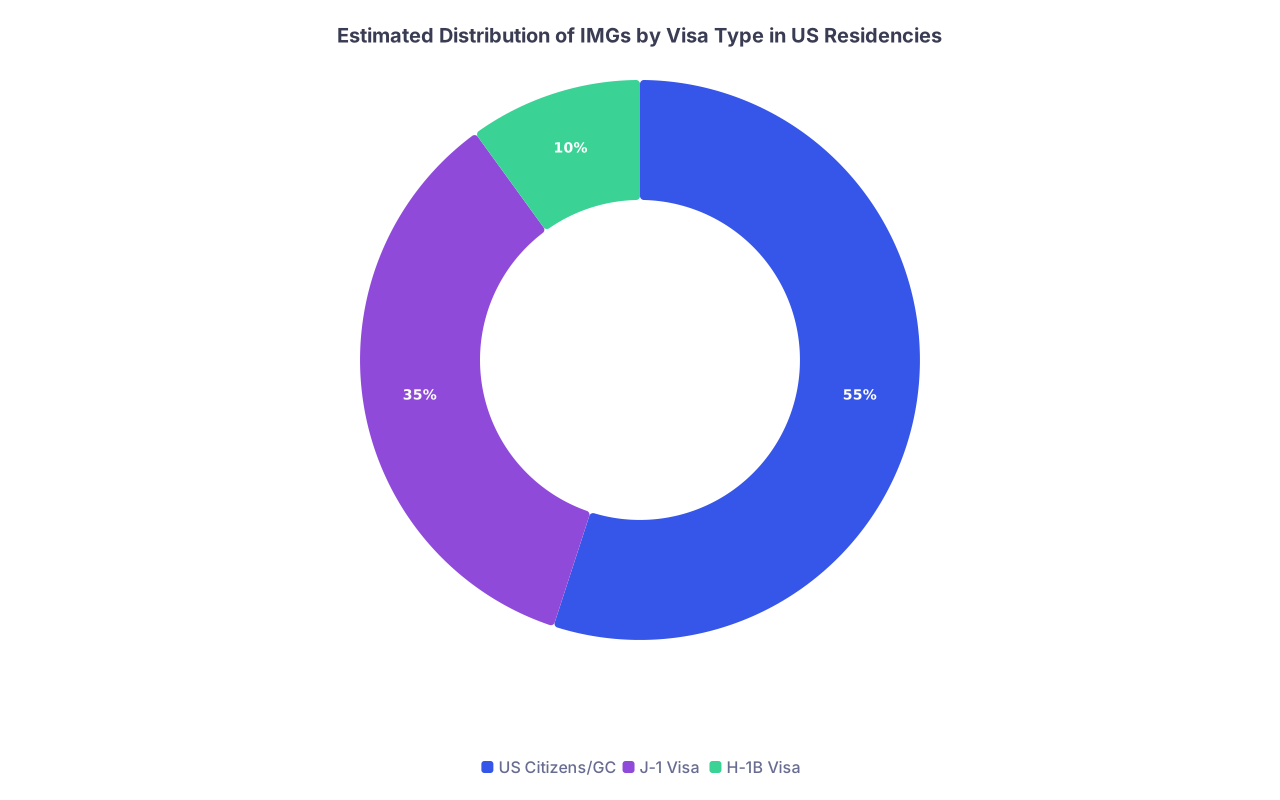
| Category | Value |
|---|---|
| US Citizens/GC | 55 |
| J-1 Visa | 35 |
| H-1B Visa | 10 |
Bucket 1: “We do H‑1B all the time”
Large university programs, big academic centers, IMG-heavy internal medicine or neurology programs. These places have systems built for H‑1B.
Signals you’re in Bucket 1:
- Website clearly says: “We sponsor J‑1 and H‑1B visas”
- Current residents list includes multiple H‑1B holders
- PD or coordinator mentions “we frequently sponsor H‑1B”
Here, asking about H‑1B is normal. It rarely hurts you if you’re a solid candidate.
Bucket 2: “We might do H‑1B… if we really like you”
Some community programs and mid-sized academic centers: they’re not anti–H‑1B, but it’s extra hassle and money.
Clues:
- Website vague: “We sponsor visas for qualified applicants.” No specific type.
- Coordinator says “We usually use J‑1; H‑1B may be considered in special cases.”
- You see 1 H‑1B resident out of 30.
Here, your timing and tone matter a lot. You don’t want the first thing they remember about you to be “complicated visa request.”
Bucket 3: “We don’t do H‑1B. Period.”
Plenty of community programs and smaller hospitals are J‑1 only by policy or budget.
Clues:
- Website: “We sponsor J‑1 visas only” or “We do not sponsor H‑1B visas.”
- Coordinator directly says “We only work with J‑1.”
- No H‑1B residents. At all.
Here, repeatedly pushing H‑1B just marks you as someone who doesn’t read instructions.
Step 3: When To Bring Up H‑1B (And When To Shut Up About It)
This is where most IMGs mess up: the timing. They either never ask (and regret it in March), or they open their very first answer on interview day with “So, can you sponsor my H‑1B?”
Golden rule: Don’t lead with visa talk in the interview
Your goal on interview day: be memorable for your clinical strengths, personality, and fit. Not for being “the H‑1B guy.”
Here’s a clean, safe structure for interview day:
- Early interview: Focus entirely on your story, training, and fit.
- Mid-day / resident lunch: Ask general visa questions, not demands.
- End-of-day / with coordinator: Clarify what they usually do, not “what about me specifically?”
Example you can use with residents at lunch:
“Are most of the IMGs here on J‑1 or H‑1B? Just trying to understand how the program usually handles visas.”
And with the coordinator (they often know more than faculty on logistics):
“For IMGs who match here, which visa type does the program typically sponsor?”
That gives you 80% of the information you need, without looking desperate.

| Step | Description |
|---|---|
| Step 1 | Pre-interview research |
| Step 2 | Faculty interviews |
| Step 3 | Resident lunch |
| Step 4 | Coordinator/PD closing |
| Step 5 | Post-interview email if needed |
Step 4: Exactly How Direct To Be About H‑1B, Based on Your Situation
Now let’s get concrete. I’ll walk you through scenarios and the exact language I’d use.
Scenario A: You strongly prefer H‑1B but will accept J‑1
This is most IMGs.
Your goal: Signal preference, don’t create a barrier.
Email after the interview (usually within 1–3 days):
Dear [Coordinator Name],
Thank you again for the opportunity to interview with [Program Name] on [date]. I really enjoyed meeting the team.
I had one follow-up question regarding visa sponsorship for IMGs. I’m currently eligible for both J‑1 and H‑1B. I’d prefer an H‑1B if feasible, but I’m also fully able to proceed on a J‑1 if that’s the program’s standard.
Could you let me know which visa type your IMG residents are usually on?
Best regards,
[Your Name]
You’re clear, not pushy, and you’ve made it easy for them to say, “We usually use J‑1.”
If they say J‑1 only and you’re okay with that, you’re done. No need to raise H‑1B again.
Scenario B: You must have H‑1B (for personal or legal reasons)
In this case, you actually need to risk being more explicit, but still not on your very first line.
During or right after the interview, usually with the PD or coordinator:
“I wanted to briefly clarify something about my visa situation so there aren’t surprises later. Due to [family/immigration] circumstances, I’m specifically seeking H‑1B sponsorship for residency. I’m fully Step 3–eligible (or: I plan to take Step 3 by [month/year]). Is H‑1B sponsorship something your program is able to support for incoming residents?”
If they say no, that’s painful but useful. You now know not to rank them highly (or at all).
If they say “maybe, for strong candidates,” you keep them on the list but don’t rely on them unless you’re clearly one of their top applicants.
Scenario C: You don’t have Step 3 yet
This changes the math.
For H‑1B, most states and programs want Step 3 passed before they file the petition or before you start. You can’t bluff your way through this.
If you haven’t taken Step 3 but plan to:
“I’m currently scheduled to take Step 3 in [month]. If I pass as planned, I’d be eligible for H‑1B. Do you ever sponsor H‑1B for residents, or do you prefer J‑1 regardless?”
Be honest. If they’re H‑1B-friendly, they’ll tell you the deadlines and whether your timing still works.
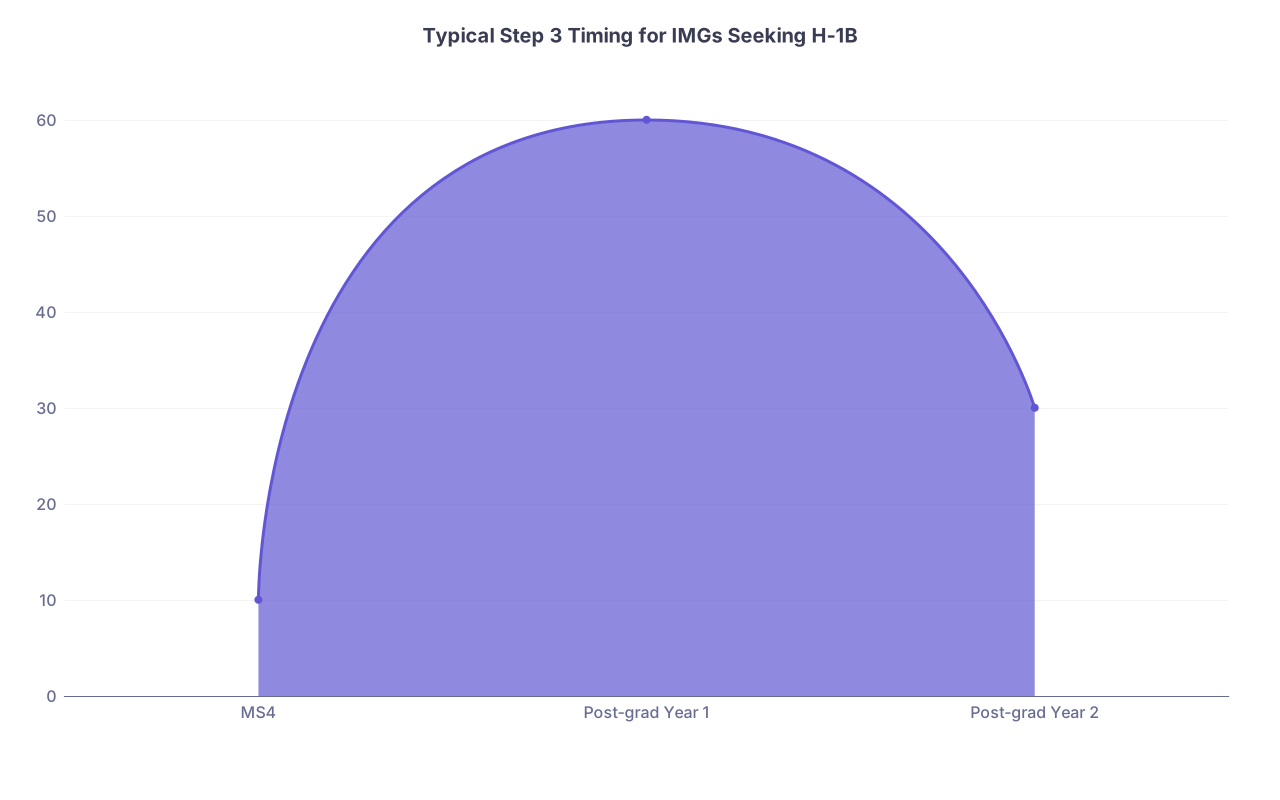
| Category | Value |
|---|---|
| MS4 | 10 |
| Post-grad Year 1 | 60 |
| Post-grad Year 2 | 30 |
(Interpretation: many IMGs targeting H‑1B push Step 3 earlier, around post-grad year 1.)
Step 5: How Asking For H‑1B Affects Your Chances – Honestly
Here’s the part nobody says out loud.
Where asking for H‑1B barely affects you
- Big academic IM residencies that already have multiple H‑1B residents
- Specialties/programs with chronically unfilled IMG spots (some FM, psych, peds in certain states)
In those places, if you’re strong, they’ll work with you.
Where it can absolutely hurt
- Marginal programs that are just barely able to support any visa at all
- Programs that state J‑1 only and you keep pushing H‑1B
- Programs that are IMG-heavy but financially tight (small community hospitals)
I’ve seen PDs say, off the record, “Between two equal IMGs, if one needs J‑1 and the other demands H‑1B and we’re not set up for it, we’ll rank the J‑1 one higher. We just don’t have the bandwidth.”
So the strategic move is this:
- If you can accept J‑1, don’t make H‑1B sound like a non-negotiable at places that are clearly J‑1 focused.
- If you can’t accept J‑1, don’t waste emotional energy on J‑1-only programs. Filter them out.
Step 6: How To Research Programs Before You Even Interview
You shouldn’t be going into interviews blind about visa policies. That’s just self-sabotage.
Do this for every program:
Check their website: Look for “International Medical Graduates,” “Visa Sponsorship,” or FAQ sections.
Check FREIDA: Sometimes they list “H‑1B offered” vs “J‑1 only.”
Stalk current residents’ bios: H‑1B sometimes appears in their intro or CVs.
Email the coordinator briefly before interview season if you truly must know:
“I’m an IMG applicant interviewing this cycle and had a quick logistical question: Does your program sponsor H‑1B visas for incoming residents, or is J‑1 the only option?”
Straightforward, no drama.

Step 7: Putting It All Together – A Simple Decision Framework
Let’s strip it down to a decision tree you can actually use.

| Step | Description |
|---|---|
| Step 1 | Do you absolutely need H-1B? |
| Step 2 | Research if program ever sponsors H-1B |
| Step 3 | Prefer H-1B but can take J-1 |
| Step 4 | Deprioritize or dont rank |
| Step 5 | Mention H-1B preference clearly |
| Step 6 | Ask about typical visa type, mention H-1B as preference in email |
| Step 7 | Program supports H-1B? |
Practical rules:
- If you must avoid J‑1 → identify H‑1B-capable programs early, ask directly, and don’t rank J‑1-only places.
- If you prefer H‑1B → ask generally on interview day, clarify by email, don’t push hard at J‑1-only programs.
- If you don’t care → a simple “I’m open to J‑1 or H‑1B, whatever the program typically sponsors” is enough.

Common Mistakes To Avoid
I’ve seen these blow up otherwise good applications:
- Making your visa needs the first or main thing you talk about.
- Pushing for H‑1B at a program that has “J‑1 only” all over their site.
- Being vague or evasive about Step 3 when you’re asking for H‑1B.
- Sending long, emotional emails about “my dreams depend on H‑1B.” Programs don’t decide based on emotion; they decide based on logistics and policy.
- Waiting until after the rank list deadline to clarify visa type. That’s too late.
FAQ: H‑1B Questions IMGs Ask Right Before Rank Lists
1. Will asking about H‑1B during the interview hurt my chances?
If you’re at a program that already sponsors H‑1B, asking about it in a normal, non-demanding way won’t hurt you. It shows you’re informed.
It can hurt you when:
- The program is J‑1 only and you keep pushing
- You sound like you care more about the visa than the training
- You make H‑1B sound like a rigid demand when they’re clearly not set up for it
Controlled, polite curiosity is fine. Aggressive insistence is not.
2. Can I match on a J‑1, then switch to H‑1B later in the same residency?
Sometimes, but don’t count on it.
Most programs choose one visa type per resident per contract period. Changing mid-residency is bureaucratically painful and uncommon. A few people have switched when they changed roles (e.g., chief resident year, research year), but that’s not a strategy—it’s a lucky exception.
Plan as if the visa you start residency on is the one you’ll finish that program with.
3. Do I have to have Step 3 before rank list submission to get H‑1B?
Not necessarily, but you need to fit the program’s and state’s timelines.
Many programs want Step 3 passed by the time they file the H‑1B petition (often spring) or before you start on July 1. If you’re taking Step 3 in April or May, some programs will be okay; others won’t.
If you’re targeting H‑1B, I strongly recommend Step 3 before interview season or at least before February. Late Step 3 is one of the biggest reasons programs quietly decide, “We’ll just go J‑1.”
4. What if a program says, “We’ll see about H‑1B if you match here”?
Translation: “Maybe. But no promises.”
At that point, you rank them based on your risk tolerance:
- If you absolutely can’t accept J‑1 → rank them low or not at all.
- If you’d accept J‑1 but prefer H‑1B → rank them based on training quality, not visa alone.
But do not assume “we’ll see” means “automatic H‑1B.” It doesn’t.
5. What’s one sentence I can safely use in any email about this?
Use this, tweak the details, and you’ll be fine:
“I’m currently eligible for both J‑1 and H‑1B. I’d prefer H‑1B if feasible, but I’m fully able to proceed on a J‑1 as well. Which visa type do you typically sponsor for IMG residents?”
That line is clear, professional, and doesn’t scare off a borderline program.
Today’s actionable step:
Open your residency program list and add two columns: “J‑1 only / H‑1B possible?” and “My visa flexibility (Must H‑1B / Prefer H‑1B / Either).” Fill them in for at least 10 programs right now. Once you see that laid out, your decision about when and how to ask for H‑1B will get a lot simpler.