
Most IMGs apply to the wrong number of visa-sponsoring programs—and it costs them interviews.
Let me give you the straight answer first, then we’ll unpack it.
If you’re an IMG needing visa sponsorship (J‑1 or H‑1B), your “realistic” target is usually:
- Moderately competitive profile:
80–120 programs that sponsor your visa type - Stronger profile:
50–80 programs that sponsor your visa type - Weaker / at-risk profile:
120–180+ programs that sponsor your visa type
The exact number depends more on your risk category than on some magic “average.” So let’s build that framework properly instead of guessing.
1. The Real Question: What’s Your Risk Category?
Forget what your friend did. You care about you plus visa sponsorship.
Here’s a clean way to think about it: you’re either Low, Medium, or High risk for the Match as an IMG requiring a visa.
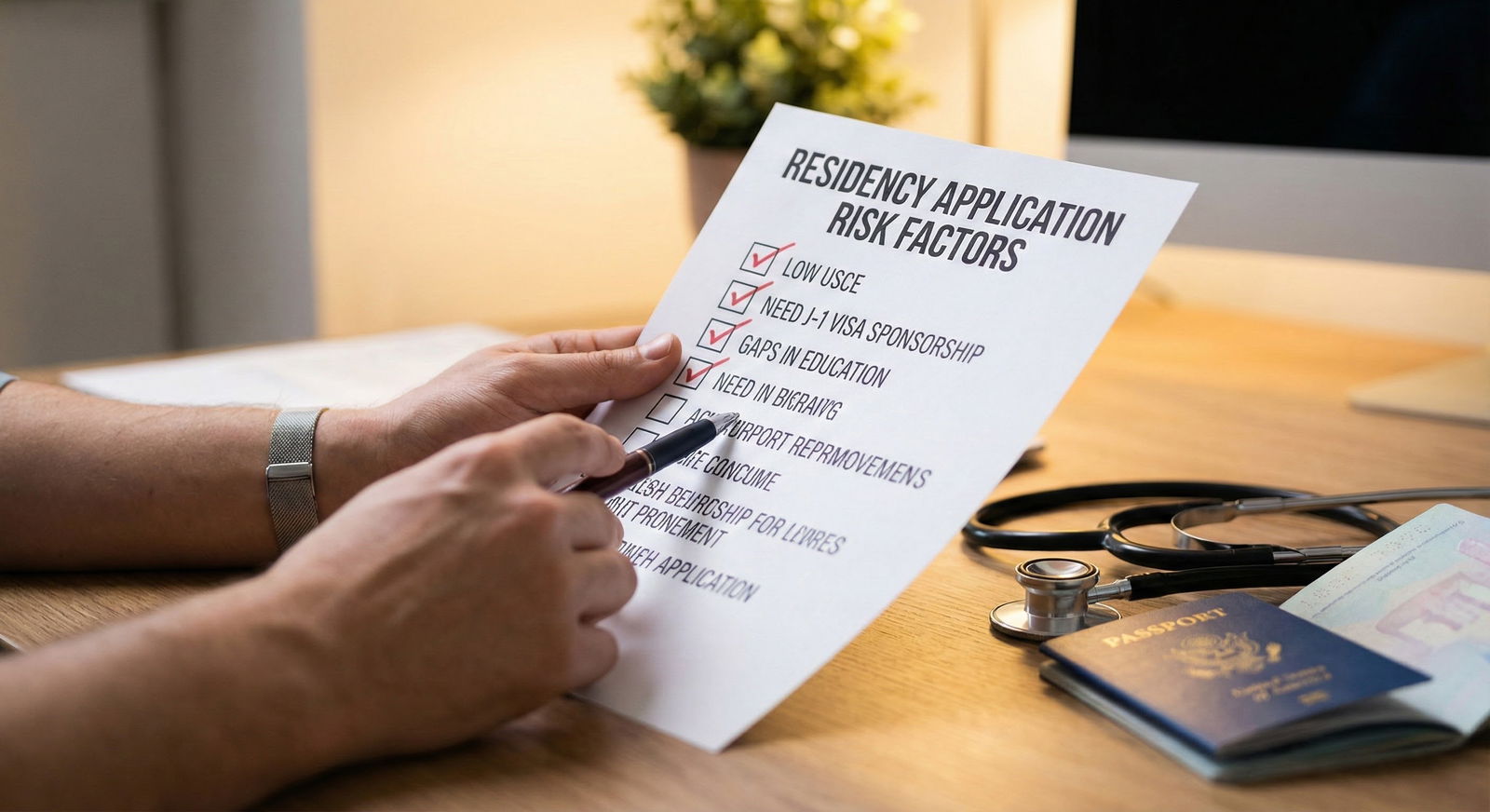
Use this table as a quick filter:
| Risk Level | Typical Profile | Recommended Visa-Sponsoring Programs |
|---|---|---|
| Low | Solid scores, recent grad, USCE, no major red flags | 50–80 |
| Medium | One or two mild issues (older YOG, average scores, limited USCE) | 80–120 |
| High | Multiple red flags (low scores, gaps, multiple attempts, old grad) | 120–180+ |
Low-Risk Visa-Need IMG (Rare but exists)
You’re here if most of these are true:
- USMLE Step 2: 245+ (or very strong equivalent if you’re in a non-USMLE system)
- Year of graduation (YOG): within 3–4 years
- Solid US clinical experience (USCE): 2+ months, with strong LORs
- No exam failures
- Applying to less competitive specialties (IM, FM, Psych, Peds, maybe Path)
- Multiple interviews in prior cycles if reapplying
For you, 50–80 visa-sponsoring programs is usually enough—if they genuinely sponsor your visa type and your application is well targeted.
Medium-Risk Visa-Need IMG (Most people)
You’re here if:
- Step 2 is in the 225–245 zone
- YOG 4–8 years ago
- Some USCE but not extensive
- Maybe one mild red flag (single failure, attempt, or gap explained)
- Applying in IM/FM/Psych/Peds/Path
You’re the average IMG needing a visa. Not a disaster, not a superstar.
You should be thinking 80–120 visa-sponsoring programs.
High-Risk Visa-Need IMG
You’re high risk if:
- Step 2 < 225 or multiple attempts
- No or very little USCE
- YOG > 8–10 years
- Multiple gaps, repeated failures, or prior unmatched cycles
- Or you’re going for a relatively tougher specialty (even within IM, aiming academic-only with a weak profile)
You’re in “throw a wider net or don’t match” territory.
You should be thinking 120–180+ visa-sponsoring programs, all filtered for your exact visa type.
2. Visa Sponsorship Changes the Math—A Lot
Here’s what many IMGs misunderstand:
The usual “how many programs to apply to?” numbers are based on all programs in a specialty.
But a big chunk of those programs:
- Don’t sponsor any visas
- Only sponsor J‑1, not H‑1B
- “Used to” sponsor but no longer do
- Informally limit IMGs despite not stating it bluntly
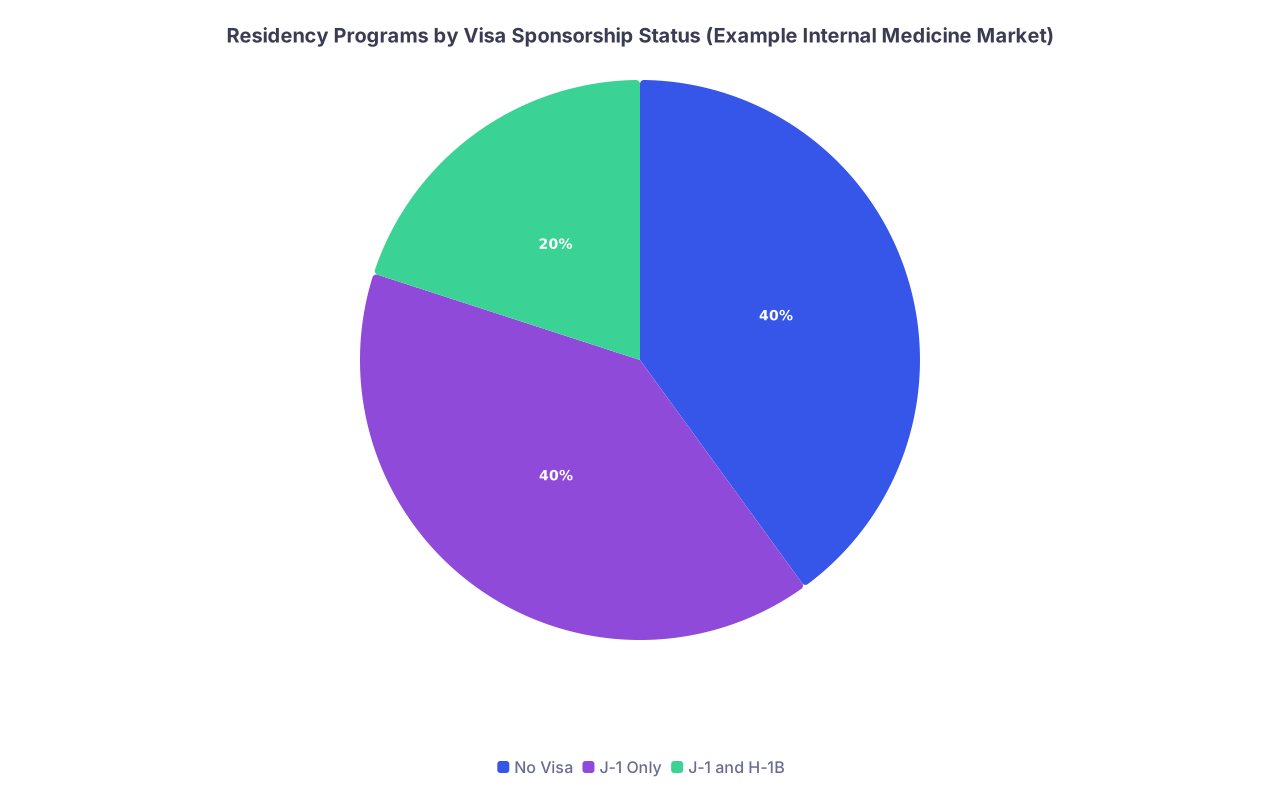
| Category | Value |
|---|---|
| No Visa | 40 |
| J-1 Only | 40 |
| J-1 and H-1B | 20 |
This is why some IMGs apply to 150 programs and get 1–2 interviews: half their list was basically fake options from the start.
If you need any visa and you’re not filtering aggressively by current sponsorship behavior, your application count is meaningless.
3. Decide First: J‑1 vs H‑1B vs “Either”
This matters more than most people admit.
If you’re J‑1 only (or open to J‑1):
- J‑1 is more commonly sponsored.
- Many community programs are fine with J‑1.
- For most IMGs, J‑1 is the practical route.
Your main questions:
- Does the program actually sponsor J‑1 every year (not just “in theory”)?
- Are there current residents on J‑1?
- Any unofficial bias against J‑1s mentioned by residents?
For J‑1, you typically have more options, so the lower end of the ranges above might be safe if your profile is decent.
If you’re H‑1B only:
This is where people torch their match chances.
H‑1B:
- Is more expensive and paperwork-heavy for programs
- Often requires all USMLE steps done before they’ll even consider sponsorship
- Is explicitly avoided by many smaller or underfunded programs
So if you say, “I only want H‑1B,” your available pool can drop to something like:
- Internal Medicine: maybe 70–120 real H‑1B programs (varies by year)
- Family Medicine: far fewer
- Psych/Peds: limited and very competitive on H‑1B
If you’re H‑1B-only, you basically must:
- Apply to almost every realistic H‑1B program in your specialty
- Accept that you may need 150–200+ total applications if you double-apply (e.g., IM + FM) just to get enough H‑1B-sponsoring options
If you’re “Either J‑1 or H‑1B”:
Then stop acting like you’re H‑1B-only.
Tell programs you’re open to J‑1. It dramatically widens your pool.
Your real strategy: filter for any visa sponsorship, then let match outcomes and institutional preferences decide.
4. How to Build a Visa-Sponsoring Program List That’s Not Delusional
Here’s the part most people get wrong. They trust databases blindly.

| Step | Description |
|---|---|
| Step 1 | Start |
| Step 2 | Filter by specialty and state |
| Step 3 | Filter to programs that sponsor your visa |
| Step 4 | Check program website & FAQ |
| Step 5 | Verify with recent residents/current IMG profiles |
| Step 6 | Score program fit & competitiveness |
| Step 7 | Finalize target number by risk category |
Step 1: Start with broad filters
Use ERAS, FREIDA, or other tools and:
- Select your specialty
- Filter by “Sponsoring J‑1” or “Sponsoring H‑1B” or both
- Export or build a spreadsheet
This list is only your starting point, not gospel.
Step 2: Manually verify visa info
Yes, this is tedious. Yes, you still have to do it.
For each program:
- Check the program’s own website:
- Do they list J‑1/H‑1B under “Eligibility”?
- Do they quietly say “J‑1 only” anywhere?
- Look at resident bios:
- Any IMGs?
- Any with obvious non-US medical schools?
- Any mention of “J‑1” or “H‑1B” status?
If you don’t see a single IMG or non-US med school in 3–4 years of current residents, that program is functionally non-IMG or very IMG-resistant—apply only if you’re strong and casting a wide net.
Step 3: Quantify realistic options
Once you’ve cleaned the list, you’ll see something like:
- 220 total programs in specialty
- 140 list “visa sponsorship”
- 90 clearly support your visa type in recent years
- 60–70 have IMGs in the last 3–4 classes
Those last 60–70 are your high-yield core.
The rest (20–40 more) are “maybe” options if you’re going big with application volume.
5. Matching Your Application Volume to Your Profile
Let’s put numbers on this with concrete scenarios.
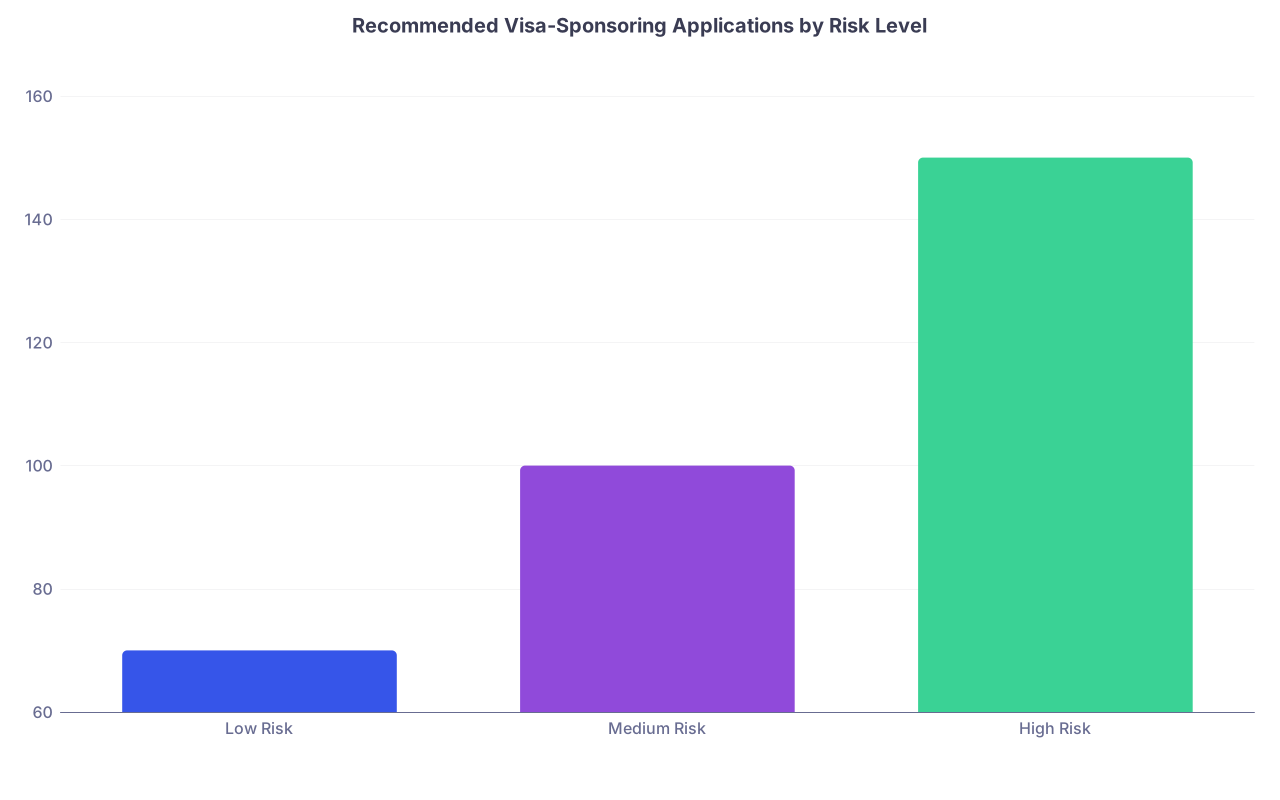
| Category | Value |
|---|---|
| Low Risk | 70 |
| Medium Risk | 100 |
| High Risk | 150 |
Scenario A: Medium-risk IMG, J‑1 okay, Internal Medicine
- Step 2: 233
- YOG: 2019
- 2 months USCE
- No failures
- Visa: needs J‑1 (fine with it)
Your realistic plan:
- Identify ~90–110 IM programs clearly sponsoring J‑1 with current IMGs
- Apply to all those that aren’t absurdly out of reach (e.g., Harvard, Mayo, etc. if your profile doesn’t match)
- Total: 90–110 applications
Scenario B: High-risk IMG, H‑1B only, Internal Medicine
- Step 2: 222, one prior failure on Step 1
- YOG: 2015
- 1 month USCE
- Visa: insists on H‑1B only
You’re playing on hard mode.
Your realistic plan:
- Identify every single IM program that:
- Explicitly sponsors H‑1B
- Has done so in the last few years (check current/past residents)
- You may find ~60–80 truly H‑1B-friendly programs
- Apply to all of them
- Strongly consider:
- Adding Family Medicine or another specialty and repeating the same process
- Total: 120–180+ applications across specialties
Scenario C: Low-risk IMG, open to J‑1, Psychiatry
- Step 2: 248
- YOG: 2022
- 3 months USCE, solid academic work
- Visa: J‑1 or H‑1B
Psych is competitive but you’re strong.
Your realistic plan:
- Identify ~70–90 psych programs with clear visa sponsorship + recent IMGs
- Trim the list to 60–70 that fit you geographically and academically
- Apply to 60–80 programs and focus on quality of application
6. When to Add a Second Specialty
This is the part nobody wants to think about, but you should.
If all are true:
- You’re high-risk
- You need a visa
- Your primary specialty has limited visa-sponsoring programs
- And you can’t or won’t increase your application count beyond ~120
Then you should seriously consider adding a more IMG/visa-friendly specialty:
- Internal Medicine
- Family Medicine
- Psychiatry
- Pediatrics
- Pathology (for some profiles)
Your total number of visa-sponsoring programs across both specialties should still land in your risk-based range:
- Medium risk with two specialties: maybe 50–70 per specialty → ~100–140
- High risk with two specialties: 70–90 per specialty → 140–180+
7. The Hidden Constraint: Money and Sanity
ERAS is not cheap. And building 150 tailored applications is brutal.
You’ve got three levers:
- Application volume — how many programs that sponsor your visa
- Application quality — how tailored and coherent your story is
- Specialty breadth — how many specialties you’re open to
If money is tight and you must cap yourself at, say, 80 programs:
- Don’t waste a single slot on unclear visa policies
- Don’t chase “dream” programs that never take IMGs
- Prioritize programs with a track record of matching IMGs on your visa type
8. Quick Reality Checks Before You Decide Your Number
Ask yourself:
- Do I know exactly how many programs currently sponsor my visa type in my specialty?
- Can I honestly say my file is strong for an IMG, or am I stretching the word “strong”?
- Have I overestimated how “competitive” I am because of one mentor or one good clerkship eval?
If you’re not sure, you’re probably medium-to-high risk. Which means err upward on application volume.
FAQ (Exactly 6 Questions)
1. Is 50 programs enough if they all sponsor my visa type?
Maybe—but only if you’re a low-risk visa-need IMG (solid scores, recent YOG, good USCE) and you’ve confirmed every program reliably sponsors your visa. For most medium- or high-risk IMGs, 50 is too low, even if all sponsor your visa.
2. How do I know if a program really sponsors H‑1B or J‑1?
Don’t trust a single database entry. Cross-check: program website eligibility page, current resident bios (look for IMGs), and recent match lists. If they haven’t had any IMGs in several years, treat their “we sponsor H‑1B” claim as theoretical, not guaranteed.
3. I can’t afford more than 80 applications. What should I do?
Then you must be ruthless. Only apply to programs that: 1) clearly sponsor your visa type, and 2) show a history of matching IMGs. Drop “reach” programs that don’t sponsor visas consistently. Also consider adding a very IMG‑friendly specialty rather than only applying to a competitive one.
4. Should I apply to programs that say “no visa sponsorship” but have IMGs in the past?
If they explicitly say “no visa sponsorship,” assume that’s current policy. Those IMGs may be green card holders, Canadians not needing a visa, or residents from years when policy was different. Don’t waste applications on them if you need sponsorship now.
5. If I’m open to J‑1 and H‑1B, do I need to tell programs that?
Yes. Make it clear in your communications and, if appropriate, in your personal statement or ERAS fields that you’re open to either J‑1 or H‑1B. Programs are much more comfortable ranking you if they know they have flexibility and won’t be forced into an H‑1B if they don’t like it.
6. Is applying to more than 200 programs ever smart for a visa-need IMG?
Only in extreme high‑risk situations where: 1) you have multiple major red flags, and 2) you’re applying across two specialties with limited visa-sponsoring programs. For most people, beyond ~180 you start hitting severe diminishing returns. You’re better off improving your application quality and targeting than hitting 250+ blindly.
Key takeaways:
- Your realistic number of visa-sponsoring programs depends on your risk level: low (50–80), medium (80–120), high (120–180+).
- Visa sponsorship status is not a checkbox; verify J‑1/H‑1B behavior through websites and resident rosters before counting a program as “real.”
- If you need a visa and you’re not exceptional, you win by applying widely but intelligently—high volume, but only to places that actually sponsor your visa type and actually take IMGs.