

Programs do not just rank applicants. They rank visas. And that part almost nobody tells you.
If you are an IMG, you are not walking into a neutral system where everyone is just evaluated on “merit.” Behind every rank list meeting, there’s a quiet, often unspoken column on the spreadsheet: J-1, H-1B, “no visa,” “US citizen/GC.” I’ve watched PDs drag names up or down based purely on which visa they think you’ll need.
Nobody writes this in their website. But it absolutely shapes who gets ranked, where, and how high.
Let me walk you through how this really works behind closed doors.
What Programs Really Think When They Hear “Visa”
Publicly, programs say: “We sponsor J-1 and occasionally H-1B visas. We evaluate all applicants holistically.”
Privately, the conversation sounds more like this in the conference room:
- “She’s great. But she needs an H-1B—do we want to do that this year?”
- “He’s J-1 eligible, fine, easier. Move him up.”
- “We’re capped on H-1Bs. I don’t want to spend another on an intern.”
- “Legal shut us down on new H-1Bs this cycle. Just J-1s.”
You need to understand that to a PD, visa type is not just a formality. It’s work, cost, risk, and politics.
Here’s how the hierarchy often looks behind the scenes:
- US citizen / green card
- J-1 (through ECFMG)
- H-1B (for residency)
- “We do not sponsor” (silent death for many IMGs)
Almost no one will say that out loud, but I’ve seen it play out every rank meeting.
The Real Differences Between J-1 and H-1B — From a Program’s Eyes
You’ve probably read the surface-level differences: waiver, home-return, exam requirements. Fine. That’s the candidate-side view.
Let me show you the program perspective. Because that’s what shapes your fate.
| Factor | J-1 (ECFMG) | H-1B (Residency) |
|---|---|---|
| Admin burden | Low–moderate | High |
| Legal cost | Lower | Higher |
| Step 3 required before start | No | Yes |
| Perceived risk | Lower | Higher |
| Flexibility for moonlighting | More restricted | More flexible |
| Post-training retention | Hard (waiver needed) | Easier |
Now the real commentary behind each row:
Admin burden
J-1 is mostly “handed off” to ECFMG. There’s a training program application, some institutional sign-offs, but it’s standardized. GME coordinators know the drill.
H-1B is different. It almost always means:
- HR
- Legal
- PD
- Sometimes department chair
All have to sign off. Someone has to prepare an LCA, file a petition, chase signatures, track deadlines. Every PD remembers the year immigration delayed an H-1B approval and the intern almost could not start. That scar tissue sticks.
Legal cost
Most institutions pay outside counsel for H-1B petitions. J-1 is cheaper and more predictable. Ask any PD off the record: if all else is equal, the program will usually choose the cheaper, easier path.
Step 3 requirement
Programs hate depending on an applicant to pass Step 3 before July 1st. Why?
Because every year, at least one candidate somewhere in the country fails Step 3 in May or June and suddenly cannot start on H-1B. The PD then has to scramble to fill a position, justify it to GME, and cover the schedule.
So a PD seeing “needs H-1B, hasn’t taken Step 3” will often quietly drop you several spots down. Or off. They will not email you to explain this, obviously.
Perceived risk
With H-1B, programs fear delays, RFEs (Requests for Evidence), last-minute denials. They remember that one year USCIS slow-walked approvals and dozens of interns were in limbo.
With J-1, ECFMG has an established pipeline. Is it perfect? No. But PDs trust patterns.
Post-training retention
Here’s one situation where H-1B sometimes wins: a program wants to keep people long-term. Big internal medicine departments, certain subspecialties, anesthesia groups—they like H-1B because you can often convert to long-term employment more cleanly than J-1, which triggers the 2-year home requirement without a waiver.
But notice the nuance: this helps mostly in fellowships or when a department already knows it wants a “pipeline” candidate. As an applicant, you don’t see these strategic discussions. They’re happening without you.
The Hidden Filters Programs Use Before You Ever See an Interview
Let’s talk about the screening phase. You submit ERAS, you dream about interviews. The reality is your file might be dead in the first 60 seconds because of one box: “Visa needed?”
Here’s how that goes in real life.
Filter 1: “We don’t sponsor visas”
Some programs are honest and put this on their website. Some are lazy or evasive and just never mention it.
In the screening meeting, a coordinator might say:
“We’ve been told not to invite anyone who needs sponsorship this year.”
That’s it. No discussion about your research, your LORs, your scores. You never even enter the real competition.
Filter 2: “J-1 only”
Many community and mid-tier university programs are quietly “J-1 only” in practice, even if their site says “we may consider H-1B.”
What they actually do is:
- Mark “visa needed, H-1B” as low priority
- Let faculty fill interviews with US/GC and J-1-eligible IMGs
- Use H-1B only in exceptional circumstances (faculty’s favorite applicant, internal preliminary positions, or politics)
Filter 3: “We only use H-1B for fellows, not residents”
Common pattern in big-name academic centers. Their HR/legal teams are more willing to sponsor H-1B for fellows (who are seen as more valuable/advanced and fewer in number) but place unofficial limits on residents.
You see “H-1B considered” on the IM residency website and think you’re fine. Inside the department, what they’re actually doing is:
- H-1B: reserved for cardiology fellow or advanced fellow
- J-1: the default for IMGs entering residency
- Residents on H-1B: rare exceptions, often with a champion
I’ve sat in those meetings. An attending will say, “If we give him an H-1B, that’s one we can’t use for a cardiology recruit next year,” and the room goes quiet. Then they push that resident down or out.
How H-1B vs J-1 Quietly Reorders the Rank List
By the time you get to the rank meeting, the visa conversation is coded. It rarely sounds like outright discrimination. It sounds “pragmatic.”
The spreadsheet is up on the projector. Columns: Name, Scores, Medical school, Interview score, Visa type.
Then the subtle surgery begins.
Here’s what really happens:
- A top candidate with no visa need stays at the top. No friction.
- A top candidate needing J-1 stays high, maybe slightly adjusted, but not heavily penalized.
- A top candidate needing H-1B triggers debate.
I’ve literally heard:
“I like him a lot, but if we rank him at 3 and he needs an H-1B, that’s going to be a headache. Can we push him to like 8 or 9 and see if he falls to us only if others match elsewhere?”
That’s the game. They’re managing risk, not just ranking talent.
Sometimes they group you:
- “All the J-1s in this section”
- “The H-1Bs further down”
- “Non-sponsorship candidates at the very top”
The scary part? Your interview performance doesn’t always matter as much as your visa label once you’re in the “good enough” bin.
The Silent Pressure from GME, HR, and Legal
You imagine the PD as the fully autonomous decision-maker. That’s only half true.
There are three other power centers you never see:
- GME Office
- Human Resources
- Legal / Immigration counsel
Those offices send quiet signals like:
- “We prefer J-1s for residents.”
- “H-1B budget is tight this year.”
- “We’d like to minimize new H-1Bs at the intern level.”
- “Only X number of new H-1Bs this academic year overall.”
So what does the PD do? They turn those constraints into ranking behavior. Not officially, not documented, but very real.
This is why you see bizarre situations where:
- Program A used to sponsor H-1B, now suddenly “doesn’t this year.”
- Program B sponsored H-1B for your friend but now tells you “J-1 only.”
It’s not personal. It’s institutional politics. But it crushes individuals.
Strategy: How You Should Play This as an IMG
You’re not going to change the system. But you can stop playing blind.
1. Understand your “visa profile” early
Ask yourself honestly:
- Are you J-1 eligible via ECFMG?
- Can you realistically pass Step 3 well before Match (and have the score in by Jan/Feb) if you want H-1B?
- Are you okay with the J-1 home requirement + waiver grind later?
If you want H-1B but do not have Step 3 done by the time most rank lists are made, you are a risk. Programs will treat you as such.
2. Treat Step 3 as a strategic tool, not an afterthought
For IMGs targeting H-1B, Step 3 is not just another test. It’s your entry ticket into the serious H-1B conversation.
I’ve seen PDs bump an IMG up the rank list because:
- Strong performance
- Excellent interview
- Step 3 already passed
- H-1B requested, but low risk (documents in order, strong English, clear path)
If you send a Step 3 pass result in December or early January, that email often gets forwarded: PD → coordinator → GME. That changes your label from “risk” to “possible.”
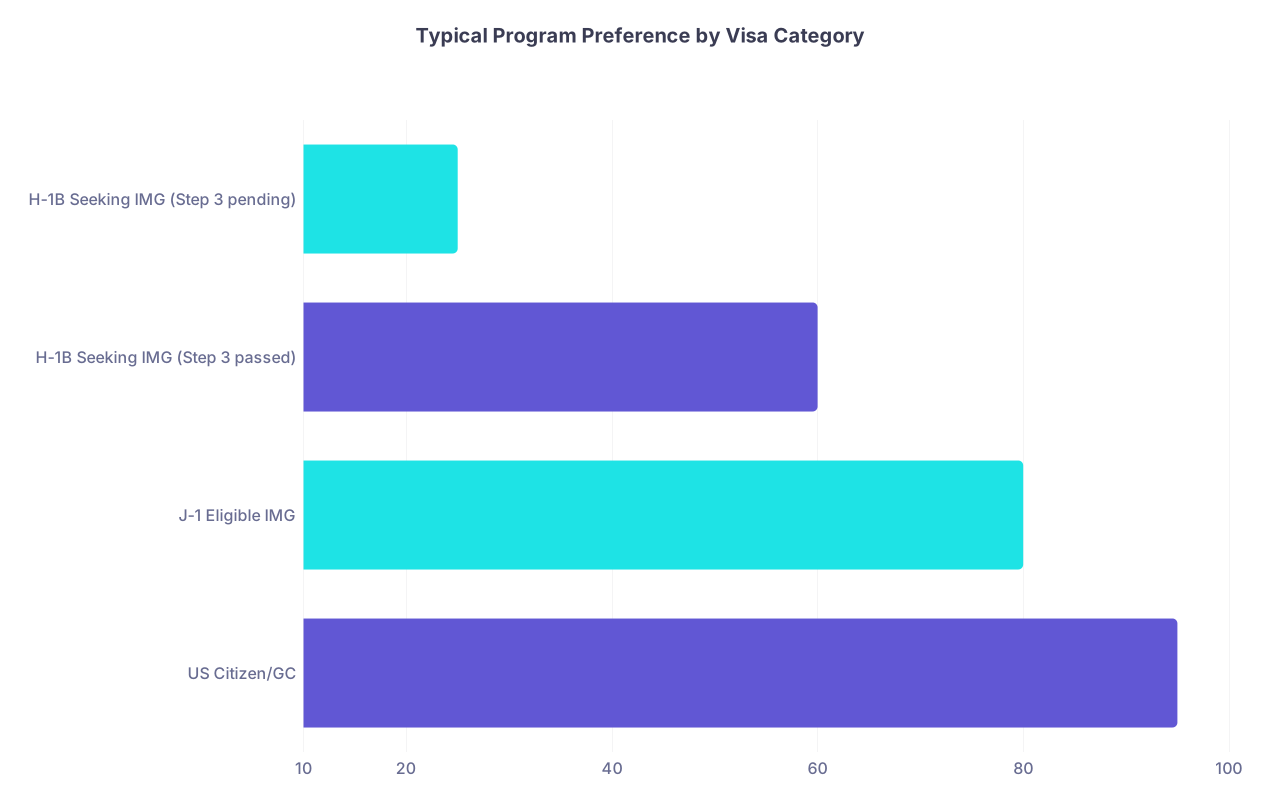
| Category | Value |
|---|---|
| US Citizen/GC | 95 |
| J-1 Eligible IMG | 80 |
| H-1B Seeking IMG (Step 3 passed) | 60 |
| H-1B Seeking IMG (Step 3 pending) | 25 |
Numbers are illustrative, but the pattern is real.
3. Stop believing websites; verify current practice
Programs rarely update their visa text yearly. I’ve seen sites say “H-1B available” long after institutional policy practically shut it down.
You need current-cycle intelligence:
- Email the program coordinator (brief, respectful) asking:
“For the current application cycle, do you anticipate sponsoring H-1B visas for incoming residents, or will J-1 be preferred?” - Ask seniors from your med school who recently matched.
- Check matched residents’ profiles on program websites and LinkedIn: how many current residents are on H-1B vs J-1 vs none?
Patterns tell you far more than a 5-year-old web page.
How Visa Type Affects Which Programs You Should Target
This part no one frames honestly for IMGs, so let me be blunt.
If you are J-1 flexible (okay with it, or planning for a waiver), your universe is much larger.
If you insist on H-1B and do not have Step 3 done early, your realistic list shrinks dramatically.
Here’s how programs tend to break down in reality:
| Program Type | Common Visa Behavior | |
|---|---|---|
| Elite academics (top 20 IM) | J-1 common; H-1B selective, usually Step 3 done | |
| Mid-tier university IM | J-1 default; H-1B rare/variable | |
| Community IM (strong IMG history) | J-1 heavy; a few H-1Bs depending on year | |
| Community with “no visa” | Dead end for IMG needing sponsorship | |
| B --> | Yes | C[Normal holistic review] |
| B --> | No | D{Visa Sponsorship Allowed This Year?} |
| D --> | No | E[Screened out early] |
| D --> | Yes | F{J-1 or H-1B?} |
| F --> | J-1 | G[Standard IMG review pool] |
| F --> | H-1B | H{Step 3 Passed?} |
| H --> | No | I[Considered but risk-labeled] |
| H --> | Yes | J[Serious consideration with caution] |
You want to avoid being in that “risk-labeled” bucket as much as possible.
Bottom Line: You’re Competing Against Policies, Not Just People
If you’re an IMG, you are in two competitions:
- Against other applicants.
- Against institutional tolerance for your visa type.
Most people only see the first. The second is what blindsides them.
So, use the insider rules:
- Treat visa status as a strategic variable, not a footnote.
- Take and pass Step 3 early if you are serious about H-1B.
- Actively seek programs whose current behavior matches your visa goals.
- Be flexible (J-1 vs H-1B) if your ultimate priority is just “train in the US.”
You’ll never fully control how programs think about visas. But you can stop walking in naive.


