
Understanding the Transitional Year and Why Visa Planning Matters
A Transitional Year (TY) residency is a one-year, broad-based clinical training experience that typically serves as a preliminary year before advanced specialties such as radiology, anesthesiology, dermatology, neurology, PM&R, ophthalmology, radiation oncology, and some categorical programs that begin at the PGY-2 level.
For international medical graduates (IMGs), a transitional year residency often represents:
- A bridge between medical school and advanced specialty training
- An opportunity to gain U.S. clinical experience
- A chance to build professional networks and obtain strong letters of recommendation
However, none of this is possible without the right visa strategy. Because the TY program is short (only 12 months), IMGs face unique challenges:
- Time-limited training vs. multi-year visa expectations
- Need to align the visa with both the TY program and subsequent advanced residency
- Understanding how a residency visa choice now (J-1 vs H-1B) affects future career options, including fellowship and practice plans
This guide walks you through the core IMG visa options, key differences between J-1 vs H-1B, timing and documentation considerations, and practical strategies to avoid common pitfalls when pursuing a transitional year residency in the United States.
Visa Basics for Transitional Year Applicants
The Main Visa Types for Residency
Most IMGs pursue residency using one of three main visa categories:
- J-1 Exchange Visitor (ECFMG-sponsored)
- H-1B Temporary Worker in a Specialty Occupation
- Other categories that are less common but sometimes relevant:
- F-1 (student) with work authorization (OPT)
- Green card / permanent resident status
- Other work visas (O-1, TN, etc. — rare in residency settings)
If you are not already a U.S. permanent resident or citizen, you will almost certainly need to choose between J-1 vs H-1B for residency.
Why the Transitional Year Complicates Visa Strategy
Unlike a categorical 3–5-year residency, a TY program lasts only one year. That raises specific issues:
Short duration and continuity
- You might complete your transitional year under one visa arrangement and then need another for your advanced program.
- Program sponsorship policies may differ between your TY and advanced residency sites.
Timing of Match decisions
- Many TY residents apply for advanced positions before or during the TY year.
- Visa type selected for TY can influence your competitiveness or options for certain advanced programs.
Two-step planning
- You must think beyond “How do I start my transitional year?” to “How will my visa choice this year affect my advanced training and future practice?”
Key Question to Answer Before Choosing a Visa Path
Before deciding on a residency visa strategy, ask yourself:
- Do I already have a confirmed advanced residency position (advanced match)?
- Does my future specialty tend to prefer or require a certain visa type?
- Am I aiming for long-term practice in the U.S., and how soon?
- Would a two-year home-country return requirement (J-1) be acceptable in my long-term plan?
- Do I have USMLE Step 3 completed (a key requirement for H-1B for residents at many programs)?
Your answers to these questions will shape whether a J-1 or H-1B is a better fit for your transitional year residency.
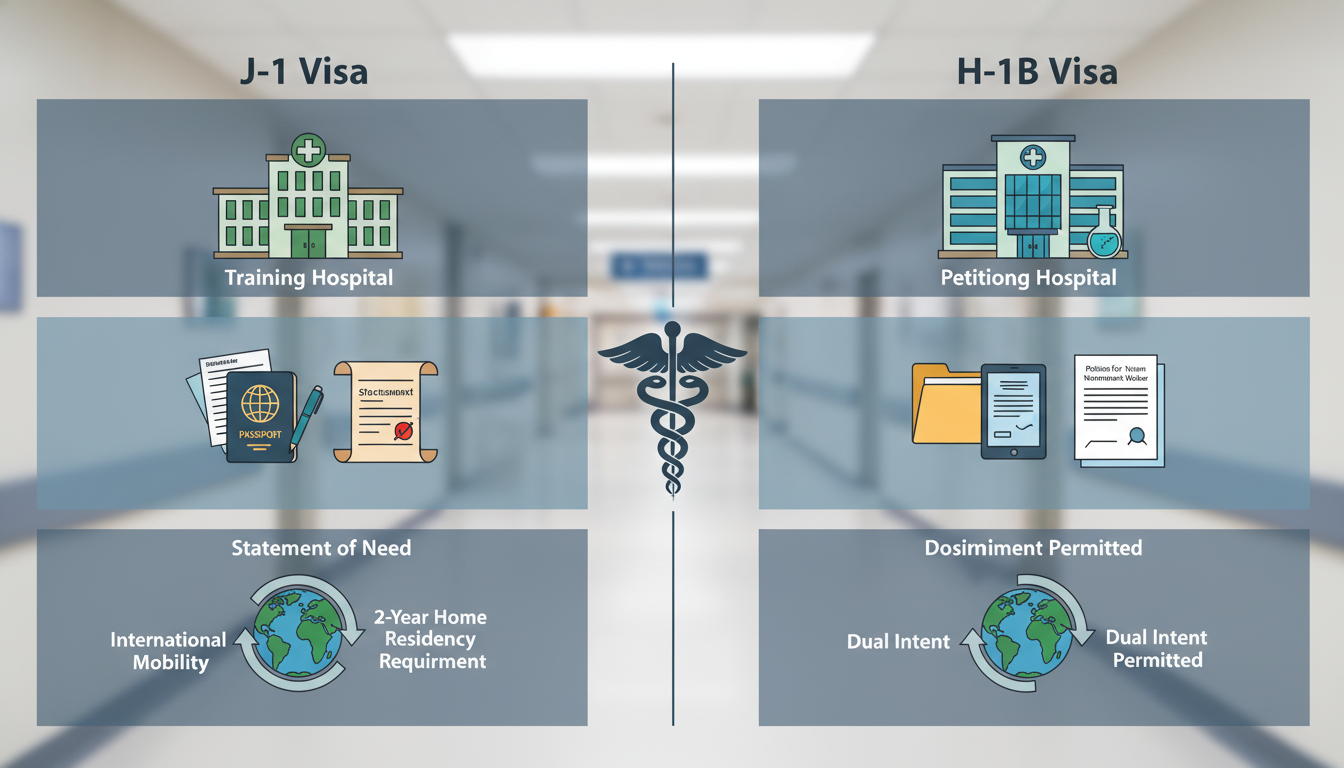
J-1 vs H-1B for Transitional Year: In-Depth Comparison
1. J-1 Exchange Visitor Visa (ECFMG-Sponsored)
The J-1 is the most common IMG visa option for residency training in the U.S.
Key Features:
- Sponsored by ECFMG, not by the individual hospital directly
- Specifically designed for graduate medical education (GME)
- Valid for the duration of an approved GME program, often renewable annually
- For a transitional year, the J-1 would typically cover the full 12 months
Eligibility Requirements (High-Level):
- Valid ECFMG certification
- Passed USMLE Step 1 and Step 2 CK (or equivalent)
- An offer from an ACGME-accredited program
- Adequate funding (program salary generally satisfies this)
Advantages for Transitional Year Residents:
Widely accepted by programs
- Many TY programs and advanced residency programs are comfortable and familiar with J-1 procedures.
- No need for the program to handle complex employer-sponsored H-1B petitions.
Simpler for the institution
- Administrative burden is lower; ECFMG manages much of the visa processing.
- Programs with limited legal resources often prefer J-1 sponsorship.
Quicker to implement in some cases
- ECFMG has established timelines and checklists (Form DS-2019, etc.).
- Especially helpful when there is little time between Match Day and residency start.
Disadvantages and Long-Term Implications:
Two-year home-country physical presence requirement (212(e))
- After completing J-1 training, you are generally required to return to your home country for two years before obtaining:
- H-1B (for non-training employment)
- L-1, K, or immigrant visas (green card pathways)
- This can be avoided only through a J-1 waiver (e.g., Conrad 30, hardship, persecution grounds), which may be uncertain or location-limited.
- After completing J-1 training, you are generally required to return to your home country for two years before obtaining:
Limited flexibility for moonlighting and outside work
- Work is generally restricted to the approved training site(s).
- Extra training or research sometimes requires additional authorization.
May limit certain career paths if no waiver is obtained
- Fellowship and early career steps must be carefully planned around the waiver and home-country requirement.
Practical TY Example (J-1 Path):
- You match into a transitional year residency in State A on a J-1 visa.
- You later match into an advanced radiology residency in State B, also using J-1 sponsorship through ECFMG.
- You complete 1-year TY + 4-year radiology residency on J-1.
- After training, you secure a Conrad 30 J-1 waiver job in a medically underserved area in State B, work 3 years, then transition to H-1B or green card sponsorship.
This is a common and successful pathway for many IMGs.
2. H-1B Temporary Worker Visa
The H-1B is an employment-based visa category for specialty occupations requiring a bachelor’s degree or higher (for physicians, a medical degree plus USMLE and licensing).
Key Features:
- Employer-sponsored (residency program is the petitioner)
- Dual intent: you may actively pursue permanent residency while on H-1B
- Up to 6 years of total H-1B time, with possible extensions if in green card process
Eligibility in a Residency Context:
- USMLE Step 3 often required by state licensure boards and many GME offices
- Valid ECFMG certification
- Program must be willing and able to sponsor an H-1B petition
- Prevailing wage and legal filing obligations must be met by the employer
Advantages for Transitional Year Residents:
No automatic two-year home-country requirement
- Unlike J-1, there’s no 212(e) rule built into H-1B.
- Greater flexibility to transition directly into U.S. fellowships or attending jobs (still requires appropriate visas/permits, but no J-1-specific obstacle).
Dual-intent compatibility
- You can pursue a green card while in training, particularly during later residency or early practice.
More flexibility (in some settings) for paid clinical work
- Moonlighting is sometimes possible if added to your H-1B petition, depending on state laws and institutional policies.
Disadvantages and Challenges for a Transitional Year:
Not all TY programs sponsor H-1B visas
- Due to cost, administrative burden, and lack of long-term commitment (it’s only a one-year program), many transitional year residencies prefer or exclusively sponsor J-1 visas.
Step 3 timing-pressure
- Many programs require that Step 3 be passed before filing the H-1B petition.
- For students outside the U.S., scheduling Step 3 in time for the Match can be difficult.
Continuity problems with advanced programs
- If your TY is on H-1B but your advanced program only sponsors J-1, you may need to
- Change visa type between PGY-1 and PGY-2, and
- Possibly start a new visa process with associated delays and costs.
- If your TY is on H-1B but your advanced program only sponsors J-1, you may need to
Cap and timing considerations
- Most residency programs at universities and non-profits are cap-exempt H-1B employers, which is helpful.
- But if you later move to a cap-subject employer, your prior cap-exempt status may not automatically exempt you from the national H-1B lottery.
Practical TY Example (H-1B Path):
- You pass USMLE Step 3 during medical school and secure an H-1B-sponsored transitional year residency.
- During your TY, you match into an advanced anesthesiology residency at a university hospital that also sponsors H-1B.
- You transition seamlessly on H-1B from TY to advanced program and continue toward a green card sponsorship during later residency or early attending years.
This pathway is attractive if you are strongly committed to long-term practice in the U.S. and can secure H-1B sponsorship at both the TY and advanced levels.
3. F-1 with OPT and Other Less Common Paths
Some IMGs are already in the U.S. on F-1 student visas (e.g., graduates of U.S. medical schools or U.S.-based research/MPH programs). They might have:
- OPT (Optional Practical Training) available after graduation
- Theoretical ability to use OPT work authorization for part or all of a transitional year residency
However:
- Many residency programs are unfamiliar or uncomfortable with F-1/OPT for GME.
- OPT is time-limited (usually 12 months), which may not cleanly align with future residency needs.
- Transitioning from F-1 to J-1 or H-1B is common, but planning must be precise.
For most IMGs trained outside the U.S., J-1 or H-1B remain the primary IMG visa options for a transitional year residency.

Strategic Visa Planning Across TY and Advanced Training
Step 1: Map Your Entire Training Path
Before choosing a visa type for your transitional year, create a multi-year roadmap:
Transitional Year (PGY-1)
- Where do you want to train?
- Which TY programs sponsor which visas?
Advanced Residency (PGY-2+)
- Do you already have an advanced position through the NRMP Advanced Match?
- If not, what specialties and regions are you targeting for the following year?
Fellowship and Early Career
- Will you likely need additional training (e.g., cardiology after internal medicine, interventional radiology after diagnostic radiology)?
- Are you open to practicing in underserved or rural areas (important for J-1 waivers)?
The more clearly you see your pathway, the more effectively you can choose between J-1 vs H-1B for the TY year.
Step 2: Research Program-Specific Visa Policies
Visa policies vary dramatically by institution. When researching TY programs and advanced specialty residencies, review:
- Program websites (often list “Visa sponsorship: J-1 only,” “J-1 and H-1B,” or “No visa sponsorship”)
- FREIDA and ERAS program descriptions
- Direct email inquiries to program coordinators or GME offices
Questions to ask specifically:
- Do you sponsor J-1 visas?
- Do you sponsor H-1B visas for PGY-1 transitional year residents?
- If yes, is USMLE Step 3 required before starting or before petition filing?
- Are there any institutional caps or restrictions on visa sponsorship?
For your advanced specialty programs, ask similar questions early, especially if you are leaning towards H-1B for your transitional year.
Step 3: Align Visa Type with Specialty Trends
Some specialties are more flexible or experienced with certain visa types.
Radiology, Anesthesiology, Neurology, PM&R, Dermatology, Ophthalmology, Radiation Oncology (common advanced paths after TY):
- Many programs sponsor J-1 routinely.
- Fewer programs offer H-1B, and competition for these spots may be higher.
Highly competitive specialties (e.g., Dermatology)
- May have stricter requirements; some prefer U.S. graduates and may limit visa sponsorship.
If you anticipate needing to be geographically flexible or are entering a competitive field, J-1 may open more doors simply because more programs sponsor it. If your long-term goal is stable U.S. employment without a J-1 waiver route, H-1B may better align with your objectives, but with more limited program options.
Step 4: Consider Timing and Documentation Requirements
Timeline anchors for TY + visa process:
Before ERAS submission:
- Clarify which visa type you will request at each program.
- If aiming for H-1B, plan Step 3 scheduling and results accordingly.
During interview season:
- Confirm or reconfirm each program’s current visa policy (policies sometimes change year to year).
- Communicate clearly and consistently about your visa needs and flexibility.
After Match Day:
- Start the visa process immediately with your matched program.
- For J-1: Follow ECFMG instructions for DS-2019 issuance.
- For H-1B: Work with the program’s legal/HR team to gather documents (diplomas, ECFMG certificate, USMLE transcripts, contracts, etc.).
Common documentation for both J-1 and H-1B:
- Valid passport
- Medical school diploma and transcript
- ECFMG certificate
- USMLE transcripts
- Residency contract or offer letter
- CV and supporting personal information
Step 5: Coordinate TY and Advanced Program Planning (If Doing Separate Matches)
If you do not secure an advanced position in the same Match as your transitional year (e.g., you only match into TY, and plan to apply again for PGY-2+), the stakes of your TY visa choice become even higher:
On J-1:
- It is relatively straightforward to continue subsequent years of GME at another institution with J-1 sponsorship.
- Programs are used to residents transferring on J-1 from one training site to another.
On H-1B:
- Your advanced program must be willing to file a new H-1B petition for you at the PGY-2 level.
- If that program only sponsors J-1, you may need to convert from H-1B to J-1, which is possible but requires careful coordination and sometimes returning home for consular processing.
For TY residents without an advanced spot yet, a J-1 visa often provides smoother continuity across multiple institutions, at the cost of accepting the two-year home-country requirement and/or planning for a future waiver.
Practical Tips to Avoid Visa Pitfalls as a Transitional Year Applicant
1. Be Honest and Consistent in Applications and Interviews
Programs need accurate information about your:
- Citizenship and immigration status
- Prior U.S. visa history
- Preferred or required visa type
Do not promise to “take any visa” if that is not realistic; for example, if your home country or personal situation makes J-1’s two-year requirement problematic, share this thoughtfully when appropriate. Inconsistencies can harm trust and delay processing.
2. Take USMLE Step 3 Early if You’re Considering H-1B
If your strategy includes H-1B at any point (TY or advanced program):
- Aim to pass Step 3 before applying to programs or at least before Rank Order List deadlines.
- Highlight your Step 3 completion in your ERAS application, personal statement, and CV.
- This significantly strengthens your case for H-1B sponsorship, particularly for transitional year programs that might otherwise default to J-1.
3. Understand the Financial and Legal Responsibilities
For J-1:
- ECFMG sponsorship fees and SEVIS fees are often shared between the institution and the resident (varies by program).
- Know what costs you must cover (e.g., visa interview travel, document mailing, SEVIS fee).
For H-1B:
- Certain employer fees for the petition must legally be paid by the employer, not by you.
- You may still incur costs for dependent visas, consular processing, etc.
Before committing, ask your program’s GME office for a breakdown of expected visa-related costs and responsibilities.
4. Factor in Family and Dependents
If you have a spouse or children:
- J-1 dependents (J-2):
- J-2 spouses can often apply for work authorization (EAD), a significant advantage.
- H-1B dependents (H-4):
- H-4 spouses usually cannot work unless they qualify for separate authorization (e.g., based on your approved I-140 in the green card process).
Educational and work needs of your family might influence whether J-1 vs H-1B is more suitable for your residency visa strategy.
5. Keep Backup Options in Mind
Visa processing can be unpredictable due to:
- Policy shifts
- U.S. consulate backlogs
- Security clearance delays
To reduce risk:
- Maintain updated and organized documentation (passports, certificates, prior visas, etc.).
- Keep in close contact with your program’s international office or GME visa coordinator.
- If possible, identify a backup plan (e.g., another start date, alternate visa category, or different institution).
FAQs: Visa Navigation for Transitional Year Residency
1. Is it easier to get J-1 or H-1B for a transitional year residency?
For most IMGs, it is easier to obtain a J-1 visa for a transitional year. Many TY programs either do not sponsor H-1B at all or restrict it to specific situations due to cost and administrative burden. J-1 is standardized through ECFMG and is the default visa for many institutions. However, if you have Step 3 completed and target programs that explicitly support H-1B, securing an H-1B for a TY program is possible.
2. If I do my transitional year on a J-1 visa, can I switch to H-1B for my advanced residency?
Yes, it is possible to change from J-1 to H-1B in some circumstances, but there are important limitations:
- If your J-1 is subject to the two-year home-country requirement, you generally cannot change to H-1B status inside the U.S. unless you obtain a J-1 waiver first.
- Sometimes physicians complete all GME on J-1, then obtain a J-1 waiver job and transition to H-1B afterward.
- Switching mid-training from J-1 to H-1B is more complex and less common; it requires legal consultation and institutional willingness.
3. Should I delay applying for transitional year until I pass USMLE Step 3 if I want H-1B?
Not necessarily. While Step 3 is crucial for many H-1B-sponsoring programs, delaying your application cycle can be risky. A practical strategy is:
- Apply broadly, indicating that you are open to J-1 vs H-1B depending on the program’s policy.
- Attempt Step 3 as early as is feasible; if you pass before or during the interview season, inform programs immediately.
- If you match into a J-1-only program, you can still build U.S. experience and re-evaluate your long-term visa strategy during the TY year.
4. Can a transitional year residency help me obtain a green card directly?
No. A transitional year residency itself does not directly grant permanent residency. However:
- If you train on H-1B, your later employer (e.g., a hospital or practice group) can sponsor you for a green card while you are still within your H-1B period.
- If you train on J-1, you usually must first complete the J-1 waiver service (such as a Conrad 30 waiver job) or fulfill the two-year home-country requirement before pursuing most employment-based green cards.
- The TY year is best viewed as a stepping stone to advanced training, which then leads to opportunities for permanent residency sponsorship.
Navigating visa options for IMGs in a transitional year residency is complex, but with early planning, careful research of program policies, and a clear understanding of J-1 vs H-1B, you can align your residency visa strategy with both your training goals and long-term career plans in the United States.