
Understanding the Visa Landscape as a Caribbean IMG in Cardiothoracic Surgery
For a Caribbean medical school graduate aiming for a cardiothoracic surgery residency in the United States, the clinical and academic bar is already high. Layer on top of that the complexity of residency visa rules, and the path can feel intimidating. Yet every year, international medical graduates (IMGs) from Caribbean schools successfully navigate this system, match into competitive programs, and progress toward careers in heart surgery.
This article breaks down visa navigation specifically for a Caribbean IMG interested in cardiothoracic surgery—from your first post‑graduate step in general surgery to advanced fellowship training in heart surgery, and eventually independent practice or academic leadership. We’ll connect the dots between Caribbean medical school residency opportunities, IMG visa options, and long‑term career implications in a high‑stakes specialty.
We’ll focus on:
- How cardiothoracic surgery training is structured in the U.S.
- The two main visa pathways: J‑1 vs H‑1B
- How your visa choice can affect competitiveness, mobility, and future jobs
- Practical strategies to strengthen your profile as a Caribbean IMG
- Common scenarios and FAQs
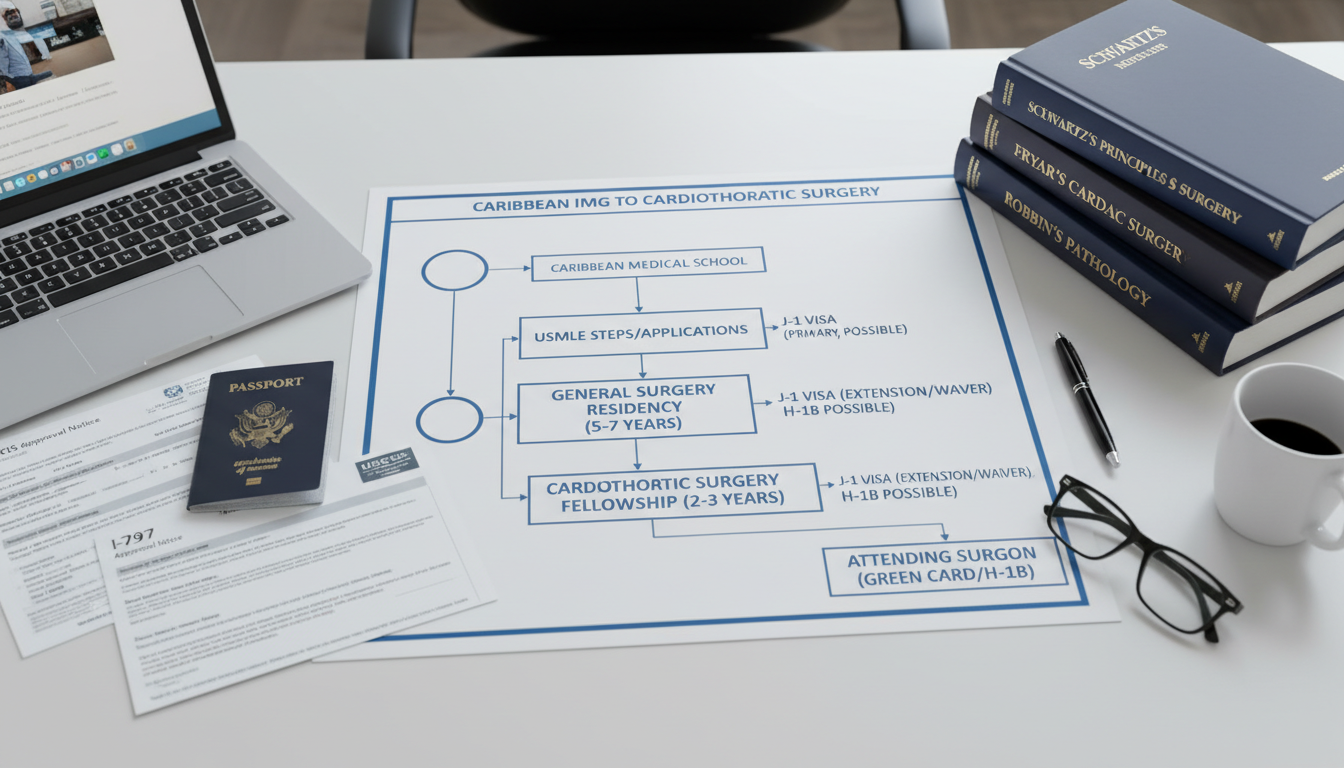
Pathway to Cardiothoracic Surgery for Caribbean IMGs
Before diving into visas, it’s crucial to understand the training pathway, because visa strategy must align with that path.
Typical Training Route
For most IMGs, cardiothoracic surgery is not a direct-entry residency. The usual trajectory:
- Medical School
- Caribbean medical school (e.g., SGU, AUC, Ross, etc.)
- Strong performance, especially in clinical rotations and USMLE scores
- General Surgery Residency (5 years)
- Your match will most likely be into a categorical general surgery residency, not cardiothoracic directly
- This is where your residency visa is first sponsored
- Cardiothoracic Surgery Fellowship (2–3 years)
- After general surgery, you apply for:
- Traditional Thoracic Surgery Fellowship (2–3 years), or
- Integrated 6-year I-6 cardiothoracic surgery residency (much more difficult for IMGs, especially on a non-citizen visa)
- After general surgery, you apply for:
- Subspecialty Training (Optional)
- Advanced fellowships in:
- Congenital heart surgery
- Heart failure and transplant
- Structural heart disease / TAVR
- Advanced fellowships in:
- Practice & Long-Term Immigration Status
- Academic vs private practice
- Interest in research, leadership, or global health
- Long-term goals (e.g., green card, returning to Caribbean, global practice)
At every stage, your visa status affects:
- Where you can train and for how long
- What types of programs can sponsor you
- Your ability to moonlight, do research, or change institutions
- Your long-term options for staying in the U.S.
For a Caribbean IMG, especially from a school like SGU that regularly publishes SGU residency match data, understanding the patterns of where graduates match on J‑1 vs H‑1B can help you identify realistic options early.
Core IMG Visa Options: J‑1 vs H‑1B for Residency
For most Caribbean IMGs applying for U.S. residency, two main visa categories matter:
- J‑1 Exchange Visitor (ECFMG-sponsored)
- H‑1B Temporary Worker (employer-sponsored)
Understanding the pros, cons, and practical realities of J‑1 vs H‑1B is essential—especially in a long training pipeline like cardiothoracic surgery, which can span 7–10+ years of postgraduate training.
J‑1 Visa for Residency and Fellowship
What it is:
A J‑1 visa for graduate medical education is sponsored by ECFMG (not directly by hospitals) and is specifically designed for physicians in training.
Key features:
- Most common pathway for IMGs in residency and fellowship
- Valid for the duration of your ACGME-accredited training, renewable annually
- Covers both general surgery residency and cardiothoracic surgery fellowship
- Requires ongoing ECFMG sponsorship and monitoring
- Subject to a two-year home-country physical presence requirement after training (also called the “two-year rule”)
Advantages:
Widely accepted
- The majority of IMG-friendly general surgery programs accept or even prefer J‑1.
- Many cardiothoracic surgery fellowships are familiar with J‑1 trainees.
Streamlined for training
- One central sponsor (ECFMG) handles much of the process.
- Renewal is routine as long as you stay in good standing.
Predictable for multiple training steps
- You can go from general surgery residency to cardiothoracic surgery fellowship on J‑1 without needing a new employer-based visa category.
Disadvantages:
Two-Year Home Residency Requirement (§212(e))
- After completion of all training, you must:
- Return to your home country or country of last permanent residence (often in the Caribbean) for two cumulative years, or
- Obtain a waiver of this requirement.
- You generally cannot convert directly to H‑1B or permanent residency (green card) inside the U.S. until this requirement is fulfilled or waived.
- After completion of all training, you must:
Limited non-training work options
- Moonlighting is possible in some settings but restricted.
- J‑1 is strictly tied to clinical training, not independent practice.
Waiver can be challenging in highly specialized fields
- For cardiothoracic surgeons, many waiver programs (e.g., underserved/rural service) are designed for primary care and general internists or psychiatrists.
- It is still possible to find a J‑1 waiver job as a cardiothoracic surgeon in some underserved regions or academic centers, but options may be fewer and more geographically constrained.
H‑1B Visa for Residency and Fellowship
What it is:
A work visa for “specialty occupations” sponsored by an employer (hospital or university). For physicians, it can be used for residency, fellowship, or attending-level positions.
Key features:
- Max duration: typically 6 years, with some exceptions or extensions in certain green card processes
- Requires USMLE Step 3 passed before visa filing (often before match or early PGY-1)
- Sponsored directly by the residency/fellowship program’s institution
Advantages:
No two-year home-country requirement
- You are generally free to transition to another H‑1B job or a green card–sponsoring employer after training.
Potentially smoother path to independent practice in the U.S.
- Since there’s no J‑1 waiver requirement, your first job as a cardiothoracic surgeon can be based purely on merit and institutional fit.
Stronger positioning for long-term U.S. immigration
- Many surgeons on H‑1B transition directly into an employer-sponsored green card process.
Disadvantages:
Many programs don’t sponsor H‑1B for residency
- Particularly in general surgery, a large proportion of programs accept J‑1 only.
- Even IMG-friendly institutions may be reluctant to handle the extra cost and legal complexity of H‑1B.
USMLE Step 3 timing pressure
- You must pass Step 3 early enough for the program to submit the petition and for you to start on time.
- As a Caribbean IMG, arranging Step 3 before starting PGY-1 can be logistically challenging given exam scheduling and clinical rotations.
H‑1B cap and portability issues
- Some institutions are “cap-exempt,” others are not.
- Transitioning between different employers (e.g., from a university hospital to private practice) may involve careful timing and legal strategy.
How Visa Choice Impacts a Caribbean IMG in Cardiothoracic Surgery
The reality is that your visa is not just a paperwork choice; it shapes your:
- Match options in general surgery
- Ability to secure a cardiothoracic surgery fellowship
- First job as a heart surgeon
- Long-term U.S. immigration strategy
Step 1: General Surgery Residency – Where the Visa Conversation Starts
For Caribbean graduates (including SGU, Ross, AUC, etc.), the first priority is matching into a strong general surgery residency. Here’s how visa status affects that step:
- More programs accept J‑1 than H‑1B
- If you require H‑1B only, you drastically shrink your pool of programs.
- Program attitude matters more than theoretical eligibility
- Even if a hospital’s HR system can sponsor H‑1B, individual departments might prefer not to—for budget or administrative reasons.
- Competitiveness of surgery
- General surgery is moderately competitive. Being from a Caribbean school + IMG + needing visa support can be three layers of “risk” for programs.
- Choosing J‑1 often removes one layer of complexity from the program’s perspective.
Practical takeaway:
Most Caribbean IMGs targeting general surgery residency (with an eye on cardiothoracic later) keep both J‑1 and H‑1B options open, but in practice, many will match on a J‑1 due to program preferences.
Step 2: Transition to Cardiothoracic Surgery Fellowship
Once you are in a U.S. general surgery residency:
- On a J‑1 visa:
- ECFMG sponsorship can usually be extended to cover your cardiothoracic surgery fellowship.
- Fellowship programs are familiar with this; it is a standard scenario.
- On an H‑1B visa:
- Your new training institution must be willing to file another H‑1B petition.
- Timing and Step 3 are already handled, but institutional legal approval varies.
For highly competitive subspecialties like cardiothoracic surgery residency/fellowship, program directors may prioritize:
- Track record of excellence during general surgery
- Strong letters and case logs
- Research productivity and academic potential
Visa type is typically a secondary factor, but your visa must be feasible for them to sponsor.
Step 3: Post-Training Employment and the J‑1 Waiver Issue
If you complete training on a J‑1, you must:
- Return home for 2 years, or
- Get a J‑1 waiver job, often in a designated underserved area or with a government/institutional waiver.
For cardiothoracic surgeons:
- J‑1 waiver jobs may be harder to find than for primary care physicians.
- However, large regional health systems and some academic centers in underserved states may support waivers for high-need specialties:
- States with fewer cardiothoracic surgeons
- Institutions building heart transplant or LVAD programs
- Public/university hospitals serving wide catchment areas
If you train on an H‑1B:
- You can move into any H‑1B-eligible job that can sponsor you (subject to cap issues and licensing).
- You are not constrained by the two-year home requirement, giving more flexibility in pursuing specific academic or high-volume heart surgery centers.
Strategic implication for Caribbean IMGs:
Focusing exclusively on avoiding the J‑1 can backfire if it costs you a solid general surgery residency match. Many IMGs accept a J‑1 for training and later solve the waiver question with early networking and careful job search planning.

Practical Strategies for Caribbean IMGs: Maximizing Your Options
You cannot change the structure of U.S. immigration law, but you can position yourself strategically as a Caribbean IMG seeking cardiothoracic surgery training.
1. Start Visa Planning Early in Medical School
During your clinical years at a Caribbean medical school:
Clarify your long-term goals
- Do you want to practice long-term in the U.S., return to the Caribbean, or have a global career?
- Are you drawn more to academic cardiothoracic surgery or high-volume private practice?
Understand your citizenship context
- Citizens of some Caribbean nations may have specific bilateral agreements or waiver opportunities.
- If you hold dual citizenship (e.g., Caribbean + EU/Canada), explore how that impacts the “home country” designation for J‑1.
Engage your school’s advising system
- Many Caribbean schools have dedicated advisors familiar with IMG visa options.
- Review match lists from your school (e.g., SGU residency match data) to see patterns:
- Which states and institutions frequently take graduates in surgery?
- Are they J‑1 predominant?
2. Keep Both J‑1 and H‑1B Pathways Technically Open
To preserve flexibility:
J‑1 Readiness:
- Obtain ECFMG certification promptly.
- Ensure all documents (diploma, transcripts) are ready for visa sponsorship.
H‑1B Readiness:
- Aim to pass USMLE Step 3 as early as reasonably possible if you are serious about H‑1B.
- However, recognize that prioritizing Step 3 too early must not compromise Step 1/2 performance or clinical evaluations.
Important caution:
Do not insist on H‑1B in your applications unless you have a compelling reason and a strong enough profile; doing so may unnecessarily limit your match prospects, especially in general surgery.
3. Be Honest but Strategic in Program Communication
When applying for general surgery residency:
- Research each program’s visa policy on their website or through current residents.
- In ERAS applications:
- Indicate willingness to accept a J‑1 unless you have strong reasons otherwise.
- During interviews:
- If asked, you can say:
- “I am open to both J‑1 and H‑1B sponsorship. My primary goal is to train in a strong program in general surgery to become a cardiothoracic surgeon. I understand many programs sponsor J‑1 and I’m fully prepared for that route as well.”
- If asked, you can say:
This signals flexibility and reduces perceived administrative burden.
4. Build a Profile That Offsets Visa “Risk”
Cardiothoracic surgery is among the most selective fields. To overcome biases against non‑US grads and visa‑requiring applicants:
USMLE performance:
- Aim for above-average scores for surgery applicants.
- Even with Step 1 pass/fail, your Step 2 CK score remains critical.
Clinical excellence in U.S. rotations:
- Seek surgical rotations in academic hospitals, ideally with exposure to cardiac or thoracic services.
- Request strong, detailed letters of recommendation from U.S. surgeons.
Research in cardiac/thoracic fields:
- Get involved in:
- Outcomes research in heart surgery
- Quality improvement projects in cardiothoracic ICUs
- Case reports of complex cardiac cases
- Present at meetings (STS, AATS, ACS) when possible.
- Get involved in:
Programs are more likely to tolerate visa complexity when you offer clear academic and clinical value.
5. Understand Residency Visa vs Fellowship and Job Visa
Your residency visa is not necessarily your forever status. For instance:
You may complete general surgery on J‑1, then:
- Return home and later come back on H‑1B for a faculty job, or
- Secure a J‑1 waiver job and subsequently apply for permanent residency.
Or you may do residency on H‑1B, but later:
- Move to a fellowship or job that prefers a different pathway.
Keep perspective: the priority is to enter and complete high-quality surgical training; visa optimization should support, not replace, that central objective.
Scenario Examples: Putting It All Together
Scenario 1: SGU Graduate Matching General Surgery on J‑1, then Cardiothoracic Fellowship
- You graduate from a Caribbean school like SGU with strong USMLE and surgical rotations.
- You match into a J‑1–friendly general surgery residency in a midwestern academic center.
- During residency:
- You publish research in cardiac surgery outcomes.
- You complete electives on the cardiothoracic service.
- You then match into a J‑1–accepting cardiothoracic surgery fellowship at a university hospital.
- After all training, you:
- Work with a large health system in a state that supports J‑1 waiver positions for cardiothoracic surgeons—possibly a secondary city or underserved region.
- After meeting waiver obligations (often 3 years), your employer sponsors a green card.
Outcome:
J‑1 did not block your cardiothoracic career; it required targeted planning and geographic flexibility after fellowship.
Scenario 2: Caribbean IMG Pursues Early H‑1B but Limits Match Options
- You are determined to avoid the J‑1 two-year rule and focus on H‑1B only.
- You take Step 3 early and pass but:
- Apply only to programs that explicitly sponsor H‑1B for surgery.
- Your application pool shrinks significantly; competition is intense.
- You either:
- Do not match into general surgery, or
- Match into a less academic program with limited cardiothoracic exposure.
Outcome:
By focusing too rigidly on H‑1B, you significantly hurt your chances of laying the clinical and academic foundation needed for cardiothoracic surgery.
Scenario 3: Flexible Strategy with Both J‑1 and H‑1B on the Table
- You prepare for both visas:
- Take Step 3 if manageable, but do not compromise Step 2 CK or your clinical performance.
- You apply broadly to general surgery programs, signalling openness to J‑1.
- You match at a strong academic center that sponsors J‑1 only.
- During residency, you:
- Build a strong cardiothoracic profile (research, rotations, mentorship).
- By PGY-4/5, you:
- Have enough connections to explore J‑1 waiver options or consider temporary return to the Caribbean for 2 years while working as a surgeon.
Outcome:
You maximized your chances to get into quality training, then handled immigration flexibly later.
Frequently Asked Questions (FAQ)
1. As a Caribbean IMG, should I insist on H‑1B to avoid the J‑1 two-year home requirement?
Generally, no. Especially for general surgery, insisting on H‑1B can sharply reduce your match opportunities. For most Caribbean IMGs, it is wiser to:
- Stay open to J‑1 for residency and fellowship
- Focus on getting the best possible surgical training
- Start exploring J‑1 waiver or longer-term immigration solutions near the end of training, when your value as a cardiothoracic surgeon is clearer.
2. Can I complete general surgery on J‑1 and then switch to H‑1B for cardiothoracic surgery fellowship?
Usually not directly, if you are subject to the J‑1 two-year rule. You would either need:
- A J‑1 waiver approved before switching status, or
- Completion of the two-year home-country presence requirement.
Without one of these, switching from J‑1 to H‑1B inside the U.S. is typically not permitted.
3. Do cardiothoracic surgery programs prefer one visa type over another?
Most cardiothoracic surgery fellowships and integrated programs care primarily about:
- Your surgical ability and training background
- Research and academic potential
- Letters of recommendation and references
Visa feasibility matters, but there is no universal preference for J‑1 vs H‑1B. Many programs simply have institutional defaults (e.g., “We sponsor J‑1 only” or “We can do both”). Your job is to verify each program’s policy early and plan accordingly.
4. How can I find J‑1 waiver jobs as a cardiothoracic surgeon after fellowship?
Strategies include:
- Networking early with:
- Program directors
- Alumni from your Caribbean school and U.S. training programs
- Cardiothoracic surgeons practicing in underserved areas
- Consulting:
- Hospital recruitment departments
- Immigration attorneys experienced with physician J‑1 waiver cases
- Looking at:
- Large regional health systems in states with workforce shortages
- Academic centers in less saturated markets that are expanding heart surgery services
While options may be fewer than for primary care, waiver positions do exist for high-need cardiothoracic surgeons willing to be geographically flexible.
For a Caribbean IMG aspiring to cardiothoracic surgery, visa navigation is not an obstacle to fear, but a system to understand and plan around. By focusing first on excellent surgical training and remaining flexible about J‑1 vs H‑1B within realistic constraints, you can keep the path open from Caribbean medical school residency in general surgery to advanced heart surgery training and, ultimately, a fulfilling career in the U.S. or abroad.