
Understanding the Visa Landscape for IMGs in General Surgery
For an international medical graduate (IMG) pursuing a general surgery residency in the United States, understanding visa options is just as critical as scoring well on the USMLE. Your visa status can determine:
- Where you can interview and match
- Whether programs can rank you
- What contracts you’re offered
- Your long‑term career path in the U.S.
This IMG residency guide focuses on visa navigation for general surgery residency, walking through the J-1 vs H-1B decision, timelines, practical strategies, and common pitfalls. While the core visa concepts apply to all specialties, general surgery has unique features that affect your choices and opportunities.
You should always confirm details with each program’s GME office and (when possible) an immigration attorney, because institutional policies and immigration rules can change. This article gives you a structured framework so you can ask the right questions and plan proactively.
Core Visa Options for IMGs in General Surgery
In the context of the surgery residency match, most IMGs will pursue one of three main pathways:
- J-1 Physician Visa (ECFMG-sponsored) – the most common route
- H-1B Temporary Worker Visa – less common but strategically important
- Green card / other permanent status – ideal but relatively rare at entry
1. J-1 Visa for Physician Training
The J-1 physician visa is the default for many IMGs entering general surgery. It is sponsored not by the hospital but by ECFMG (Educational Commission for Foreign Medical Graduates).
Key characteristics
- Purpose: Graduate medical education and training
- Sponsor: ECFMG, not the residency program
- Duration: Up to 7 years total of clinical GME training (extensions possible in limited circumstances)
- Employment: Restricted to the specific ACGME-accredited program and site(s) approved on your DS-2019
- Exam requirement: You must have cleared USMLE Steps required for ECFMG certification
- Home residency requirement: The famous “two-year home country physical presence” after training
Advantages for IMGs in surgery
- Widely accepted by general surgery programs
- Straightforward and standardized process through ECFMG
- Often easier for programs to manage than H-1B (no prevailing wage/LCA issues)
- No USMLE Step 3 requirement before starting residency
Limitations and downstream implications
Mandatory 2-year home country rule (INA 212(e)):
After completing training, you must either:- Return to your home country (or country of last permanent residence) for 2 years, or
- Obtain a J-1 waiver (e.g., Conrad 30, federal waiver programs, or hardship/persecution waivers)
Impact on fellowship and job planning
- If you want to stay in the U.S. for a general surgery fellowship or practice, you typically need a J-1 waiver job first (usually in a medically underserved / shortage area).
- Planning is essential if your goal is a competitive fellowship (e.g., surgical oncology, transplant, cardiothoracic) that often clusters in academic centers not always offering waiver jobs.
Practical example
A general surgery IMG on a J-1 visa completes 5 years of residency. They secure a Conrad 30 J-1 waiver position as a general surgeon in a rural community hospital, work there for 3 years on an H-1B, and then apply for a green card. Only after fulfilling this obligation (or via other complex routes) might they pursue a fellowship or move to a major academic center.
2. H-1B Visa for Residency
The H-1B visa is a work visa for “specialty occupations” and can be used for residency and fellowship. For general surgery, some large academic centers and university‑affiliated programs support H-1B, but many community programs do not.
Key characteristics
- Purpose: Employment in a specialty occupation (surgery residency qualifies)
- Sponsor: Your residency program / institution (the employer)
- Duration: Up to 6 years (often 3+3) with possible extensions in some green card processes
- Exam requirement: USMLE Step 3 is required before H-1B petition filing in most states
- Portability: You can change H-1B employers under certain conditions
Advantages for surgery IMGs
- No 2-year home country requirement like the J-1
- Potentially smoother transition to:
- Fellowship (extension or transfer of H-1B)
- Attending positions (H-1B transfer or green card sponsorship)
- Aligns well with long‑term U.S. career plans if you aim to stay and practice in the U.S.
Limitations and challenges
- Not all general surgery programs sponsor H-1B:
Many explicitly state: “J-1 only” on their websites. - Administrative burden for programs:
- Prevailing wage determination
- Labor Condition Application (LCA)
- Legal fees and processing time
- Timing: You need Step 3 results before visa filing, which compresses your schedule if you graduate medical school late or take Step 3 close to match season.
- Cap considerations:
- Many academic institutions are cap‑exempt (not limited by the annual H-1B numerical cap), but some are not. You must confirm this with the program.
Practical example
An IMG who plans a long career in the U.S. academic general surgery space takes USMLE Step 3 early, targets mostly H-1B‑friendly university programs, and matches into a 5‑year general surgery residency under H-1B status. After residency, they transition directly into a surgical oncology fellowship on the same H-1B category, then move to an attending role with green card sponsorship.
3. Other Statuses and Pathways (Brief Overview)
Although less common at entry into a general surgery residency, you may encounter:
Permanent resident (green card):
Best-case scenario; you apply like a U.S. graduate from an immigration standpoint. No J-1 or H-1B limitations.Dependent status (e.g., H-4, L-2, etc.):
Sometimes you’re in the U.S. already as a dependent of a spouse.- You may or may not have work authorization (EAD) depending on category and rules.
- It’s common to convert to J-1 or H-1B for residency.
O-1 (extraordinary ability):
Rare at residency level, more relevant for senior researchers or post‑fellowship attending surgeons.
Even if you’re in another status, residency programs will usually want you in a clear, work‑authorized category (most commonly J-1 or H-1B) for the duration of training.
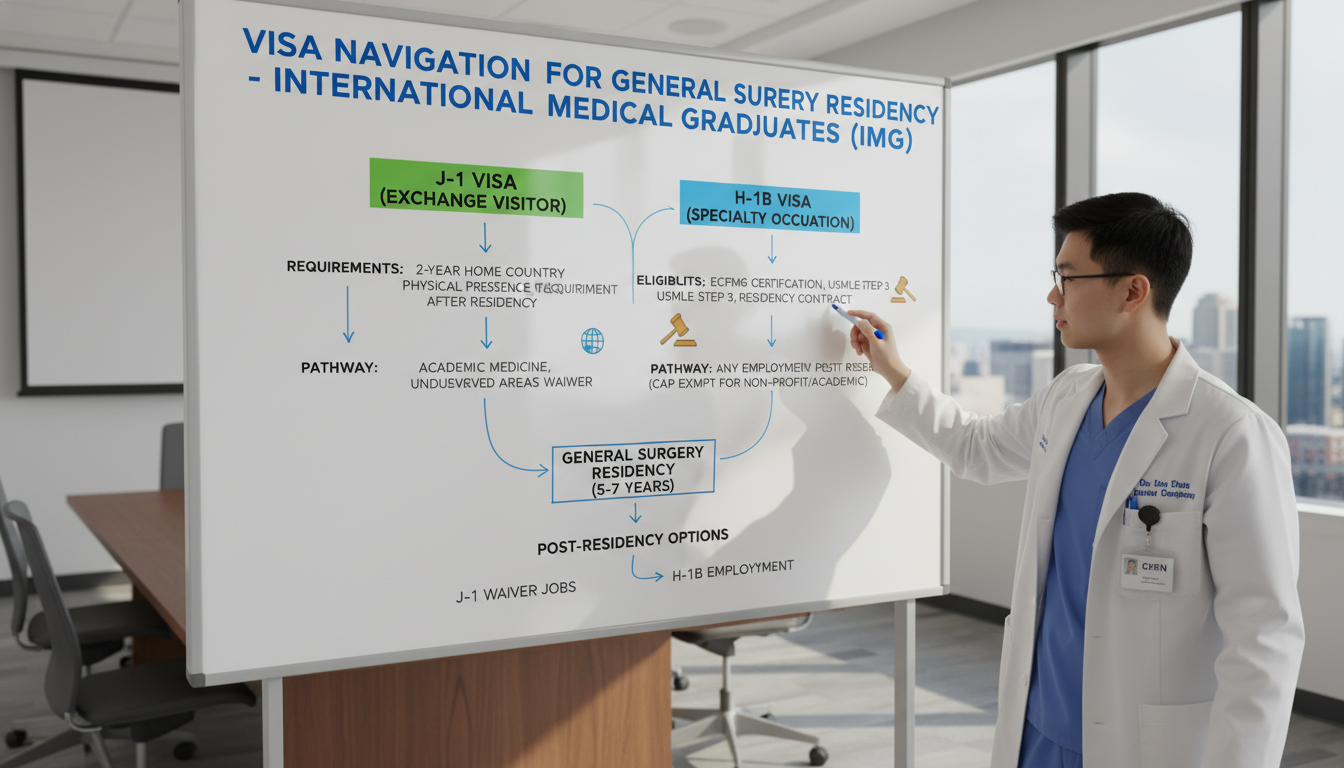
J-1 vs H-1B: Strategic Considerations for General Surgery IMGs
Choosing between J-1 vs H-1B is not just a bureaucratic decision. It shapes your opportunities during and after residency. Because general surgery is long (5+ years with research or prelim years), strategy matters.
Program Policies and Reality
Even if you prefer H-1B, your options are constrained by what programs actually sponsor.
- Many community general surgery programs: J-1 only
- Many university / academic centers: May offer both, but sometimes prefer J-1
- Some high‑demand academic programs: State they accept H-1B only under limited conditions (e.g., candidate already in H-1B or has strong research funding)
Actionable step:
Before applying, create an Excel or Notion tracker listing:
- Program name
- Visa policy (J-1 only / J-1 & H-1B / no visas)
- Any notes from email responses (e.g., “H-1B possible only if Step 3 passed by Dec 1”)
Career Goals and Training Path
Ask yourself:
- Do you want a long‑term U.S. career in general surgery?
- Are you aiming for a competitive fellowship (e.g., HPB, colorectal, cardiothoracic)?
- Are you open to working in rural or underserved areas after training?
J-1 is often acceptable when:
- You are open to working in a waiver job in a shortage area after residency.
- You are uncertain about long-term plans and primarily focused on training quality.
- Your priority programs only sponsor J-1.
H-1B may be preferable when:
- You are committed to staying in the U.S. and want more flexibility in job/fellowship location.
- You already have (or will have) Step 3 completed early.
- You are targeting academic careers where staying at the same institution for fellowship or faculty roles is highly likely.
Risk Management and Timelines
Residency visa timeline (high-level)
- 12–18 months before Match: Begin clarifying IMG visa options for each program.
- 9–12 months before Match: Take Step 3 if aiming for H-1B.
- Immediately after Match (March–May):
- J-1: Start ECFMG online application, submit required documents.
- H-1B: Institution’s legal team files petition; you provide documents and may need premium processing.
Key risk for H-1B‑aiming candidates:
- If Step 3 is delayed or failed, you may lose the H-1B option and the program may insist on J-1 (if they accept it) or, in extreme cases, struggle to sponsor you at all. Always clarify with the program:
“If Step 3 is not passed by X date, will you still support a J-1 visa?”
Application, Match, and Visa: How They Interact
Your visa planning should be integrated into your ERAS application strategy, not treated as an afterthought. For a general surgery IMG, this can influence everything from personal statements to program lists.
Before Applying: Research and Targeting
Identify your visa priorities
- Are you strictly J-1 vs H-1B, or flexible?
- Do you already have Step 3? This can be a strong plus for H-1B-supporting programs.
Research each program’s stance using:
- Program website (often under “Eligibility & Visa” or “FAQ”)
- FREIDA and program informational PDFs
- Email directly:
- Ask: “Do you sponsor J-1, H-1B, or both for categorical general surgery residents?”
- Keep emails concise and professional.
Shape your program list based on reality, not wishful thinking
- If your heart is set on H-1B but you have no Step 3 score yet, a heavily H-1B‑dependent list is high risk.
- Most IMGs apply broadly to a mix of J-1 and H-1B programs.
During the Interview Season
Be prepared for visa-related questions in interviews and know how to respond confidently.
Common interview questions about visas
- “What visa will you require to train in the U.S.?”
- “Have you already passed Step 3?”
- “Are you open to a J-1 visa if H-1B is not feasible?”
- “What are your long-term plans after residency?”
Tips for answering as a general surgery IMG
Be transparent but flexible:
- “I am eligible for both J-1 and H-1B. I have passed Step 3 and would prefer H-1B due to my long-term goal of practicing in academic general surgery in the U.S., but I understand institutional constraints and am open to J-1 if needed.”
Show commitment to U.S. practice:
- Emphasize that you’re planning a long-term surgical career in the U.S. and are willing to manage the necessary immigration steps.
Rank List and Match Considerations
Residency programs must be confident that they can legally employ you. Visa uncertainty can be a red flag, especially in high-workload fields like general surgery, where vacancies are costly.
Avoid these pitfalls:
- Targeting many programs that cannot sponsor your needed visa
- Failing to communicate clearly: If your status changes (e.g., you pass Step 3), inform programs early.
- Assuming “I’ll figure the visa out after I match” – programs dislike late surprises.
Smart strategy example
- An IMG in Pakistan aiming for general surgery has ECFMG certification but no Step 3 yet.
- They primarily apply to J-1‑friendly programs, with a handful of H-1B programs scheduled late in interview season, giving time to attempt Step 3.
- Once Step 3 is passed in November, they email H-1B programs: “I am pleased to share that I have now passed Step 3 and remain very interested in your program.”

Practical Steps for Each Visa Type (From Match to Start Date)
If You Match and Plan to Use a J-1 Visa
Confirm Sponsorship with Program
- The program will typically send onboarding information indicating that you’ll be on a J-1.
- They’ll provide instructions to start the ECFMG J-1 sponsorship application.
Complete ECFMG Online Application
- Fill out personal information, upload passport, photos, and required forms.
- Provide Statement of Need from your home country’s Ministry of Health or relevant authority.
- Provide contract/offer letter from your residency program.
Wait for DS-2019 Issuance
- ECFMG reviews the documents and, if approved, issues the DS-2019, which your program forwards or ECFMG ships directly to you.
Schedule Visa Interview at U.S. Embassy/Consulate
- Complete DS-160, pay SEVIS fee, pay visa fee, and schedule your interview.
- Bring DS-2019, ECFMG letter, program contract, financial documentation if requested.
Enter the U.S. in J-1 Status
- You can usually enter up to 30 days before your program start date.
- Upon arrival, check in with ECFMG and your program’s GME office as instructed.
General surgery‑specific point:
Because general surgery starts with high clinical responsibility, many programs want you in the U.S. at least 1–2 weeks early for orientation, ATLS/ACLS, EMR training, and surgical skills boot camps. Factor consular wait times into your planning.
If You Match and Plan to Use an H-1B Visa
Confirm Eligibility and Institutional Policy
- Confirm that your program does sponsor H-1B for residents.
- Verify that you have Step 3 passed and a valid ECFMG certificate.
Work with Institution’s Legal Office
They will typically ask you for:- CV, passport copy, medical diploma, ECFMG certificate
- USMLE transcripts (including Step 3)
- License/permit information (if state requires certain steps before H-1B filing)
H-1B Petition Filing (Form I-129)
- The institution handles filing; you may need to pay some or none of the fees depending on policy.
- They will file a Labor Condition Application (LCA) with the Department of Labor.
- Many institutions use premium processing to ensure timely approval before July 1.
Consular Processing or Change of Status
- If you are outside the U.S.:
- Once approved, you schedule a visa interview at the consulate with the H-1B approval notice (I-797).
- If you are in the U.S. in another status:
- They may request a change of status; you might not need to leave the U.S. at that point.
- If you are outside the U.S.:
Start of Training
- You can begin working only after the approved H-1B start date, which is typically your program start date.
General surgery‑specific point:
Because of the 5‑year (or more) training duration, programs must plan H-1B years carefully, especially if you anticipate research years (which might not be H-1B eligible if purely non‑clinical and not part of GME). Clarify whether research years will impact your total H-1B time.
Long-Term Planning: Fellowships, Waivers, and Beyond
Visa decisions during residency affect your post-residency pathway. General surgery often leads to fellowship; many IMGs also need to think about J-1 waivers and long‑term immigration status.
If You Trained on a J-1 Visa
You face the two-year home residence requirement unless you obtain a waiver.
Common waiver routes for surgeons
Conrad 30 Waiver (State Health Department)
- Each state can sponsor up to 30 J-1 physicians per year, often prioritizing primary care but increasingly open to general surgeons in underserved areas.
- You must work full-time (usually 3 years) in a designated shortage area or facility.
Federal Programs (e.g., VA, HHS, etc.)
- Certain federal agencies can sponsor waivers, including facilities like VA hospitals.
- Less common but useful for surgeons interested in federal or veteran-care facilities.
Hardship or Persecution Waivers
- Complex and case-specific, used when returning home would cause exceptional hardship to a U.S. citizen spouse/child or persecution.
Once you get a waiver job, your employer usually sponsors you for H-1B and often later for a green card.
Fellowships on J-1
- If you complete general surgery on J-1 and then start a fellowship also on J-1, you continue accumulating J-1 time (within the 7-year limit).
- After all training is done, you still owe the 2-year home requirement or a waiver.
- Competitive fellowships sometimes prefer or require that you will be able to stay in the U.S. to practice after training; clear planning helps.
If You Trained on an H-1B Visa
Your challenges are different:
- You have a 6-year general limit in H-1B status (with potential extensions in some green card scenarios).
- A 5-year general surgery residency + 2-year fellowship would exceed 6 years unless:
- You recapture time spent outside the U.S., or
- You begin a green card process early enough to qualify for H-1B extensions beyond 6 years.
Strategic moves
- Start discussing long‑term plans with your department and GME office by PGY-3 or PGY-4.
- Ask whether your institution routinely sponsors green cards for residents/fellows who will become faculty.
- If your end goal is academic surgery at your training institution, early planning can smooth the transition.
Frequently Asked Questions (FAQ)
1. As an international medical graduate, should I avoid programs that only sponsor J-1 visas?
Not necessarily. For many IMGs, the J-1 visa is the most realistic and widely available route into general surgery residency. Programs that only sponsor J-1 can still provide excellent training and strong fellowship outcomes. The key is understanding the post‑training implications, especially the two-year home requirement and J-1 waiver process, and deciding if you are comfortable working in a shortage area or pursuing a waiver after residency.
2. Is taking USMLE Step 3 before applying really worth it for general surgery?
If you’re interested in H-1B visa options, then yes, Step 3 can be extremely valuable. Many programs will only consider or sponsor H-1B if you already have a Step 3 passing score. Even for J-1 programs, Step 3 can strengthen your application and signal maturity and readiness for high-intensity training like general surgery. However, you must balance Step 3 prep with the need to secure strong scores on Step 1 and Step 2 CK, which remain more critical for initial selection.
3. Can I switch from J-1 to H-1B during residency?
This is very difficult in practice if you are on a J-1 physician visa sponsored by ECFMG. Once you are subject to the 212(e) two-year home residency requirement, you generally cannot change to H-1B or adjust status to permanent resident inside the U.S. unless you first satisfy or waive that requirement. Some rare exceptions involve different J categories or earlier statuses, but for typical J-1 clinical trainees, switching is not a simple option.
4. How do I find out which general surgery programs sponsor H-1B visas?
There is no single official centralized list, so you have to do your own research:
- Check each program’s website (Eligibility/Visa section).
- Look at FREIDA and any program fact sheets.
- Email the program coordinator or GME office with a concise question:
- “I am an international medical graduate preparing to apply for general surgery residency. Could you please confirm whether your program sponsors J-1, H-1B, or both for categorical residents?”
Create a personal database or spreadsheet so you can make informed decisions when building your ERAS list and ranking programs.
Navigating the residency visa landscape as an IMG in general surgery requires early planning, clear self-assessment, and proactive communication. Understand your IMG visa options, be realistic about J-1 vs H-1B availability, and align your choices with your long‑term surgical career goals. With the right strategy, visa considerations become a manageable part of your journey rather than an obstacle to your success in the surgery residency match.