
Understanding the J-1 Waiver Landscape in Appalachia
Residency programs in Appalachia occupy a unique position in U.S. graduate medical education. Many hospitals in West Virginia, eastern Kentucky, and adjacent Appalachian counties in surrounding states rely heavily on international medical graduates (IMGs) to maintain physician coverage—especially in primary care and high-need specialties. For these programs, mastering J-1 waiver strategies is no longer optional; it is a core component of long-term workforce planning.
Most IMGs in U.S. residencies and fellowships train on J-1 visas sponsored by ECFMG. After completing training, they are expected to return to their home countries for two years (the “two‑year home residency requirement”). A J-1 waiver allows them to remain in the U.S. and transition to work visas (usually H‑1B) if they commit to service in an underserved area or meet other waiver criteria.
For Appalachian residency programs and affiliated hospitals, understanding how to support J‑1 waiver pathways can:
- Strengthen recruitment of high-caliber IMGs
- Increase retention of graduates in the local community
- Stabilize service lines in hard‑to‑recruit locations
- Enhance the program’s reputation as an IMG‑friendly, visa‑savvy training site
This article focuses on practical, program-level strategies for J-1 waivers in Appalachia, with particular emphasis on:
- Appalachian residency programs in West Virginia and Kentucky
- The Conrad 30 program and other state-based waivers
- Federal underserved area waiver options
- Operational and legal considerations for program leadership
Core J-1 Waiver Pathways Relevant to Appalachian Programs
Before discussing strategy, program leaders must understand the main waiver mechanisms they and their graduates will encounter.
1. Conrad 30 State J-1 Waivers
Every state can sponsor up to 30 J‑1 waivers per fiscal year under the Conrad 30 program. These waivers require:
- A full‑time clinical job offer (at least 40 hours per week)
- A three‑year service commitment
- Employment in a designated underserved area or under a flex slot
- Sponsorship by the state health department or equivalent agency
For Appalachian residency programs, especially those in West Virginia and Kentucky, the “West Virginia Kentucky residency” connection is important: graduates often seek Conrad 30 waivers in the same state where they trained, or in other Appalachian states with similar needs and cultures.
Typical requirements include:
- HPSA (Health Professional Shortage Area) or MUA/P designation (with some flexibility for specialist “flex” slots)
- Evidence of recruitment efforts to hire a U.S. physician
- Letter of support from the employer and sometimes from local community leaders
- Minimum service period of three years in the approved site
Each state’s Conrad program has its own rules, timelines, and priorities. This is critical for Appalachian programs that may straddle multiple states or recruit across the region.
West Virginia example:
The state typically prioritizes primary care, psychiatry, and truly rural/remote communities. It often expects ongoing recruitment of U.S. graduates but recognizes the unique dependence on IMGs in Appalachian counties.
Kentucky example:
Kentucky’s Conrad program often receives high demand, especially for placements in the Appalachian eastern region. Competition for urban or semi‑urban slots can be intense, while more remote Appalachian counties may have less competition but also more difficulty attracting candidates.
2. Federal Underserved Area Waivers
Besides Conrad 30, there are several federal J‑1 waiver options that may apply to Appalachian institutions:
- VA (Department of Veterans Affairs) waivers: For physicians serving at VA facilities.
- HHS waivers: Historically narrower in scope (e.g., employment at specific types of health centers or research institutions).
- ARC (Appalachian Regional Commission) waivers: Particularly important in the Appalachian context, though availability and criteria can vary over time and by state.
- Delta Regional Authority (DRA) waivers: More relevant in the Mississippi Delta region, but some border areas overlap with parts of Appalachia.
These federal options often focus on:
- Serving designated underserved or health professional shortage areas
- Serving special populations (e.g., veterans, low-income, or rural communities)
- Strengthening access to primary care or mental health services
For Appalachia, the ARC has historically supported workforce and health initiatives. Programs should monitor whether ARC‑related waiver opportunities apply to their counties and specialties.
3. Other Pathways (Hardship and Persecution Waivers)
A smaller subset of graduates may qualify for:
- Exceptional hardship waivers (if returning home would cause exceptional hardship to a U.S. citizen or LPR spouse/child)
- Persecution waivers (if returning would result in persecution)
Residency programs have a limited role in these individual legal pathways, but they should:
- Recognize that some graduates may pursue them
- Avoid giving immigration advice beyond the program’s expertise
- Refer residents to qualified immigration counsel
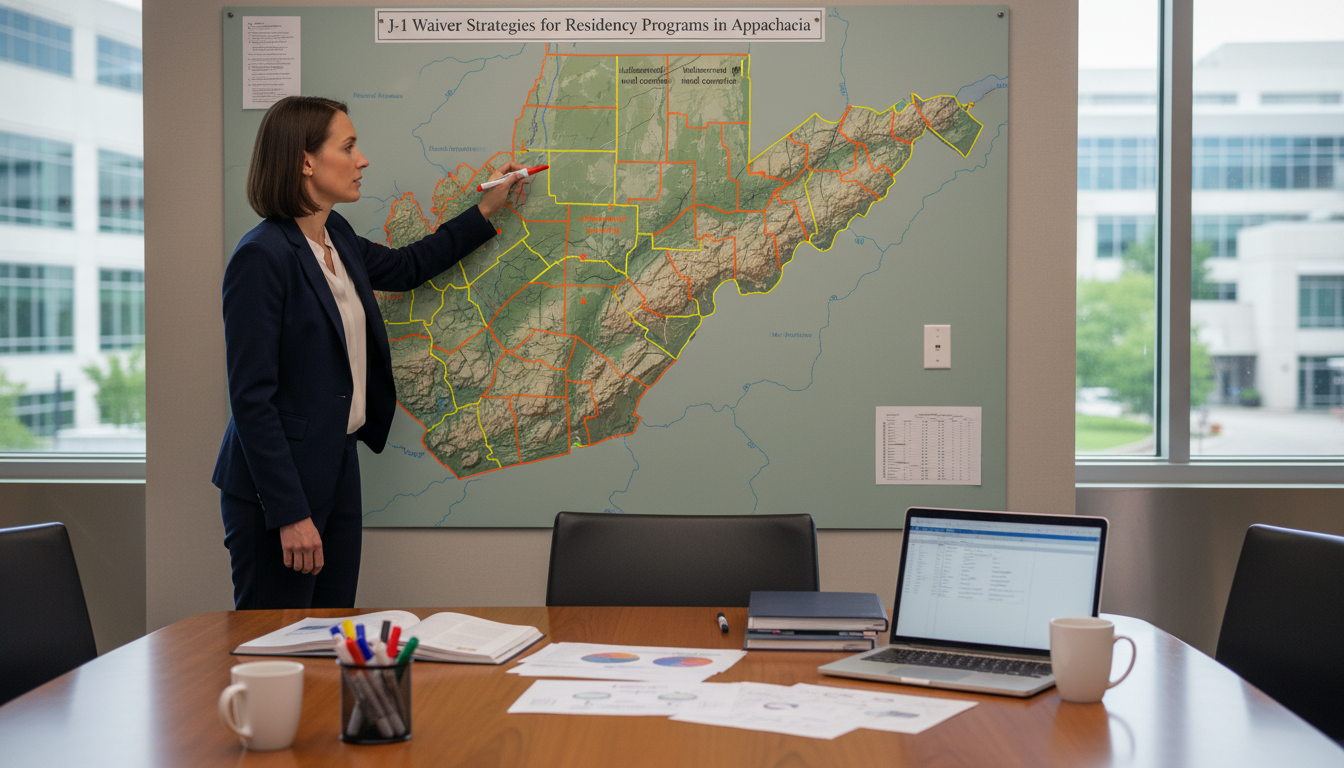
Strategic Role of Residency Programs in J-1 Waiver Planning
Residency and fellowship programs do not file J-1 waivers themselves (that’s done by employers and their attorneys), but they have enormous influence on whether IMG graduates can realistically pursue waivers in the region.
1. Build an Institutional J-1 Waiver Strategy
Program directors should work with:
- GME offices
- Hospital leadership
- In‑house legal/HR departments
- External immigration counsel
to create a coherent institutional J-1 waiver framework, including:
- A clear policy for sponsoring H‑1B after J‑1 waivers
- Priority service lines and geographic areas for waiver recruitment
- Standardized offer letter templates that meet Conrad 30 and other waiver criteria
- Timelines tied to match dates and graduation dates
Practical elements to formalize:
Site Eligibility Mapping
- Maintain an updated list of clinic/hospital locations with:
- HPSA or MUA/P status
- Rural/urban classification
- ARC or other special designations
- Note which locations are best suited for primary care vs. specialty waiver positions.
- Maintain an updated list of clinic/hospital locations with:
Position Planning
- Forecast physician vacancies 2–3 years ahead in high-need Appalachian counties.
- Design positions with waiver requirements in mind:
- Full‑time, ≥40 clinical hours/week
- Three-year minimum contracts
- Clear patient care expectations in underserved areas.
Internal Communication
- Educate department chairs and service chiefs about what distinguishes a “waiver‑friendly” position from a standard attending role.
- Ensure HR understands that changing job locations after waiver approval can be problematic.
2. Educate Residents Early and Transparently
IMG residents often struggle to find accurate visa and waiver information. Appalachian programs can become highly attractive by providing structured education:
Annual visa/waiver information sessions featuring:
- An experienced immigration attorney
- HR and GME representatives
- Former graduates who successfully secured waivers in Appalachia
Written guidance tailored to the region, clarifying:
- Conrad 30 processes in West Virginia, Kentucky, and neighboring Appalachian states
- Typical timeline (applications can open as early as September for the following fiscal year)
- The importance of securing contracts well before application windows open
Individual advising:
- Program directors should not provide legal advice, but can:
- Discuss realistic job options within the institution or region
- Connect residents with potential employers in underserved areas
- Direct them to qualified immigration counsel
- Program directors should not provide legal advice, but can:
3. Leveraging the Appalachian Identity
Programs in Appalachia can use the region’s needs and strengths to their advantage:
- Emphasize mission-driven practice: serving rural, low-income, and high-need populations.
- Highlight continuity between Appalachian residency training and post‑training service under waiver jobs (e.g., “Train here, stay here, serve here.”).
- Show concrete examples of J‑1 waiver success stories:
- Former residents from West Virginia or Kentucky programs who now practice in local critical access hospitals or FQHCs under waiver or who have completed their obligations and remained long-term.
This framing helps IMGs see Appalachian programs as a reliable pathway—not just to a U.S. residency, but to long‑term, stable practice in the United States.
Designing Waiver-Friendly Positions for Appalachian Graduates
Residency programs and affiliated hospitals in Appalachia can take specific, actionable steps to create positions that align with J-1 waiver criteria and regional workforce needs.
1. Match Specialties to Local Needs
In Appalachia, common high‑priority specialties for J‑1 waiver recruitment include:
- Family Medicine
- Internal Medicine (especially outpatient or hospitalist roles)
- Pediatrics
- Psychiatry and Child/Adolescent Psychiatry
- OB/GYN
- General Surgery (in some rural hospitals)
Programs should analyze:
- County‑level HPSA scores (primary care, mental health, dental, etc.)
- Hospital service coverage gaps
- Community health center needs
Then, align training opportunities and potential waiver positions accordingly. For example:
- A rural track family medicine residency in West Virginia might coordinate with local FQHCs to create graduating-resident waiver positions in the same communities where they rotated as residents.
- A psychiatry residency serving eastern Kentucky might plan for outpatient telepsychiatry plus one or two anchor clinics in high‑HPSA counties to satisfy waiver location requirements.
2. Understand and Use Flex Slots Strategically
Conrad 30 programs may allow a limited number of “flex” slots, where:
- The worksite is not strictly in a HPSA/MUA/P area, but
- It serves a substantial number of patients from underserved areas
In Appalachian contexts, flex slots can be valuable for:
- Regional referral centers in small cities serving many rural counties
- Specialty practices (e.g., cardiology, oncology, gastroenterology) where direct HPSA designations are less common
Residency programs should:
- Collaborate with state health departments to clarify how flex slots are used in their state
- Identify institutional clinics or hospital departments that could qualify for flex consideration
- Prioritize primary care and mental health jobs for non‑flex slots in deeply rural counties, reserving flex opportunities for strategically important specialists
3. Create “Residency-to-Waiver” Pathways
Some of the most successful Appalachia-based strategies involve formal or semi-formal pathways from training to waiver employment.
Example structures:
Affiliated Rural Hospital Pipeline
- The residency’s sponsoring institution partners with 2–3 rural hospitals or health centers in surrounding Appalachian counties.
- Residents rotate there during training, building familiarity with the community and staff.
- Those hospitals commit to offering 1–2 J‑1 waiver positions per year to program graduates in key specialties.
Rural Track → Waiver Position
- A family medicine or internal medicine program establishes a rural track with longitudinal continuity clinics in a designated HPSA.
- Graduates of the rural track receive priority for attending positions in the same clinic/hospital under a waiver arrangement.
Mentored Transition
- In the final year of residency or fellowship, a future waiver position is pre-negotiated:
- Senior resident spends an elective month at the target practice site.
- Employer begins contract discussions 12–18 months before graduation.
- By the time state Conrad 30 applications open, the candidate has a finalized contract and a strong employer letter.
- In the final year of residency or fellowship, a future waiver position is pre-negotiated:
These models benefit everyone:
- Residents gain clarity and reduced uncertainty.
- Hospitals/clinics secure early commitments from high-quality candidates.
- Residency programs demonstrate tangible career outcomes to prospective applicants, particularly IMGs.

Navigating State and Federal Systems: Practical Tips for Appalachian Programs
Turning strategy into action requires careful navigation of state Conrad programs and federal waiver frameworks.
1. Know Your State’s Conrad 30 Rules Inside Out
For each state in your catchment area (e.g., West Virginia, Kentucky, neighboring Appalachian states):
- Download and review the current-year Conrad 30 guidelines.
- Track changes annually (priority specialties, flex policies, application deadlines).
- Clarify the role of hospitals vs. clinics; in some states, FQHCs and rural health clinics may be prioritized.
Residency leadership should:
- Keep a one-page summary of each relevant state’s requirements handy.
- Share these summaries with graduating residents and potential employers.
- Maintain regular contact with the state’s J-1 waiver program coordinator to understand informal expectations and common pitfalls.
2. Anticipate Application Timing and Competition
In many states, especially those with fewer overall physicians, Conrad 30 slots may:
- Fill quickly (sometimes within days or weeks of opening), or
- Remain available but be underutilized in very remote counties
Appalachian programs should:
- Encourage residents to begin job searches 18–24 months before graduation.
- Aim for finalized contracts 3–6 months before the state’s application window opens.
- Advise residents that high‑demand metro or near‑metro areas may be very competitive, whereas truly rural Appalachian counties might offer stronger waiver prospects and community support.
For West Virginia Kentucky residency graduates, this means:
- Considering positions not only in larger towns but also in smaller Appalachian communities where the hospital’s need is acute and support for IMGs is strong.
- Understanding that some states may prioritize “first come, first served,” while others use scoring systems or priority tiers.
3. Coordinate with Immigration Counsel Early
While programs should not provide legal services, they can:
- Compile a list of reputable immigration attorneys with experience in J‑1 waivers and physician immigration.
- Encourage residents to attend group consultations or Q&A sessions.
- Remind employers (especially small rural hospitals or clinics) to engage immigration counsel early; missteps can cost both the physician and the community a crucial waiver slot.
Common issues that legal counsel can help prevent:
- Contracts that do not fully meet waiver requirements (e.g., unclear clinical FTE, inappropriate non-compete clauses, ambiguous work locations).
- Misunderstanding about “moonlighting” or split-site arrangements under waiver.
- Errors in timing that cause a candidate to miss a state’s application cycle.
4. Consider Federal and Regional Waivers for Special Cases
While Conrad 30 is often the main pathway, programs should remain alert to:
- VA facilities that may have their own waiver options for physicians.
- ARC‑related initiatives that could support waiver placements in designated Appalachian counties.
- Emerging federal or pilot programs aimed at severely underserved rural regions.
When a resident is interested in serving at certain institutions (e.g., a VA medical center, a large FQHC network), program leadership can encourage them to ask potential employers whether they have previously used federal waiver pathways beyond Conrad 30.
Aligning J-1 Waiver Strategies with Long-Term Workforce Goals
Effective J-1 waiver use is not just about helping individual IMGs stay in the U.S.; it’s a cornerstone of sustainable physician workforce planning in Appalachia.
1. Retention Beyond the Three-Year Commitment
Programs and employers should design waiver roles with long-term retention in mind:
- Competitive compensation and benefits relative to regional norms
- Robust onboarding and mentorship, especially for IMGs who may be transitioning from an academic center to an isolated rural setting
- Professional development opportunities (CME support, leadership tracks, academic appointments through the residency program)
- Support for family integration (spousal employment assistance, school guidance, community introduction)
When waiver physicians feel valued and connected, many stay well beyond the three‑year requirement, transforming temporary “underserved area waiver” placements into permanent solutions.
2. Integrating Waiver Physicians into Academic Roles
Residency programs can strengthen both their training and retention pipeline by:
- Offering J-1 waiver physicians volunteer or paid teaching appointments.
- Inviting them to precept residents during rural rotations or telemedicine clinics.
- Involving them in curriculum development around rural medicine, addiction care, or other Appalachian-specific health challenges.
This mutually beneficial arrangement:
- Enhances the learning environment for residents.
- Builds professional identity and satisfaction for waiver physicians.
- Reinforces ties between the academic center and outlying communities.
3. Measuring and Communicating Impact
To secure institutional support, programs should document and share the impact of their J-1 waiver strategies:
- Number and percentage of IMG graduates placed in Appalachian underserved communities
- Retention rates after completion of the waiver obligation
- Service outcomes (clinic volumes, new service lines, reduced wait times for mental health or primary care)
- Qualitative stories: community testimonials, patient access improvements
These data points help make the case that thoughtful use of Conrad 30 and other waivers is mission‑critical—not just for IMGs, but for the health of Appalachia as a region.
FAQs: J‑1 Waivers and Appalachian Residency Programs
1. Can a residency program itself sponsor a J-1 waiver?
No. Residency and fellowship programs do not directly sponsor J‑1 waivers. The employer (hospital, clinic, FQHC, practice group, etc.) files the waiver application—often with support from immigration counsel. However, programs play a key strategic role by:
- Connecting residents to waiver‑friendly employers in Appalachia
- Helping structure positions that satisfy waiver criteria
- Coordinating with institutional leadership and HR on long‑term workforce needs
2. Do all Appalachian counties qualify as underserved for J-1 waiver purposes?
Not automatically. Eligibility generally depends on whether a site is in:
- A federally designated Health Professional Shortage Area (HPSA), or
- A Medically Underserved Area/Population (MUA/P)
Some states also allow flex slots, where the practice site is not designated but the patient base is largely underserved. Programs should maintain an updated map of HPSA/MUA/P designations in their region and confirm status regularly, as designations can change.
3. Is it easier for IMG graduates to get a Conrad 30 waiver in West Virginia or Kentucky?
It depends on:
- The specialty
- The specific practice location (rural vs. urban)
- Annual demand for Conrad 30 slots
Both West Virginia and Kentucky have significant needs in their Appalachian regions and often welcome IMG physicians who commit to underserved communities. However, near‑urban or higher‑resource areas may be more competitive. Residents should begin exploring options early and remain flexible about location to maximize their chances.
4. Should a resident rely on their program for immigration advice?
Residency programs can provide general information and connect residents with resources, but they should not give individualized legal advice. For questions about:
- J‑1 waiver eligibility
- Complex immigration histories
- Long‑term plans (e.g., permanent residence pathways)
residents should consult a qualified immigration attorney with experience in physician visas and J‑1 waivers. Programs can help by maintaining a referral list and hosting informational sessions, but final legal strategy should come from counsel.
By approaching J-1 waivers as a strategic, regionally tailored tool rather than a last‑minute scramble, Appalachian residency programs can simultaneously support international graduates, strengthen local health systems, and advance their mission to serve some of the most medically underserved communities in the United States.