
Most community programs are not “unable” to sponsor H‑1B for IMGs. They are unwilling—and the real reasons are not the ones they tell you on the website.
Let me walk you through what actually gets said in those closed-door GME and finance meetings. Because what shows up on FREIDA or a program’s “we only sponsor J‑1 visas” blurb is the sanitized, PR-friendly version. The decision itself is almost always political, financial, and defensive—not legal impossibility.
The Official Story vs. What’s Really Going On
Here’s the pattern you see as an applicant:
Website says some variation of:
“We sponsor J‑1 visas only” or “We do not sponsor H‑1B visas.”
If you ask why, you get one of a few canned lines:
- “Our institution isn’t set up for H‑1B.”
- “It’s too complex with our HR structure.”
- “Legal advised against it.”
- “We’d love to, but the hospital policy doesn’t allow it.”
Some of that is technically true. But incomplete. The “policy” they’re talking about was usually written by a finance person, an overworked HR lead, and a risk-averse lawyer who didn’t want to deal with one more thing.
Here’s the real breakdown of why many community programs (and some academic ones) avoid H‑1B like it’s radioactive.
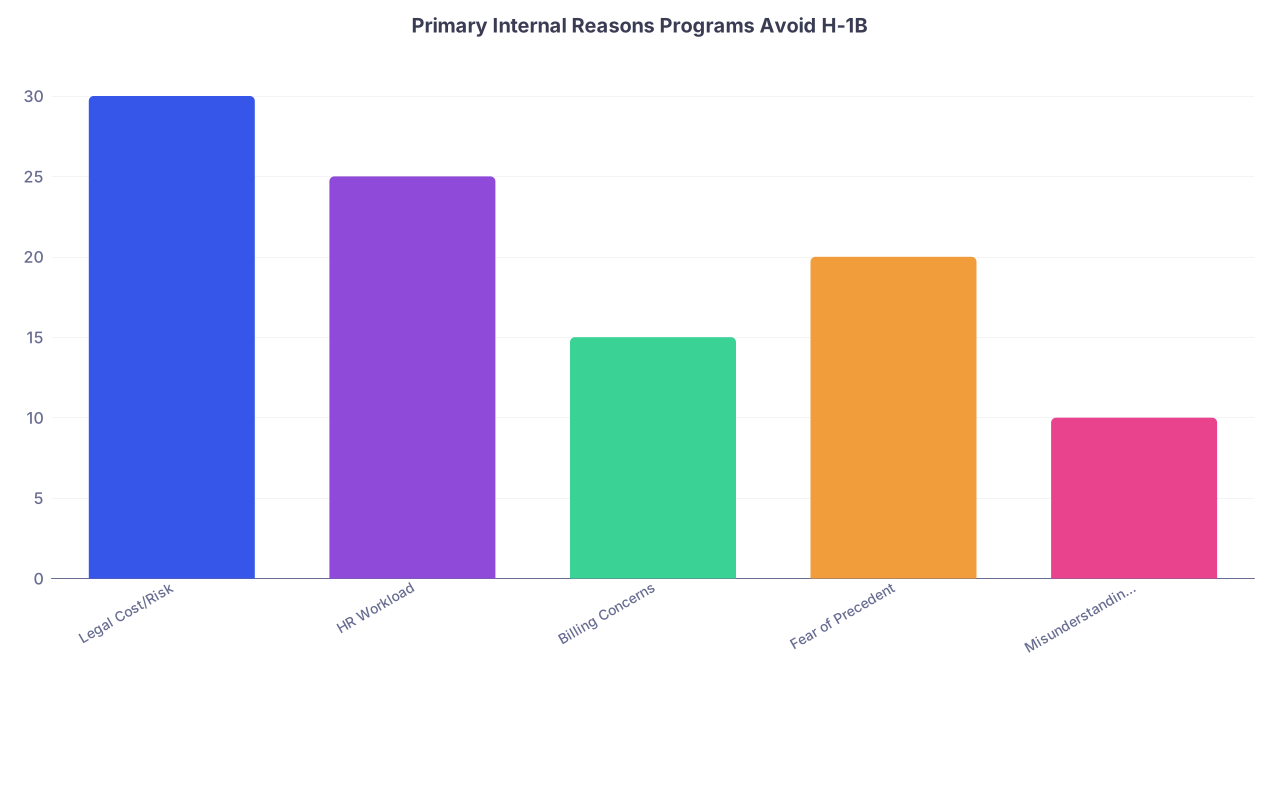
| Category | Value |
|---|---|
| Legal Cost/Risk | 30 |
| HR Workload | 25 |
| Billing Concerns | 15 |
| Fear of Precedent | 20 |
| Misunderstanding Rules | 10 |
The numbers are illustrative, but the categories are real. I’ve heard each of these, verbatim, in program meetings.
Reason #1: The Billing and Step Exam Mirage
This is the excuse that gets repeated the most by PDs, chiefs, and coordinators—often because they were misinformed years ago and never updated their understanding.
The Billing Myth
The classic line:
“We can’t bill for H‑1B residents until they’re fully licensed, so it costs us money.”
Here’s what’s actually happening:
For J‑1 and H‑1B residents, the billing rules around supervision and attending oversight are basically the same. Residents are not solo billable FFS machines; they’re part of a supervised team. Most community hospitals bill under attendings with resident involvement, not under the resident alone.
The real issue is not visa type. It’s licensing and Step exams. Some states require full license (Step 3 passed + certain training time) for any resident—regardless of J‑1 or H‑1B—to bill under certain structures. But that has nothing to do with whether you’re J‑1 or H‑1B. Programs conflate these in their own head.
What actually scares administrators is this:
“If we have to wait for them to get Step 3 and a license, maybe for months, can we still justify their salary before we can fully bill?”
Instead of understanding that plenty of billing still happens with supervised trainees, they simplify it in their mind to:
H‑1B = Step 3 upfront = Maybe licensing weirdness = Headache = No.
So the myth survives because nobody in GME wants to sit on a call with billing, compliance, and legal to separate billing complexity from visa category. Much easier to declare “No H‑1B.”
The Step 3 Requirement
Here’s another insider truth: H‑1B requires Step 3 before starting residency (for most states/programs), while J‑1 does not.
Program directors, especially at community sites, quietly like this constraint because:
- It narrows the IMG pool to those who already jumped through a bigger hoop.
- But it also creates risk: if you rank an IMG for H‑1B and they somehow do not clear Step 3 in time, you’re stuck. They matched, you can’t swap them, and now GME has a disaster: a funded position with no resident in it.
So a lot of PDs think:
“I don’t want my program’s staffing hanging on a Step 3 deadline and USCIS timing.”
Then the default becomes: we’ll just avoid H‑1B entirely.
Nobody writes that on the website.
Reason #2: HR and Legal Don’t Want Another Problem Child
Here’s the blunt truth: international trainees are often seen as extra “work units” for HR and Legal. Not bad people. Just additional tasks.
HR person’s mental checklist:
- J‑1: ECFMG handles sponsorship, rules, tracking, DS‑2019, SEVIS, etc. Our role is limited.
- H‑1B: We are the sponsor. We deal with USCIS forms, LCA, wage documentation, prevailing wage issues, extensions, amendments if rotation sites change.
Who do you think HR would rather deal with? An external sponsor (ECFMG) or direct federal oversight (USCIS)?
I’ve sat in meetings where the HR lead literally said, “J‑1 is ECFMG’s headache. H‑1B becomes our headache. We don’t have bandwidth for this.”
So from their perspective:
- J‑1 = ECFMG as shield
- H‑1B = we own the whole mess
Legal departments are no better. Most hospital lawyers are not deep immigration experts. Their incentive is to reduce potential points of federal scrutiny, not to optimize IMG career flexibility.
So when someone asks, “Can we start H‑1B sponsorship?” the lawyer’s instinctive answer is:
“We’d prefer not to add that. Too much regulatory exposure. Also we’d have to ensure wage levels, site compliance, rotations, etc. I recommend we stick to J‑1.”
That single sentence from legal becomes “institutional policy” for the next decade.
Reason #3: Money—But Not In the Way You Think
Everyone assumes the real reason is: “H‑1B is more expensive.” That’s only partially true, and often exaggerated.
Let’s separate what’s actually going on.
Direct Costs
H‑1B has:
- Filing fees
- Attorney fees (if the hospital uses outside counsel)
- Internal HR time
For a hospital system, this is rounding error in the annual budget. For a residency program’s GME cost center, though, it can feel like a big hit—because GME budgets are carved up and scrutinized line by line.
J‑1, on the other hand:
- Cost mostly borne by you (visa fee, ECFMG fees).
- Administrative load borne by ECFMG.
From the CFO and GME director’s angle:
- J‑1 = predictable, outsourced, cheap internally.
- H‑1B = new line items, legal invoices, explanation to the board about why “we’re taking on more immigration risk.”
So yes, cost matters. But you need to understand where: not at the hospital macro level, but at the GME micro-bureaucracy level.
Hidden Financial Fear: What If They Stay?
Here’s another twisted part: some hospital administrators privately prefer J‑1 because of the 2‑year home-residency requirement.
Translation:
“We’d like them to train here but not necessarily compete with our own grads or local candidates for full-time jobs later.”
They won’t say that out loud. But I’ve heard versions of:
- “With J‑1 they usually rotate out after training; it keeps the market fluid.”
- “If we sponsor H‑1B, they’ll want us to convert them to attending later, or do waivers here, and it gets politically complicated.”
The idea that H‑1B physicians might want to stick around creates perceived long-term expectations and obligations. Some administrators do not want that pressure.
Reason #4: Fear of Setting a Precedent
This one is huge and almost never discussed with applicants.
Many program directors might personally be willing to do H‑1B “for one exceptional candidate.” But they know what happens next: the policy becomes hard to reverse.
Once a program sponsors one H‑1B, every future IMG with strong scores will ask:
“I saw you sponsored H‑1B for Dr. X last year… will you do it again?”
Now the program has two choices:
- Say yes and open the door widely, generating a lot more work for HR and Legal.
- Say no and look arbitrary or discriminatory.
To avoid this, administrators push for an all-or-nothing rule:
- Either we sponsor H‑1B routinely, as a standard policy
- Or we never sponsor it at all
Most community hospitals default to “never” because they anticipate a floodgate effect. They do not want to handle 20 H‑1B requests for every 1 they might actually be willing to support.
So you see this rigid language:
“We do not sponsor H‑1B for residents.”
Behind those words is often an earlier era conversation that went like this:
- PD: “I really want to bring in this one phenomenal IMG on H‑1B.”
- HR/Legal: “If we do it once, we’ll have to do it for others. Are you ready for that?”
- PD, calculating headache vs benefit: “…Fine. Then let’s make it no H‑1B across the board.”
That single compromise kills H‑1B access for years.
Reason #5: Ignorance, Outdated Info, and Institutional Laziness
Do not underestimate how many program policies are built on outdated, half-understood immigration rules.
I’ve heard:
- “We can’t do H‑1B because residents are ‘trainees,’ not workers.” (Wrong. They are employees.)
- “H‑1B is capped, and we don’t want to risk them not getting selected.”
(Reality: Most hospitals are cap-exempt.) - “If we change rotation sites, that invalidates the visa.”
(It may require amendments, not automatic invalidation.)
Instead of checking with a real immigration specialist, people rely on:
- Something a lawyer said 8 years ago.
- Something a prior PD believed.
- Something a coordinator heard from a friend at another hospital.
Over time, this gossip hardens into “policy.”

Why Community Programs Are Stricter Than Big Academic Centers
You’ve probably noticed the pattern: large university-based programs are more likely to sponsor H‑1B than small community hospitals.
That’s not an accident.
Here’s what big academic centers usually have that community hospitals often lack:
- In-house immigration counsel familiar with physician visas.
- A long history of hiring foreign faculty on H‑1B and O‑1.
- Established HR systems for handling multiple visa categories.
- Enough political weight and academic prestige to justify, “This is how we recruit top talent.”
So adding H‑1B for residents isn’t a huge new lift; they’re already doing H‑1B for attendings and researchers.
Community programs, on the other hand:
- May have never handled H‑1B for anyone except maybe a random IT engineer years ago.
- Use an external law firm that charges per case and warns about every possible risk.
- Have small HR departments that are swamped just onboarding staff and nurses.
- Have PDs who are clinicians first, administrators second, immigration policy experts never.
Imagine being that PD. You’re already drowning in duty hour reports, ACGME citations, resident complaints, and service coverage. Then HR asks:
“Do you want to open the door to H‑1B? It’ll mean legal review, new processes, documentation, compliance checks, and more complicated recruitment.”
Most will quietly think: “Absolutely not. I don’t need one more complicated thing.” And just stick to the simplest path: J‑1 only.
What This Means For You As an IMG
You cannot “argue” a community hospital into offering you H‑1B if the institution has already decided it won’t. This is not a negotiation at the applicant level. It’s a policy decision that predates you and will likely outlive you.
But you can be strategic.
First, understand the landscape.
| Program Type | J-1 Sponsorship | H-1B Sponsorship | Flexibility |
|---|---|---|---|
| Big university IM | Common | Often yes | High |
| University-affiliated community | Common | Sometimes | Medium |
| Pure community IM | Common | Rare | Low |
| Small rural community | Common | Very rare | Very low |
These are generalizations, but they track with what I’ve seen across multiple regions.
Second, be clear about your own priorities:
- If your long-term plan requires H‑1B (e.g., you want to avoid J‑1 waiver entanglements), then you filter programs aggressively. Only apply or rank places that have a documented, recent history of sponsoring H‑1B for residents.
- If you’re flexible and willing to do a J‑1 + waiver, then community programs suddenly become much more accessible.
Third, don’t fall for vague promises. If a community program says:
“We don’t usually do H‑1B, but we might make an exception,”
what that really means is:
“We probably won’t. But we don’t want to say no directly.”
Unless they can point to multiple residents currently training on H‑1B, consider that “maybe” a soft no.
How the Conversations Actually Go Inside Programs
Let me be blunt and show you the real script of internal meetings.
Scenario: PD Wants a Strong IMG on H‑1B
- PD: “We have this outstanding IMG, top scores, spectacular letters. They want H‑1B.”
- HR: “We’ve never processed H‑1B for residents. That means new work for us. We’d have to coordinate with external counsel.”
- Legal: “H‑1B has compliance implications. Prevailing wage, LCA, tracking work locations. We’d need to set strict procedures.”
- CFO/GME: “How much will that cost? And if we do it once, will we be forced to do it and pay for it every year?”
- PD, calculating: “Is this one resident worth picking a fight with three departments that sign off on my budget?”
Nine times out of ten, the PD backs down. They like you, but they like keeping their internal alliances more.
Scenario: Policy is Being Written
Someone asks: “Should our institutional policy allow H‑1B for residents?”
- Legal: “My recommendation is to avoid extra visa categories unless necessary.”
- HR: “We’re already overloaded. J‑1 via ECFMG is simpler.”
- Finance: “If J‑1 works and is cheaper, why change?”
- Result: blanket policy: “We sponsor J‑1 only.”
That line, made in a 45-minute meeting, locks out generations of IMGs from H‑1B at that institution.

| Step | Description |
|---|---|
| Step 1 | PD proposes H-1B for IMG |
| Step 2 | Recommend J-1 only |
| Step 3 | Consult Legal |
| Step 4 | Estimate costs |
| Step 5 | Allow limited H-1B |
| Step 6 | HR capacity? |
| Step 7 | Legal risk tolerance |
| Step 8 | Finance approval |
You see the pattern. Every step biases toward “no.”
The Big Picture: It’s Not About You, It’s About Their System
The harsh part: when a community program rejects H‑1B, it’s almost never a reflection of your strength as an applicant. You can be 260+ on Step 2, AOA equivalent, glowing US letters from big-name attendings—they still won’t touch H‑1B if the institutional gears are set against it.
From your side, it feels personal. From theirs, you’re one variable inside a much larger equation that includes:
- HR workload
- Legal risk aversion
- GME history
- Billing confusion
- Precedent anxiety
You’re not losing to another applicant. You’re losing to institutional inertia.
And inertia usually wins.
FAQs
1. If a program says “case-by-case” for H‑1B, should I believe them?
Treat “case-by-case” at a community program as a yellow light, not a green one. It often translates to:
“We aren’t committing, and odds are we’ll default to J‑1 if there’s any friction.”
Ask specific questions:
“Have you sponsored H‑1B for residents in the last 3 years? How many? In which specialties?”
If they can’t answer with concrete examples, assume the risk is high that it won’t happen for you.
2. Can I convince a program to switch me from J‑1 to H‑1B after matching?
Almost never at a community institution. Once you’ve matched, the power dynamic is completely against you and the administrative machinery has already been set in motion for J‑1. Switching to H‑1B would require new approvals, legal review, fee allocations, and timeline risk. Very few programs will take that on post-Match unless they are already H‑1B-friendly with established systems.
3. Do some community programs quietly make exceptions for “star” candidates?
Rarely, but yes, especially in specialties where recruitment is painful (psychiatry, FM in some regions, very underserved IM programs). But those exceptions are usually in hospitals that already handle H‑1B for other roles (faculty, hospitalists). Cold-start exceptions at a place that’s never done H‑1B for anyone are exceedingly rare. Banking your future on being “the exception” is a bad strategy.
4. Is J‑1 always worse than H‑1B for my long-term career?
No. That’s another over-simplified myth. J‑1 plus a good waiver job can be an excellent route for many IMGs, especially if you’re open to working in underserved or rural areas for a few years. H‑1B gives you more flexibility geographically and in job choice early on, but it doesn’t magically guarantee a smoother green card path—your employer, specialty, and timing matter a lot more. The real mistake is choosing a bad training environment just to chase a visa category.
5. How can I realistically identify H‑1B-friendly programs as an IMG?
Do three things:
- Ignore vague website language. Look for explicit: “We sponsor H‑1B for eligible candidates,” ideally with examples.
- Talk to current residents, not just coordinators. Ask: “Is anyone in your program right now on H‑1B?” Names, years, and specialties matter.
- Check patterns, not one-off rumors. If a program has consistently had H‑1B residents over multiple cycles, it’s far more likely they have a true system in place rather than a one-time exception they regret.
Strip it down and here’s what you need to remember:
Most community programs avoid H‑1B not because they legally cannot, but because their HR, legal, and GME structures are too risk-averse and too tired to change. J‑1 pushes the problem onto ECFMG; H‑1B makes it their problem. And when institutions choose between “do more work with more risk” and “keep things simple,” they almost always choose simple.