
The usual slogan “J‑1 for academics, H‑1B for private practice” is lazy advice that gets a lot of IMGs in trouble.
You are not choosing between “fellowship” and “private practice.” You’re choosing between two very different immigration paths with different risks, costs, and doors that open (or slam shut) later.
Let me walk you through how this actually works, from a residency and fellowship perspective, not from random WhatsApp group mythology.
The real bottom line
Here’s the short, blunt version:
If your top priority is doing a competitive fellowship (especially cardiology, GI, heme/onc, advanced imaging, etc.) and you are okay with a 2‑ or 3‑year service obligation after training,
→ J‑1 is usually better and more realistic.If your top priority is flexibility to work anywhere, stay in big cities, or move into private practice quickly after training (and you can get program support + handle extra exam and timing constraints),
→ H‑1B is usually better, but harder to secure.
That’s the frame. Now let’s pull it apart in detail.
J‑1 vs H‑1B for fellowship: what actually happens
Most people asking this question are terrified of one thing:
“If I choose the wrong visa, will I ruin my chances of getting the fellowship I want?”
For fellowship applications, here’s the truth:
Program directors care first about your file, not your visa.
Your Step scores, letters, research, performance. Visa is secondary… until it’s not.But visa type does affect how many places you can realistically apply to.
- Many academic fellowships sponsor J‑1 without hesitation (through ECFMG).
- A smaller subset are willing/able to sponsor H‑1B.
- Some will say “no H‑1B for fellows at all.” Or “only rare exceptions.”
So if you enter residency on J‑1, then apply for fellowship on J‑1, you’ll find more fellowship programs that are structurally set up to take you.
If you enter residency on H‑1B and want your fellowship also on H‑1B, your pool of programs shrinks. Sometimes massively, depending on specialty and region.
But wait, what about the 2‑year home residency requirement on J‑1?
This is where everyone panics and half‑understands the rule.
- J‑1 clinical IMGs almost always become subject to the 2‑year home residency requirement.
- That requirement can usually be waived if you:
- Get a J‑1 waiver job (Conrad 30, VA, HHS, etc.) in an underserved or designated area
- Work there for 3 years full-time on H‑1B
- Then you’re free to move into private practice, different jobs, etc., and pursue a green card.
Here’s the key insight most applicants miss:
- You do not need to “finish the 2 years at home” before fellowship.
- Most IMGs doing J‑1 → fellowship just stay on J‑1 for fellowship.
- The 2‑year requirement becomes a real issue only when they’re done with all training and want to stay in the US permanently.
So for pure fellowship training access, J‑1 is usually smoother:
- Easier for programs to sponsor
- Familiar ECFMG pipeline
- No H‑1B lottery for fellowship
- No prevailing wage headaches
If your dream is: IM → Cardiology → Advanced imaging → maybe academic attending after a J‑1 waiver job, then J‑1 is often the smoother road.
H‑1B for “private practice”: what people get wrong
You’ll hear this all the time: “Take H‑1B if you want private practice.” That’s only half true.
What they mean is:
- H‑1B does not carry the J‑1 2‑year foreign residency requirement.
- After residency (and/or fellowship), you can:
- Take a job in a private group
- Work in a big metro area that isn’t underserved
- Immediately start working toward a green card (EB‑2, EB‑2 NIW, EB‑1, etc.) with more employer freedom
So yes:
If your long‑term dream is 100% private practice in a major city with maximum job flexibility, H‑1B gives you a cleaner immigration path.
But here are the catches nobody brags about in Facebook groups:
Not all residencies sponsor H‑1B.
Many community programs are J‑1 only. Some big-name institutions are J‑1 only for residents.H‑1B for residency has requirements:
- You usually need all Steps passed, including Step 3, before H‑1B filing deadlines.
- Programs may say: “We can rank you only if Step 3 is passed by X date.”
- Some specialties/programs just don’t want the administrative hassle.
H‑1B is tied to a specific employer, location, and role.
Every time you change jobs (residency → fellowship → attending) you’re dealing with new petitions, timing, and maybe the national H‑1B cap (if cap‑subject).H‑1B for fellowship is harder than J‑1 for fellowship.
Plenty of programs will tell you bluntly: “We do not sponsor H‑1B for fellows.”
That’s the hidden bottleneck. You might get your dream residency on H‑1B, then find your dream fellowship won’t take H‑1B.
So the real statement is:
- H‑1B is better for end‑stage private practice freedom…
- …but worse/limited for some fellowship options and harder to secure upfront.
Side‑by‑side: residency, fellowship, and post‑training impact
| Stage | J-1 Visa | H-1B Visa |
|---|---|---|
| Residency match | More programs sponsor; Step 3 not mandatory | Fewer programs sponsor; Step 3 usually required |
| Fellowship access | More programs accept J-1 fellows | Fewer programs accept H-1B fellows |
| Post-training | Must do 3-year J-1 waiver job to stay | Can take many private practice jobs directly |
| Location freedom | Restricted to waiver/HPSA areas initially | More flexibility on geography |
| Green card path | Typically after waiver job | Often started sooner by employer |
Specialty matters: competitive vs non‑competitive
Let’s be clear: if you’re going for a competitive fellowship, visa friction hurts more.
- Highly competitive fellowships: Cardiology, GI, heme/onc, interventional, some radiology subspecialties, etc.
- Moderately competitive: Pulm/CC, nephrology (less now), ID (varies by region).
- Less competitive (currently): Geriatrics, endocrine, some hospitalist tracks (which are jobs, not fellowships).
For competitive fellowships, being on H‑1B can hurt you in two ways:
- Some top academic programs do not want to deal with H‑1B for fellows.
- Even if they technically can, they may quietly favor J‑1 candidates because their system is already built around it.
So if your dream is:
IMG → mid‑tier IM residency → top‑tier cards fellowship → interventional → large academic center…
Choosing H‑1B at residency can shrink your realistic fellowship options.
On the flip side, if your dream is:
IMG → FM residency → outpatient primary care in suburban private practice near a big city → maybe hospitalist shifts → early green card…
Then the inconvenience of chasing an H‑1B residency may absolutely be worth it.
The J‑1 waiver path: not as scary as people think
Let’s kill one myth cleanly: “If I take J‑1, I’ll be forced to return home for 2 years and my career in the US is over.” Wrong.
Actual J‑1 pathway for most IMGs looks like this:
- J‑1 for residency (3 years for IM/FM, 4+ for others).
- Maybe J‑1 for fellowship (3 more years, for example).
- End of total training: you’re now subject to 2‑year home requirement.
- You secure a J‑1 waiver job:
- Conrad 30 at a state level (primary care, hospitalist, some specialties)
- VA hospital
- Certain federal programs (HHS‑based waivers)
- You switch from J‑1 → H‑1B for that job.
- Work there for 3 years. That fulfills the waiver obligation.
- During/after this time, your employer can sponsor a green card.
- Post‑waiver, you can move into private practice in more desirable locations.
Is it perfect? No. You may end up in a rural area or underserved community for 3 years. But it’s a common, stable pipeline that thousands of IMGs use.
If your long‑term goal is academic medicine or hospital employment, this path is absolutely viable and, in some fields, very standard.
When is H‑1B clearly the better move?
There are scenarios where I’d strongly lean H‑1B if you can get it.
You already have a clear, realistic private practice plan.
You have contacts, maybe a community or faith‑based network, or family in the US who are physicians in private groups who actually hire IMGs.You’re okay limiting fellowship options.
Either you’re not committed to a fellowship at all, or you’re comfortable with a narrower fellowship search (fewer institutions that take H‑1B).You’re organized and capable of getting Step 3 done early.
No drama. No excuses. H‑1B programs do not wait around.You want to avoid the J‑1 waiver geographic restrictions.
You really don’t want to be “forced” into rural or semi‑rural areas for 3 years.
In these cases, targeting H‑1B for residency makes sense. But you must actively verify which programs sponsor H‑1B and what they require. Do not assume.
When is J‑1 the smarter, safer move?
Honestly, more often than people want to admit.
Go J‑1 if:
Your primary concern is matching at all, in your chosen specialty.
J‑1 gives you more programs to apply to and fewer Step 3 timing constraints.You’re interested in an academic or hospital‑based career.
J‑1 → fellowship → waiver job → hospital or academic practice is a very standard route.You want maximum fellowship choices.
Especially in competitive subspecialties where H‑1B sponsorship for fellows is limited.You’re willing to do a 3‑year J‑1 waiver job.
You see it as a trade‑off, not a life sentence. Many IMGs use those years to pay down debt, stack experience, and build an immigration foundation.
Visual: how your options evolve over time

| Step | Description |
|---|---|
| Step 1 | Residency on J-1 |
| Step 2 | Fellowship on J-1 |
| Step 3 | J-1 Waiver Job 3 yrs |
| Step 4 | Open Practice Options + GC Path |
| Step 5 | Finish Residency, No Fellowship |
| Step 6 | Residency on H-1B |
| Step 7 | Fellowship on H-1B or J-1* |
| Step 8 | Private Practice or Academic Job |
| Step 9 | GC Path |
*Note: Switching from H‑1B to J‑1 for fellowship is possible at some places but must be handled carefully with legal advice.
Concrete decisions you should make now
You cannot choose a visa in isolation. Tie it to actual, grounded decisions:
Decide your priority ranking:
- Rank these 1–3 for yourself:
- Matching into any decent residency in your specialty
- Maximizing fellowship options
- Maximizing geographic/ job flexibility post‑training
- Rank these 1–3 for yourself:
Look up real program policies, not rumors.
Check:- Program websites (Residency + GME pages)
- FREIDA
- Direct emails to coordinators: “Do you sponsor H‑1B for residents?”
Do not assume. Verify.
Talk to current residents/fellows on each visa type.
Ask them bluntly:- Are you happy with your decision?
- Anything you wish you’d known before choosing J‑1 or H‑1B?
- Any issues applying to fellowship or jobs because of your visa?
If targeting H‑1B, schedule your Step 3 timeline now.
If you cannot realistically get Step 3 done when programs need it, drop the fantasy and plan for J‑1.
One more misconception: “I’ll just switch later”
People often say: “I’ll start on J‑1 then switch to H‑1B during residency.” Or the reverse.
Reality check:
- Switching from J‑1 (clinical) to H‑1B during training does not erase the 2‑year requirement in most cases; the requirement sticks.
- Many programs do not want the administrative headache mid‑training.
- Visa changes mid‑residency can jeopardize your status if mishandled.
So no, “I’ll just switch later” is not a smart default plan. Assume you’ll stay on whichever status you start with, at least through training, unless strongly advised by a competent immigration attorney.
Summary: match the visa to your real goal
So, to answer the headline bluntly:
Is J‑1 better if I want fellowship?
For most IMGs, yes. Programs know it, sponsor it easily, and it usually expands your fellowship options, especially in competitive fields. You pay for that with a post‑training waiver obligation.Is H‑1B better if I want private practice?
Yes, if:- You can secure an H‑1B residency,
- You accept potentially fewer fellowship options,
- And your priority is geographic and job flexibility after training.
What you cannot do is try to get the “best of both” without trade‑offs. There’s always a trade.
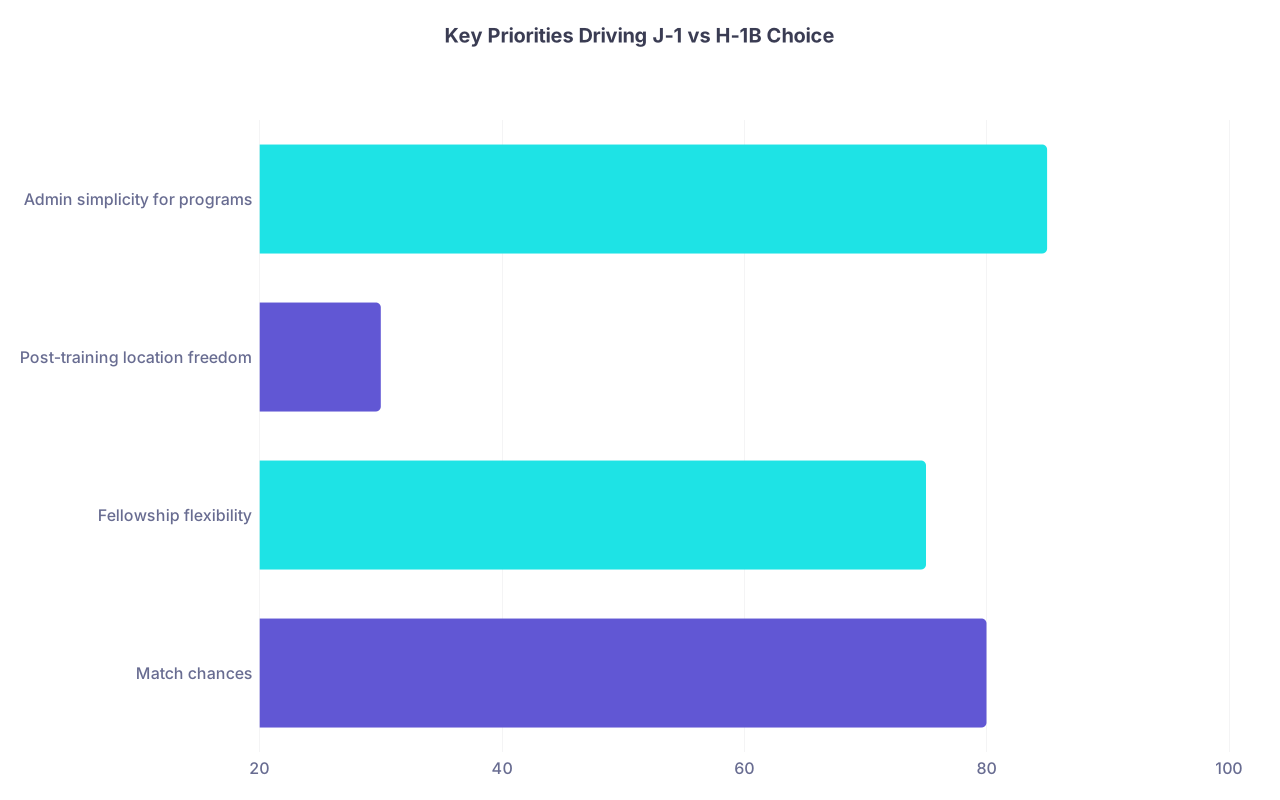
| Category | Value |
|---|---|
| Match chances | 80 |
| Fellowship flexibility | 75 |
| Post-training location freedom | 30 |
| Admin simplicity for programs | 85 |
Your next step today
Write down, on paper, your top 3 priorities in order:
- Match security, 2) Fellowship options, 3) Post‑training flexibility.
Then next to each residency program on your list, mark: “J‑1 only”, “J‑1 + H‑1B”, or “Unknown—email them.” Do that before you build your rank list or obsess about “J‑1 vs H‑1B.” The visa decision should follow your actual opportunities, not lead them.
FAQ (exactly 6 questions)
1. Can I get a competitive fellowship like cardiology or GI on H‑1B?
Yes, it’s possible, but harder. Your pool of programs is smaller because fewer fellowships sponsor H‑1B, and some strongly prefer J‑1 for administrative simplicity. If you’re on H‑1B, you’ll have to target programs that explicitly sponsor H‑1B or are willing to make exceptions. That’s why IMGs who are laser‑focused on competitive fellowships often choose J‑1 for more options.
2. If I choose J‑1 for residency, am I stuck returning to my home country for 2 years?
Usually no. Most J‑1 IMGs avoid physically returning for 2 years by doing a J‑1 waiver job: 3 years of full‑time work in an approved underserved or qualifying setting on H‑1B. That service fulfills the 2‑year requirement, and you can then change jobs and continue your immigration process. Actually going home for 2 years is the backup option, not the default.
3. Is it true that I must have Step 3 before I can get an H‑1B for residency?
For almost all programs, yes. They want Step 3 passed before filing the H‑1B petition. The timeline can be tight: you may need Step 3 done before rank list deadlines or at least before contract signing. Programs differ, but if you are serious about pursuing H‑1B, you must plan Step 3 early and confirm each program’s exact requirements.
4. Can I switch from J‑1 to H‑1B for fellowship?
You can technically switch, but it does not erase the 2‑year home residency requirement attached to your J‑1. It also adds complexity: you’ll be dealing with different sponsors and potentially fewer fellowship programs willing to handle H‑1B. Most IMGs on J‑1 stay on J‑1 through all training (residency + fellowship) and then switch to H‑1B when they start their waiver job.
5. Do program directors prefer H‑1B residents because they can stay long‑term?
Not generally. Many PDs and GME offices actually prefer J‑1 because ECFMG handles a lot of the paperwork and it’s predictable. Some institutions have explicit policies: “Residents = J‑1 only.” A few programs prefer H‑1B for long‑term retention, but that’s not the norm. For most PDs, your performance and fit matter more than which visa you’re on.
6. If I’m unsure about fellowship but want to keep the option open, which visa should I lean toward?
If you’re genuinely unsure, and you don’t have a strong, realistic private practice plan already lined up, J‑1 is usually the safer hedge. It keeps more fellowship doors open, especially at academic centers. You can still move into non‑academic or private practice roles later via a J‑1 waiver path. Only lean hard into H‑1B early if private practice flexibility is clearly your top priority and you can realistically secure an H‑1B residency.